

What you'll learn
- How to draw and label a force diagram in two dimensions.
- How to resolve forces into perpendicular components.
- How to apply Newton’s second law separately in two chosen directions.
- How to handle inclined planes and forces acting at an angle.
Prerequisites
Newton’s second law
A force can change an object’s velocity, so it can produce an acceleration. Newton’s second law connects the resultant force on an object to its mass and acceleration.
Newton's second law
The resultant force on a particle equals its mass multiplied by its acceleration:
F=ma\boldsymbol{F}=m\boldsymbol{a}F=maIn any chosen direction, this becomes:
resultant force in that direction=m×acceleration in that direction.\text{resultant force in that direction}=m\times\text{acceleration in that direction}.resultant force in that direction=m×acceleration in that direction.Both force and acceleration are vectors, so they have direction as well as magnitude. The acceleration is always in the direction of the resultant force, not necessarily in the direction of one individual force.
Common forces
You should recognise the following forces:
- Weight, of magnitude mgmgmg, acts vertically downwards.
- The normal reaction, often written RRR, acts perpendicular to a surface and away from it.
- Friction, often written FFF, acts parallel to a rough surface and opposes actual or impending relative motion.
- Tension acts along a taut string or cable, away from the object.
- A push or pull may act at a stated angle.
Use SI units: mass in kg, force in N and acceleration in m s⁻². Unless told otherwise, take g=9.8 m s−2g=9.8\text{ m s}^{-2}g=9.8 m s−2.
Mass is not weight
Mass is measured in kg, whereas weight is a force measured in N. A particle of mass mmm has weight mgmgmg, not simply mmm.
Resolving a force
To resolve a force means to replace it with perpendicular components whose combined effect is the same as the original force.
For a force of magnitude PPP acting at an angle θ\thetaθ above the positive horizontal direction:
- the horizontal component is PcosθP\cos\thetaPcosθ;
- the vertical component is PsinθP\sin\thetaPsinθ.
This follows because the components form a right-angled triangle with PPP as its hypotenuse.
Choosing sine or cosine
The component adjacent to the given angle uses cosine, while the component opposite the angle uses sine. Give each component the correct sign according to your chosen positive directions.
Resolving an angled force
A force of magnitude 20 N acts at an angle of 35∘35^\circ35∘ above the horizontal. Find its horizontal and vertical components.
-
The horizontal component is adjacent to the angle, so it is
20cos35∘=16.4 N20\cos35^\circ=16.4\text{ N}20cos35∘=16.4 N -
The vertical component is opposite the angle, so it is
20sin35∘=11.5 N.20\sin35^\circ=11.5\text{ N}.20sin35∘=11.5 N. -
Therefore, the force has a horizontal component of 16.4 N and an upward vertical component of 11.5 N, to 3 significant figures.
Applying Newton’s second law in two dimensions
When forces act in different directions, choose two perpendicular axes and apply Newton’s second law separately along each axis.
For horizontal and vertical axes:
∑Fx=max,∑Fy=may.\begin{aligned} \sum F_x&=ma_x,\\ \sum F_y&=ma_y. \end{aligned}∑Fx∑Fy=max,=may.Here, ∑Fx\sum F_x∑Fx and ∑Fy\sum F_y∑Fy mean the resultant force components in the horizontal and vertical directions.
A positive term acts in your chosen positive direction. A negative term acts in the opposite direction.
Two directions, two equations
Newton’s second law is one vector equation, but resolving it produces a separate scalar equation in each perpendicular direction.
Pulling a block at an angle
A 5 kg block is pulled across a smooth horizontal floor by a force of 30 N acting at 25∘25^\circ25∘ above the horizontal. Find its acceleration and the normal reaction.
-
The floor is smooth, so there is no friction. Resolving horizontally gives
30cos25∘=5a.30\cos25^\circ=5a.30cos25∘=5a.Hence,
a=5.44 m s−2.a=5.44\text{ m s}^{-2}.a=5.44 m s−2. -
The block remains on the floor, so it has no vertical acceleration. Its vertical forces must therefore balance:
R+30sin25∘−5g=0.R+30\sin25^\circ-5g=0.R+30sin25∘−5g=0. -
Substituting g=9.8 m s−2g=9.8\text{ m s}^{-2}g=9.8 m s−2 gives
R=49−30sin25∘=36.3 N.R=49-30\sin25^\circ=36.3\text{ N}.R=49−30sin25∘=36.3 N.
Assuming the reaction equals the weight
The normal reaction is not automatically equal to mgmgmg. An angled pull or push has a perpendicular component that changes the reaction.
Choosing useful axes
You may resolve forces in any two perpendicular directions, but a sensible choice simplifies the equations.
For a particle on an inclined plane, choose:
- one axis parallel to the plane;
- one axis perpendicular to the plane.
The normal reaction then lies entirely along the perpendicular axis, while friction lies entirely along the parallel axis.
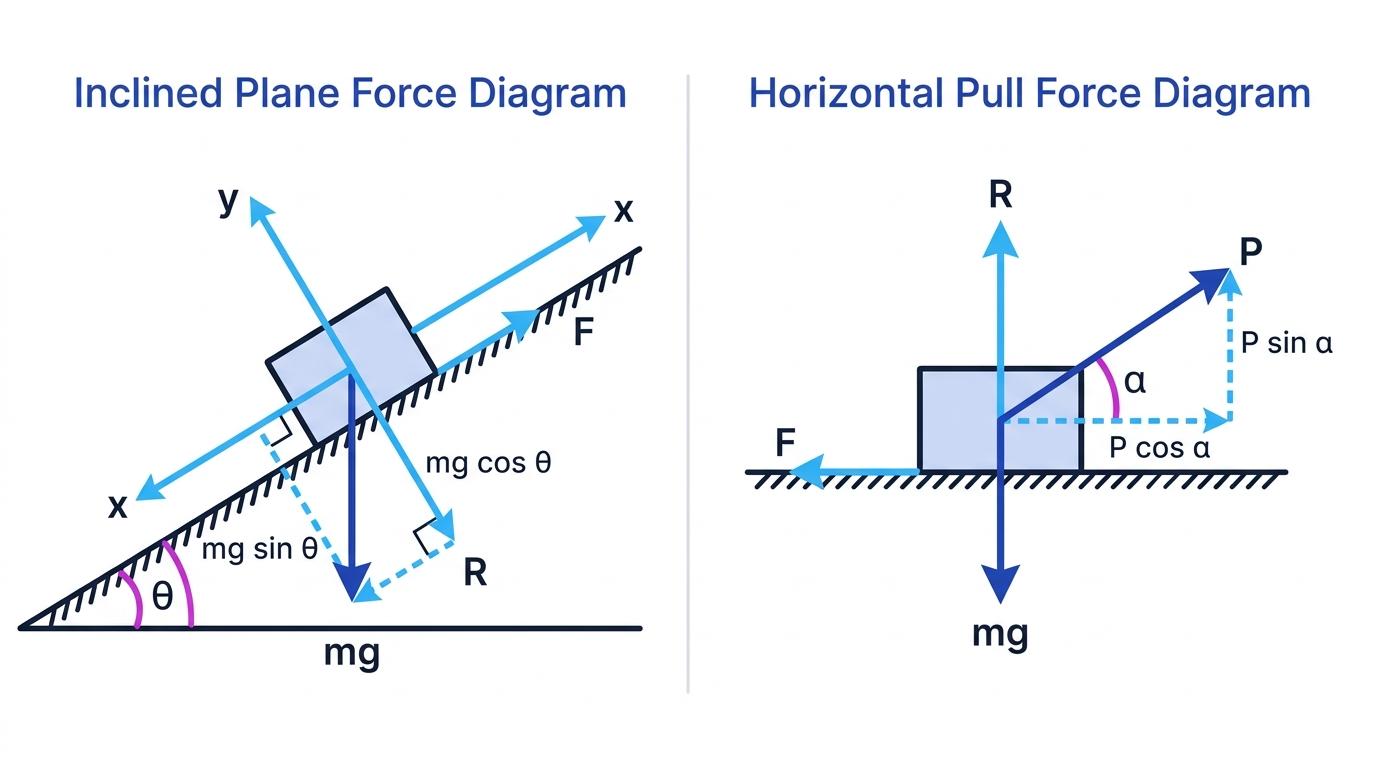
Resolving weight on an inclined plane
Suppose a plane is inclined at angle θ\thetaθ to the horizontal. The weight mgmgmg resolves into:
- mgsinθmg\sin\thetamgsinθ parallel to and down the plane;
- mgcosθmg\cos\thetamgcosθ perpendicular to and into the plane.
Checking the weight components
On a nearly horizontal plane, θ\thetaθ is small. The component down the plane should therefore be small, while the perpendicular component should be close to mgmgmg. This confirms the sine and cosine are in the correct places.
Motion on an inclined plane
If a particle stays in contact with a straight inclined plane, its acceleration perpendicular to the plane is zero. Therefore:
∑F⊥=0.\sum F_{\perp}=0.∑F⊥=0.It may still accelerate parallel to the plane, so in that direction:
∑F∥=ma.\sum F_{\parallel}=ma.∑F∥=ma.Accelerating down a smooth inclined plane
A particle of mass 4 kg is released on a smooth plane inclined at 30∘30^\circ30∘ to the horizontal. Find its acceleration and the normal reaction.
-
Choose the positive direction down the plane. The only force component parallel to the plane is mgsin30∘mg\sin30^\circmgsin30∘, so
4gsin30∘=4a.4g\sin30^\circ=4a.4gsin30∘=4a.Therefore,
a=gsin30∘=4.9 m s−2.a=g\sin30^\circ=4.9\text{ m s}^{-2}.a=gsin30∘=4.9 m s−2. -
There is no acceleration perpendicular to the plane, so the reaction balances the perpendicular component of the weight:
R−4gcos30∘=0.R-4g\cos30^\circ=0.R−4gcos30∘=0. -
Hence,
R=4gcos30∘=19.63 N.R=4g\cos30^\circ=19.6\sqrt{3}\text{ N}.R=4gcos30∘=19.63 N.
Using the full weight down the slope
Weight always acts vertically downwards. Only the component mgsinθmg\sin\thetamgsinθ acts down a plane inclined at angle θ\thetaθ to the horizontal.
Inclined planes with additional forces
When friction, tension or another applied force is present, include its component in the relevant resolved equation.
For example, if a particle accelerates down a rough plane and friction acts up the plane, taking down the plane as positive gives:
mgsinθ−F=ma.mg\sin\theta-F=ma.mgsinθ−F=ma.If a force PPP also acts up the plane, the equation becomes:
mgsinθ−F−P=ma.mg\sin\theta-F-P=ma.mgsinθ−F−P=ma.The signs come from the chosen positive direction, not from a rule that particular forces must always be negative.
Finding a force on a rough slope
A 3 kg particle accelerates down a plane inclined at 20∘20^\circ20∘ to the horizontal. A frictional force of 2 N acts up the plane. Find the acceleration.
-
Take down the plane as positive. The component of weight down the plane is 3gsin20∘3g\sin20^\circ3gsin20∘, while friction acts in the negative direction.
-
Newton’s second law parallel to the plane gives
3gsin20∘−2=3a.3g\sin20^\circ-2=3a.3gsin20∘−2=3a. -
Solving,
a=3gsin20∘−23=2.69 m s−2a=\frac{3g\sin20^\circ-2}{3}=2.69\text{ m s}^{-2}a=33gsin20∘−2=2.69 m s−2to 3 significant figures. The positive answer confirms that the acceleration is down the plane as assumed.
Modelling and interpreting signs
A mechanics diagram is a model of the physical situation. Before writing equations, identify the object whose motion you are considering and include only the forces acting on that object.
You may assume a direction of acceleration before knowing the actual direction. If your calculated acceleration is negative, the object accelerates opposite to your chosen positive direction.
Contact can be lost
An equation such as ∑F⊥=0\sum F_{\perp}=0∑F⊥=0 assumes the particle remains in contact with the surface. A normal reaction cannot be negative; a calculation requiring R<0R<0R<0 indicates that the assumed contact model is not physically valid.
In the exam
- Draw a force diagram and label every force, keeping weight vertical and the reaction perpendicular to the surface.
- Choose perpendicular axes that align with the surface or with as many forces as possible.
- Mark a positive direction, resolve each force carefully, and write one Newton’s second law equation for each required direction.
- Use zero acceleration in a direction only when the motion is constrained in that direction.
- Include units and interpret any negative answer in terms of the direction you originally chose.
Check yourself
- Why is the normal reaction not always equal to mgmgmg?
- What are the components of weight parallel and perpendicular to a plane inclined at angle θ\thetaθ?
- A calculated acceleration is negative. What does this tell you about the actual direction of acceleration?
