

What you'll learn
- How to find the resultant force acting on an object.
- What Newton's first law says about rest and constant velocity.
- How to recognise and use equilibrium in force problems.
- Why zero resultant force does not necessarily mean that an object is stationary.
Prerequisite: forces are vectors
A force is a push or pull acting on an object. Force is measured in newtons, abbreviated to N.
A force is a vector quantity, so it has both a magnitude and a direction. This means that you must take direction into account when combining forces.
For example, a force of 12 N to the right and a force of 7 N to the left do not give a total of 19 N. If right is chosen as the positive direction, their combined effect is
F=12−7=5 N.F=12-7=5\text{ N}.F=12−7=5 N.The resultant force is therefore 5 N to the right.
Resultant force
The resultant force is the single force that has the same effect as all the forces acting on an object combined. It is the vector sum of those forces.
In one-dimensional problems, choose one direction as positive and give forces in the opposite direction negative signs. In two-dimensional problems, resolve the forces into horizontal and vertical components.
Finding a resultant force
A crate is pulled horizontally to the right by a force of 45 N. Resistance acts to the left with magnitude 18 N. Find the resultant force.
-
Choose right as the positive direction, so the pulling force is positive and the resistance is negative.
-
Add the forces with their correct signs:
F=45−18=27 N.F=45-18=27\text{ N}.F=45−18=27 N. -
The answer is positive, so the resultant force is 27 N to the right.
Adding opposing forces
Do not add the magnitudes of forces acting in opposite directions. Choose a positive direction and use signs consistently.
Newton's first law
Newton's first law describes what happens when the resultant force on an object is zero.
Newton's first law
An object remains at rest, or continues to move with constant velocity in a straight line, unless acted on by a non-zero resultant force.
This gives two possible situations when the resultant force is zero:
- The object is stationary and remains stationary.
- The object is moving and continues with the same velocity.
The word velocity is important. Velocity is a vector, so constant velocity means both constant speed and constant direction.
An object moving around a bend at constant speed does not have constant velocity, because its direction is changing. It must therefore have a non-zero resultant force.
Balanced forces
Forces are balanced when their vector sum is zero. In symbols,
∑F=0.\sum \mathbf{F}=\mathbf{0}.∑F=0.The symbol ∑\sum∑ means “the sum of”, while F\mathbf{F}F represents a force vector.
Balanced forces can occur on a stationary object or on an object moving at constant velocity. The following diagrams show both possibilities.
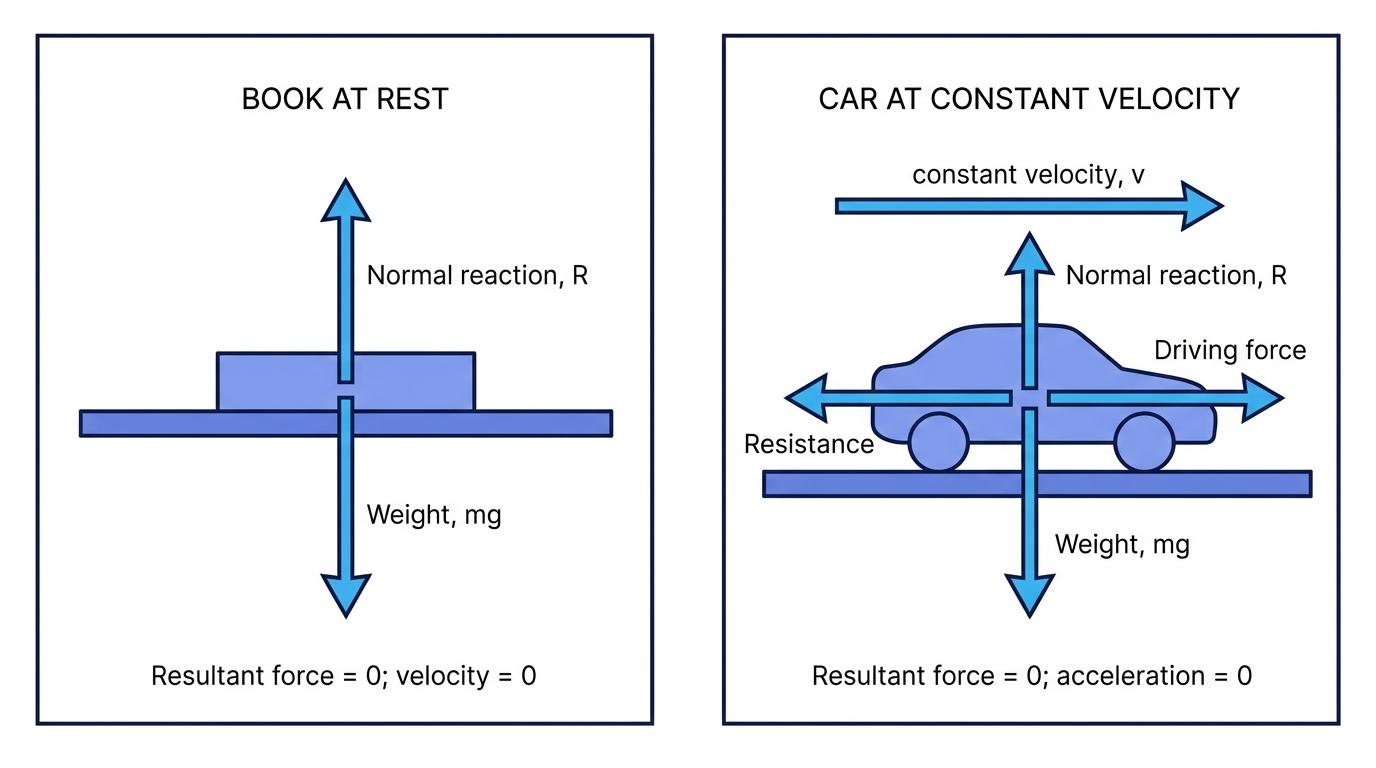
For the stationary book, the upward normal reaction from the table balances the downward weight. For the moving car, the driving force balances the resistance horizontally, while the normal reaction balances the weight vertically.
Normal reaction
The normal reaction is the contact force exerted by a surface on an object. It acts perpendicular to the surface.
Finding the force needed for constant velocity
A car travels along a straight, horizontal road at constant velocity. Its engine provides a driving force of 1600 N. Find the total resistance acting on the car.
-
Constant velocity means that the car has zero acceleration.
-
By Newton's first law, the resultant force must therefore be zero. Taking the direction of motion as positive gives
1600−R=0,1600-R=0,1600−R=0,where RRR is the magnitude of the resistance.
-
Solving gives
R=1600 N.R=1600\text{ N}.R=1600 N.The total resistance is 1600 N opposite to the direction of motion.
Zero resultant does not mean zero forces
Several non-zero forces may act on an object and still produce a zero resultant. The forces cancel; they do not disappear.
Equilibrium
An object is in equilibrium when the resultant force acting on it is zero.
Equilibrium
A particle is in equilibrium if
∑F=0.\sum \mathbf{F}=\mathbf{0}.∑F=0.It then has zero acceleration, so it is either at rest or moving with constant velocity.
In mechanics questions, the word particle refers to a model in which the object's size and shape are ignored. Its mass is treated as being concentrated at one point. This makes it possible to show all forces as acting at the same point.
For equilibrium in two dimensions, the resultant must be zero in every direction. Using horizontal and vertical axes,
∑Fx=0and∑Fy=0.\sum F_x=0 \qquad\text{and}\qquad \sum F_y=0.∑Fx=0and∑Fy=0.It is not enough for the horizontal forces to balance if there is still a non-zero vertical resultant.
Using equilibrium in two directions
A particle is held in equilibrium by three forces. Two of the forces are 8 N8\text{ N}8 N horizontally to the right and 6 N6\text{ N}6 N vertically upwards. Find the third force.
-
For horizontal equilibrium, the third force must have a horizontal component of 8 N to the left.
-
For vertical equilibrium, it must have a vertical component of 6 N downwards.
-
Its magnitude is found using Pythagoras:
F=82+62=10 N.F=\sqrt{8^2+6^2}=10\text{ N}.F=82+62=10 N. -
If θ\thetaθ is the angle below the horizontal towards the left, then
tanθ=68,\tan\theta=\frac{6}{8},tanθ=86,so
θ≈36.9∘.\theta\approx36.9^\circ.θ≈36.9∘.The third force has magnitude 10 N and acts 36.9° below the horizontal towards the left.
Inertia
Inertia is the tendency of an object to resist a change in its velocity. Newton's first law is sometimes called the law of inertia.
An object does not need a force to keep it moving at constant velocity. A non-zero resultant force is needed to change its velocity.
Mass is a measure of inertia. An object with a larger mass is more resistant to a change in velocity than an object with a smaller mass.
Motion without resistance
Imagine sliding an object on surfaces with less and less friction. It travels farther before stopping. With no resistive force at all, it would continue at constant velocity rather than naturally slowing down.
Connecting force, velocity and acceleration
Newton's first law can be summarised through the chain
zero resultant force⇒zero acceleration⇒constant velocity.\text{zero resultant force} \Rightarrow \text{zero acceleration} \Rightarrow \text{constant velocity}.zero resultant force⇒zero acceleration⇒constant velocity.Remember that “constant velocity” includes rest: a stationary object has a constant velocity of zero.
The reverse implication is also useful in mechanics questions:
constant velocity⇒zero acceleration⇒zero resultant force.\text{constant velocity} \Rightarrow \text{zero acceleration} \Rightarrow \text{zero resultant force}.constant velocity⇒zero acceleration⇒zero resultant force.This lets you use information about motion to form an equation involving the forces.
Finding a missing force on a lift
A lift of mass 750 kg moves vertically upwards at constant speed. Find the tension in its supporting cable, taking g=9.8 m s−2g=9.8\text{ m s}^{-2}g=9.8 m s−2.
-
The lift moves upwards at constant speed in a straight line, so its velocity is constant and its acceleration is zero.
-
Its weight acts downwards with magnitude
W=mg=750×9.8=7350 N.W=mg=750\times9.8=7350\text{ N}.W=mg=750×9.8=7350 N. -
Let the upward tension be TTT. Since the resultant force is zero,
T−7350=0.T-7350=0.T−7350=0. -
Therefore,
T=7350 N.T=7350\text{ N}.T=7350 N.The cable tension is 7350 N.
Translate motion into forces
Phrases such as “at rest”, “constant velocity” and “constant speed in a straight line” tell you that the acceleration and resultant force are zero.
Constant speed may not be enough
Constant speed only guarantees zero acceleration when the direction is also constant. Circular motion at constant speed has changing velocity and therefore non-zero acceleration.
In the exam
- Draw a clear force diagram and include only forces acting on the object you are considering.
- Choose positive directions before forming equations, then give every force the correct sign.
- Translate “at rest” or “constant velocity” into ∑F=0\sum \mathbf{F}=\mathbf{0}∑F=0, applying this separately in each required direction.
- Include units and state the direction of a force when its direction is not already clear.
Check yourself
- Can an object be moving when the resultant force on it is zero? Explain your answer.
- A cyclist travels in a straight line at constant speed while producing a driving force of 220 N. What can you deduce about the resistance?
- Why does travelling around a circular track at constant speed not satisfy the constant-velocity part of Newton's first law?
