

What you'll learn
- What the moment of a force means and how it measures a turning effect.
- How to identify the correct perpendicular distance from an axis to a force’s line of action.
- How to calculate moments using M=FdM=FdM=Fd or M=FrsinθM=Fr\sin\thetaM=Frsinθ.
- How to assign signs to clockwise and anticlockwise moments.
Forces and turning effects
A force is a push or pull, measured in newtons (N). As well as changing an object’s motion, a force can make a rigid body turn.
For example, pushing a door near its handle produces a much greater turning effect than pushing close to its hinges. The force may be the same, but its distance from the axis of rotation is different.
An axis is a line about which a body can rotate. In a two-dimensional mechanics diagram, the axis passes through a point in the plane of the body and is perpendicular to that plane. It is often represented by a pivot labelled OOO.
Moment of a force
The moment of a force about an axis is the turning effect of the force about that axis.
A moment may act clockwise or anticlockwise, depending on which way the force would tend to rotate the body.
The line of action
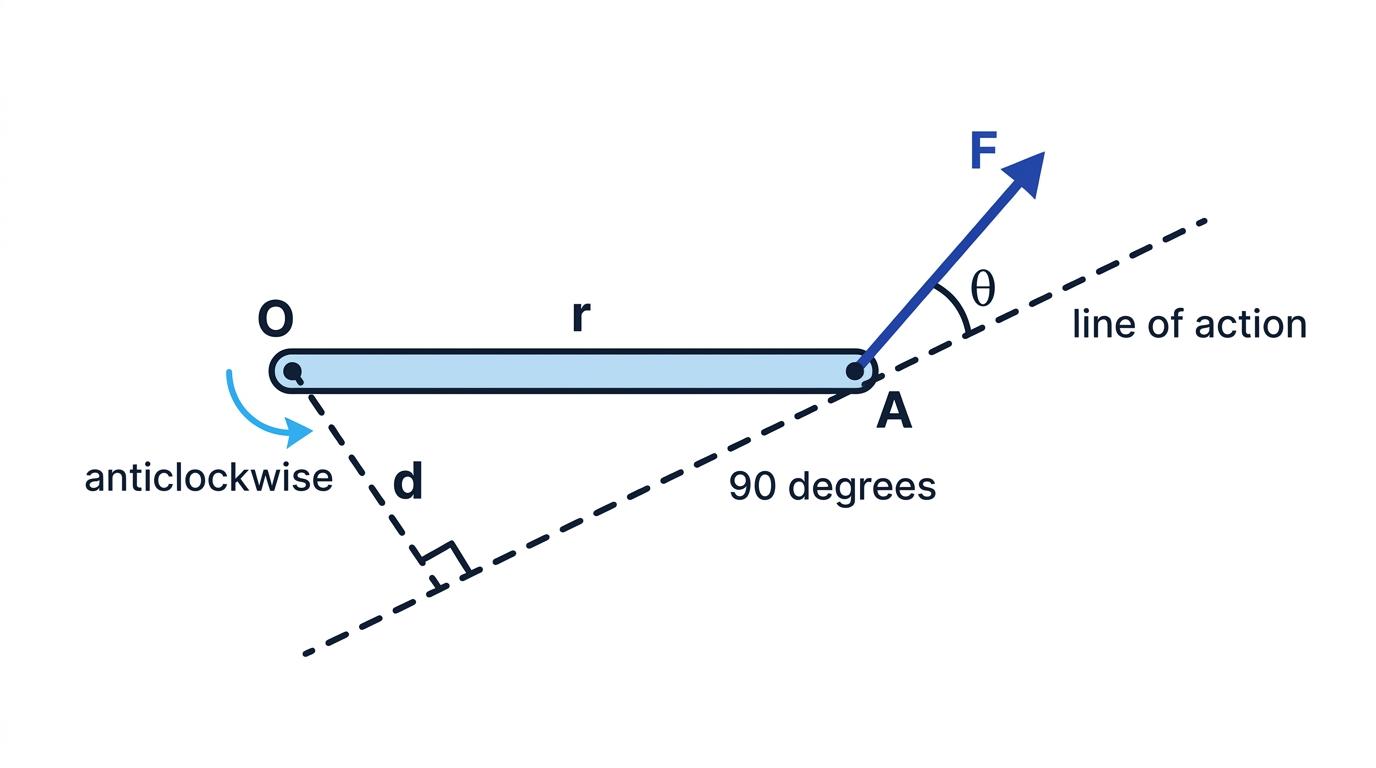
The line of action of a force is the straight line extending through the force arrow in both directions.
To calculate a moment about an axis, you need the shortest distance from the axis to this line. The shortest distance between a point and a line is always measured perpendicularly.
The diagram shows the key quantities. The force FFF acts at AAA, while ddd is the perpendicular distance from OOO to the force’s line of action.
Use the perpendicular distance
The distance used in a moment calculation is the perpendicular distance from the axis to the force’s line of action, not necessarily the distance from the axis to the point where the force is applied.
Calculating a moment
If a force of magnitude FFF has a line of action at perpendicular distance ddd from the axis, the magnitude of its moment is
M=Fd.M=Fd.M=Fd.The SI unit of moment is the newton metre, written N m.
Notice that moment is measured in N m, not joules (J). Although both units involve newtons and metres, moment and energy are different physical quantities.
Using a perpendicular distance
A horizontal force of 15 N acts on a body. Its line of action is 0.40 m above an axis through OOO. Calculate the magnitude of its moment about the axis.
-
The given distance is perpendicular to the force’s horizontal line of action, so use d=0.40 md=0.40\text{ m}d=0.40 m.
-
Apply the moment formula:
M=Fd=15×0.40.M=Fd=15\times 0.40.M=Fd=15×0.40. -
Therefore, the magnitude of the moment is 6 N m.
Using the wrong length
Do not automatically multiply the force by the distance to its point of application. That length is valid only when it is perpendicular to the force’s line of action.
A force acting at an angle
Suppose a force FFF acts at a point whose distance from the axis is rrr. If the angle between the position line and the force is θ\thetaθ, the perpendicular distance is
d=rsinθ.d=r\sin\theta.d=rsinθ.Therefore,
M=F(rsinθ)=Frsinθ.M=F(r\sin\theta)=Fr\sin\theta.M=F(rsinθ)=Frsinθ.This is an alternative form of the moment formula:
M=Frsinθ.\boxed{M=Fr\sin\theta}.M=Frsinθ.Here:
- FFF is the magnitude of the force;
- rrr is the distance from the axis to the point where the force acts;
- θ\thetaθ is the angle between the position line and the force.
Finding the moment of an angled force
A force of 20 N is applied at the end of a rod, 0.60 m from an axis through OOO. The force makes an angle of 35∘35^\circ35∘ with the rod. Find the magnitude of its moment about the axis.
-
The rod gives the distance r=0.60 mr=0.60\text{ m}r=0.60 m, but it is not perpendicular to the force. Use M=FrsinθM=Fr\sin\thetaM=Frsinθ.
-
Substitute the force, distance and included angle:
M=20×0.60×sin35∘.M=20\times 0.60\times\sin 35^\circ.M=20×0.60×sin35∘. -
This gives
M≈6.88 N m.M\approx 6.88\text{ N m}.M≈6.88 N m.
Check the angle
In M=FrsinθM=Fr\sin\thetaM=Frsinθ, θ\thetaθ must be the angle between the force and the line joining the axis to the point of application. If the question gives the complementary angle, use it carefully.
Resolving the force instead
There is another way to reach the same result. Resolve the force into components:
- the component parallel to the position line is FcosθF\cos\thetaFcosθ;
- the component perpendicular to the position line is FsinθF\sin\thetaFsinθ.
The parallel component acts along a line through the axis, so it produces no moment. Only the perpendicular component turns the body:
M=(Fsinθ)r.M=(F\sin\theta)r.M=(Fsinθ)r.This is the same as FrsinθFr\sin\thetaFrsinθ.
Only the perpendicular effect turns
You may either multiply the whole force by its perpendicular distance from the axis, or multiply the perpendicular component of the force by the distance to its point of application.
When the moment is zero
If the line of action of a force passes through the axis, its perpendicular distance from the axis is zero. Hence,
M=F×0=0.M=F\times 0=0.M=F×0=0.The force may still cause linear acceleration, but it has no turning effect about that particular axis.
This also follows from M=FrsinθM=Fr\sin\thetaM=Frsinθ. When the force acts directly towards or away from the axis, θ=0∘\theta=0^\circθ=0∘ or 180∘180^\circ180∘, so sinθ=0\sin\theta=0sinθ=0.
The chosen axis matters
A force can have zero moment about one axis but a non-zero moment about another. Always calculate distances from the specific axis named in the question.
Clockwise and anticlockwise moments
When several forces act, their moments may oppose one another. You therefore need a sign convention.
A common choice is:
- anticlockwise moments are positive;
- clockwise moments are negative.
You may choose the opposite convention, but you must use it consistently throughout your calculation.
Combining moments about an axis
Two forces act on a horizontal bar about an axis through OOO:
- a downward force of 8 N acts 0.50 m to the right of OOO;
- an upward force of 5 N acts 0.30 m to the right of OOO.
Find the resultant moment about OOO, taking anticlockwise as positive.
-
The 8 N downward force tends to turn the bar clockwise, so its moment is
−8×0.50=−4 N m.-8\times 0.50=-4\text{ N m}.−8×0.50=−4 N m. -
The 5 N upward force tends to turn the bar anticlockwise, so its moment is
5×0.30=1.5 N m.5\times 0.30=1.5\text{ N m}.5×0.30=1.5 N m. -
Add the signed moments:
Mresultant=−4+1.5=−2.5 N m.M_{\text{resultant}}=-4+1.5=-2.5\text{ N m}.Mresultant=−4+1.5=−2.5 N m.The negative sign means the resultant moment is 2.5 N m clockwise.
Adding all moment magnitudes
Opposing moments must not simply be added. Decide whether each force acts clockwise or anticlockwise, then combine the moments using a consistent sign convention.
A reliable calculation method
For each force:
- Identify the axis about which moments are required.
- Extend the force mentally to identify its line of action.
- Find the perpendicular distance from the axis to that line.
- Calculate the moment using M=FdM=FdM=Fd.
- Determine whether the turning effect is clockwise or anticlockwise.
- If there are several forces, add their signed moments.
A useful modelling assumption is that the body is rigid, meaning that it does not deform as the forces act. This lets you treat all distances within the body as fixed.
In the exam
- Mark the named axis and draw or imagine each force’s complete line of action.
- Use a perpendicular distance with M=FdM=FdM=Fd; if only a sloping length is available, use M=FrsinθM=Fr\sin\thetaM=Frsinθ or resolve the force.
- State a sign convention before combining several moments, and interpret the sign of your final answer.
- Include the unit N m and keep full calculator accuracy until the final rounding step.
Check yourself
- Why does a force whose line of action passes through the axis have zero moment about that axis?
- A force FFF acts a distance rrr from an axis at angle θ\thetaθ to the position line. How would you calculate its moment?
- How would you decide whether a moment should be recorded as positive or negative?
