Question 37
In this question use g=9.8g = 9.8g=9.8 m s−2^{-2}−2.
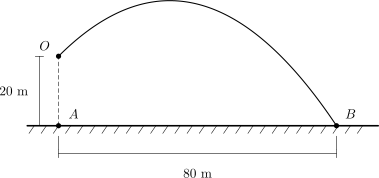
A ball is projected with speed U U\,U m s−1^{-1}−1 from a point OOO, which is 20 m above horizontal ground. The ball is projected at an angle of 45° 45°\,45° above the horizontal.
The point A A\,A is on the ground vertically below OOO. The ball hits the ground at the point BBB, where AB=80AB = 80AB=80 m. The motion of the ball is modelled as that of a particle moving freely under gravity, with air resistance negligible.
a.[4]
Find the value of UUU.
b.[2]
Find the greatest height of the ball above the ground.
c.[1]
A refined model includes the effect of air resistance. State how the value of U U\,U needed to reach B B\,B would compare with your answer to part (a).
3.3 Projectiles (A-level only) Questions
91 exam-style questions on OCR (MEI) A Level Maths 3.3 Projectiles (A-level only), covering 3.3.1 Model motion under gravity using vectors (A-level only), 3.3.2 Position, velocity, range and maximum height (A-level only), 3.3.3 Find the initial velocity of a projectile (A-level only), 3.3.4 Equation of the trajectory (A-level only), and 3.3.5 Solve simple projectile problems (A-level only). Each one has a worked solution and a mark scheme showing where the marks go.