

What you'll learn
- How a position vector describes the location of a point.
- How to find the vector joining two points by subtracting position vectors.
- How to calculate the distance between two points in two or three dimensions.
- How to interpret and check your answers geometrically.
Prerequisites: vectors and components
A vector is a quantity with both magnitude and direction. The magnitude is the length or size of the vector.
In two dimensions, a vector can be written as a column vector:
(xy)\begin{pmatrix} x\\ y \end{pmatrix}(xy)The number xxx is the horizontal component and yyy is the vertical component. A positive horizontal component points right, while a positive vertical component points upwards.
In three dimensions, a vector has three components:
(xyz)\begin{pmatrix} x\\ y\\ z \end{pmatrix}xyzVectors may also be written using the perpendicular unit vectors i\mathbf{i}i, j\mathbf{j}j and k\mathbf{k}k:
xi+yj+zkx\mathbf{i}+y\mathbf{j}+z\mathbf{k}xi+yj+zkHere, i\mathbf{i}i points in the positive xxx-direction, j\mathbf{j}j in the positive yyy-direction and k\mathbf{k}k in the positive zzz-direction.
Adding and subtracting vectors
To add or subtract vectors, work with corresponding components.
For example:
(ab)−(cd)=(a−cb−d)\begin{pmatrix} a\\ b \end{pmatrix} - \begin{pmatrix} c\\ d \end{pmatrix} = \begin{pmatrix} a-c\\ b-d \end{pmatrix}(ab)−(cd)=(a−cb−d)The order matters when subtracting because changing the order reverses the direction of the resulting vector.
Subtracting two vectors
Given
p=(7−2)andq=(34),\mathbf{p}= \begin{pmatrix} 7\\ -2 \end{pmatrix} \qquad\text{and}\qquad \mathbf{q}= \begin{pmatrix} 3\\ 4 \end{pmatrix},p=(7−2)andq=(34),find p−q\mathbf{p}-\mathbf{q}p−q.
- Subtract the horizontal components: 7−3=47-3=47−3=4.
- Subtract the vertical components: −2−4=−6-2-4=-6−2−4=−6.
- Therefore,
What is a position vector?
Choose a fixed point called the origin, labelled OOO. The position vector of a point AAA is the vector that starts at OOO and ends at AAA.
Position vector
The position vector of AAA is OA→\overrightarrow{OA}OA. It describes the position of AAA relative to the origin OOO.
If AAA has coordinates (3,−2)(3,-2)(3,−2), then its position vector is
OA→=(3−2).\overrightarrow{OA} = \begin{pmatrix} 3\\ -2 \end{pmatrix}.OA=(3−2).This tells you to travel 3 units to the right and 2 units down from the origin to reach AAA.
A position vector is often represented by a lowercase bold letter. For example:
OA→=a.\overrightarrow{OA}=\mathbf{a}.OA=a.Similarly, if OB→=b\overrightarrow{OB}=\mathbf{b}OB=b, then a\mathbf{a}a and b\mathbf{b}b give the positions of AAA and BBB.
The fixed starting point
A vector is a position vector only when its starting point is the origin. The vector AB→\overrightarrow{AB}AB describes a displacement from AAA to BBB, so it is not usually a position vector.
Finding the vector between two points
Suppose the position vectors of AAA and BBB are
OA→=aandOB→=b.\overrightarrow{OA}=\mathbf{a} \qquad\text{and}\qquad \overrightarrow{OB}=\mathbf{b}.OA=aandOB=b.To travel from AAA to BBB, you can first travel from AAA back to OOO, then from OOO to BBB:
AB→=AO→+OB→.\overrightarrow{AB} = \overrightarrow{AO}+\overrightarrow{OB}.AB=AO+OB.Since AO→=−OA→=−a\overrightarrow{AO}=-\overrightarrow{OA}=-\mathbf{a}AO=−OA=−a, this gives
AB→=−a+b=b−a.\overrightarrow{AB} = -\mathbf{a}+\mathbf{b} = \mathbf{b}-\mathbf{a}.AB=−a+b=b−a.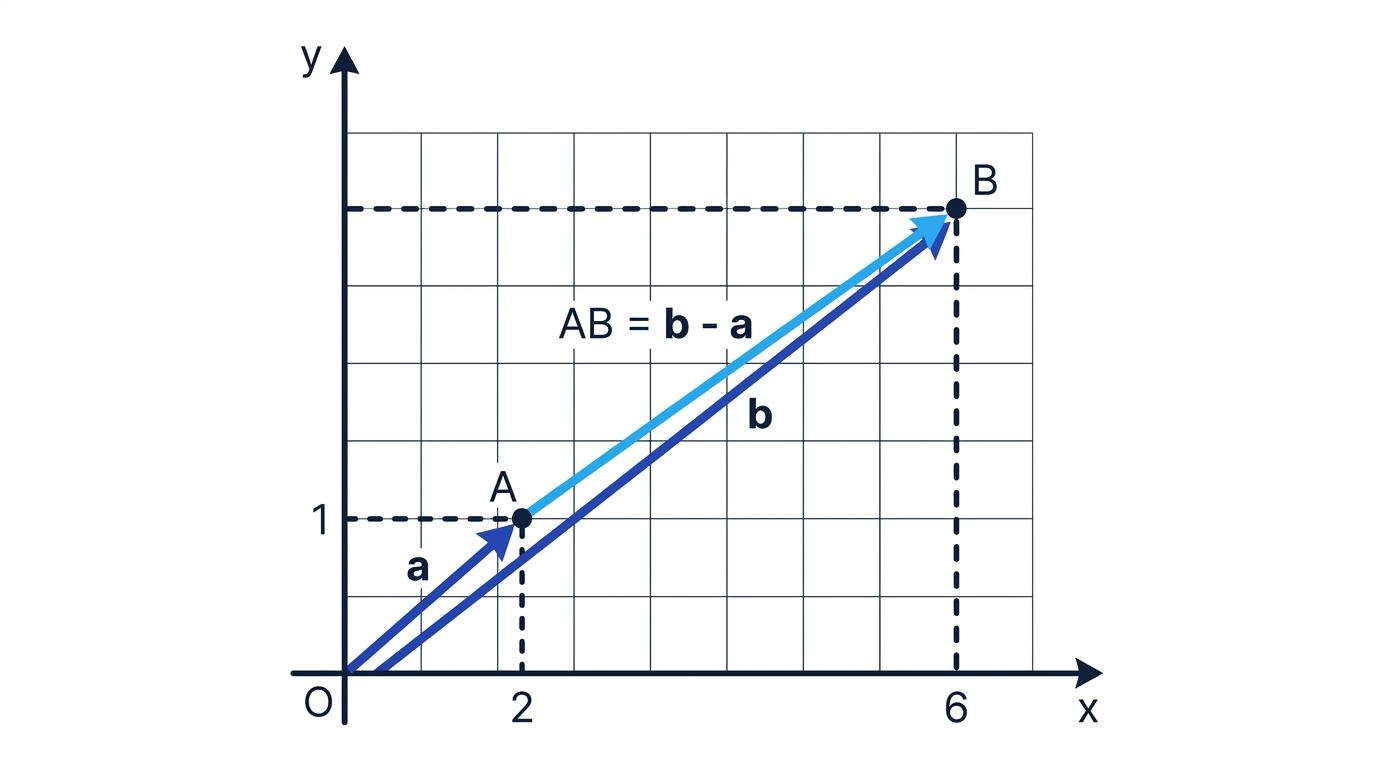
End minus start
To find a vector from one point to another, subtract the position vector of the starting point from the position vector of the ending point:
AB→=b−a.\overrightarrow{AB}=\mathbf{b}-\mathbf{a}.AB=b−a.Finding a vector between two points
Points AAA and BBB have position vectors
a=(2−1)andb=(83).\mathbf{a}= \begin{pmatrix} 2\\ -1 \end{pmatrix} \qquad\text{and}\qquad \mathbf{b}= \begin{pmatrix} 8\\ 3 \end{pmatrix}.a=(2−1)andb=(83).Find AB→\overrightarrow{AB}AB and BA→\overrightarrow{BA}BA.
- For AB→\overrightarrow{AB}AB, use end minus start:
- Reverse the subtraction to find BA→\overrightarrow{BA}BA:
- The answers satisfy BA→=−AB→\overrightarrow{BA}=-\overrightarrow{AB}BA=−AB, as expected because they have equal lengths but opposite directions.
Subtracting in the wrong order
For AB→\overrightarrow{AB}AB, calculate b−a\mathbf{b}-\mathbf{a}b−a, not a−b\mathbf{a}-\mathbf{b}a−b. The arrow tells you that AAA is the start and BBB is the end.
Magnitude of a vector
The magnitude of a vector is its length. The magnitude of v\mathbf{v}v is written as ∣v∣\lvert\mathbf{v}\rvert∣v∣.
For a two-dimensional vector
v=(xy),\mathbf{v}= \begin{pmatrix} x\\ y \end{pmatrix},v=(xy),Pythagoras' theorem gives
∣v∣=x2+y2.\lvert\mathbf{v}\rvert=\sqrt{x^2+y^2}.∣v∣=x2+y2.In three dimensions, if
v=(xyz),\mathbf{v}= \begin{pmatrix} x\\ y\\ z \end{pmatrix},v=xyz,then
∣v∣=x2+y2+z2.\lvert\mathbf{v}\rvert=\sqrt{x^2+y^2+z^2}.∣v∣=x2+y2+z2.Finding the magnitude of a vector
Find the magnitude of
v=(−512).\mathbf{v}= \begin{pmatrix} -5\\ 12 \end{pmatrix}.v=(−512).- Square each component and add:
- Take the positive square root because a length cannot be negative:
Losing negative components
A negative component becomes positive when squared. Write brackets, such as (−5)2(-5)^2(−5)2, to avoid incorrectly treating it as −52-5^2−52.
Distance between two points
The distance from AAA to BBB is the magnitude of the vector AB→\overrightarrow{AB}AB.
If the points have position vectors a\mathbf{a}a and b\mathbf{b}b, then
AB=∣AB→∣=∣b−a∣.AB=\lvert\overrightarrow{AB}\rvert =\lvert\mathbf{b}-\mathbf{a}\rvert.AB=∣AB∣=∣b−a∣.Notice that AB→\overrightarrow{AB}AB is a vector, but ABABAB is a distance and therefore a non-negative scalar.
Calculating a distance in two dimensions
Points AAA and BBB have position vectors
a=(−25)andb=(4−3).\mathbf{a}= \begin{pmatrix} -2\\ 5 \end{pmatrix} \qquad\text{and}\qquad \mathbf{b}= \begin{pmatrix} 4\\ -3 \end{pmatrix}.a=(−25)andb=(4−3).Find the exact distance ABABAB.
- Find the displacement from AAA to BBB:
- Find its magnitude:
- Simplify the exact value:
A useful check
Distance does not depend on direction: ∣AB→∣=∣BA→∣\lvert\overrightarrow{AB}\rvert=\lvert\overrightarrow{BA}\rvert∣AB∣=∣BA∣. Reversing the vector changes every sign but not its magnitude.
Position vectors in three dimensions
The same method works in three dimensions. First subtract the position vectors, then use all three components when finding the magnitude.
Calculating a distance in three dimensions
Points PPP and QQQ have position vectors
p=(1−24)andq=(51−2).\mathbf{p}= \begin{pmatrix} 1\\ -2\\ 4 \end{pmatrix} \qquad\text{and}\qquad \mathbf{q}= \begin{pmatrix} 5\\ 1\\ -2 \end{pmatrix}.p=1−24andq=51−2.Find the exact distance PQPQPQ.
- Calculate the displacement from PPP to QQQ:
- Apply the three-dimensional magnitude formula:
- Hence,
Since 61 has no square factors greater than 1, this is already in exact form.
In the exam
- Label the position vectors clearly, then use end minus start to form the required displacement vector.
- When finding a distance, square every component, add the results and take the positive square root.
- Keep distances exact unless a decimal is requested, and check that reversing the direction would leave your distance unchanged.
Check yourself
- If OA→=a\overrightarrow{OA}=\mathbf{a}OA=a and OB→=b\overrightarrow{OB}=\mathbf{b}OB=b, what is BA→\overrightarrow{BA}BA?
- How would you find the distance between points with position vectors (23)\begin{pmatrix}2\\3\end{pmatrix}(23) and (−48)\begin{pmatrix}-4\\8\end{pmatrix}(−48)?
- Which extra term is needed in the magnitude formula when you move from two dimensions to three dimensions?
