

What you'll learn
- How parametric equations model the position and movement of an object.
- How to interpret the parameter, including its permitted range.
- How to construct parametric models from geometric and physical information.
- How to eliminate the parameter and assess whether a model is realistic.
Prerequisites
Before starting, you should be comfortable with:
- coordinates in the (x,y)(x,y)(x,y) plane;
- rearranging equations and substituting expressions;
- the identities sin2θ+cos2θ=1\sin^2\theta+\cos^2\theta=1sin2θ+cos2θ=1 and tanθ=sinθcosθ\tan\theta=\frac{\sin\theta}{\cos\theta}tanθ=cosθsinθ;
- interpreting graphs and restricting the domain of a function.
What are parametric equations?
In a Cartesian equation, yyy is usually written directly in terms of xxx, such as y=x2+3y=x^2+3y=x2+3.
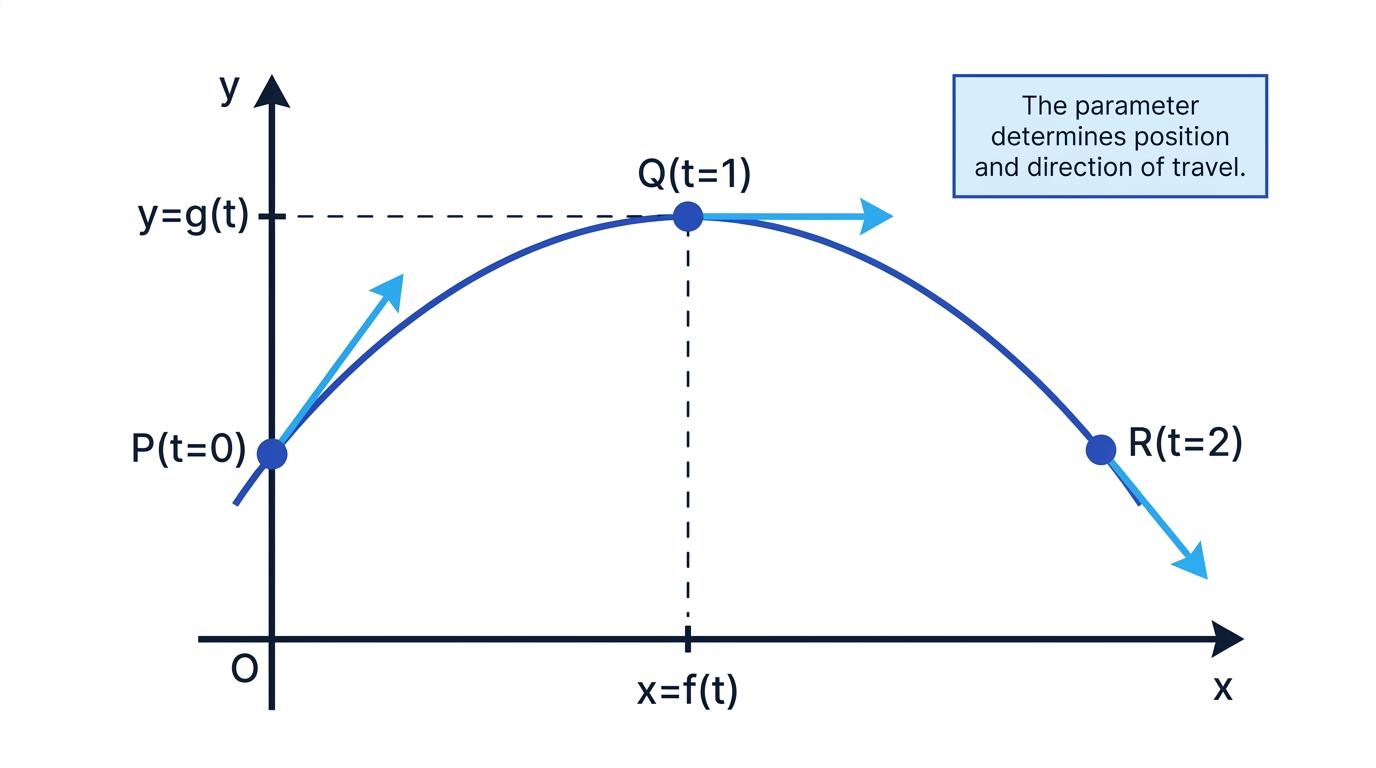
Parametric equations describe both coordinates using a third variable. For example,
x=2t+1,y=t2.x=2t+1,\qquad y=t^2.x=2t+1,y=t2.Here, each permitted value of ttt produces a point on the curve.
Parameter
A parameter is an additional variable used to determine the coordinates of points on a curve. In modelling, it often represents time, an angle or another changing quantity.
For x=2t+1x=2t+1x=2t+1 and y=t2y=t^2y=t2, setting t=0t=0t=0 gives (1,0)(1,0)(1,0), while setting t=2t=2t=2 gives (5,4)(5,4)(5,4). As ttt changes, the point moves along the curve.
Finding positions from a parameter
A particle has position
x=3t−2,y=5−t2,x=3t-2,\qquad y=5-t^2,x=3t−2,y=5−t2,where ttt is measured in seconds. Find its position when t=0t=0t=0 and when t=2t=2t=2.
-
At t=0t=0t=0, substitute into both equations:
x=3(0)−2=−2,y=5−02=5.x=3(0)-2=-2,\qquad y=5-0^2=5.x=3(0)−2=−2,y=5−02=5.The initial position is (−2,5)(-2,5)(−2,5).
-
At t=2t=2t=2:
x=3(2)−2=4,y=5−22=1.x=3(2)-2=4,\qquad y=5-2^2=1.x=3(2)−2=4,y=5−22=1.After 2 seconds, the position is (4,1)(4,1)(4,1).
-
Comparing the coordinates shows that the particle has moved to the right, because xxx increased, and downwards, because yyy decreased.
Why use parametric equations in modelling?
A mathematical model is a simplified mathematical description of a real situation. Parametric equations are particularly useful when both coordinates depend naturally on the same changing quantity.
Examples include:
- the position of a projectile after time ttt;
- a point moving around a wheel through an angle θ\thetaθ;
- the position of a boat affected by two components of motion;
- the path traced by a point on a moving mechanism.
Position and movement
A Cartesian equation describes the shape of a path. Parametric equations can additionally show where an object is at a particular time and the direction in which it travels.
The range of the parameter
A model must state which parameter values are allowed. This restriction is called the parameter range.
For example, a projectile model might apply only while
0≤t≤4.0\le t\le 4.0≤t≤4.Although the formulas can be evaluated when t>4t>4t>4, those values may represent the object continuing below ground level and therefore have no physical meaning.
Ignoring the parameter range
Do not sketch or interpret the whole mathematical curve when the model gives a restricted range. Only the section corresponding to the permitted parameter values belongs to the model.
Interpreting a restricted model
A model for a moving point is
x=2t,y=t2−4t+3,0≤t≤3.x=2t,\qquad y=t^2-4t+3,\qquad 0\le t\le 3.x=2t,y=t2−4t+3,0≤t≤3.Find the starting and finishing points and the lowest point reached.
-
At the start, t=0t=0t=0, so
x=0,y=3.x=0,\qquad y=3.x=0,y=3.The point starts at (0,3)(0,3)(0,3).
-
At the finish, t=3t=3t=3, so
x=6,y=9−12+3=0.x=6,\qquad y=9-12+3=0.x=6,y=9−12+3=0.It finishes at (6,0)(6,0)(6,0).
-
Complete the square in the expression for yyy:
y=t2−4t+3=(t−2)2−1.y=t^2-4t+3=(t-2)^2-1.y=t2−4t+3=(t−2)2−1.Therefore the minimum occurs when t=2t=2t=2, which is within the permitted range.
-
At t=2t=2t=2,
x=4,y=−1.x=4,\qquad y=-1.x=4,y=−1.The lowest point is (4,−1)(4,-1)(4,−1).
Constructing a parametric model
Motion with constant components
Suppose an object starts at (x0,y0)(x_0,y_0)(x0,y0) and moves with constant horizontal and vertical components uuu and vvv. After time ttt,
x=x0+ut,y=y0+vt.x=x_0+ut,\qquad y=y_0+vt.x=x0+ut,y=y0+vt.The starting coordinates provide the constant terms, while the coefficients of ttt describe how quickly each coordinate changes.
Modelling a boat's motion
Relative to the shore, a boat starts at (20,5)(20,5)(20,5) and moves east at 4 m s⁻¹ and north at 3 m s⁻¹. Write a parametric model and find its position after 6 seconds.
-
Let the positive xxx-direction be east and the positive yyy-direction be north. The initial coordinates are x0=20x_0=20x0=20 and y0=5y_0=5y0=5.
-
Apply the horizontal and vertical components:
x=20+4t,y=5+3t,t≥0.x=20+4t,\qquad y=5+3t,\qquad t\ge 0.x=20+4t,y=5+3t,t≥0. -
At t=6t=6t=6,
x=20+4(6)=44,y=5+3(6)=23.x=20+4(6)=44,\qquad y=5+3(6)=23.x=20+4(6)=44,y=5+3(6)=23.The boat is at (44,23)(44,23)(44,23).
Circular motion
For a circle of radius rrr centred at (a,b)(a,b)(a,b), a useful parametrisation is
x=a+rcosθ,y=b+rsinθ.x=a+r\cos\theta,\qquad y=b+r\sin\theta.x=a+rcosθ,y=b+rsinθ.The parameter θ\thetaθ is the angle measured from the positive xxx-direction. As θ\thetaθ increases from 0 to 2π2\pi2π, the point travels once anticlockwise around the circle.
Choosing sine and cosine
At θ=0\theta=0θ=0, the standard model gives (a+r,b)(a+r,b)(a+r,b). Check this starting point against the context; you may need to swap sine and cosine or insert a minus sign.
Modelling a Ferris wheel
A Ferris wheel has radius 12 m and its centre is 14 m above the ground. A passenger starts at the lowest point. Model the passenger's position using an angle θ\thetaθ that increases anticlockwise from the starting position.
-
Place the wheel's centre at (0,14)(0,14)(0,14). Since the passenger starts 12 m below the centre, the initial position must be (0,2)(0,2)(0,2).
-
Use x=−12sinθx=-12\sin\thetax=−12sinθ for the horizontal displacement and y=14−12cosθy=14-12\cos\thetay=14−12cosθ for the height:
x=−12sinθ,y=14−12cosθ,0≤θ≤2π.x=-12\sin\theta,\qquad y=14-12\cos\theta,\qquad 0\le\theta\le2\pi.x=−12sinθ,y=14−12cosθ,0≤θ≤2π. -
Check the model at θ=0\theta=0θ=0:
x=0,y=14−12=2.x=0,\qquad y=14-12=2.x=0,y=14−12=2.This matches the required starting point.
-
At the top, θ=π\theta=\piθ=π, giving
x=0,y=14−12(−1)=26.x=0,\qquad y=14-12(-1)=26.x=0,y=14−12(−1)=26.The model predicts a maximum height of 26 m.
Eliminating the parameter
To find the Cartesian equation of the path, eliminate the parameter: rearrange one parametric equation and substitute it into the other.
Finding the path of a particle
A particle is modelled by
x=3t+1,y=2t2−4.x=3t+1,\qquad y=2t^2-4.x=3t+1,y=2t2−4.Find a Cartesian equation for its path.
-
Rearrange the linear equation for xxx:
t=x−13.t=\frac{x-1}{3}.t=3x−1. -
Substitute this expression into the equation for yyy:
y=2(x−13)2−4.y=2\left(\frac{x-1}{3}\right)^2-4.y=2(3x−1)2−4. -
Simplify:
y=29(x−1)2−4.y=\frac{2}{9}(x-1)^2-4.y=92(x−1)2−4.The path is part or all of this parabola, depending on the permitted values of ttt.
Losing modelling information
Eliminating the parameter can lose information about time, direction and repeated motion. Keep the original parametric equations when answering questions about when or how an object moves.
Checking a model
A model is based on assumptions. You should check that:
- parameter values have a sensible meaning;
- coordinates and units are consistent;
- starting and finishing positions match the context;
- predicted values are physically possible;
- any ignored effects, such as air resistance, are understood.
A model can be useful without being perfectly realistic. The important question is whether its assumptions are suitable for the purpose.
In the exam
- Identify what the parameter represents and write down its permitted range.
- Substitute into both coordinate equations when finding a position; a value of ttt does not by itself give a point.
- Check endpoints and special parameter values before accepting or sketching a model.
- When eliminating the parameter, carry the original restriction across to the Cartesian curve.
- Interpret your final result in context, including coordinates, direction and units where appropriate.
Check yourself
- How does a parametric model contain more information than a Cartesian equation of the same path?
- What parametric equations would describe a circle of radius 5 centred at (2,−1)(2,-1)(2,−1)?
- Why might parameter values outside a stated range give mathematically valid but unrealistic coordinates?
