Question 11
Figure 1 below shows the region RRR, which is bounded by the curve with equation y=2x+1y = \sqrt{2^x + 1}y=2x+1, the xxx-axis and the lines x=0x = 0x=0 and x=3x = 3x=3.
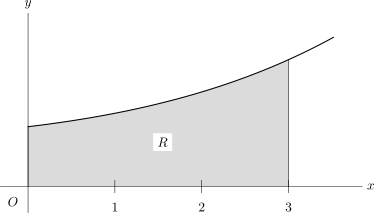
a.[2]
Complete the table below, giving the missing values of 2x+1 \sqrt{2^x + 1}\,2x+1 to three decimal places.
xxx: 0, 0.5, 1, 1.5, 2, 2.5, 3 2x+1\sqrt{2^x + 1}2x+1: 1.414, 1.554, 1.732, 1.957, ..., ..., ...
b.[4]
Use the trapezium rule with all the values from the table to find an approximation for the area of RRR, giving your answer to four significant figures.
c.[2]
State, giving a reason, whether your approximation in part (b) is an overestimate or an underestimate for the area of RRR.
1.10 Numerical Methods (A-level only) Questions
133 exam-style questions on OCR (MEI) A Level Maths 1.10 Numerical Methods (A-level only), covering 1.10.1 Locate roots by change of sign (A-level only), 1.10.2 When change of sign methods fail (A-level only), 1.10.3 Fixed point iteration (A-level only), 1.10.4 Newton-Raphson method (A-level only), 1.10.5 Convergence of iterations (A-level only), 1.10.6 Trapezium rule (A-level only), 1.10.7 Upper and lower bounds using rectangles (A-level only), and 1.10.8 Numerical methods to solve problems (A-level only). Each one has a worked solution and a mark scheme showing where the marks go.