

What you'll learn
- How to calculate the magnitude of a vector from its components.
- How to find a vector's direction, including choosing the correct quadrant.
- How to convert between component form and magnitude/direction form.
- How to apply these techniques to two-dimensional and three-dimensional vectors.
Prerequisites: vectors and components
A vector is a quantity with both a size and a direction. For example, a displacement of 5 m east is a vector because it tells you how far to travel and in which direction.
In two dimensions, a vector can be written in component form as
a=(xy).\mathbf{a}= \begin{pmatrix} x\\ y \end{pmatrix}.a=(xy).The number xxx is the horizontal component and the number yyy is the vertical component.
- A positive horizontal component means movement to the right.
- A negative horizontal component means movement to the left.
- A positive vertical component means movement upwards.
- A negative vertical component means movement downwards.
For example,
(3−4)\begin{pmatrix} 3\\ -4 \end{pmatrix}(3−4)represents movement 3 units to the right and 4 units downwards.
Vectors can also be written using the unit vectors i\mathbf{i}i and j\mathbf{j}j:
(xy)=xi+yj,\begin{pmatrix} x\\ y \end{pmatrix} =x\mathbf{i}+y\mathbf{j},(xy)=xi+yj,where i\mathbf{i}i points one unit in the positive horizontal direction and j\mathbf{j}j points one unit in the positive vertical direction.
Component form
The component form of a vector lists its signed movement in each coordinate direction. In two dimensions, (xy)\begin{pmatrix}x\\y\end{pmatrix}(xy) means xxx units horizontally and yyy units vertically.
Magnitude of a vector
The magnitude of a vector is its length or size. The magnitude of a\mathbf{a}a is written as ∣a∣|\mathbf{a}|∣a∣.
The horizontal and vertical components form the perpendicular sides of a right-angled triangle. Therefore, Pythagoras' theorem gives
∣a∣=x2+y2.|\mathbf{a}|=\sqrt{x^2+y^2}.∣a∣=x2+y2.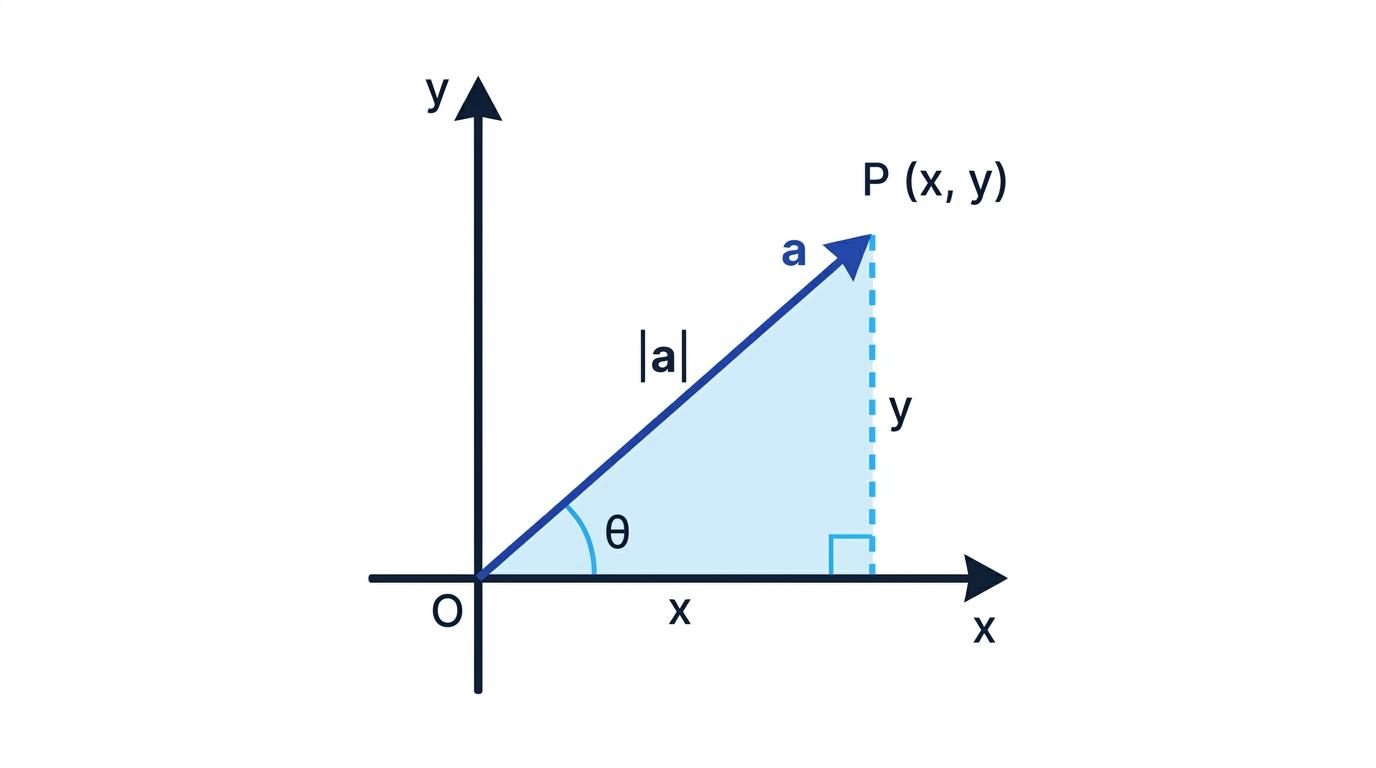
Magnitude formula
For a=(xy)\mathbf{a}=\begin{pmatrix}x\\y\end{pmatrix}a=(xy),
∣a∣=x2+y2.|\mathbf{a}|=\sqrt{x^2+y^2}.∣a∣=x2+y2.The signs of the components do not affect the magnitude because the components are squared.
Finding the magnitude of a vector
Find the magnitude of
a=(−512).\mathbf{a}= \begin{pmatrix} -5\\ 12 \end{pmatrix}.a=(−512).-
Substitute the horizontal and vertical components into the magnitude formula:
∣a∣=(−5)2+122.|\mathbf{a}|=\sqrt{(-5)^2+12^2}.∣a∣=(−5)2+122. -
Square each component:
∣a∣=25+144=169.|\mathbf{a}|=\sqrt{25+144}=\sqrt{169}.∣a∣=25+144=169. -
Take the positive square root, since a length cannot be negative:
∣a∣=13.|\mathbf{a}|=13.∣a∣=13.
Forgetting brackets around negative components
Write (−5)2(-5)^2(−5)2, not −52-5^2−52. The first expression equals 25, whereas the second is interpreted as −(52)=−25-(5^2)=-25−(52)=−25.
Magnitude in three dimensions
A three-dimensional vector has three components:
a=(xyz)=xi+yj+zk.\mathbf{a}= \begin{pmatrix} x\\ y\\ z \end{pmatrix} =x\mathbf{i}+y\mathbf{j}+z\mathbf{k}.a=xyz=xi+yj+zk.Its magnitude is found by extending Pythagoras' theorem:
∣a∣=x2+y2+z2.|\mathbf{a}|=\sqrt{x^2+y^2+z^2}.∣a∣=x2+y2+z2.Finding a three-dimensional magnitude
Find the magnitude of a=2i−3j+6k\mathbf{a}=2\mathbf{i}-3\mathbf{j}+6\mathbf{k}a=2i−3j+6k.
-
Identify the three components as x=2x=2x=2, y=−3y=-3y=−3 and z=6z=6z=6.
-
Substitute them into the three-dimensional magnitude formula:
∣a∣=22+(−3)2+62.|\mathbf{a}|=\sqrt{2^2+(-3)^2+6^2}.∣a∣=22+(−3)2+62. -
Simplify:
∣a∣=4+9+36=49=7.|\mathbf{a}|=\sqrt{4+9+36}=\sqrt{49}=7.∣a∣=4+9+36=49=7.
Direction of a two-dimensional vector
The direction angle θ\thetaθ is usually measured anticlockwise from the positive horizontal axis, unless the question states a different convention.
For a vector in the first quadrant,
tanθ=yx,\tan\theta=\frac{y}{x},tanθ=xy,so
θ=tan−1(yx).\theta=\tan^{-1}\left(\frac{y}{x}\right).θ=tan−1(xy).Here, tan−1\tan^{-1}tan−1 means the inverse tangent function on your calculator, not the reciprocal of tangent.
Finding a direction in the first quadrant
Find the direction of
a=(47),\mathbf{a}= \begin{pmatrix} 4\\ 7 \end{pmatrix},a=(47),giving your answer to 1 decimal place.
-
Since both components are positive, the vector lies in the first quadrant, so the calculator's inverse tangent result will give the required angle directly.
-
Use the ratio of the vertical component to the horizontal component:
θ=tan−1(74).\theta=\tan^{-1}\left(\frac{7}{4}\right).θ=tan−1(47). -
Evaluate and round only at the end:
θ≈60.3∘.\theta\approx60.3^\circ.θ≈60.3∘.
Choosing the correct quadrant
Using tan−1(y/x)\tan^{-1}(y/x)tan−1(y/x) alone can produce an angle in the wrong quadrant because tangent has a period of 180∘180^\circ180∘.
The signs of the components tell you where the vector lies:
- x>0x>0x>0, y>0y>0y>0: first quadrant.
- x<0x<0x<0, y>0y>0y>0: second quadrant.
- x<0x<0x<0, y<0y<0y<0: third quadrant.
- x>0x>0x>0, y<0y<0y<0: fourth quadrant.
A reliable method is to find the positive reference angle
α=tan−1(∣yx∣)\alpha=\tan^{-1}\left(\left|\frac{y}{x}\right|\right)α=tan−1(xy)and then use the quadrant to obtain θ\thetaθ:
- first quadrant: θ=α\theta=\alphaθ=α;
- second quadrant: θ=180∘−α\theta=180^\circ-\alphaθ=180∘−α;
- third quadrant: θ=180∘+α\theta=180^\circ+\alphaθ=180∘+α;
- fourth quadrant: θ=360∘−α\theta=360^\circ-\alphaθ=360∘−α.
Finding a direction in the second quadrant
Find the direction of
b=(−34),\mathbf{b}= \begin{pmatrix} -3\\ 4 \end{pmatrix},b=(−34),measured anticlockwise from the positive horizontal axis.
-
The horizontal component is negative and the vertical component is positive, so the vector lies in the second quadrant.
-
Find the reference angle:
α=tan−1(43)≈53.1∘.\alpha=\tan^{-1}\left(\frac{4}{3}\right)\approx53.1^\circ.α=tan−1(34)≈53.1∘. -
Subtract the reference angle from 180∘180^\circ180∘:
θ=180∘−53.1∘=126.9∘.\theta=180^\circ-53.1^\circ=126.9^\circ.θ=180∘−53.1∘=126.9∘.
Use your calculator's coordinate-aware angle function
Some calculators provide a function such as Arg(x+yi)\operatorname{Arg}(x+yi)Arg(x+yi) or atan2(y,x)\operatorname{atan2}(y,x)atan2(y,x) that uses both components and identifies the quadrant. Check whether it returns an angle between −180∘-180^\circ−180∘ and 180∘180^\circ180∘; if it gives a negative angle, add 360∘360^\circ360∘ when an angle from 0∘0^\circ0∘ to 360∘360^\circ360∘ is required.
Vectors on the axes
The formula tan−1(y/x)\tan^{-1}(y/x)tan−1(y/x) cannot be used when x=0x=0x=0 because division by zero is undefined. Read the direction directly: an upward vector has direction 90∘90^\circ90∘, while a downward vector has direction 270∘270^\circ270∘.
From magnitude and direction to components
Suppose a vector has magnitude rrr and direction θ\thetaθ, measured anticlockwise from the positive horizontal axis.
From right-angled triangle trigonometry,
cosθ=xrandsinθ=yr.\cos\theta=\frac{x}{r} \qquad\text{and}\qquad \sin\theta=\frac{y}{r}.cosθ=rxandsinθ=ry.Therefore,
x=rcosθandy=rsinθ.x=r\cos\theta \qquad\text{and}\qquad y=r\sin\theta.x=rcosθandy=rsinθ.The vector is
a=(rcosθrsinθ).\mathbf{a}= \begin{pmatrix} r\cos\theta\\ r\sin\theta \end{pmatrix}.a=(rcosθrsinθ).This is called its magnitude/direction form.
Converting to components
A vector of magnitude rrr at an angle θ\thetaθ to the positive horizontal axis has component form
a=(rcosθrsinθ).\mathbf{a}= \begin{pmatrix} r\cos\theta\\ r\sin\theta \end{pmatrix}.a=(rcosθrsinθ).Cosine gives the horizontal component; sine gives the vertical component.
Converting magnitude and direction to components
A vector has magnitude 10 and direction 150∘150^\circ150∘. Find its exact component form.
-
Use the component formula:
a=(10cos150∘10sin150∘).\mathbf{a}= \begin{pmatrix} 10\cos150^\circ\\ 10\sin150^\circ \end{pmatrix}.a=(10cos150∘10sin150∘). -
Use the exact trigonometric values cos150∘=−32\cos150^\circ=-\frac{\sqrt3}{2}cos150∘=−23 and sin150∘=12\sin150^\circ=\frac12sin150∘=21:
a=(10(−32)10(12)).\mathbf{a}= \begin{pmatrix} 10\left(-\frac{\sqrt3}{2}\right)\\ 10\left(\frac12\right) \end{pmatrix}.a=(10(−23)10(21)). -
Simplify:
a=(−535).\mathbf{a}= \begin{pmatrix} -5\sqrt3\\ 5 \end{pmatrix}.a=(−535).The signs are sensible because a direction of 150∘150^\circ150∘ lies in the second quadrant.
Swapping sine and cosine
When the angle is measured from the horizontal axis, the horizontal component is rcosθr\cos\thetarcosθ and the vertical component is rsinθr\sin\thetarsinθ. If the angle is measured from the vertical, this relationship changes, so draw a triangle and identify the adjacent side.
The zero vector
The zero vector has every component equal to zero:
0=(00).\mathbf{0}= \begin{pmatrix} 0\\ 0 \end{pmatrix}.0=(00).Its magnitude is zero, but it has no defined direction. There is no arrow of positive length from which an angle can be measured.
In the exam
- For component form, calculate the magnitude using Pythagoras and use the component signs to identify the quadrant before finding the direction.
- Check the angle convention carefully: it may be anticlockwise from the positive horizontal axis, an angle from another axis, or a three-figure bearing.
- When converting back to components, use x=rcosθx=r\cos\thetax=rcosθ and y=rsinθy=r\sin\thetay=rsinθ, then check that their signs agree with the stated direction.
- Keep exact surds where possible and delay decimal rounding until the final answer.
Check yourself
- What are the magnitude and direction of (−8−6)\begin{pmatrix}-8\\-6\end{pmatrix}(−8−6)?
- A vector has magnitude 12 and direction 210∘210^\circ210∘. What is its exact component form?
- Why does tan−1(y/x)\tan^{-1}(y/x)tan−1(y/x) need a quadrant check, and what happens when x=0x=0x=0?
