

What you'll learn
- What an intersection point with an axis means.
- How to find where a curve meets the xxx-axis by setting y=0y=0y=0.
- How to find where a curve meets the yyy-axis by setting x=0x=0x=0.
- How to handle repeated roots, restrictions and curves given implicitly.
Coordinates and axes
A point in the coordinate plane is written in the form (x,y)(x,y)(x,y), where:
- the xxx-coordinate gives its horizontal position;
- the yyy-coordinate gives its vertical position.
Every point on the xxx-axis has a vertical position of zero, so its yyy-coordinate is zero. Similarly, every point on the yyy-axis has a horizontal position of zero, so its xxx-coordinate is zero.
Axis intersection
An intersection point with an axis is a point where a graph and that coordinate axis have a point in common.
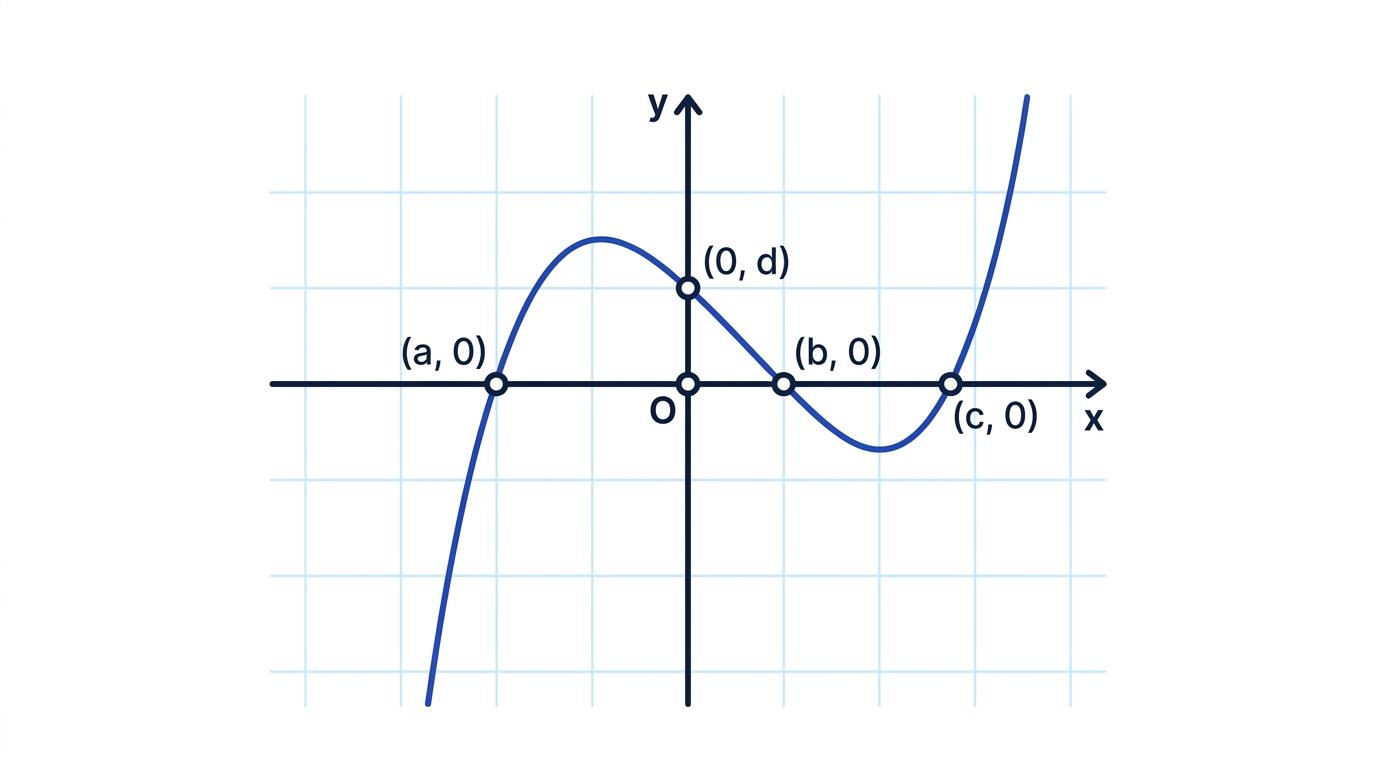
The graph below meets the xxx-axis at points of the form (a,0)(a,0)(a,0), (b,0)(b,0)(b,0) and (c,0)(c,0)(c,0). It meets the yyy-axis at a point of the form (0,d)(0,d)(0,d).
The two substitutions
- To find intersections with the xxx-axis, set y=0y=0y=0 and solve for xxx.
- To find intersections with the yyy-axis, set x=0x=0x=0 and solve for yyy.
Intersections with the y-axis
Suppose a curve is given in the form
y=f(x).y=f(x).y=f(x).On the yyy-axis, x=0x=0x=0. Substituting this into the equation gives
y=f(0).y=f(0).y=f(0).Therefore, provided f(0)f(0)f(0) is defined, the curve meets the yyy-axis at (0,f(0))(0,f(0))(0,f(0)).
For a polynomial, this is particularly quick: substituting x=0x=0x=0 removes every term containing xxx, leaving only the constant term.
Finding a y-axis intersection
Find where the curve
y=2x3−5x2+7x−4y=2x^3-5x^2+7x-4y=2x3−5x2+7x−4meets the yyy-axis.
-
A point on the yyy-axis has x=0x=0x=0, so substitute this into the equation:
y=2(0)3−5(0)2+7(0)−4.y=2(0)^3-5(0)^2+7(0)-4.y=2(0)3−5(0)2+7(0)−4. -
Simplifying gives the equation y=−4y=-4y=−4.
-
The intersection point therefore satisfies both x=0x=0x=0 and y=−4y=-4y=−4, so its coordinates are (0,−4)(0,-4)(0,−4).
Polynomial shortcut
For a polynomial written as y=f(x)y=f(x)y=f(x), the constant term is the yyy-coordinate of its intersection with the yyy-axis.
Intersections with the x-axis
On the xxx-axis, y=0y=0y=0. For a curve y=f(x)y=f(x)y=f(x), its xxx-axis intersections therefore satisfy
f(x)=0.f(x)=0.f(x)=0.The values of xxx that satisfy this equation are called the roots or zeros of the function.
Root of a function
A root of f(x)f(x)f(x) is a value of xxx for which f(x)=0f(x)=0f(x)=0. Each real root gives an intersection point with the xxx-axis.
Finding these intersections may require factorising, using the quadratic formula, completing the square, or applying another equation-solving technique.
Finding two x-axis intersections
Find where the curve
y=x2−5x+6y=x^2-5x+6y=x2−5x+6meets the xxx-axis.
-
Points on the xxx-axis have y=0y=0y=0, so solve
x2−5x+6=0.x^2-5x+6=0.x2−5x+6=0. -
Factorise the quadratic:
(x−2)(x−3)=0.(x-2)(x-3)=0.(x−2)(x−3)=0. -
A product is zero when at least one factor is zero, giving x=2x=2x=2 or x=3x=3x=3.
-
In each case the yyy-coordinate is zero, so the intersection points are (2,0)(2,0)(2,0) and (3,0)(3,0)(3,0).
Giving roots instead of points
The values x=2x=2x=2 and x=3x=3x=3 are the roots, but the intersection points are (2,0)(2,0)(2,0) and (3,0)(3,0)(3,0). Check whether the question asks for values of xxx or coordinates.
How many x-axis intersections are there?
A curve may have:
- no real intersections with the xxx-axis;
- one intersection;
- two or more intersections, depending on the type of function.
For a quadratic curve, the discriminant b2−4acb^2-4acb2−4ac determines the number of real roots of
ax2+bx+c=0.ax^2+bx+c=0.ax2+bx+c=0.- If b2−4ac>0b^2-4ac>0b2−4ac>0, there are two distinct xxx-axis intersections.
- If b2−4ac=0b^2-4ac=0b2−4ac=0, there is one repeated root and the curve touches the axis.
- If b2−4ac<0b^2-4ac<0b2−4ac<0, there are no real xxx-axis intersections.
Recognising a point of contact
Find the intersections of
y=x2−6x+9y=x^2-6x+9y=x2−6x+9with the coordinate axes.
-
For the xxx-axis, set y=0y=0y=0 and factorise:
x2−6x+9=(x−3)2=0.x^2-6x+9=(x-3)^2=0.x2−6x+9=(x−3)2=0. -
The only root is x=3x=3x=3. It is a repeated root, so the curve touches the xxx-axis at (3,0)(3,0)(3,0) rather than crossing it there.
-
For the yyy-axis, set x=0x=0x=0:
y=(0)2−6(0)+9=9.y=(0)^2-6(0)+9=9.y=(0)2−6(0)+9=9. -
The intersections are therefore (3,0)(3,0)(3,0) and (0,9)(0,9)(0,9).
Touching still counts
A curve does not need to cross an axis to intersect it. A point where the curve just touches the axis is still an intersection point.
Curves not written as y equals f of x
Some curves are given by an implicit equation, in which xxx and yyy appear together rather than with yyy isolated. For example,
x2+xy+y2=12.x^2+xy+y^2=12.x2+xy+y2=12.The same axis rules still apply: substitute y=0y=0y=0 for the xxx-axis and x=0x=0x=0 for the yyy-axis.
Intersections of an implicit curve
Find all intersections of
x2+xy+3y2=12x^2+xy+3y^2=12x2+xy+3y2=12with the coordinate axes.
-
On the xxx-axis, y=0y=0y=0, so the equation becomes
x2=12.x^2=12.x2=12.Hence x=±23x=\pm 2\sqrt{3}x=±23, giving the points (−23,0)(-2\sqrt{3},0)(−23,0) and (23,0)(2\sqrt{3},0)(23,0).
-
On the yyy-axis, x=0x=0x=0, so the equation becomes
3y2=12.3y^2=12.3y2=12.Therefore y2=4y^2=4y2=4, so y=±2y=\pm 2y=±2.
-
The complete set of axis intersections is
(−23,0),(23,0),(0,−2),(0,2).(-2\sqrt{3},0),\quad (2\sqrt{3},0),\quad (0,-2),\quad (0,2).(−23,0),(23,0),(0,−2),(0,2).
Losing a negative solution
When an equation simplifies to x2=kx^2=kx2=k with k>0k>0k>0, both x=kx=\sqrt{k}x=k and x=−kx=-\sqrt{k}x=−k must be considered. Missing the negative root loses an intersection.
Restrictions and undefined values
You must check that each proposed coordinate is allowed by the original equation. This matters especially for rational functions, square roots and logarithms.
For example, the function
y=x+1xy=\frac{x+1}{x}y=xx+1has no yyy-axis intersection because substituting x=0x=0x=0 would require division by zero. The graph is not defined on the yyy-axis.
Substitution may be invalid
Setting x=0x=0x=0 does not guarantee a yyy-axis intersection. If the original function is undefined at x=0x=0x=0, the graph cannot meet the yyy-axis.
Intersections at the origin
The origin is the point (0,0)(0,0)(0,0), where the two coordinate axes meet.
If a curve passes through the origin, that single point is an intersection with both axes. It should not be listed twice when you give the distinct intersection points.
For a function y=f(x)y=f(x)y=f(x), the graph passes through the origin exactly when
f(0)=0.f(0)=0.f(0)=0.In the exam
- Decide which axis is involved: use y=0y=0y=0 for the xxx-axis and x=0x=0x=0 for the yyy-axis.
- Solve the resulting equation completely, including negative, repeated or exact roots where appropriate.
- Return to the original equation to reject undefined values, then give coordinates rather than only roots when points are requested.
- Check your answers quickly: every xxx-axis point must have y=0y=0y=0, and every yyy-axis point must have x=0x=0x=0.
Check yourself
- Where does y=x2+x−6y=x^2+x-6y=x2+x−6 meet each coordinate axis?
- How many xxx-axis intersections does y=2x2+4x+5y=2x^2+4x+5y=2x2+4x+5 have?
- Why does y=3x−2y=\frac{3}{x-2}y=x−23 have no xxx-axis intersection?
