

What you'll learn
- How to interpret a modulus as a distance.
- How to solve inequalities of the forms ∣f(x)∣<a|f(x)|<a∣f(x)∣<a and ∣f(x)∣>a|f(x)|>a∣f(x)∣>a.
- How to handle inclusive inequalities, variable expressions on both sides and special cases.
- How graphs and number lines can help you check your solutions.
What does a modulus mean?
The modulus or absolute value of a real number is its distance from zero on a number line. It is written using vertical bars.
For example, both 4 and −4-4−4 are a distance of 4 from zero, so ∣4∣=4|4|=4∣4∣=4 and ∣−4∣=4|-4|=4∣−4∣=4.
The modulus function
For any real number xxx,
∣x∣={x,x≥0,−x,x<0.|x|= \begin{cases} x, & x\ge 0,\\ -x, & x<0. \end{cases}∣x∣={x,−x,x≥0,x<0.The output of a modulus is therefore always non-negative.
The expression ∣x−a∣|x-a|∣x−a∣ represents the distance between xxx and aaa. This distance interpretation is the key to understanding modulus inequalities.
Interpreting a modulus as a distance
Solve ∣x−5∣=2|x-5|=2∣x−5∣=2.
- The expression ∣x−5∣|x-5|∣x−5∣ is the distance between xxx and 5.
- A number at distance 2 from 5 could lie either to its left or to its right.
- Therefore x=5−2x=5-2x=5−2 or x=5+2x=5+2x=5+2, giving x=3x=3x=3 or x=7x=7x=7.
Less-than modulus inequalities
Consider an inequality of the form
∣x−a∣<b,|x-a|<b,∣x−a∣<b,where b>0b>0b>0.
It says that the distance between xxx and aaa is less than bbb. Therefore, xxx must lie between the two boundary values a−ba-ba−b and a+ba+ba+b.
The inside rule
If b>0b>0b>0, then
∣x−a∣<b⟺a−b<x<a+b.|x-a|<b \quad\Longleftrightarrow\quad a-b<x<a+b.∣x−a∣<b⟺a−b<x<a+b.Equivalently,
∣u∣<b⟺−b<u<b.|u|<b \quad\Longleftrightarrow\quad -b<u<b.∣u∣<b⟺−b<u<b.A less-than modulus inequality produces an interval inside two boundaries.
Solving a less-than inequality
Solve ∣2x−1∣<7|2x-1|<7∣2x−1∣<7.
-
Replace the modulus inequality with a double inequality:
−7<2x−1<7.-7<2x-1<7.−7<2x−1<7. -
Add 1 to all three parts:
−6<2x<8.-6<2x<8.−6<2x<8. -
Divide all three parts by 2:
−3<x<4.-3<x<4.−3<x<4.
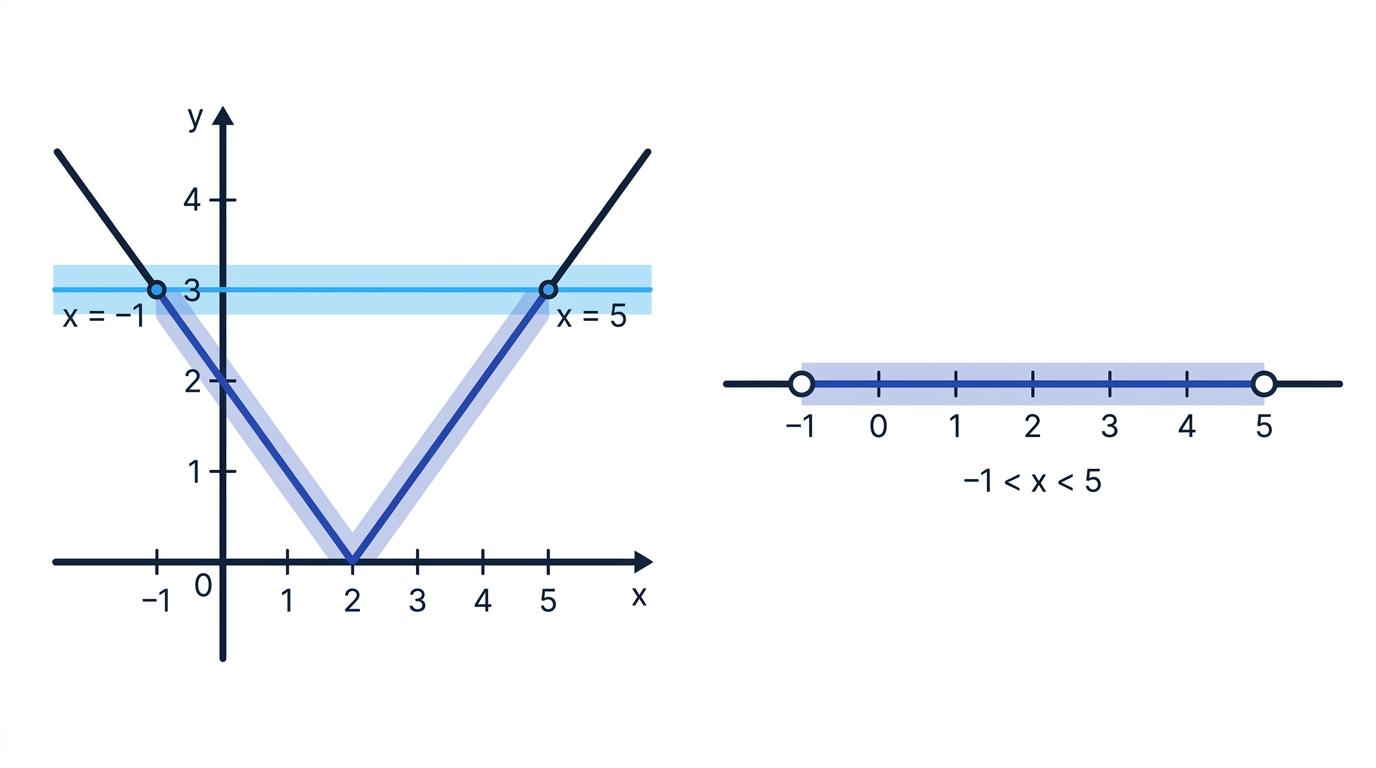
The inequality ∣x−2∣<3|x-2|<3∣x−2∣<3 can also be understood graphically. The graph of y=∣x−2∣y=|x-2|y=∣x−2∣ lies below y=3y=3y=3 between their two intersection points.
Greater-than modulus inequalities
Now consider
∣x−a∣>b,|x-a|>b,∣x−a∣>b,where b>0b>0b>0.
This says that the distance between xxx and aaa is greater than bbb. The solution lies outside the two boundary values.
The outside rule
If b>0b>0b>0, then
∣x−a∣>b⟺x<a−borx>a+b.|x-a|>b \quad\Longleftrightarrow\quad x<a-b \quad\text{or}\quad x>a+b.∣x−a∣>b⟺x<a−borx>a+b.Equivalently,
∣u∣>b⟺u<−boru>b.|u|>b \quad\Longleftrightarrow\quad u<-b \quad\text{or}\quad u>b.∣u∣>b⟺u<−boru>b.A greater-than modulus inequality usually produces two separate regions joined by or.
Solving a greater-than inequality
Solve ∣3x+2∣>8|3x+2|>8∣3x+2∣>8.
-
Split the inequality into its two possible cases:
3x+2<−8or3x+2>8.3x+2<-8 \quad\text{or}\quad 3x+2>8.3x+2<−8or3x+2>8. -
Solve the first inequality:
3x<−10⇒x<−103.3x<-10 \quad\Rightarrow\quad x<-\frac{10}{3}.3x<−10⇒x<−310. -
Solve the second inequality:
3x>6⇒x>2.3x>6 \quad\Rightarrow\quad x>2.3x>6⇒x>2. -
Combine the two regions:
x<−103orx>2.x<-\frac{10}{3} \quad\text{or}\quad x>2.x<−310orx>2.
Using and instead of or
For ∣u∣>b|u|>b∣u∣>b, the conditions are u<−bu<-bu<−b or u>bu>bu>b. They cannot both hold at once, so joining them with “and” would give no solutions.
Inclusive inequalities
The same rules apply when the inequality includes equality.
If b≥0b\ge 0b≥0, then
∣u∣≤b⟺−b≤u≤b,|u|\le b \quad\Longleftrightarrow\quad -b\le u\le b,∣u∣≤b⟺−b≤u≤b,and
∣u∣≥b⟺u≤−boru≥b.|u|\ge b \quad\Longleftrightarrow\quad u\le-b \quad\text{or}\quad u\ge b.∣u∣≥b⟺u≤−boru≥b.On a number line, use a closed circle when an endpoint is included by ≤\le≤ or ≥\ge≥. Use an open circle when it is excluded by <<< or >>>.
Including the boundary values
Solve ∣5−2x∣≤9|5-2x|\le 9∣5−2x∣≤9.
-
Write the equivalent double inequality:
−9≤5−2x≤9.-9\le 5-2x\le 9.−9≤5−2x≤9. -
Subtract 5 throughout:
−14≤−2x≤4.-14\le -2x\le 4.−14≤−2x≤4. -
Divide throughout by −2-2−2. Dividing an inequality by a negative number reverses both inequality signs:
7≥x≥−2.7\ge x\ge -2.7≥x≥−2. -
Put the bounds in increasing order:
−2≤x≤7.-2\le x\le 7.−2≤x≤7.
Forgetting to reverse inequality signs
When you multiply or divide an inequality by a negative quantity, reverse its direction. In a double inequality, both signs must be reversed.
When the other side contains a variable
You may meet an inequality such as
∣f(x)∣<g(x).|f(x)|<g(x).∣f(x)∣<g(x).The right-hand side needs careful attention because a modulus is always non-negative. In particular, ∣f(x)∣<g(x)|f(x)|<g(x)∣f(x)∣<g(x) can hold only where g(x)>0g(x)>0g(x)>0.
When g(x)>0g(x)>0g(x)>0, you can use
−g(x)<f(x)<g(x).-g(x)<f(x)<g(x).−g(x)<f(x)<g(x).Comparing a modulus with a variable expression
Solve ∣x−1∣<x+3|x-1|<x+3∣x−1∣<x+3.
-
Since ∣x−1∣≥0|x-1|\ge 0∣x−1∣≥0, the right-hand side must be positive:
x+3>0⇒x>−3.x+3>0 \quad\Rightarrow\quad x>-3.x+3>0⇒x>−3. -
Apply the inside rule:
−(x+3)<x−1<x+3.-(x+3)<x-1<x+3.−(x+3)<x−1<x+3. -
Solve the left-hand inequality:
−x−3<x−1⇒−2<2x⇒x>−1.-x-3<x-1 \quad\Rightarrow\quad -2<2x \quad\Rightarrow\quad x>-1.−x−3<x−1⇒−2<2x⇒x>−1. -
The right-hand inequality simplifies to −1<3-1<3−1<3, which is true for every xxx. Combining this with the restrictions gives
x>−1.x>-1.x>−1.
Check the sign of the right-hand side
You may use ∣f(x)∣<g(x)⟺−g(x)<f(x)<g(x)|f(x)|<g(x)\Longleftrightarrow-g(x)<f(x)<g(x)∣f(x)∣<g(x)⟺−g(x)<f(x)<g(x) only where g(x)>0g(x)>0g(x)>0. Ignoring this condition can introduce invalid solutions.
Squaring both sides
If both sides are known to be non-negative, squaring preserves their order. This gives
∣f(x)∣<g(x)⟺f(x)2<g(x)2,|f(x)|<g(x) \quad\Longleftrightarrow\quad f(x)^2<g(x)^2,∣f(x)∣<g(x)⟺f(x)2<g(x)2,provided g(x)>0g(x)>0g(x)>0.
This method can be useful when both sides contain expressions, although you must then solve the resulting polynomial inequality carefully.
Solving by squaring
Solve ∣x+1∣≤2x+1|x+1|\le 2x+1∣x+1∣≤2x+1.
-
The right-hand side must be non-negative:
2x+1≥0⇒x≥−12.2x+1\ge 0 \quad\Rightarrow\quad x\ge-\frac12.2x+1≥0⇒x≥−21. -
Under this restriction, square both sides:
(x+1)2≤(2x+1)2.(x+1)^2\le(2x+1)^2.(x+1)2≤(2x+1)2. -
Expand and collect terms:
x2+2x+1≤4x2+4x+1⇒0≤3x2+2x.x^2+2x+1\le4x^2+4x+1 \quad\Rightarrow\quad 0\le3x^2+2x.x2+2x+1≤4x2+4x+1⇒0≤3x2+2x. -
Factorise:
x(3x+2)≥0.x(3x+2)\ge0.x(3x+2)≥0.This gives x≤−23x\le-\frac23x≤−32 or x≥0x\ge0x≥0.
-
Intersect this with the earlier restriction x≥−12x\ge-\frac12x≥−21. The first region is removed, leaving
x≥0.x\ge0.x≥0.
Check with a test value
After finding an interval, substitute one value from inside it and one from outside it into the original inequality. This quickly detects reversed signs or an incorrect choice of region.
Special right-hand sides
Because ∣f(x)∣≥0|f(x)|\ge0∣f(x)∣≥0, comparisons with zero or a negative number can often be decided immediately.
- ∣f(x)∣<0|f(x)|<0∣f(x)∣<0 has no solutions.
- ∣f(x)∣≤0|f(x)|\le0∣f(x)∣≤0 means f(x)=0f(x)=0f(x)=0.
- ∣f(x)∣>0|f(x)|>0∣f(x)∣>0 means f(x)≠0f(x)\neq0f(x)=0.
- ∣f(x)∣≥0|f(x)|\ge0∣f(x)∣≥0 is true for every value where f(x)f(x)f(x) is defined.
- If c<0c<0c<0, then ∣f(x)∣>c|f(x)|>c∣f(x)∣>c is always true, while ∣f(x)∣<c|f(x)|<c∣f(x)∣<c is impossible.
These observations can save considerable algebra.
Using graphs
To solve ∣f(x)∣<g(x)|f(x)|<g(x)∣f(x)∣<g(x) graphically, sketch or plot y=∣f(x)∣y=|f(x)|y=∣f(x)∣ and y=g(x)y=g(x)y=g(x). The solution consists of the xxx-values where the modulus graph lies below the other graph.
For ∣f(x)∣>g(x)|f(x)|>g(x)∣f(x)∣>g(x), select the regions where the modulus graph lies above. Intersection points give the boundary values, and the original inequality tells you whether those boundaries are included.
In the exam
- Identify whether the solution should be inside an interval for <<< or ≤\le≤, or outside for >>> or ≥\ge≥.
- If the right-hand side is not a positive constant, check its sign before removing the modulus or squaring.
- Solve every resulting inequality carefully, reversing signs when multiplying or dividing by a negative quantity.
- State separate regions using or, and include endpoints only when the original inequality includes equality.
- Test a value in each proposed region in the original inequality.
Check yourself
- Can you solve ∣4x−3∣<5|4x-3|<5∣4x−3∣<5 and show the answer on a number line?
- How does the solution of ∣x+2∣≥6|x+2|\ge6∣x+2∣≥6 differ from that of ∣x+2∣≤6|x+2|\le6∣x+2∣≤6?
- Why must you check the sign of x+4x+4x+4 before rewriting ∣2x−1∣<x+4|2x-1|<x+4∣2x−1∣<x+4?
