

What you'll learn
- How to use the symbols ≡\equiv≡, ⇒\Rightarrow⇒ and ⇔\Leftrightarrow⇔ correctly.
- How to distinguish an identity from an equation.
- How to identify the direction of an implication and write its converse.
- How to prove an “if and only if” statement by establishing both directions.
Starting point: mathematical statements
A statement is a mathematical sentence that is either true or false. It is common to use letters such as PPP and QQQ to represent statements.
For example:
- PPP: “The integer nnn is divisible by 4.”
- QQQ: “The integer nnn is even.”
A logical connective is a symbol or phrase that describes the logical relationship between statements or expressions.
The three connectives in this topic have different meanings:
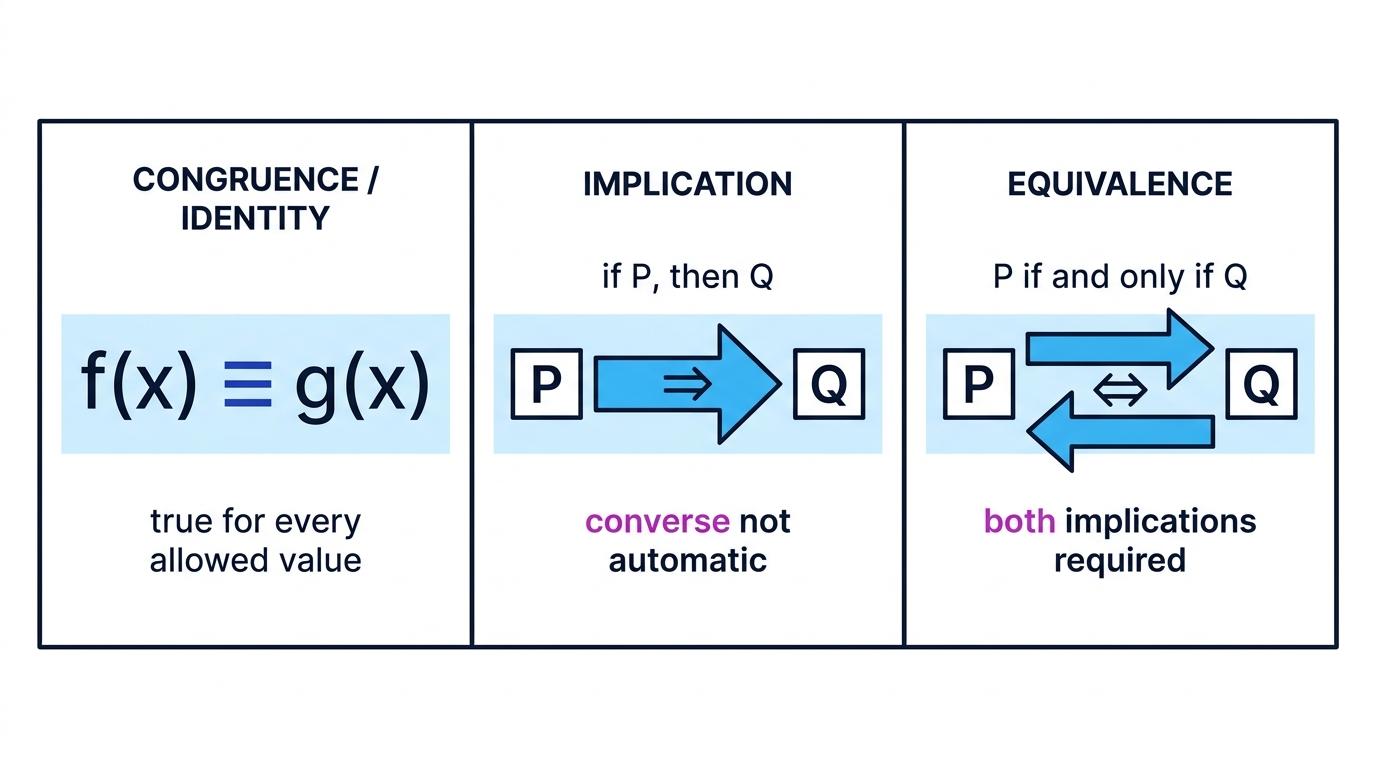
Congruence and identity: ≡\equiv≡
The symbol ≡\equiv≡ is read as “is identically equal to” or, in this context, “is congruent to”.
Identity
An identity is an equality that is true for every allowed value of the variable. The symbol ≡\equiv≡ can be used to show that two expressions are identically equal.
For example,
(x+1)2≡x2+2x+1.(x+1)^2 \equiv x^2+2x+1.(x+1)2≡x2+2x+1.This is true for every real value of xxx, so it is an identity.
By contrast,
(x+1)2=9(x+1)^2=9(x+1)2=9is an equation. It is true only for particular values of xxx, namely x=2x=2x=2 and x=−4x=-4x=−4.
Identity or equation?
Use ≡\equiv≡ when two expressions have the same value for every allowed value of their variables. Use === when asserting equality, including when solving for particular values.
Establishing an identity
To show that two expressions are identically equal, you can transform one side using valid algebra until it matches the other side.
Verifying an algebraic identity
Show that
(x+2)2−(x−2)2≡8x.(x+2)^2-(x-2)^2 \equiv 8x.(x+2)2−(x−2)2≡8x.-
Expand both squared brackets:
(x+2)2=x2+4x+4(x+2)^2=x^2+4x+4(x+2)2=x2+4x+4and
(x−2)2=x2−4x+4.(x-2)^2=x^2-4x+4.(x−2)2=x2−4x+4. -
Substitute these expansions into the left-hand side:
(x+2)2−(x−2)2≡(x2+4x+4)−(x2−4x+4).(x+2)^2-(x-2)^2 \equiv (x^2+4x+4)-(x^2-4x+4).(x+2)2−(x−2)2≡(x2+4x+4)−(x2−4x+4). -
Remove the second bracket carefully and collect like terms:
(x2+4x+4)−(x2−4x+4)≡x2+4x+4−x2+4x−4≡8x.\begin{aligned} (x^2+4x+4)-(x^2-4x+4) &\equiv x^2+4x+4-x^2+4x-4\\ &\equiv 8x. \end{aligned}(x2+4x+4)−(x2−4x+4)≡x2+4x+4−x2+4x−4≡8x.Therefore, the identity is established.
Testing only a few values
Checking an equality for one or two values does not prove an identity. An identity must hold for every allowed value, so you need a general algebraic argument.
Implication: ⇒\Rightarrow⇒
The symbol ⇒\Rightarrow⇒ is read as “implies”.
Implication
The statement P⇒QP\Rightarrow QP⇒Q means “if PPP, then QQQ”. Whenever PPP is true, QQQ must also be true.
The statement PPP is called the hypothesis or condition, and QQQ is called the conclusion.
For example,
n is divisible by 4⇒n is even.n\text{ is divisible by }4\Rightarrow n\text{ is even}.n is divisible by 4⇒n is even.This is true because every integer divisible by 4 can be written as n=4k=2(2k)n=4k=2(2k)n=4k=2(2k) for some integer kkk, so it is also divisible by 2.
Direction matters
An implication works in one stated direction. If P⇒QP\Rightarrow QP⇒Q is true, you cannot automatically assume that Q⇒PQ\Rightarrow PQ⇒P is true.
The reversed statement Q⇒PQ\Rightarrow PQ⇒P is called the converse of the original implication.
Testing the converse of an implication
Consider the implication:
n is divisible by 4⇒n is even.n\text{ is divisible by }4\Rightarrow n\text{ is even}.n is divisible by 4⇒n is even.-
Reverse the two statements to form the converse:
n is even⇒n is divisible by 4.n\text{ is even}\Rightarrow n\text{ is divisible by }4.n is even⇒n is divisible by 4. -
Test the converse using an even integer such as 6. The number 6 is even because it is divisible by 2.
-
However, 6 is not divisible by 4. This counterexample shows that the converse is false, even though the original implication is true.
A counterexample is a single example that shows a general statement is false.
Assuming the converse
From P⇒QP\Rightarrow QP⇒Q, you may conclude QQQ when you know PPP. You may not reverse the arrow unless you have separately shown that Q⇒PQ\Rightarrow PQ⇒P.
Necessary and sufficient conditions
Implications can also be described using the words necessary and sufficient.
If P⇒QP\Rightarrow QP⇒Q, then:
- PPP is a sufficient condition for QQQ: knowing PPP is enough to guarantee QQQ.
- QQQ is a necessary condition for PPP: PPP cannot be true unless QQQ is also true.
For example, being divisible by 4 is sufficient for an integer to be even. Being even is necessary for an integer to be divisible by 4.
Translating “if” and “only if”
- “PPP if QQQ” means Q⇒PQ\Rightarrow PQ⇒P.
- “PPP only if QQQ” means P⇒QP\Rightarrow QP⇒Q.
The condition following if points towards the result; the condition following only if is necessary.
Equivalence: ⇔\Leftrightarrow⇔
The symbol ⇔\Leftrightarrow⇔ is read as “if and only if”, often shortened to “iff”.
Logical equivalence
The statement P⇔QP\Leftrightarrow QP⇔Q means that both P⇒QP\Rightarrow QP⇒Q and Q⇒PQ\Rightarrow PQ⇒P are true. Each statement is both necessary and sufficient for the other.
You can think of ⇔\Leftrightarrow⇔ as a two-way implication:
P⇔QmeansP⇒Q and Q⇒P.P\Leftrightarrow Q \quad\text{means}\quad P\Rightarrow Q\text{ and }Q\Rightarrow P.P⇔QmeansP⇒Q and Q⇒P.For example, for an integer nnn,
n is even⇔n2 is even.n\text{ is even}\Leftrightarrow n^2\text{ is even}.n is even⇔n2 is even.To prove this fully, you must prove both directions.
Proving an if and only if statement
Prove that, for an integer nnn,
n is even⇔n2 is even.n\text{ is even}\Leftrightarrow n^2\text{ is even}.n is even⇔n2 is even.-
Prove the forward implication. If nnn is even, then n=2kn=2kn=2k for some integer kkk. Therefore,
n2=(2k)2=4k2=2(2k2),n^2=(2k)^2=4k^2=2(2k^2),n2=(2k)2=4k2=2(2k2),so n2n^2n2 is even.
-
Prove the reverse implication. Suppose n2n^2n2 is even. If nnn were odd, then n=2k+1n=2k+1n=2k+1 for some integer kkk, giving
n2=(2k+1)2=2(2k2+2k)+1,n^2=(2k+1)^2=2(2k^2+2k)+1,n2=(2k+1)2=2(2k2+2k)+1,which would be odd.
-
This contradicts the assumption that n2n^2n2 is even, so nnn must be even. Both implications are true, and hence
n is even⇔n2 is even.n\text{ is even}\Leftrightarrow n^2\text{ is even}.n is even⇔n2 is even.
Two directions are required
To prove P⇔QP\Leftrightarrow QP⇔Q, prove P⇒QP\Rightarrow QP⇒Q and then prove Q⇒PQ\Rightarrow PQ⇒P. Proving only one direction establishes an implication, not an equivalence.
Using connectives in algebra
Logical symbols are useful when presenting chains of reasoning. However, the symbol you choose must accurately describe the relationship between consecutive lines.
Consider solving x2=16x^2=16x2=16 over the real numbers:
x2=16⇔x2−16=0⇔(x−4)(x+4)=0⇔x=4 or x=−4.\begin{aligned} x^2=16 &\Leftrightarrow x^2-16=0\\ &\Leftrightarrow (x-4)(x+4)=0\\ &\Leftrightarrow x=4\text{ or }x=-4. \end{aligned}x2=16⇔x2−16=0⇔(x−4)(x+4)=0⇔x=4 or x=−4.Each line is equivalent to the previous line, so the double implication is appropriate.
By contrast,
x=4⇒x2=16x=4\Rightarrow x^2=16x=4⇒x2=16is true, but
x2=16⇒x=4x^2=16\Rightarrow x=4x2=16⇒x=4is false because x=−4x=-4x=−4 is another possibility. Therefore, x=4⇔x2=16x=4\Leftrightarrow x^2=16x=4⇔x2=16 would be incorrect.
Losing solutions in an equivalence chain
A step is not reversible if it removes possible solutions. For example, replacing x2=16x^2=16x2=16 with x=4x=4x=4 loses the solution x=−4x=-4x=−4, so those statements are not equivalent.
In the exam
- Decide whether the relationship is an identity, a one-way consequence or a two-way equivalence before choosing ≡\equiv≡, ⇒\Rightarrow⇒ or ⇔\Leftrightarrow⇔.
- When asked to prove an “if and only if” statement, clearly establish both implications, preferably in separate parts.
- Test a suspected converse with simple values; one valid counterexample is enough to disprove a universal claim.
- Check that every ⇔\Leftrightarrow⇔ step in algebra can be reversed without introducing or losing solutions.
Check yourself
- What is the difference between (x+1)2≡x2+2x+1(x+1)^2\equiv x^2+2x+1(x+1)2≡x2+2x+1 and (x+1)2=9(x+1)^2=9(x+1)2=9?
- If P⇒QP\Rightarrow QP⇒Q, what is the converse, and must it be true?
- What two separate implications must you prove to establish P⇔QP\Leftrightarrow QP⇔Q?
