

What you'll learn
- How rectangles can approximate the area under a graph.
- How sigma notation represents a sum of rectangle areas.
- Why taking a limit turns an approximation into a definite integral.
- How to evaluate and recognise integrals written as limits of sums.
Prerequisites
Before starting, you should be comfortable with:
- definite integrals such as ∫abf(x) dx\int_a^b f(x)\,dx∫abf(x)dx;
- the area of a rectangle: width multiplied by height;
- sequences and limits, including the meaning of n→∞n\to\inftyn→∞;
- sigma notation, written using ∑\sum∑.
Sigma notation
The Greek capital letter sigma, ∑\sum∑, means “add together”.
For example,
∑r=1nr2=12+22+32+⋯+n2.\sum_{r=1}^{n} r^2=1^2+2^2+3^2+\cdots+n^2.r=1∑nr2=12+22+32+⋯+n2.Here:
- rrr is the index: it changes as the terms are added;
- r=1r=1r=1 is the starting value;
- nnn is the finishing value;
- r2r^2r2 gives the form of each term.
A useful standard result is
∑r=1nr2=n(n+1)(2n+1)6.\sum_{r=1}^{n}r^2=\frac{n(n+1)(2n+1)}{6}.r=1∑nr2=6n(n+1)(2n+1).You may need this when evaluating a limit of a sum.
Expanding sigma notation
Write out the first four terms of
∑r=14(2r+1).\sum_{r=1}^{4}\left(2r+1\right).r=1∑4(2r+1).-
Substitute r=1,2,3,4r=1,2,3,4r=1,2,3,4 into the expression 2r+12r+12r+1:
3, 5, 7, 9.3,\ 5,\ 7,\ 9.3, 5, 7, 9. -
Add the terms:
∑r=14(2r+1)=3+5+7+9=24.\sum_{r=1}^{4}\left(2r+1\right)=3+5+7+9=24.r=1∑4(2r+1)=3+5+7+9=24.
Approximating an area with rectangles
Suppose y=f(x)y=f(x)y=f(x) is above the horizontal axis between x=ax=ax=a and x=bx=bx=b. We want the area between the curve, the horizontal axis, and the lines x=ax=ax=a and x=bx=bx=b.
Divide the interval [a,b][a,b][a,b] into nnn strips of equal width.
The total interval has width b−ab-ab−a, so each strip has width
Δx=b−an.\Delta x=\frac{b-a}{n}.Δx=nb−a.The symbol Δx\Delta xΔx means a change, or small increment, in xxx.
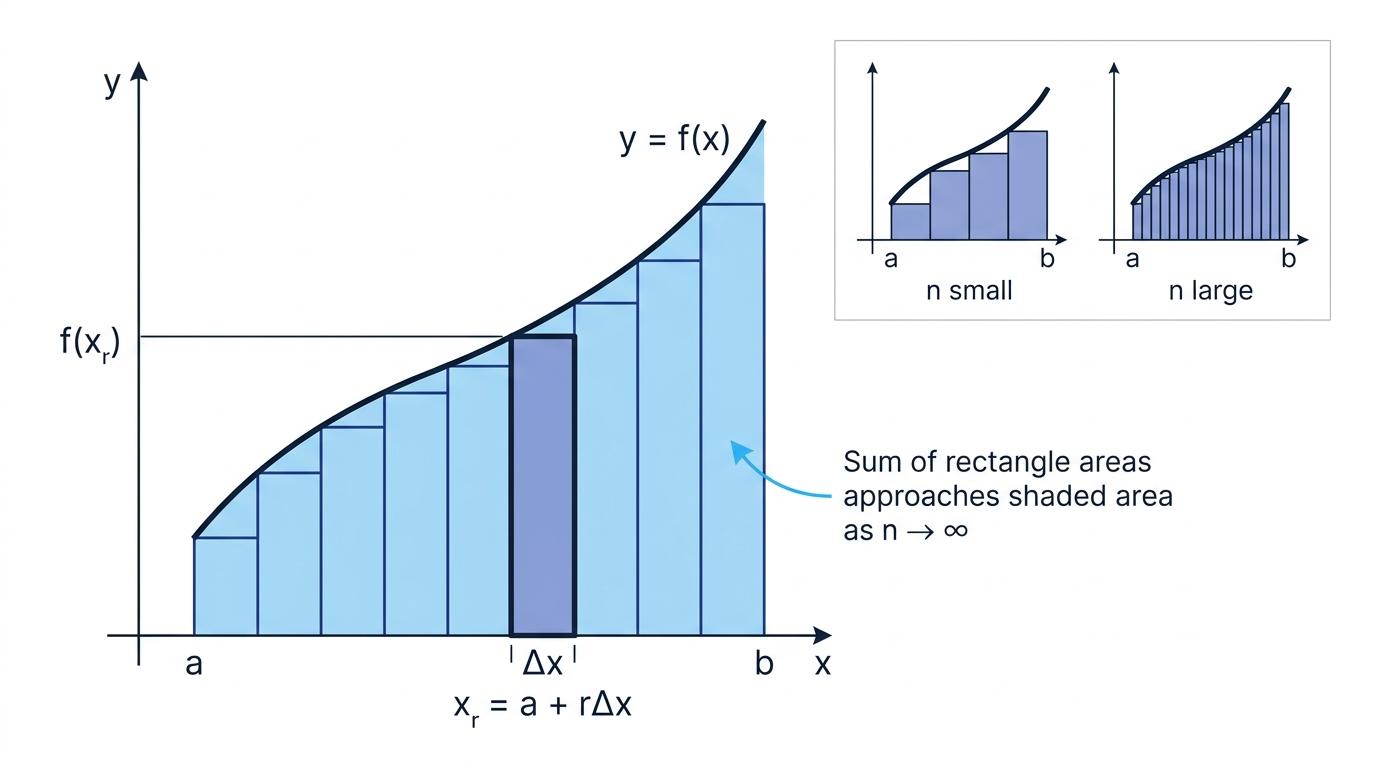
If we use the right-hand endpoint of each strip to choose its rectangle height, the right-hand endpoint of strip rrr is
xr=a+rΔx=a+r(b−a)n.x_r=a+r\Delta x =a+\frac{r(b-a)}{n}.xr=a+rΔx=a+nr(b−a).The rectangle therefore has:
- width Δx\Delta xΔx;
- height f(xr)f(x_r)f(xr);
- area f(xr)Δxf(x_r)\Delta xf(xr)Δx.
Adding the areas of all nnn rectangles gives
∑r=1nf(xr)Δx.\sum_{r=1}^{n}f(x_r)\Delta x.r=1∑nf(xr)Δx.Riemann sum
A Riemann sum is a sum of rectangle areas used to approximate the area under a curve. A right-endpoint Riemann sum is
∑r=1nf(a+r(b−a)n)b−an.\sum_{r=1}^{n}f\left(a+\frac{r(b-a)}{n}\right)\frac{b-a}{n}.r=1∑nf(a+nr(b−a))nb−a.Forming a rectangle sum
Form a right-endpoint rectangle sum for the area under y=x2y=x^2y=x2 between x=0x=0x=0 and x=2x=2x=2, using nnn equal strips.
-
The strip width is
Δx=2−0n=2n.\Delta x=\frac{2-0}{n}=\frac{2}{n}.Δx=n2−0=n2. -
The right-hand endpoint of strip rrr is
xr=0+rΔx=2rn.x_r=0+r\Delta x=\frac{2r}{n}.xr=0+rΔx=n2r.Its height is therefore
f(xr)=(2rn)2.f(x_r)=\left(\frac{2r}{n}\right)^2.f(xr)=(n2r)2. -
Multiply each height by the strip width and sum:
∑r=1n(2rn)22n=8n3∑r=1nr2.\sum_{r=1}^{n} \left(\frac{2r}{n}\right)^2\frac{2}{n} = \frac{8}{n^3}\sum_{r=1}^{n}r^2.r=1∑n(n2r)2n2=n38r=1∑nr2.
Taking the limit
With only a few rectangles, there are visible gaps or overlaps between the rectangles and the curve. As nnn increases:
- the number of rectangles increases;
- each width Δx\Delta xΔx decreases;
- the sum of their areas becomes a better approximation.
As n→∞n\to\inftyn→∞, the rectangle widths approach zero. The limit of the rectangle sum gives the exact definite integral.
Integration as a limit of a sum
For a continuous function fff,
∫abf(x) dx=limn→∞∑r=1nf(a+r(b−a)n)b−an.\int_a^b f(x)\,dx = \lim_{n\to\infty} \sum_{r=1}^{n} f\left(a+\frac{r(b-a)}{n}\right) \frac{b-a}{n}.∫abf(x)dx=n→∞limr=1∑nf(a+nr(b−a))nb−a.The definite integral is therefore the limit of a sum of rectangle areas.
The symbol dxdxdx can be connected to the rectangle width Δx\Delta xΔx. In the limiting process, Δx\Delta xΔx tends to zero, and the sum notation becomes integral notation:
∑f(xr)Δx⟶∫abf(x) dx.\sum f(x_r)\Delta x \quad\longrightarrow\quad \int_a^b f(x)\,dx.∑f(xr)Δx⟶∫abf(x)dx.Forgetting the rectangle width
The expression ∑f(xr)\sum f(x_r)∑f(xr) adds rectangle heights, not rectangle areas. Every term must be multiplied by the strip width Δx\Delta xΔx.
Evaluating an integral from first principles
Returning to the area under y=x2y=x^2y=x2 from x=0x=0x=0 to x=2x=2x=2, we found the rectangle sum
8n3∑r=1nr2.\frac{8}{n^3}\sum_{r=1}^{n}r^2.n38r=1∑nr2.Taking its limit gives the integral.
Finding an area from a limiting sum
Evaluate ∫02x2 dx\int_0^2x^2\,dx∫02x2dx by taking the limit of the rectangle sum.
-
Write the integral as the limit obtained from the rectangles:
∫02x2 dx=limn→∞8n3∑r=1nr2.\int_0^2x^2\,dx = \lim_{n\to\infty} \frac{8}{n^3}\sum_{r=1}^{n}r^2.∫02x2dx=n→∞limn38r=1∑nr2. -
Substitute the standard formula for the sum of squares:
∫02x2 dx=limn→∞8n3⋅n(n+1)(2n+1)6=limn→∞4n(n+1)(2n+1)3n3.\begin{aligned} \int_0^2x^2\,dx &= \lim_{n\to\infty} \frac{8}{n^3} \cdot \frac{n(n+1)(2n+1)}{6}\\ &= \lim_{n\to\infty} \frac{4n(n+1)(2n+1)}{3n^3}. \end{aligned}∫02x2dx=n→∞limn38⋅6n(n+1)(2n+1)=n→∞lim3n34n(n+1)(2n+1). -
Divide the numerator and denominator by n3n^3n3:
4n(n+1)(2n+1)3n3=43(1+1n)(2+1n).\frac{4n(n+1)(2n+1)}{3n^3} = \frac{4}{3} \left(1+\frac{1}{n}\right) \left(2+\frac{1}{n}\right).3n34n(n+1)(2n+1)=34(1+n1)(2+n1). -
As n→∞n\to\inftyn→∞, both 1n\frac{1}{n}n1 terms approach zero:
∫02x2 dx=43(1)(2)=83.\int_0^2x^2\,dx = \frac{4}{3}(1)(2) = \frac{8}{3}.∫02x2dx=34(1)(2)=38.
This agrees with ordinary integration:
∫02x2 dx=[x33]02=83.\int_0^2x^2\,dx = \left[\frac{x^3}{3}\right]_0^2 = \frac{8}{3}.∫02x2dx=[3x3]02=38.Recognising a limit as an integral
You may also be given a limit of a sum and asked to express it as a definite integral.
The key form to recognise is
limn→∞b−an∑r=1nf(a+r(b−a)n)=∫abf(x) dx.\lim_{n\to\infty} \frac{b-a}{n} \sum_{r=1}^{n} f\left(a+\frac{r(b-a)}{n}\right) = \int_a^b f(x)\,dx.n→∞limnb−ar=1∑nf(a+nr(b−a))=∫abf(x)dx.For the special interval [0,1][0,1][0,1], the strip width is 1n\frac{1}{n}n1 and the right-hand endpoint is rn\frac{r}{n}nr. Therefore,
limn→∞1n∑r=1nf(rn)=∫01f(x) dx.\lim_{n\to\infty} \frac{1}{n} \sum_{r=1}^{n} f\left(\frac{r}{n}\right) = \int_0^1f(x)\,dx.n→∞limn1r=1∑nf(nr)=∫01f(x)dx.Converting a limit into an integral
Express the following limit as an integral, and hence evaluate it:
limn→∞1n∑r=1n(1+rn)3.\lim_{n\to\infty} \frac{1}{n} \sum_{r=1}^{n} \left(1+\frac{r}{n}\right)^3.n→∞limn1r=1∑n(1+nr)3.-
Compare the sum with
1n∑r=1nf(rn).\frac{1}{n}\sum_{r=1}^{n}f\left(\frac{r}{n}\right).n1r=1∑nf(nr).Here, f(x)=(1+x)3f(x)=(1+x)^3f(x)=(1+x)3 and the interval is [0,1][0,1][0,1].
-
Replace the limiting sum with the corresponding integral:
limn→∞1n∑r=1n(1+rn)3=∫01(1+x)3 dx.\lim_{n\to\infty} \frac{1}{n} \sum_{r=1}^{n} \left(1+\frac{r}{n}\right)^3 = \int_0^1(1+x)^3\,dx.n→∞limn1r=1∑n(1+nr)3=∫01(1+x)3dx. -
Integrate and apply the limits:
∫01(1+x)3 dx=[(1+x)44]01=244−144=154.\begin{aligned} \int_0^1(1+x)^3\,dx &= \left[\frac{(1+x)^4}{4}\right]_0^1\\ &= \frac{2^4}{4}-\frac{1^4}{4}\\ &= \frac{15}{4}. \end{aligned}∫01(1+x)3dx=[4(1+x)4]01=424−414=415.
Matching the pieces
First identify the factor outside the sum as Δx\Delta xΔx. Then identify the sampled value of xxx inside the function. Together, these reveal the interval and the integrand.
Signed area
A definite integral represents signed area. Regions above the horizontal axis contribute positively, while regions below it contribute negatively.
This also follows from rectangle sums: if f(xr)<0f(x_r)<0f(xr)<0, then the rectangle’s signed height and hence its contribution f(xr)Δxf(x_r)\Delta xf(xr)Δx are negative.
Therefore, the limit-of-a-sum definition still works when the graph crosses or lies below the horizontal axis, but the result may not equal the total geometrical area.
Assuming every integral is positive
The limit of a rectangle sum gives a signed integral. To find total geometrical area, split the interval at any roots and make the area of each region positive.
In the exam
- Identify the strip width Δx=b−an\Delta x=\frac{b-a}{n}Δx=nb−a before finding any rectangle heights.
- Write the sampled point carefully, usually xr=a+rΔxx_r=a+r\Delta xxr=a+rΔx for right endpoints.
- Check that each summand has the form “height multiplied by width”.
- When recognising a limiting sum, match Δx\Delta xΔx, the interval and the function before integrating.
- Keep the limit notation until you have simplified to an expression whose limit you can evaluate.
Check yourself
- How would you form a right-endpoint rectangle sum for the area under y=xy=\sqrt{x}y=x from x=1x=1x=1 to x=5x=5x=5?
- Which definite integral is represented by limn→∞2n∑r=1n(2rn)4\displaystyle \lim_{n\to\infty}\frac{2}{n}\sum_{r=1}^{n}\left(\frac{2r}{n}\right)^4n→∞limn2r=1∑n(n2r)4?
- Why does increasing nnn make a rectangle sum a better approximation to the area under a continuous curve?
