

What you'll learn
- How to recognise and prove that a sequence is increasing or decreasing.
- How the difference un+1−unu_{n+1}-u_nun+1−un determines the behaviour of consecutive terms.
- How to identify periodic sequences and find their least period.
- How to work with sequences whose behaviour depends on their starting value.
Sequence notation
A sequence is an ordered list of terms. We usually write it as
u1, u2, u3, …u_1,\ u_2,\ u_3,\ \ldotsu1, u2, u3, …Here, unu_nun is the term in position nnn, and un+1u_{n+1}un+1 is the term immediately after it.
A sequence may be defined:
- explicitly, by giving unu_nun directly in terms of nnn;
- recursively, by giving each term in terms of one or more earlier terms.
For example, un=n2+1u_n=n^2+1un=n2+1 is explicit, while un+1=un+3u_{n+1}=u_n+3un+1=un+3 with u1=2u_1=2u1=2 is recursive.
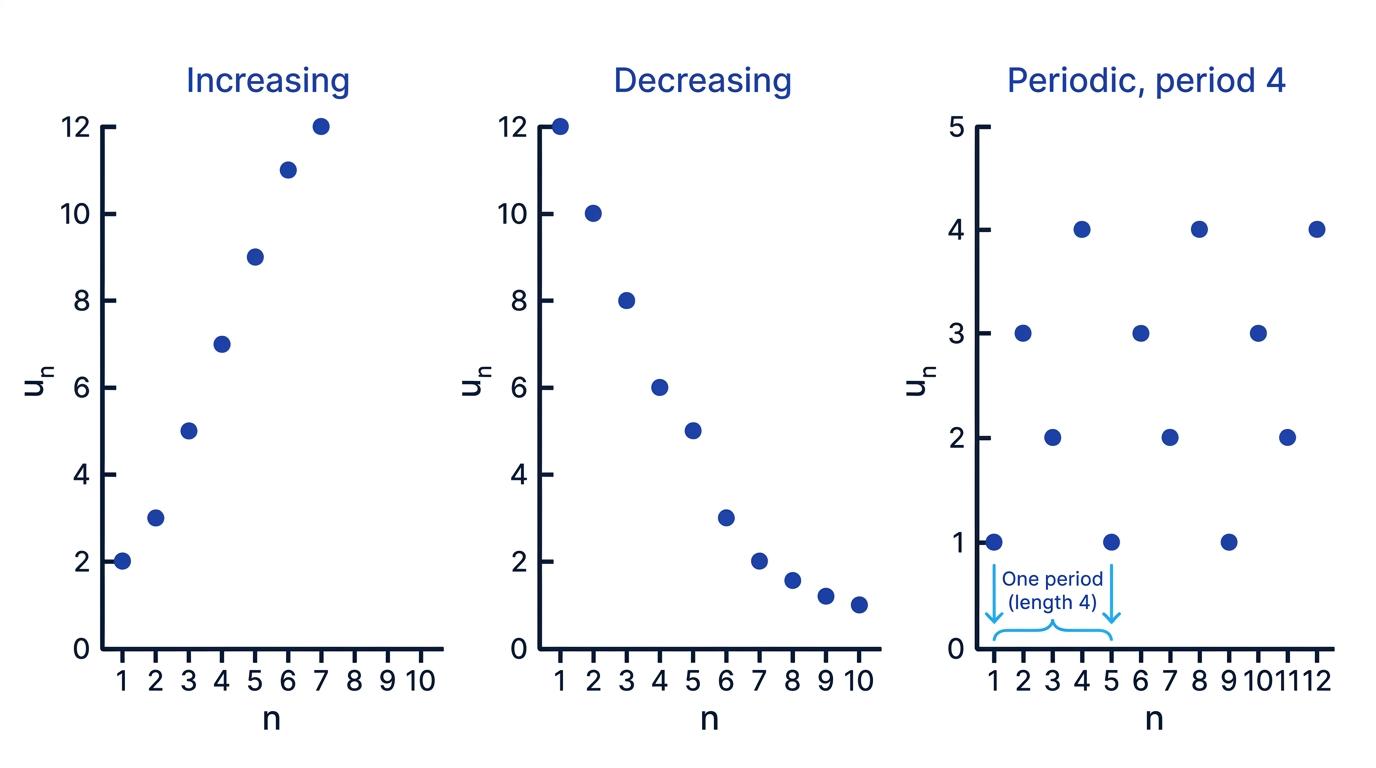
Notice that a sequence is defined only at positive integer values of nnn. Its graph therefore consists of separate points, not a continuous curve.
Increasing sequences
Increasing sequence
A sequence is increasing if every term is greater than the term before it:
un+1>unu_{n+1}>u_nun+1>unfor every relevant positive integer nnn.
To investigate whether a sequence is increasing, subtract one term from the next:
un+1−un.u_{n+1}-u_n.un+1−un.If this difference is positive for every relevant nnn, then un+1>unu_{n+1}>u_nun+1>un, so the sequence is increasing.
Test consecutive terms
To prove that a sequence is increasing, show that
un+1−un>0u_{n+1}-u_n>0un+1−un>0for every positive integer nnn in its domain.
Proving that a quadratic sequence is increasing
The sequence is defined by un=n2+2nu_n=n^2+2nun=n2+2n. Show that it is increasing for n≥1n\geq1n≥1.
-
Find the next term by replacing nnn with n+1n+1n+1:
un+1=(n+1)2+2(n+1)=n2+4n+3.\begin{aligned} u_{n+1} &=(n+1)^2+2(n+1)\\ &=n^2+4n+3. \end{aligned}un+1=(n+1)2+2(n+1)=n2+4n+3. -
Subtract the original term:
un+1−un=(n2+4n+3)−(n2+2n)=2n+3.\begin{aligned} u_{n+1}-u_n &=(n^2+4n+3)-(n^2+2n)\\ &=2n+3. \end{aligned}un+1−un=(n2+4n+3)−(n2+2n)=2n+3. -
Since n≥1n\geq1n≥1, we have 2n+3>02n+3>02n+3>0. Therefore un+1>unu_{n+1}>u_nun+1>un for every positive integer nnn, so the sequence is increasing.
Checking only the first few terms
Calculating several increasing terms suggests a pattern, but it does not prove that the sequence continues to increase. Use an inequality valid for every relevant nnn.
Decreasing sequences
Decreasing sequence
A sequence is decreasing if every term is less than the term before it:
un+1<unu_{n+1}<u_nun+1<unfor every relevant positive integer nnn.
The same consecutive-term test applies. If
un+1−un<0,u_{n+1}-u_n<0,un+1−un<0,then the sequence is decreasing.
Proving that a reciprocal sequence is decreasing
Show that the sequence defined by
un=1n+2u_n=\frac{1}{n+2}un=n+21is decreasing for n≥1n\geq1n≥1.
-
Write the next term:
un+1=1n+3.u_{n+1}=\frac{1}{n+3}.un+1=n+31. -
Find the difference using a common denominator:
un+1−un=1n+3−1n+2=n+2−(n+3)(n+3)(n+2)=−1(n+3)(n+2).\begin{aligned} u_{n+1}-u_n &=\frac{1}{n+3}-\frac{1}{n+2}\\ &=\frac{n+2-(n+3)}{(n+3)(n+2)}\\ &=-\frac{1}{(n+3)(n+2)}. \end{aligned}un+1−un=n+31−n+21=(n+3)(n+2)n+2−(n+3)=−(n+3)(n+2)1. -
For n≥1n\geq1n≥1, both n+2n+2n+2 and n+3n+3n+3 are positive. The denominator is therefore positive, so
−1(n+3)(n+2)<0.-\frac{1}{(n+3)(n+2)}<0.−(n+3)(n+2)1<0.Hence un+1<unu_{n+1}<u_nun+1<un, and the sequence is decreasing.
Choose a useful form
For an explicitly defined sequence, un+1−unu_{n+1}-u_nun+1−un is usually the clearest test. For a recurrence, you may already have an expression for un+1−unu_{n+1}-u_nun+1−un after rearranging its defining rule.
Strict and non-strict behaviour
The definitions above use strict inequalities. This means consecutive equal terms are not allowed.
Some questions or textbooks also use the following terms:
- non-decreasing means un+1≥unu_{n+1}\geq u_nun+1≥un;
- non-increasing means un+1≤unu_{n+1}\leq u_nun+1≤un.
A constant sequence is both non-decreasing and non-increasing, but it is neither strictly increasing nor strictly decreasing.
Check the inequality convention
If a question defines “increasing” using ≥\geq≥ rather than >>>, follow the definition given in that question. Otherwise, distinguish carefully between increasing and non-decreasing.
When the behaviour depends on the term number
A sequence might increase for some values of nnn and decrease for others. In that case, solve the appropriate inequality to locate the change.
Finding where a sequence begins to increase
Let un=n2−10nu_n=n^2-10nun=n2−10n. Determine when the sequence is increasing.
-
Calculate the difference between consecutive terms:
un+1−un=((n+1)2−10(n+1))−(n2−10n)=2n−9.\begin{aligned} u_{n+1}-u_n &=\left((n+1)^2-10(n+1)\right)-(n^2-10n)\\ &=2n-9. \end{aligned}un+1−un=((n+1)2−10(n+1))−(n2−10n)=2n−9. -
For the sequence to increase from unu_nun to un+1u_{n+1}un+1, require
2n−9>0,2n-9>0,2n−9>0,which gives n>92n>\frac{9}{2}n>29.
-
Since nnn is an integer, this means n≥5n\geq5n≥5. Therefore un+1>unu_{n+1}>u_nun+1>un for n≥5n\geq5n≥5. The sequence starts increasing from u5u_5u5 to u6u_6u6.
Ignoring integer values of n
After solving an inequality, convert the result to the appropriate integer values. Here, n>92n>\frac{9}{2}n>29 means n≥5n\geq5n≥5, not n≥92n\geq\frac{9}{2}n≥29.
Using a recurrence
For a recursively defined sequence, whether it increases can depend on the current term rather than directly on nnn.
Suppose
un+1=f(un).u_{n+1}=f(u_n).un+1=f(un).Then
un+1−un=f(un)−un.u_{n+1}-u_n=f(u_n)-u_n.un+1−un=f(un)−un.The sign of this expression tells you whether the next term is above or below the current one.
Determining behaviour from a recurrence
A sequence satisfies un+1=3un−4u_{n+1}=3u_n-4un+1=3un−4.
-
Compare consecutive terms by subtracting unu_nun:
un+1−un=2un−4=2(un−2).u_{n+1}-u_n=2u_n-4=2(u_n-2).un+1−un=2un−4=2(un−2). -
If un>2u_n>2un>2, then 2(un−2)>02(u_n-2)>02(un−2)>0, so un+1>unu_{n+1}>u_nun+1>un. The sequence increases at that step.
-
If un<2u_n<2un<2, then 2(un−2)<02(u_n-2)<02(un−2)<0, so un+1<unu_{n+1}<u_nun+1<un. If un=2u_n=2un=2, then un+1=2u_{n+1}=2un+1=2, so the next term is unchanged.
This example identifies the possible behaviour at a particular step. To prove that the entire sequence is increasing, you must also establish that un>2u_n>2un>2 for every relevant nnn, often using induction or a property of the recurrence.
Periodic sequences
Periodic sequence
A sequence is periodic if its terms repeat after a fixed positive integer number of positions. In symbols, there is a positive integer ppp such that
un+p=unu_{n+p}=u_nun+p=unfor every relevant nnn. The number ppp is called a period.
The least period, sometimes called the fundamental period, is the smallest positive value of ppp for which the repetition occurs.
For example, the sequence
1, 3, 2, 1, 3, 2, …1,\ 3,\ 2,\ 1,\ 3,\ 2,\ \ldots1, 3, 2, 1, 3, 2, …has least period 3. It also repeats after 6 or 9 positions, but these are not its least period.
Finding the least period
Consider the sequence defined by un=cos(πn2)u_n=\cos\left(\frac{\pi n}{2}\right)un=cos(2πn).
-
Calculate enough terms to reveal a possible repeating block:
u1=0,u2=−1,u3=0,u4=1,u5=0.u_1=0,\quad u_2=-1,\quad u_3=0,\quad u_4=1,\quad u_5=0.u1=0,u2=−1,u3=0,u4=1,u5=0.This suggests the repeating block 0,−1,0,10,-1,0,10,−1,0,1.
-
Use the periodicity of cosine:
un+4=cos(π(n+4)2)=cos(πn2+2π)=cos(πn2)=un.\begin{aligned} u_{n+4} &=\cos\left(\frac{\pi(n+4)}{2}\right)\\ &=\cos\left(\frac{\pi n}{2}+2\pi\right)\\ &=\cos\left(\frac{\pi n}{2}\right)=u_n. \end{aligned}un+4=cos(2π(n+4))=cos(2πn+2π)=cos(2πn)=un.Therefore 4 is a period.
-
Smaller positive integers do not reproduce every term: for instance, u1=0u_1=0u1=0 but u2=−1u_2=-1u2=−1, and u2=−1u_2=-1u2=−1 but u4=1u_4=1u4=1. Hence the least period is 4.
Giving any period instead of the least period
If a sequence has least period 3, then 6 is also a period. However, when asked to identify “the period”, questions usually expect the smallest positive period.
Periodic does not mean constant
A constant sequence satisfies un+1=unu_{n+1}=u_nun+1=un, so it is periodic with least period 1. However, most periodic sequences move repeatedly through a block of different values.
A non-constant periodic sequence cannot be strictly increasing or strictly decreasing forever. After one complete period, it returns to an earlier value, contradicting permanent strict movement in one direction.
Classifying the behaviour
- Increasing and decreasing describe how consecutive terms compare.
- Periodic describes repetition: un+p=unu_{n+p}=u_nun+p=un.
- A sequence may be neither increasing, decreasing nor periodic.
- A non-constant periodic sequence cannot be strictly increasing or strictly decreasing.
In the exam
- Write down un+1u_{n+1}un+1 carefully by replacing every occurrence of nnn with n+1n+1n+1.
- Simplify un+1−unu_{n+1}-u_nun+1−un and determine its sign over the stated integer domain.
- For a periodic sequence, identify a candidate repeating block and then verify un+p=unu_{n+p}=u_nun+p=un; check that no smaller positive period works.
- State the conclusion explicitly, including any restriction such as “increasing for n≥5n\geq5n≥5”.
Check yourself
- How would you prove that un=3n2−nu_n=3n^2-nun=3n2−n is increasing for positive integer values of nnn?
- For which values of nnn is the sequence un=n2−14nu_n=n^2-14nun=n2−14n increasing?
- What is the least period of the sequence 2,−1,4,2,−1,4,…2,-1,4,2,-1,4,\ldots2,−1,4,2,−1,4,…?
