

What you'll learn
- What gravitational acceleration, ggg, means and its value in SI units.
- How gravity affects falling objects and objects projected vertically upwards.
- How to choose signs correctly when using constant-acceleration formulae.
- How and when to use different degrees of accuracy for ggg.
Acceleration as a rate of change
Before looking at gravity, recall that acceleration measures how quickly velocity changes.
Acceleration
Acceleration is the rate of change of velocity with respect to time:
a=change in velocitytime takena=\frac{\text{change in velocity}}{\text{time taken}}a=time takenchange in velocityIts SI unit is metres per second squared, written m s⁻².
An acceleration of 3 m s⁻² means that the velocity changes by 3 m s⁻¹ every second. Because velocity includes direction, acceleration also has a direction.
For example, an object can be moving upwards while accelerating downwards. In this case, its upward velocity decreases until it becomes momentarily stationary.
What is gravitational acceleration?
Close to the Earth's surface, an object in free motion experiences an approximately constant downward acceleration due to the Earth's gravitational attraction. This is called gravitational acceleration.
Gravitational acceleration
The symbol ggg represents the magnitude of the acceleration caused by gravity near the Earth's surface.
Unless a question states otherwise, use
g=9.8 m s−2.g=9.8\text{ m s}^{-2}.g=9.8 m s−2.The direction of gravitational acceleration is vertically downwards.
The value 9.8 m s⁻² means that, in the absence of air resistance, the downward velocity of a freely falling object increases by approximately 9.8 m s⁻¹ every second.
The diagram shows that gravitational acceleration is downward whether the object is falling or moving upwards.
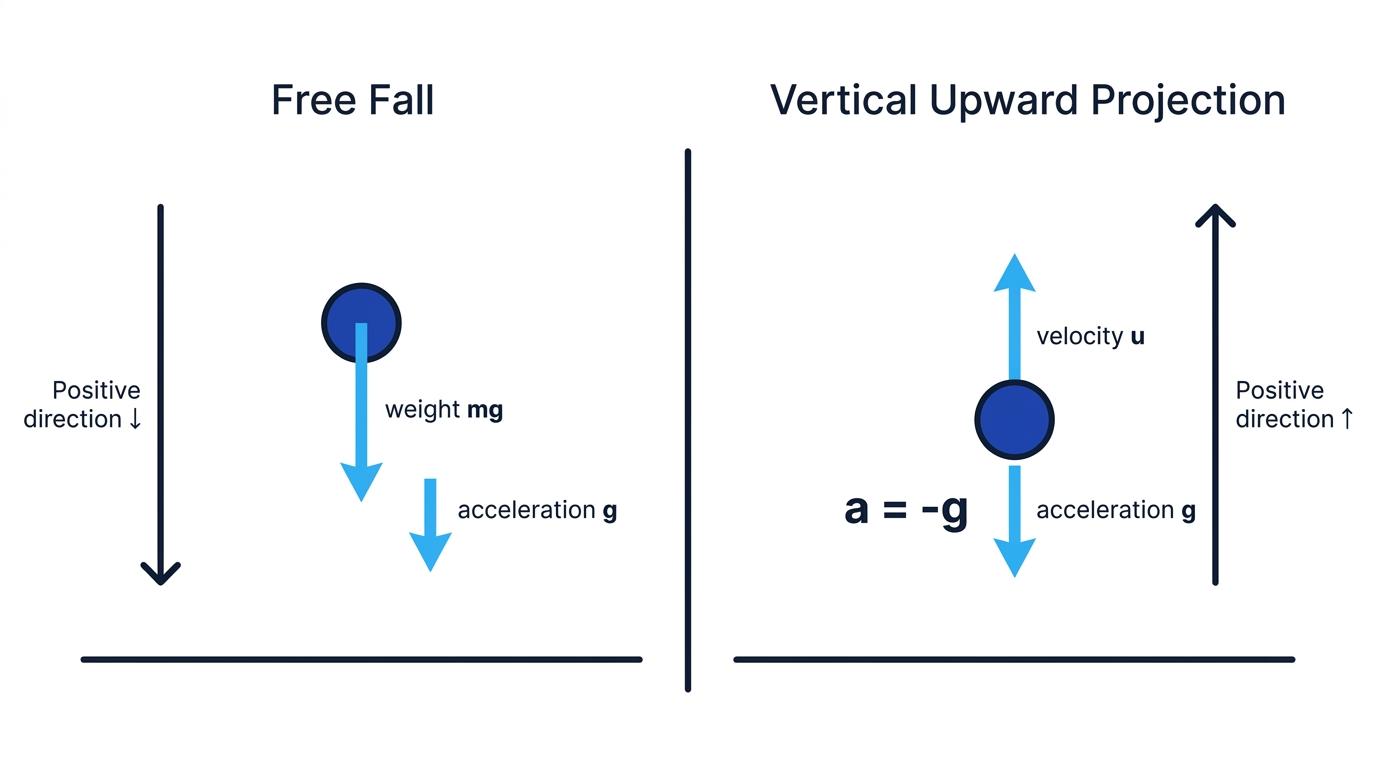
Gravity does not follow the direction of motion
Near the Earth's surface, gravitational acceleration always acts vertically downwards. An object moving upwards still has downward acceleration.
Free fall
An object is in free fall when gravity is the only force acting on it. In the mathematical model normally used at A Level, air resistance is ignored.
Under this model:
- gravitational acceleration is constant;
- gravitational acceleration is vertically downwards;
- all objects have the same acceleration ggg, regardless of their mass.
A heavier object has a greater gravitational force acting on it, but it also has greater resistance to acceleration because of its greater mass. These effects balance, giving the same value of ggg.
Finding the speed of a falling object
A stone is released from rest and falls freely for 2.5 seconds. Find its speed after this time.
-
Choose vertically downwards as positive. The stone is released from rest, so u=0u=0u=0, while a=g=9.8 m s−2a=g=9.8\text{ m s}^{-2}a=g=9.8 m s−2 and t=2.5 st=2.5\text{ s}t=2.5 s.
-
Use the constant-acceleration formula v=u+atv=u+atv=u+at:
v=0+9.8(2.5)=24.5 m s−1.v=0+9.8(2.5)=24.5\text{ m s}^{-1}.v=0+9.8(2.5)=24.5 m s−1. -
The positive result agrees with the chosen positive direction, so the stone's speed is 24.5 m s⁻¹, directed downwards.
Treating g as a speed
The quantity ggg is an acceleration, not a speed. Its unit is m s⁻², not m s⁻¹.
Gravitational acceleration and weight
The weight of an object is the gravitational force acting on it. For an object of mass mmm,
W=mg,W=mg,W=mg,where:
- WWW is weight in newtons, N;
- mmm is mass in kilograms, kg;
- ggg is gravitational acceleration in m s⁻².
Weight and gravitational acceleration both act vertically downwards, but they are different quantities. Weight is a force, whereas ggg is an acceleration.
Calculating weight
Find the weight of a particle of mass 6 kg, using g=9.8 m s−2g=9.8\text{ m s}^{-2}g=9.8 m s−2.
-
Apply the relationship W=mgW=mgW=mg, with m=6 kgm=6\text{ kg}m=6 kg.
-
Substitute the value of ggg:
W=6(9.8)=58.8 N.W=6(9.8)=58.8\text{ N}.W=6(9.8)=58.8 N. -
Weight is a force, so the answer is 58.8 N, acting vertically downwards.
Confusing mass and weight
Mass is measured in kilograms and does not change when the gravitational field changes. Weight is measured in newtons and depends on the value of ggg.
Choosing a positive direction
Vertical motion is one-dimensional, so you must choose one direction to be positive. Your signs must then remain consistent throughout the calculation.
Taking downwards as positive
If downwards is positive, gravitational acceleration is
a=+g=+9.8 m s−2.a=+g=+9.8\text{ m s}^{-2}.a=+g=+9.8 m s−2.A downward displacement or velocity is positive, while an upward displacement or velocity is negative.
Taking upwards as positive
If upwards is positive, gravitational acceleration is
a=−g=−9.8 m s−2.a=-g=-9.8\text{ m s}^{-2}.a=−g=−9.8 m s−2.An upward displacement or velocity is positive, while a downward displacement or velocity is negative.
Neither choice is more correct. The important point is to apply your choice consistently.
Write the positive direction first
At the start of a vertical-motion calculation, write something such as “taking upwards as positive”. This makes the signs of uuu, vvv, aaa and sss easier to check.
A particle projected vertically upwards
A ball is projected vertically upwards at 19.6 m s⁻¹. Find the time taken to reach its greatest height.
-
Take upwards as positive. Then u=19.6 m s−1u=19.6\text{ m s}^{-1}u=19.6 m s−1 and a=−9.8 m s−2a=-9.8\text{ m s}^{-2}a=−9.8 m s−2.
-
At the greatest height, the ball is momentarily stationary, so v=0v=0v=0. Substitute into v=u+atv=u+atv=u+at:
0=19.6−9.8t.0=19.6-9.8t.0=19.6−9.8t. -
Solve for ttt:
9.8t=19.6⇒t=2 s.9.8t=19.6 \quad\Rightarrow\quad t=2\text{ s}.9.8t=19.6⇒t=2 s.
Setting the acceleration to zero at the top
At the greatest height, the velocity is zero for an instant, but the acceleration is still 9.8 m s−29.8\text{ m s}^{-2}9.8 m s−2 downwards. Gravity continues to act.
Using constant-acceleration formulae
Because ggg is modelled as constant near the Earth's surface, you can use the standard constant-acceleration formulae, often called the SUVAT equations:
v=u+at,s=ut+12at2,v2=u2+2as,s=12(u+v)t.\begin{aligned} v&=u+at,\\ s&=ut+\frac{1}{2}at^2,\\ v^2&=u^2+2as,\\ s&=\frac{1}{2}(u+v)t. \end{aligned}vsv2s=u+at,=ut+21at2,=u2+2as,=21(u+v)t.Here, uuu is initial velocity, vvv is final velocity, aaa is acceleration, sss is displacement and ttt is time.
For vertical motion, substitute either a=ga=ga=g or a=−ga=-ga=−g, depending on your chosen positive direction.
Finding the distance fallen
A particle is released from rest and falls freely through 12 m. Find its speed when it has fallen this distance.
-
Take downwards as positive, giving u=0u=0u=0, a=9.8 m s−2a=9.8\text{ m s}^{-2}a=9.8 m s−2 and s=12 ms=12\text{ m}s=12 m.
-
Since time is not given or required, use v2=u2+2asv^2=u^2+2asv2=u2+2as:
v2=02+2(9.8)(12)=235.2.v^2=0^2+2(9.8)(12)=235.2.v2=02+2(9.8)(12)=235.2. -
Speed is non-negative, so take the positive square root:
v=235.2≈15.3 m s−1.v=\sqrt{235.2}\approx15.3\text{ m s}^{-1}.v=235.2≈15.3 m s−1.
The accuracy of g
The value of gravitational acceleration varies slightly with location, altitude and the Earth's shape. Near the Earth's surface, common approximations are:
- 9.81 m s⁻² to three significant figures;
- 9.8 m s⁻² to two significant figures;
- 10 m s⁻² to one significant figure.
For OCR A Level Mathematics, take g=9.8 m s−2g=9.8\text{ m s}^{-2}g=9.8 m s−2 unless the question gives another value.
If the question explicitly states a value of ggg, you must use that value. Different approximations will give slightly different numerical answers.
Comparing approximations for g
A particle falls freely from rest for 4 seconds. Compare the calculated speed using g=9.8 m s−2g=9.8\text{ m s}^{-2}g=9.8 m s−2 and g=10 m s−2g=10\text{ m s}^{-2}g=10 m s−2.
-
Using v=u+atv=u+atv=u+at with u=0u=0u=0 and g=9.8 m s−2g=9.8\text{ m s}^{-2}g=9.8 m s−2 gives
v=9.8(4)=39.2 m s−1.v=9.8(4)=39.2\text{ m s}^{-1}.v=9.8(4)=39.2 m s−1. -
Using the rougher approximation g=10 m s−2g=10\text{ m s}^{-2}g=10 m s−2 gives
v=10(4)=40 m s−1.v=10(4)=40\text{ m s}^{-1}.v=10(4)=40 m s−1. -
The answers are close but not identical. The second answer is suitable only if the question allows g=10 m s−2g=10\text{ m s}^{-2}g=10 m s−2 or asks for an estimate.
Do not change g during a calculation
Use one value of ggg throughout a solution. Mixing 9.8 and 9.81 can create an inconsistent final answer.
Limits of the model
Treating ggg as constant and ignoring air resistance is a mathematical model. It is usually suitable for particles moving through short vertical distances near the Earth's surface.
In reality:
- air resistance can affect the motion;
- ggg decreases as distance from the Earth increases;
- objects with different shapes may fall differently because of air resistance.
Unless a question mentions resistance or gives a different model, you should use constant gravitational acceleration.
In the exam
- State your positive direction before assigning signs to velocity, displacement and acceleration.
- Use g=9.8 m s−2g=9.8\text{ m s}^{-2}g=9.8 m s−2 unless the question gives a different value.
- Remember that a=−ga=-ga=−g when upwards is positive and a=+ga=+ga=+g when downwards is positive.
- At maximum height, set v=0v=0v=0, not a=0a=0a=0.
- Include appropriate SI units and round only at the end of the calculation.
Check yourself
- If upwards is positive, what value and sign should you use for gravitational acceleration?
- A particle is dropped from rest. Which SUVAT quantities are known immediately?
- Why do objects of different masses have the same gravitational acceleration when air resistance is ignored?
