

What you'll learn
- How to differentiate functions of the form ekxe^{kx}ekx.
- How the constant kkk controls both the shape and gradient of the graph.
- Why exponential functions model continuous growth and decay.
- How to find gradients, tangent equations and unknown model parameters.
Prerequisites
Gradient and derivative
The gradient of a curve measures its steepness at a particular point. It is the gradient of the tangent to the curve at that point.
The derivative of a function gives a formula for this gradient. If y=f(x)y=f(x)y=f(x), derivative notation includes
dydx,f′(x).\frac{dy}{dx}, \qquad f'(x).dxdy,f′(x).The natural exponential function
The function exe^xex is the natural exponential function, where eee is the mathematical constant approximately equal to 2.718. Its derivative is equal to the function itself:
ddx(ex)=ex.\frac{d}{dx}\left(e^x\right)=e^x.dxd(ex)=ex.This is a special property: at every point on the graph of y=exy=e^xy=ex, the height of the graph and its gradient have the same numerical value.
For example, at x=0x=0x=0, the height is e0=1e^0=1e0=1, so the gradient is also 1. At x=2x=2x=2, the height is e2e^2e2, so the gradient is e2e^2e2.
The chain rule
To differentiate ekxe^{kx}ekx, you need the chain rule. This is used when one function is applied to another function, forming a composite function.
For ekxe^{kx}ekx:
- the outer function is the exponential function;
- the inner function is kxkxkx.
The chain rule says to differentiate the outer function and then multiply by the derivative of the inner function.
Since
ddx(kx)=k,\frac{d}{dx}(kx)=k,dxd(kx)=k,we obtain the main result.
Gradient of an exponential function
For any constant kkk,
ddx(ekx)=kekx.\boxed{\frac{d}{dx}\left(e^{kx}\right)=ke^{kx}}.dxd(ekx)=kekx.Differentiate the exponent kxkxkx to get the multiplying factor kkk. The exponential part remains unchanged.
Differentiating exponential functions
Differentiate (a) y=e4xy=e^{4x}y=e4x and (b) y=e−3xy=e^{-3x}y=e−3x.
-
For y=e4xy=e^{4x}y=e4x, the derivative of the exponent 4x4x4x is 4, so
dydx=4e4x.\frac{dy}{dx}=4e^{4x}.dxdy=4e4x. -
For y=e−3xy=e^{-3x}y=e−3x, the derivative of the exponent −3x-3x−3x is −3-3−3, so
dydx=−3e−3x.\frac{dy}{dx}=-3e^{-3x}.dxdy=−3e−3x. -
The negative derivative in part (b) shows that e−3xe^{-3x}e−3x is decreasing for every value of xxx, because e−3xe^{-3x}e−3x is always positive.
Forgetting the chain-rule factor
Do not write ddx(ekx)=ekx\frac{d}{dx}(e^{kx})=e^{kx}dxd(ekx)=ekx. You must multiply by the derivative of the exponent, giving kekxke^{kx}kekx.
How the value of k affects the graph
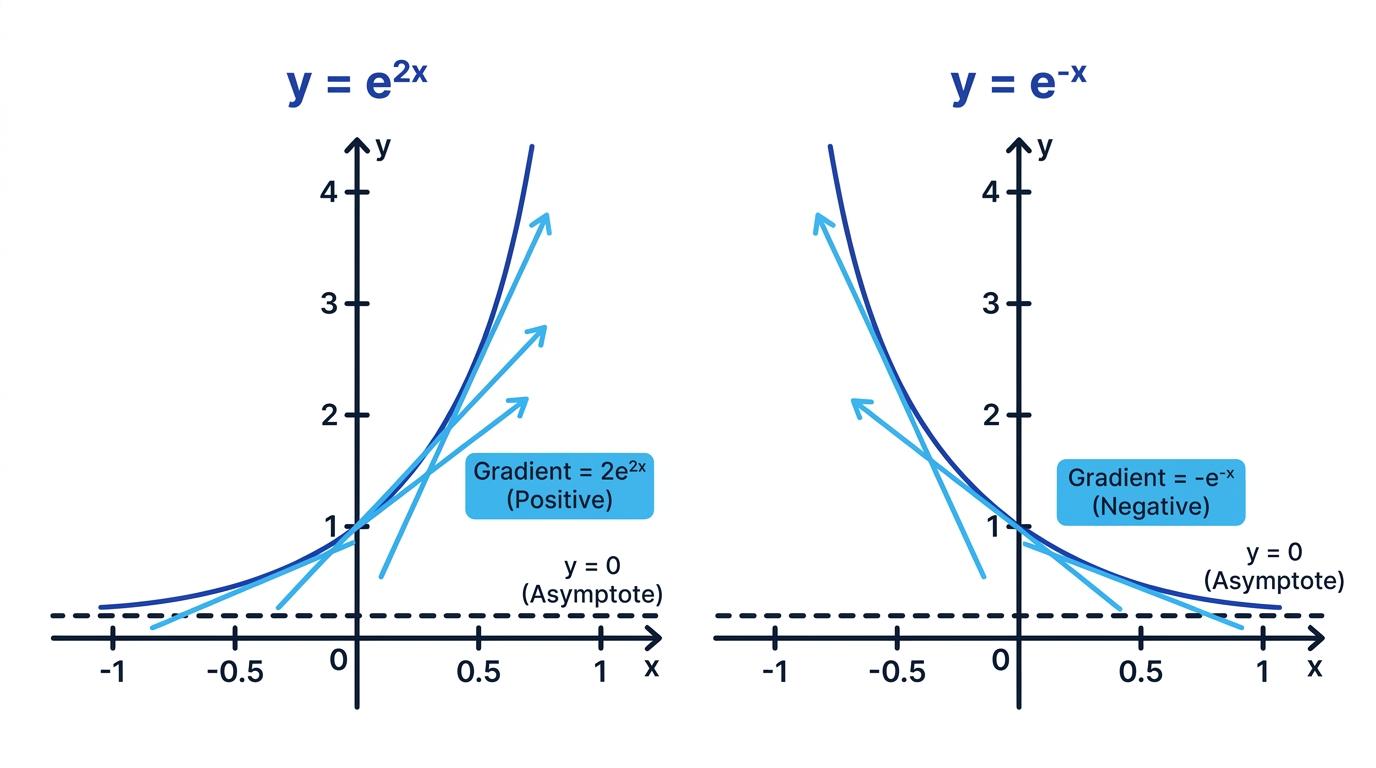
The exponential expression ekxe^{kx}ekx is positive for every real value of xxx. Therefore, the sign of its derivative
kekxke^{kx}kekxdepends entirely on the sign of kkk.
When k is positive
If k>0k>0k>0, then kekx>0ke^{kx}>0kekx>0. The gradient is positive everywhere, so the graph is increasing. Larger positive values of kkk produce faster growth and steeper curves.
When k is negative
If k<0k<0k<0, then kekx<0ke^{kx}<0kekx<0. The gradient is negative everywhere, so the graph is decreasing. This is called exponential decay.
In both cases, the graph passes through (0,1)(0,1)(0,1) because ek⋅0=e0=1e^{k\cdot 0}=e^0=1ek⋅0=e0=1. The line y=0y=0y=0 is a horizontal asymptote: the curve approaches it in one direction but never reaches it.
The graph below compares exponential growth with exponential decay and shows how the tangent gradients change.
Finding a gradient at a point
Find the gradient of y=e2xy=e^{2x}y=e2x at the point where x=ln3x=\ln 3x=ln3.
-
Differentiate using the exponential rule:
dydx=2e2x.\frac{dy}{dx}=2e^{2x}.dxdy=2e2x. -
Substitute x=ln3x=\ln 3x=ln3:
dydx=2e2ln3.\frac{dy}{dx}=2e^{2\ln 3}.dxdy=2e2ln3. -
Use 2ln3=ln(32)=ln92\ln 3=\ln(3^2)=\ln 92ln3=ln(32)=ln9, followed by eln9=9e^{\ln 9}=9eln9=9:
dydx=2×9=18.\frac{dy}{dx}=2\times 9=18.dxdy=2×9=18.
Therefore, the gradient is 18.
Keep exact values
When the input involves logarithms, use identities such as elna=ae^{\ln a}=aelna=a and blna=ln(ab)b\ln a=\ln(a^b)blna=ln(ab). This often produces an exact gradient without a calculator.
Including a constant multiplier
Many exponential functions have the form
y=Aekx,y=Ae^{kx},y=Aekx,where AAA and kkk are constants. The constant AAA is often the initial value because
y(0)=Aek⋅0=A.y(0)=Ae^{k\cdot 0}=A.y(0)=Aek⋅0=A.Using the constant multiple rule,
dydx=Akekx.\frac{dy}{dx}=Ake^{kx}.dxdy=Akekx.Since y=Aekxy=Ae^{kx}y=Aekx, this can also be written as
dydx=ky.\boxed{\frac{dy}{dx}=ky}.dxdy=ky.Rate of change
A rate of change describes how quickly one quantity changes with respect to another. In an exponential model y=Aekxy=Ae^{kx}y=Aekx, the instantaneous rate of change is dydx=ky\frac{dy}{dx}=kydxdy=ky.
Finding the equation of a tangent
Find the equation of the tangent to y=5e2xy=5e^{2x}y=5e2x at x=0x=0x=0.
-
Find the point on the curve:
y=5e2⋅0=5,y=5e^{2\cdot 0}=5,y=5e2⋅0=5,so the tangent passes through (0,5)(0,5)(0,5).
-
Differentiate to find the gradient function:
dydx=10e2x.\frac{dy}{dx}=10e^{2x}.dxdy=10e2x. -
At x=0x=0x=0, the tangent gradient is
10e0=10.10e^0=10.10e0=10. -
Use the straight-line equation y−y1=m(x−x1)y-y_1=m(x-x_1)y−y1=m(x−x1):
y−5=10(x−0),y-5=10(x-0),y−5=10(x−0),so the tangent is
y=10x+5.\boxed{y=10x+5}.y=10x+5.
Why exponential models are useful
An exponential model is suitable when a quantity's rate of change is proportional to the quantity currently present.
If y=Aekxy=Ae^{kx}y=Aekx, then
dydx=ky.\frac{dy}{dx}=ky.dxdy=ky.The constant kkk is the constant of proportionality. This equation says that a larger current amount produces a proportionally larger rate of change.
The modelling connection
Exponential models are suitable when the rate of change at any instant is a constant multiple of the current quantity:
dydx∝y⟹dydx=ky.\frac{dy}{dx}\propto y \quad\Longrightarrow\quad \frac{dy}{dx}=ky.dxdy∝y⟹dxdy=ky.Positive kkk models growth, while negative kkk models decay.
This behaviour occurs in situations such as:
- population growth when the birth rate per individual is approximately constant;
- compound interest when interest is added continuously;
- radioactive decay, where each unstable nucleus has the same chance of decaying;
- cooling under suitable conditions, when temperature difference is used as the changing quantity.
A model is a mathematical simplification. In reality, unrestricted population growth cannot continue forever because resources are limited, so an exponential model may only be valid over a stated time interval.
Interpreting an exponential population model
A population is modelled by
P=800e0.06t,P=800e^{0.06t},P=800e0.06t,where ttt is measured in years. Find its initial population and instantaneous growth rate after 5 years.
-
At t=0t=0t=0,
P(0)=800e0=800,P(0)=800e^0=800,P(0)=800e0=800,so the initial population is 800.
-
Differentiate with respect to time:
dPdt=800(0.06)e0.06t=48e0.06t.\frac{dP}{dt}=800(0.06)e^{0.06t}=48e^{0.06t}.dtdP=800(0.06)e0.06t=48e0.06t. -
At t=5t=5t=5,
dPdt=48e0.3≈64.8.\frac{dP}{dt}=48e^{0.3}\approx 64.8.dtdP=48e0.3≈64.8.The population is therefore growing at approximately 64.8 individuals per year at that instant.
-
Equivalently, dPdt=0.06P\frac{dP}{dt}=0.06PdtdP=0.06P, so the instantaneous growth rate is always 6% of the current population per year.
Confusing amount with rate
P(t)P(t)P(t) gives the population, whereas dPdt\frac{dP}{dt}dtdP gives how quickly the population is changing. Their values usually have different meanings and different units.
Finding an unknown value of k
Information about a gradient can be used to determine the parameter kkk. For y=Aekxy=Ae^{kx}y=Aekx, remember that
dydx=ky.\frac{dy}{dx}=ky.dxdy=ky.This form is often faster than differentiating and substituting separately.
Determining the model parameter
A quantity follows the model y=Aekxy=Ae^{kx}y=Aekx. At one instant, y=120y=120y=120 and the quantity is decreasing at a rate of 15 units per hour. Find kkk.
-
A decreasing rate of 15 means
dydx=−15.\frac{dy}{dx}=-15.dxdy=−15. -
Use the relationship dydx=ky\frac{dy}{dx}=kydxdy=ky and substitute the known values:
−15=120k.-15=120k.−15=120k. -
Solve for kkk:
k=−15120=−18.k=-\frac{15}{120}=-\frac18.k=−12015=−81.
The negative value confirms that the model represents exponential decay.
In the exam
- Differentiate ekxe^{kx}ekx by keeping the exponential expression unchanged and multiplying by kkk.
- For y=Aekxy=Ae^{kx}y=Aekx, use either dydx=Akekx\frac{dy}{dx}=Ake^{kx}dxdy=Akekx or the quicker relationship dydx=ky\frac{dy}{dx}=kydxdy=ky.
- Interpret the sign of kkk: positive means growth and negative means decay.
- Distinguish carefully between the value of the model and its rate of change, and include appropriate units when the variables represent measured quantities.
Check yourself
- What is the derivative of e−5xe^{-5x}e−5x, and what does its sign tell you about the graph?
- If y=7e3xy=7e^{3x}y=7e3x, what are the value of yyy and the gradient when x=0x=0x=0?
- Why does the equation dydx=0.04y\frac{dy}{dx}=0.04ydxdy=0.04y suggest that an exponential growth model is appropriate?
