

What you'll learn
- How to recognise a geometric sequence and find its common ratio.
- How to calculate the nth term and the sum of a finite geometric series.
- When an infinite geometric series converges, and how to find its sum to infinity.
- How modulus notation expresses the convergence condition precisely.
Before you start
A sequence is an ordered list of terms. For example,
3, 6, 12, 24,…3,\ 6,\ 12,\ 24,\ldots3, 6, 12, 24,…A series is formed by adding the terms of a sequence:
3+6+12+24+⋯3+6+12+24+\cdots3+6+12+24+⋯The position of a term is represented by nnn, where nnn is a positive integer. The first term corresponds to n=1n=1n=1, the second to n=2n=2n=2, and so on.
Geometric sequences
A geometric sequence is created by repeatedly multiplying by the same number.
Geometric sequence
A geometric sequence is a sequence in which each term after the first is obtained by multiplying the previous term by a fixed number called the common ratio, denoted by rrr.
If consecutive terms are unu_nun and un+1u_{n+1}un+1, then
r=un+1un.r=\frac{u_{n+1}}{u_n}.r=unun+1.For a geometric sequence with first term aaa and common ratio rrr, the terms are
a, ar, ar2, ar3,…a,\ ar,\ ar^2,\ ar^3,\ldotsa, ar, ar2, ar3,…The ratio can be positive, negative or zero. If rrr is negative, the signs of the terms alternate.
Finding the common ratio
Determine whether the sequence
80, −40, 20, −10,…80,\ -40,\ 20,\ -10,\ldots80, −40, 20, −10,…is geometric.
-
Divide the second term by the first:
−4080=−12.\frac{-40}{80}=-\frac12.80−40=−21. -
Check another pair of consecutive terms:
20−40=−12.\frac{20}{-40}=-\frac12.−4020=−21. -
The ratio is constant, so the sequence is geometric with a=80a=80a=80 and r=−12r=-\frac12r=−21.
Subtracting instead of dividing
In an arithmetic sequence you look for a common difference. In a geometric sequence, divide consecutive terms to find the common ratio.
The nth term
The first term is aaa. To reach the second term, you multiply by rrr once; to reach the third term, you multiply by rrr twice.
Therefore, reaching term number nnn requires n−1n-1n−1 multiplications by rrr.
Nth term formula
The nth term of a geometric sequence is
un=arn−1.u_n=ar^{n-1}.un=arn−1.Here, aaa is the first term and rrr is the common ratio.
Finding a term of a geometric sequence
Find the eighth term of the geometric sequence with first term 5 and common ratio 3.
-
Use the nth term formula with a=5a=5a=5, r=3r=3r=3 and n=8n=8n=8:
u8=5(3)8−1.u_8=5\left(3\right)^{8-1}.u8=5(3)8−1. -
Simplify the exponent:
u8=5(3)7.u_8=5\left(3\right)^7.u8=5(3)7. -
Evaluate:
u8=10935.u_8=10935.u8=10935.
Using the exponent n
The exponent is n−1n-1n−1, not nnn. Check that your formula gives u1=au_1=au1=a when n=1n=1n=1.
Finding an unknown position
You may need to solve arn−1=kar^{n-1}=karn−1=k to find when a particular value occurs. When the unknown appears in the exponent, logarithms may be needed.
Finding when a value is first exceeded
The nth term of a geometric sequence is un=4(1.3)n−1u_n=4\left(1.3\right)^{n-1}un=4(1.3)n−1. Find the first term greater than 50.
-
Form the inequality
4(1.3)n−1>50,4\left(1.3\right)^{n-1}>50,4(1.3)n−1>50,so
(1.3)n−1>12.5.\left(1.3\right)^{n-1}>12.5.(1.3)n−1>12.5. -
Take logarithms and divide by the positive value log(1.3)\log(1.3)log(1.3):
n−1>log(12.5)log(1.3)≈9.63.n-1>\frac{\log(12.5)}{\log(1.3)}\approx 9.63.n−1>log(1.3)log(12.5)≈9.63. -
Hence n>10.63n>10.63n>10.63. Since nnn must be an integer, the first possible value is n=11n=11n=11.
Finite geometric series
A finite geometric series is the sum of a fixed number of terms from a geometric sequence.
For example, the sum of the first nnn terms is
Sn=a+ar+ar2+⋯+arn−1.S_n=a+ar+ar^2+\cdots+ar^{n-1}.Sn=a+ar+ar2+⋯+arn−1.To derive the formula, multiply by rrr:
rSn=ar+ar2+⋯+arn−1+arn.rS_n=ar+ar^2+\cdots+ar^{n-1}+ar^n.rSn=ar+ar2+⋯+arn−1+arn.Subtracting the second equation from the first causes the middle terms to cancel:
Sn−rSn=a−arn,Sn(1−r)=a(1−rn).\begin{aligned} S_n-rS_n&=a-ar^n,\\ S_n(1-r)&=a(1-r^n). \end{aligned}Sn−rSnSn(1−r)=a−arn,=a(1−rn).Finite sum formula
For r≠1r\neq1r=1, the sum of the first nnn terms is
Sn=a(1−rn)1−r.S_n=\frac{a(1-r^n)}{1-r}.Sn=1−ra(1−rn).An equivalent form is
Sn=a(rn−1)r−1.S_n=\frac{a(r^n-1)}{r-1}.Sn=r−1a(rn−1).Summing a finite geometric series
Find the sum of the first six terms of
7+21+63+⋯ .7+21+63+\cdots.7+21+63+⋯.-
Identify a=7a=7a=7, r=3r=3r=3 and n=6n=6n=6.
-
Substitute into the finite sum formula:
S6=7(1−36)1−3.S_6=\frac{7(1-3^6)}{1-3}.S6=1−37(1−36). -
Evaluate:
S6=7(1−729)−2=2548.S_6=\frac{7(1-729)}{-2}=2548.S6=−27(1−729)=2548.
Choosing the form
When r>1r>1r>1, the form a(rn−1)r−1\frac{a(r^n-1)}{r-1}r−1a(rn−1) often keeps both the numerator and denominator positive.
The case r equals 1
The finite sum formula divides by 1−r1-r1−r, so it cannot be used when r=1r=1r=1. In that case every term equals aaa, giving Sn=naS_n=naSn=na.
Sum to infinity
An infinite geometric series has no final term:
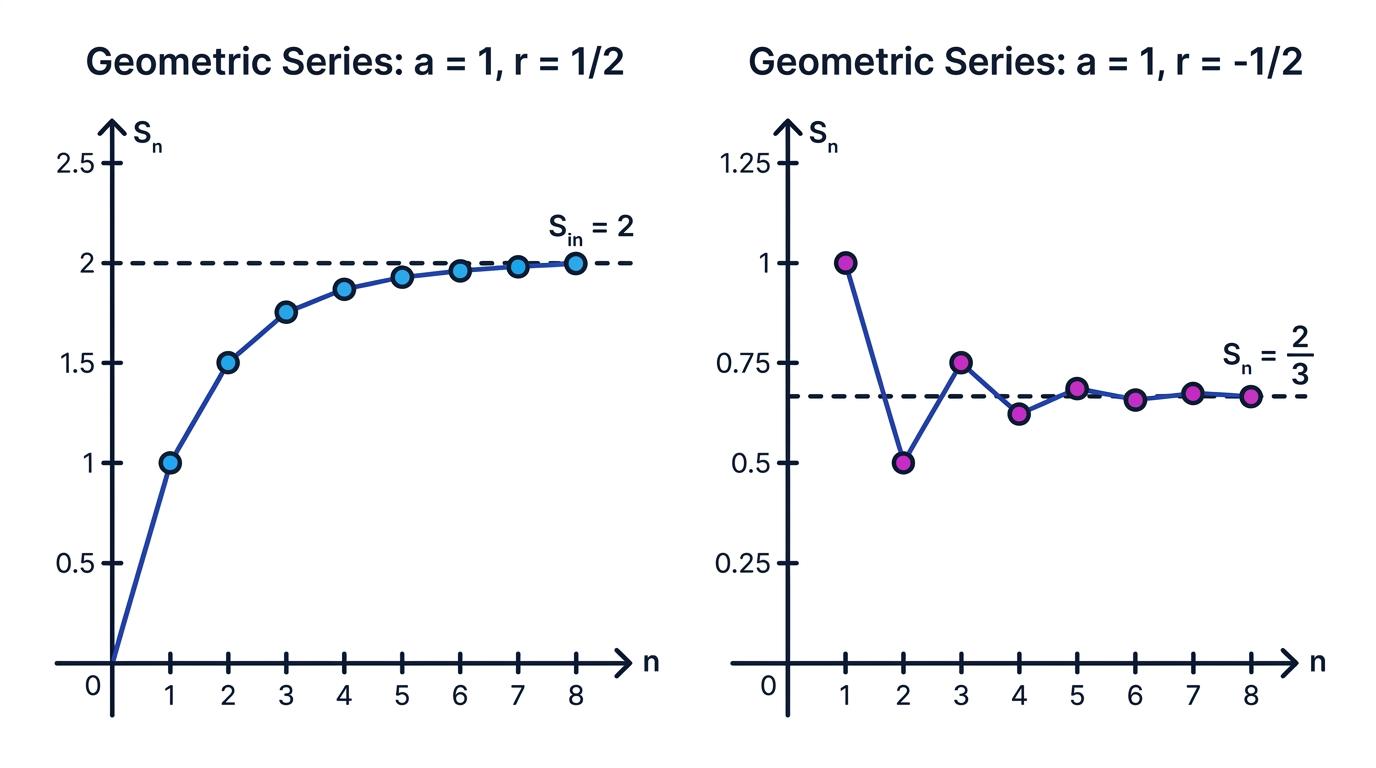
a+ar+ar2+ar3+⋯a+ar+ar^2+ar^3+\cdotsa+ar+ar2+ar3+⋯Its partial sum SnS_nSn is the sum of its first nnn terms. A series converges if its partial sums approach a finite limiting value as n→∞n\to\inftyn→∞.
Modulus notation
The modulus ∣r∣\lvert r\rvert∣r∣ is the distance of rrr from zero, so it is always non-negative. The condition ∣r∣<1\lvert r\rvert<1∣r∣<1 is equivalent to
−1<r<1.-1<r<1.−1<r<1.When ∣r∣<1\lvert r\rvert<1∣r∣<1, repeated powers of rrr approach zero:
rn→0asn→∞.r^n\to0\quad\text{as}\quad n\to\infty.rn→0asn→∞.Applying this to the finite sum formula gives
S∞=a1−r.S_\infty=\frac{a}{1-r}.S∞=1−ra.Convergence condition
A geometric series has a sum to infinity only when
∣r∣<1.\lvert r\rvert<1.∣r∣<1.If this condition holds, then
S∞=a1−r.S_\infty=\frac{a}{1-r}.S∞=1−ra.Finding a sum to infinity
Find the sum to infinity of
18−6+2−23+⋯ .18-6+2-\frac23+\cdots.18−6+2−32+⋯.-
Find the common ratio:
r=−618=−13.r=\frac{-6}{18}=-\frac13.r=18−6=−31. -
Check convergence:
∣−13∣=13<1.\left\lvert-\frac13\right\rvert=\frac13<1.−31=31<1. -
Use the sum-to-infinity formula:
S∞=181−(−13)=1843=272.S_\infty=\frac{18}{1-\left(-\frac13\right)} =\frac{18}{\frac43} =\frac{27}{2}.S∞=1−(−31)18=3418=227.
Ignoring convergence
Never use S∞=a1−rS_\infty=\frac{a}{1-r}S∞=1−ra before checking ∣r∣<1\lvert r\rvert<1∣r∣<1. For example, r=−2r=-2r=−2 is negative but its modulus is greater than 1, so the series diverges.
Forming a geometric model
Geometric series can model repeated percentage changes, depreciation and situations in which each new amount is a fixed proportion of the previous one.
Modelling repeated bounces
A ball is dropped from a height of 10 m. After each bounce, it rises to 60% of its previous height. Find the total vertical distance travelled.
-
The initial downward distance is 10 m. The upward bounce heights form a geometric series with a=6a=6a=6 and r=0.6r=0.6r=0.6.
-
Since ∣0.6∣<1\lvert0.6\rvert<1∣0.6∣<1, the total upward distance is
61−0.6=15 m.\frac{6}{1-0.6}=15\text{ m}.1−0.66=15 m. -
Each bounce height is travelled once upwards and once downwards, so the total distance is
10+2(15)=40 m.10+2(15)=40\text{ m}.10+2(15)=40 m.
Missing the return journey
In bounce problems, each bounce height usually contributes an upward and a downward distance. The original drop occurs only once.
In the exam
- Identify aaa, rrr and, for a finite sum, nnn before substituting into a formula.
- Distinguish carefully between an nth-term question, which uses un=arn−1u_n=ar^{n-1}un=arn−1, and a sum question, which uses SnS_nSn.
- Before finding a sum to infinity, explicitly state that ∣r∣<1\lvert r\rvert<1∣r∣<1.
- Keep exact fractions where possible, especially when the ratio is fractional or negative.
Check yourself
- Can you find the nth term of the sequence 24,−12,6,−3,…24,-12,6,-3,\ldots24,−12,6,−3,…?
- How would you find the sum of the first eight terms of 5+15+45+⋯5+15+45+\cdots5+15+45+⋯?
- Why does a geometric series with r=−1.2r=-1.2r=−1.2 not have a sum to infinity?
