Question 28
In this question use g=9.8g = 9.8g=9.8 m s−2^{-2}−2.
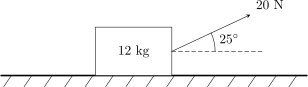
A box of mass 12 kg is pulled along a rough horizontal floor by a force of magnitude 20 N acting at an angle of 25° 25°\,25° above the horizontal. The box is modelled as a particle and the coefficient of friction between the box and the floor is 0.1.
a.[5]
Find the acceleration of the box.
b.[2]
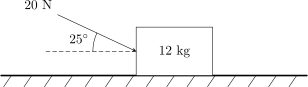
The box is now pushed along the same floor by a force of magnitude 20 N acting at an angle of 25° 25°\,25° below the horizontal. Explain why the acceleration of the box will now be less than the acceleration in part (a).
3.3 Forces and Newton's Laws Questions
139 exam-style questions on OCR A Level Maths 3.3 Forces and Newton's Laws, covering 3.3.1 Concept and vector nature of a force, 3.3.2 Newton's first law, 3.3.3 Newton's second law in a straight line, 3.3.4 Newton's second law with vectors (A-level only), 3.3.5 Newton's second law with resolved forces (A-level only), 3.3.6 Weight, 3.3.7 Gravitational acceleration, 3.3.8 Newton's third law, 3.3.9 Normal reaction force, 3.3.10 Smooth contact model, 3.3.11 Equilibrium with connected particles and pulleys, 3.3.12 Newton's third law with resolved forces (A-level only), 3.3.13 Equilibrium by resolving (A-level only), 3.3.14 Equilibrium of forces in two dimensions using vectors (A-level only), 3.3.15 Resolving forces for advanced problems (A-level only), 3.3.16 Resultant forces and components (A-level only), 3.3.17 Dynamics of a particle in a plane (A-level only), 3.3.18 Concept of a frictional force (A-level only), 3.3.19 Contact force components (A-level only), 3.3.20 Coefficient of friction (A-level only), 3.3.21 Static and limiting equilibrium on a rough surface (A-level only), 3.3.22 Motion of a body on a rough surface (A-level only), and 3.3 Forces and Newton's Laws. Each one has a worked solution and a mark scheme showing where the marks go.