

What you'll learn
- How a change of sign can be used to locate a root.
- Why continuity is essential to the method.
- How repeated roots, multiple roots and discontinuities can make sign tests fail.
- How to recognise these failures and respond appropriately in an exam.
Prerequisites: roots and signs
A root of the equation f(x)=0f(x)=0f(x)=0 is a value of xxx at which the graph of y=f(x)y=f(x)y=f(x) meets the xxx-axis.
The value of a function is:
- positive when its graph is above the xxx-axis;
- negative when its graph is below the xxx-axis;
- zero when its graph is on the xxx-axis.
If f(a)f(a)f(a) and f(b)f(b)f(b) have opposite signs, then their product is negative:
f(a)f(b)<0.f(a)f(b)<0.f(a)f(b)<0.This is called a change of sign between x=ax=ax=a and x=bx=bx=b.
Why sign-change methods usually work
A function is continuous on an interval if its graph can be drawn across that interval without lifting your pen. Informally, the graph has no gaps, jumps or vertical asymptotes there.
If a continuous graph is below the xxx-axis at one end of an interval and above it at the other, it must pass through the xxx-axis somewhere in between.
Sign-change result
If fff is continuous on [a,b][a,b][a,b] and
f(a)f(b)<0,f(a)f(b)<0,f(a)f(b)<0,then there is at least one root of f(x)=0f(x)=0f(x)=0 in the interval (a,b)(a,b)(a,b).
This result is the basis of methods such as interval bisection and decimal search, where you repeatedly evaluate the function and reduce the size of an interval containing a sign change.
Confirming that an interval contains a root
Show that f(x)=x3+x−1f(x)=x^3+x-1f(x)=x3+x−1 has a root between x=0.5x=0.5x=0.5 and x=0.75x=0.75x=0.75.
-
Evaluate the function at the lower endpoint:
f(0.5)=(0.5)3+0.5−1=−0.375.f(0.5)=(0.5)^3+0.5-1=-0.375.f(0.5)=(0.5)3+0.5−1=−0.375. -
Evaluate it at the upper endpoint:
f(0.75)=(0.75)3+0.75−1=0.171875.f(0.75)=(0.75)^3+0.75-1=0.171875.f(0.75)=(0.75)3+0.75−1=0.171875. -
The values have opposite signs, so
f(0.5)f(0.75)<0.f(0.5)f(0.75)<0.f(0.5)f(0.75)<0.Since a polynomial is continuous, there must be at least one root in (0.5,0.75)(0.5,0.75)(0.5,0.75).
A one-way test
For a continuous function, a sign change guarantees a root. However, the absence of a sign change does not guarantee that there is no root.
Three different graph behaviours
The diagrams compare a root where the graph crosses the axis, a repeated root where it only touches the axis, and a discontinuity that produces opposite signs without any root.
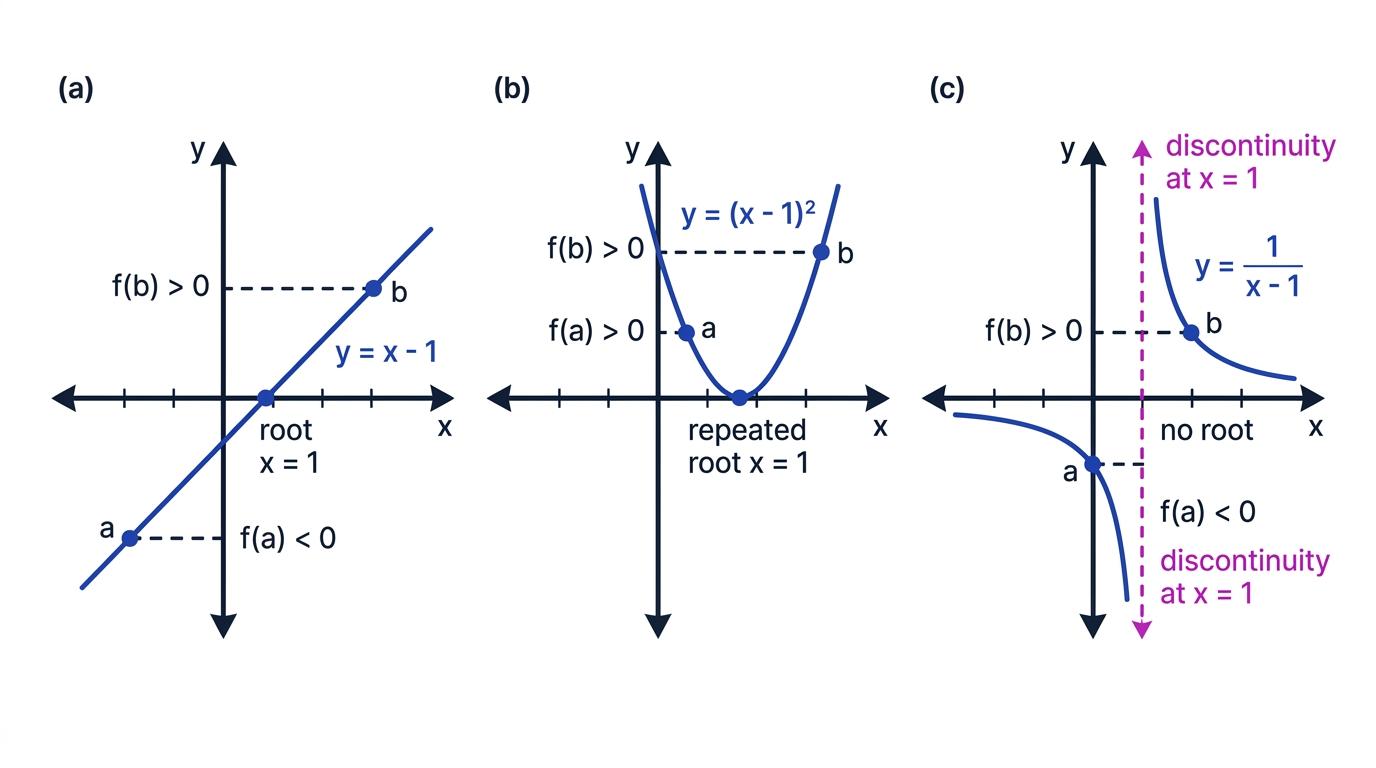
These cases show why you must consider the shape and continuity of the graph, rather than relying only on endpoint signs.
Failure 1: a root without a sign change
A graph can touch the xxx-axis and turn around without crossing it. The function then has the same sign on both sides of the root.
This often happens at a repeated root.
Multiplicity of a root
If a polynomial contains a factor (x−r)m(x-r)^m(x−r)m, then x=rx=rx=r is a root with multiplicity mmm.
- If mmm is odd, the graph usually crosses the xxx-axis and changes sign.
- If mmm is even, the graph usually touches the xxx-axis and does not change sign.
For example, the function
f(x)=(x−2)2f(x)=(x-2)^2f(x)=(x−2)2has a root at x=2x=2x=2 with multiplicity 2. Because a square is never negative, the function is positive on both sides of the root.
A repeated root missed by a sign test
Test the signs of f(x)=(x−2)2f(x)=(x-2)^2f(x)=(x−2)2 on the interval [1.9,2.1][1.9,2.1][1.9,2.1].
-
At the lower endpoint,
f(1.9)=(1.9−2)2=0.01.f(1.9)=(1.9-2)^2=0.01.f(1.9)=(1.9−2)2=0.01. -
At the upper endpoint,
f(2.1)=(2.1−2)2=0.01.f(2.1)=(2.1-2)^2=0.01.f(2.1)=(2.1−2)2=0.01. -
Both endpoint values are positive, so there is no change of sign. Nevertheless,
f(2)=(2−2)2=0,f(2)=(2-2)^2=0,f(2)=(2−2)2=0,so the interval does contain a root. The sign test misses it because the graph touches the axis without crossing it.
Treating the converse as true
Do not conclude that an interval contains no root just because f(a)f(a)f(a) and f(b)f(b)f(b) have the same sign. The sign-change result does not work in reverse.
Failure 2: an even number of crossing roots
An interval can contain two, four or another even number of roots where the graph crosses the axis. Each crossing reverses the sign, so an even number of reversals leaves the endpoint signs the same.
Two roots hidden inside one interval
Consider f(x)=(x−1)(x−2)f(x)=(x-1)(x-2)f(x)=(x−1)(x−2) on the interval [0.5,2.5][0.5,2.5][0.5,2.5].
-
Evaluate the endpoints:
f(0.5)=(0.5−1)(0.5−2)=0.75,f(2.5)=(2.5−1)(2.5−2)=0.75.\begin{aligned} f(0.5)&=(0.5-1)(0.5-2)=0.75,\\ f(2.5)&=(2.5-1)(2.5-2)=0.75. \end{aligned}f(0.5)f(2.5)=(0.5−1)(0.5−2)=0.75,=(2.5−1)(2.5−2)=0.75. -
Both values are positive, so the endpoints show no change of sign.
-
However, the factors show that
f(1)=0andf(2)=0.f(1)=0 \quad \text{and} \quad f(2)=0.f(1)=0andf(2)=0.The graph crosses the axis twice. The first crossing changes the sign from positive to negative, and the second changes it back to positive.
A coarse decimal search can therefore jump over two nearby roots. Using smaller intervals may reveal the negative values between them, although it still does not solve the repeated-root problem.
Use additional information
A graph, factorisation or knowledge of turning points can reveal roots that an endpoint sign test misses. Sign checks are most reliable when combined with information about the function's shape.
Failure 3: a sign change without a root
A sign change only guarantees a root when the function is continuous throughout the interval.
If the function has a vertical asymptote or another discontinuity, its values can switch from negative to positive without ever taking the value zero.
A discontinuity mistaken for a root
Consider
f(x)=1x−3f(x)=\frac{1}{x-3}f(x)=x−31on the interval [2.9,3.1][2.9,3.1][2.9,3.1].
-
Evaluate the function on the left of 3:
f(2.9)=12.9−3=−10.f(2.9)=\frac{1}{2.9-3}=-10.f(2.9)=2.9−31=−10. -
Evaluate it on the right of 3:
f(3.1)=13.1−3=10.f(3.1)=\frac{1}{3.1-3}=10.f(3.1)=3.1−31=10.There is a change of sign.
-
Solving f(x)=0f(x)=0f(x)=0 would require
1x−3=0,\frac{1}{x-3}=0,x−31=0,but a fraction with numerator 1 can never equal zero. Also, f(3)f(3)f(3) is undefined, so the function is not continuous on the interval. The sign change is caused by a vertical asymptote, not a root.
Check continuity first
A negative product f(a)f(b)<0f(a)f(b)<0f(a)f(b)<0 is not enough by itself. Before claiming that a root exists, check that the function is continuous on the whole interval [a,b][a,b][a,b].
For a rational function, values excluded from the domain are especially important. If a denominator becomes zero inside the interval, the continuity condition fails.
What a sign test can and cannot prove
For a continuous function:
- Opposite endpoint signs prove that at least one root lies between the endpoints.
- Opposite signs do not prove that there is exactly one root.
- Equal endpoint signs do not prove that there are no roots.
For a function that is not continuous:
- Opposite endpoint signs may be caused by a discontinuity.
- You cannot apply the sign-change result across the discontinuity.
Check the hypotheses
A numerical method is only as reliable as the conditions behind it. For a sign-change argument, the essential condition is continuity on the entire interval.
Dealing with possible failure
When a sign-change method appears to find no root, you can investigate by:
- sketching or plotting the graph;
- using smaller intervals;
- factorising where possible;
- checking whether the graph touches the axis at a turning point;
- checking the domain for discontinuities;
- considering whether more than one root lies in the interval.
A calculated value may also be displayed as zero because of rounding. Keep sufficient accuracy during numerical work and distinguish an exact zero from a small rounded value.
In the exam
- Calculate f(a)f(a)f(a) and f(b)f(b)f(b) accurately and state their signs.
- Before using a sign change to prove that a root exists, state that fff is continuous on the interval.
- If there is no sign change, do not claim that there is no root; consider repeated roots or an even number of crossings.
- Check for excluded values and vertical asymptotes before applying the method to a rational function.
- Use a graph, factorisation or turning-point information when the endpoint signs alone are inconclusive.
Check yourself
- Why does f(a)f(b)>0f(a)f(b)>0f(a)f(b)>0 not prove that the interval (a,b)(a,b)(a,b) contains no roots?
- How can a vertical asymptote create an apparent change of sign?
- What is the difference between the graph near a root of even multiplicity and one of odd multiplicity?
