

What you'll learn
- How a position vector locates a point relative to the origin.
- How subtracting position vectors gives the displacement between two points.
- How to calculate distance by finding the magnitude of a displacement vector.
- How to apply the method in two and three dimensions.
Position vectors
A vector has both a magnitude, meaning its size or length, and a direction.
A position vector describes the position of a point relative to the origin, usually labelled OOO. For example, if point AAA has position vector
OA→=a=(a1a2),\overrightarrow{OA}=\mathbf{a} = \begin{pmatrix} a_1\\ a_2 \end{pmatrix},OA=a=(a1a2),then you travel a1a_1a1 units horizontally and a2a_2a2 units vertically to move from OOO to AAA.
Bold lower-case letters such as a\mathbf{a}a and b\mathbf{b}b are commonly used to represent vectors.
Position vector
The position vector of a point AAA is the vector OA→\overrightarrow{OA}OA from the origin OOO to AAA.
In three dimensions, a position vector has three components:
OA→=(a1a2a3).\overrightarrow{OA} = \begin{pmatrix} a_1\\ a_2\\ a_3 \end{pmatrix}.OA=a1a2a3.The third component represents movement in the additional spatial direction, usually the zzz-direction.
The vector between two points
Suppose points AAA and BBB have position vectors a\mathbf{a}a and b\mathbf{b}b respectively. To find the vector taking you from AAA to BBB, subtract the starting position vector from the finishing position vector:
AB→=b−a.\overrightarrow{AB}=\mathbf{b}-\mathbf{a}.AB=b−a.This follows from the vector journey
OA→+AB→=OB→.\overrightarrow{OA}+\overrightarrow{AB}=\overrightarrow{OB}.OA+AB=OB.Rearranging gives
AB→=OB→−OA→.\overrightarrow{AB}=\overrightarrow{OB}-\overrightarrow{OA}.AB=OB−OA.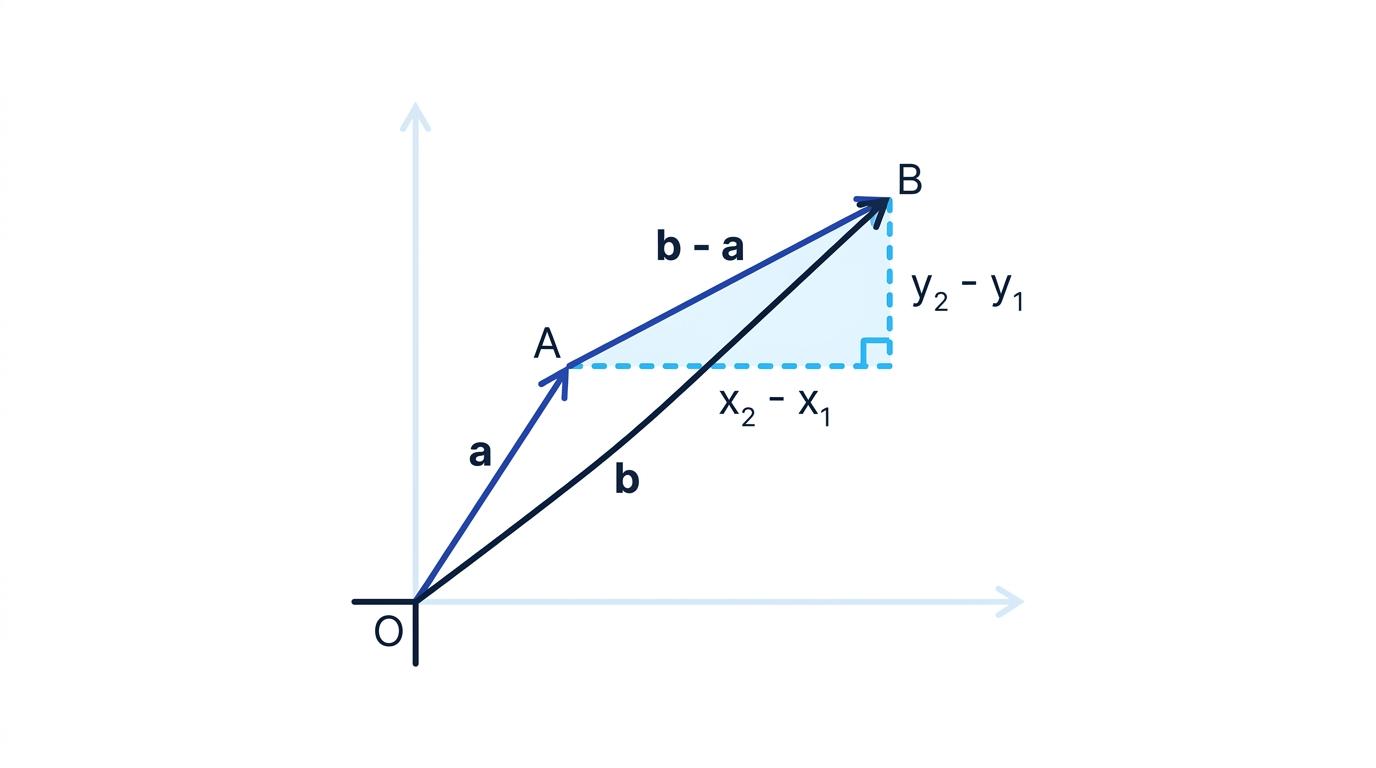
Finish minus start
For a vector from AAA to BBB, subtract the position vector of AAA from the position vector of BBB: AB→=b−a\overrightarrow{AB}=\mathbf{b}-\mathbf{a}AB=b−a.
Subtracting components
Vector subtraction is carried out component by component. In two dimensions,
(b1b2)−(a1a2)=(b1−a1b2−a2).\begin{pmatrix} b_1\\ b_2 \end{pmatrix} - \begin{pmatrix} a_1\\ a_2 \end{pmatrix} = \begin{pmatrix} b_1-a_1\\ b_2-a_2 \end{pmatrix}.(b1b2)−(a1a2)=(b1−a1b2−a2).Finding the vector from one point to another
Points AAA and BBB have position vectors
a=(2−1)andb=(73).\mathbf{a}= \begin{pmatrix} 2\\ -1 \end{pmatrix} \quad\text{and}\quad \mathbf{b}= \begin{pmatrix} 7\\ 3 \end{pmatrix}.a=(2−1)andb=(73).Find AB→\overrightarrow{AB}AB.
-
Since the required direction is from AAA to BBB, calculate b−a\mathbf{b}-\mathbf{a}b−a.
-
Subtract the corresponding components:
AB→=(73)−(2−1)=(7−23−(−1)).\overrightarrow{AB} = \begin{pmatrix} 7\\ 3 \end{pmatrix} - \begin{pmatrix} 2\\ -1 \end{pmatrix} = \begin{pmatrix} 7-2\\ 3-(-1) \end{pmatrix}.AB=(73)−(2−1)=(7−23−(−1)). -
Simplify to obtain
AB→=(54).\overrightarrow{AB} = \begin{pmatrix} 5\\ 4 \end{pmatrix}.AB=(54).Therefore, moving from AAA to BBB means moving 5 units in the first coordinate direction and 4 units in the second.
Subtracting in the wrong order
The vector AB→\overrightarrow{AB}AB is b−a\mathbf{b}-\mathbf{a}b−a, not a−b\mathbf{a}-\mathbf{b}a−b. Reversing the subtraction gives BA→\overrightarrow{BA}BA, which has the opposite direction.
Magnitude of a vector
The magnitude of a vector is its length. The magnitude of v\mathbf{v}v is written as ∣v∣\lvert\mathbf{v}\rvert∣v∣.
For a two-dimensional vector
v=(xy),\mathbf{v}= \begin{pmatrix} x\\ y \end{pmatrix},v=(xy),its magnitude is
∣v∣=x2+y2.\lvert\mathbf{v}\rvert=\sqrt{x^2+y^2}.∣v∣=x2+y2.This is Pythagoras' theorem: the components xxx and yyy form the perpendicular sides of a right-angled triangle, and the vector is its hypotenuse.
In three dimensions, if
v=(xyz),\mathbf{v}= \begin{pmatrix} x\\ y\\ z \end{pmatrix},v=xyz,then
∣v∣=x2+y2+z2.\lvert\mathbf{v}\rvert=\sqrt{x^2+y^2+z^2}.∣v∣=x2+y2+z2.Finding the magnitude of a vector
Find the magnitude of
v=(−68).\mathbf{v}= \begin{pmatrix} -6\\ 8 \end{pmatrix}.v=(−68).-
Substitute the components into the two-dimensional magnitude formula:
∣v∣=(−6)2+82.\lvert\mathbf{v}\rvert=\sqrt{(-6)^2+8^2}.∣v∣=(−6)2+82. -
Square each component. The square of a negative number is positive:
∣v∣=36+64.\lvert\mathbf{v}\rvert=\sqrt{36+64}.∣v∣=36+64. -
Simplify:
∣v∣=100=10.\lvert\mathbf{v}\rvert=\sqrt{100}=10.∣v∣=100=10.
Losing a negative sign when squaring
Use brackets when squaring a negative component. For example, (−6)2=36(-6)^2=36(−6)2=36, whereas writing −62-6^2−62 is interpreted as −(62)=−36-(6^2)=-36−(62)=−36.
Distance between two points
Distance is a scalar quantity: it has size but no direction. The distance from AAA to BBB is therefore the magnitude of the vector AB→\overrightarrow{AB}AB.
If AAA and BBB have position vectors a\mathbf{a}a and b\mathbf{b}b, then
AB=∣b−a∣.AB=\lvert\mathbf{b}-\mathbf{a}\rvert.AB=∣b−a∣.Distance between position vectors
For points with position vectors a\mathbf{a}a and b\mathbf{b}b, their distance apart is
distance=∣b−a∣.\text{distance}=\lvert\mathbf{b}-\mathbf{a}\rvert.distance=∣b−a∣.In two dimensions, if
a=(a1a2)andb=(b1b2),\mathbf{a}= \begin{pmatrix} a_1\\ a_2 \end{pmatrix} \quad\text{and}\quad \mathbf{b}= \begin{pmatrix} b_1\\ b_2 \end{pmatrix},a=(a1a2)andb=(b1b2),then
AB=(b1−a1)2+(b2−a2)2.AB=\sqrt{(b_1-a_1)^2+(b_2-a_2)^2}.AB=(b1−a1)2+(b2−a2)2.This is the coordinate distance formula, but thinking in terms of vectors makes its origin clear: subtract to find the displacement, then find its magnitude.
Calculating a distance in two dimensions
Points PPP and QQQ have position vectors
p=(−25)andq=(4−3).\mathbf{p}= \begin{pmatrix} -2\\ 5 \end{pmatrix} \quad\text{and}\quad \mathbf{q}= \begin{pmatrix} 4\\ -3 \end{pmatrix}.p=(−25)andq=(4−3).Find the exact distance PQPQPQ.
-
Find the displacement from PPP to QQQ:
PQ→=q−p=(4−(−2)−3−5)=(6−8).\overrightarrow{PQ} = \mathbf{q}-\mathbf{p} = \begin{pmatrix} 4-(-2)\\ -3-5 \end{pmatrix} = \begin{pmatrix} 6\\ -8 \end{pmatrix}.PQ=q−p=(4−(−2)−3−5)=(6−8). -
Find the magnitude of this displacement:
PQ=∣(6−8)∣=62+(−8)2.PQ = \left\lvert \begin{pmatrix} 6\\ -8 \end{pmatrix} \right\rvert = \sqrt{6^2+(-8)^2}.PQ=(6−8)=62+(−8)2. -
Simplify:
PQ=36+64=100=10.PQ=\sqrt{36+64}=\sqrt{100}=10.PQ=36+64=100=10.
Distance is unchanged by direction
Although AB→\overrightarrow{AB}AB and BA→\overrightarrow{BA}BA have opposite directions, they have the same magnitude. Therefore, ∣b−a∣=∣a−b∣\lvert\mathbf{b}-\mathbf{a}\rvert=\lvert\mathbf{a}-\mathbf{b}\rvert∣b−a∣=∣a−b∣.
Distance in three dimensions
The same method works in three dimensions. Subtract the three corresponding components and then find the magnitude.
If
a=(a1a2a3)andb=(b1b2b3),\mathbf{a}= \begin{pmatrix} a_1\\ a_2\\ a_3 \end{pmatrix} \quad\text{and}\quad \mathbf{b}= \begin{pmatrix} b_1\\ b_2\\ b_3 \end{pmatrix},a=a1a2a3andb=b1b2b3,then
AB=(b1−a1)2+(b2−a2)2+(b3−a3)2.AB=\sqrt{(b_1-a_1)^2+(b_2-a_2)^2+(b_3-a_3)^2}.AB=(b1−a1)2+(b2−a2)2+(b3−a3)2.Calculating a distance in three dimensions
Points AAA and BBB have position vectors
a=(1−24)andb=(51−2).\mathbf{a}= \begin{pmatrix} 1\\ -2\\ 4 \end{pmatrix} \quad\text{and}\quad \mathbf{b}= \begin{pmatrix} 5\\ 1\\ -2 \end{pmatrix}.a=1−24andb=51−2.Find the exact distance ABABAB.
-
Subtract the starting position vector from the finishing position vector:
AB→=b−a=(5−11−(−2)−2−4)=(43−6).\overrightarrow{AB} = \mathbf{b}-\mathbf{a} = \begin{pmatrix} 5-1\\ 1-(-2)\\ -2-4 \end{pmatrix} = \begin{pmatrix} 4\\ 3\\ -6 \end{pmatrix}.AB=b−a=5−11−(−2)−2−4=43−6. -
Apply the three-dimensional magnitude formula:
AB=42+32+(−6)2.AB=\sqrt{4^2+3^2+(-6)^2}.AB=42+32+(−6)2. -
Simplify, keeping the answer exact:
AB=16+9+36=61.AB=\sqrt{16+9+36}=\sqrt{61}.AB=16+9+36=61.
Checking your answer
A distance must always be non-negative because it is a magnitude. If the points are different, their distance is positive. If they have the same position vector, their distance is zero.
You can also estimate whether your answer is reasonable. The distance must be at least as large as the absolute value of any single component of the displacement. For example, a displacement with one component of size 8 cannot have a magnitude smaller than 8.
Adding components instead of squares
The magnitude of (xy)\begin{pmatrix}x\\y\end{pmatrix}(xy) is not x+yx+yx+y. The components are perpendicular, so Pythagoras gives x2+y2\sqrt{x^2+y^2}x2+y2.
In the exam
- Write the displacement as finish minus start, matching the direction requested.
- Find its magnitude by squaring every component, adding the results and taking the square root.
- Use brackets around negative components when squaring, and leave the answer as an exact surd unless a decimal is requested.
- Check that your final distance is non-negative and large enough compared with the individual component changes.
Check yourself
- How would you find AB→\overrightarrow{AB}AB from the position vectors a\mathbf{a}a and b\mathbf{b}b?
- What is the exact distance between points with position vectors (14)\begin{pmatrix}1\\4\end{pmatrix}(14) and (7−4)\begin{pmatrix}7\\-4\end{pmatrix}(7−4)?
- How does the distance formula change when the position vectors have three components?
