

What you'll learn
- How to recognise a first-order separable differential equation.
- How to rearrange and integrate it to find a general solution.
- How factorising a common factor can reveal separable variables.
- How to use an initial condition to find a particular solution.
Prerequisites
Before starting, you should be comfortable with:
- rearranging algebraic expressions;
- factorising by taking out a common factor;
- integrating powers, exponentials and reciprocal functions;
- using logarithm laws;
- finding an arbitrary constant from a point on a curve.
In particular, remember:
∫1y dy=ln∣y∣+C\int \frac{1}{y}\,dy=\ln|y|+C∫y1dy=ln∣y∣+CThe modulus signs matter because yyy could be positive or negative.
What is a differential equation?
A differential equation is an equation containing a derivative, such as dydx\frac{dy}{dx}dxdy. It describes how one variable changes in relation to another.
For example,
dydx=3xy\frac{dy}{dx}=3xydxdy=3xystates that the gradient of a solution curve depends on both xxx and yyy.
First-order differential equation
A differential equation is first order if its highest derivative is the first derivative, dydx\frac{dy}{dx}dxdy.
A solution is a function relating yyy and xxx that satisfies the differential equation.
Separable variables
A differential equation has separable variables if it can be rearranged so that:
- every expression involving yyy is with dydydy on one side;
- every expression involving xxx is with dxdxdx on the other side.
The target form is:
f(y) dy=g(x) dxf(y)\,dy=g(x)\,dxf(y)dy=g(x)dxYou can then integrate both sides.
The central method
Rearrange to separate the variables, integrate both sides, and then use any given condition to determine the arbitrary constant.
Separating the variables
Consider:
dydx=3xy\frac{dy}{dx}=3xydxdy=3xyDivide by yyy and multiply by dxdxdx:
1y dy=3x dx\frac{1}{y}\,dy=3x\,dxy1dy=3xdxThe variables are now separated.
Finding a general exponential solution
Solve:
dydx=3xy\frac{dy}{dx}=3xydxdy=3xy-
Separate the variables by dividing by yyy and multiplying by dxdxdx:
1y dy=3x dx\frac{1}{y}\,dy=3x\,dxy1dy=3xdx -
Integrate both sides:
∫1y dy=∫3x dxln∣y∣=32x2+C\begin{aligned} \int \frac{1}{y}\,dy&=\int 3x\,dx\\ \ln|y|&=\frac{3}{2}x^2+C \end{aligned}∫y1dyln∣y∣=∫3xdx=23x2+C -
Exponentiate to make yyy the subject:
∣y∣=e32x2+C=eCe32x2|y|=e^{\frac{3}{2}x^2+C} =e^C e^{\frac{3}{2}x^2}∣y∣=e23x2+C=eCe23x2The constant factor, including the possible sign of yyy, can be replaced by a new arbitrary constant AAA:
y=Ae32x2y=Ae^{\frac{3}{2}x^2}y=Ae23x2This is the general solution.
Treating dy/dx as an ordinary fraction
Writing dydydy and dxdxdx separately is a useful part of the standard method, but each rearrangement must correspond to valid algebra on the differential equation. Show the separation clearly before integrating.
General and particular solutions
Integrating introduces an arbitrary constant, usually written as CCC. Different values of the constant give different solution curves.
General solution
A general solution contains an arbitrary constant and represents a family of functions satisfying the differential equation.
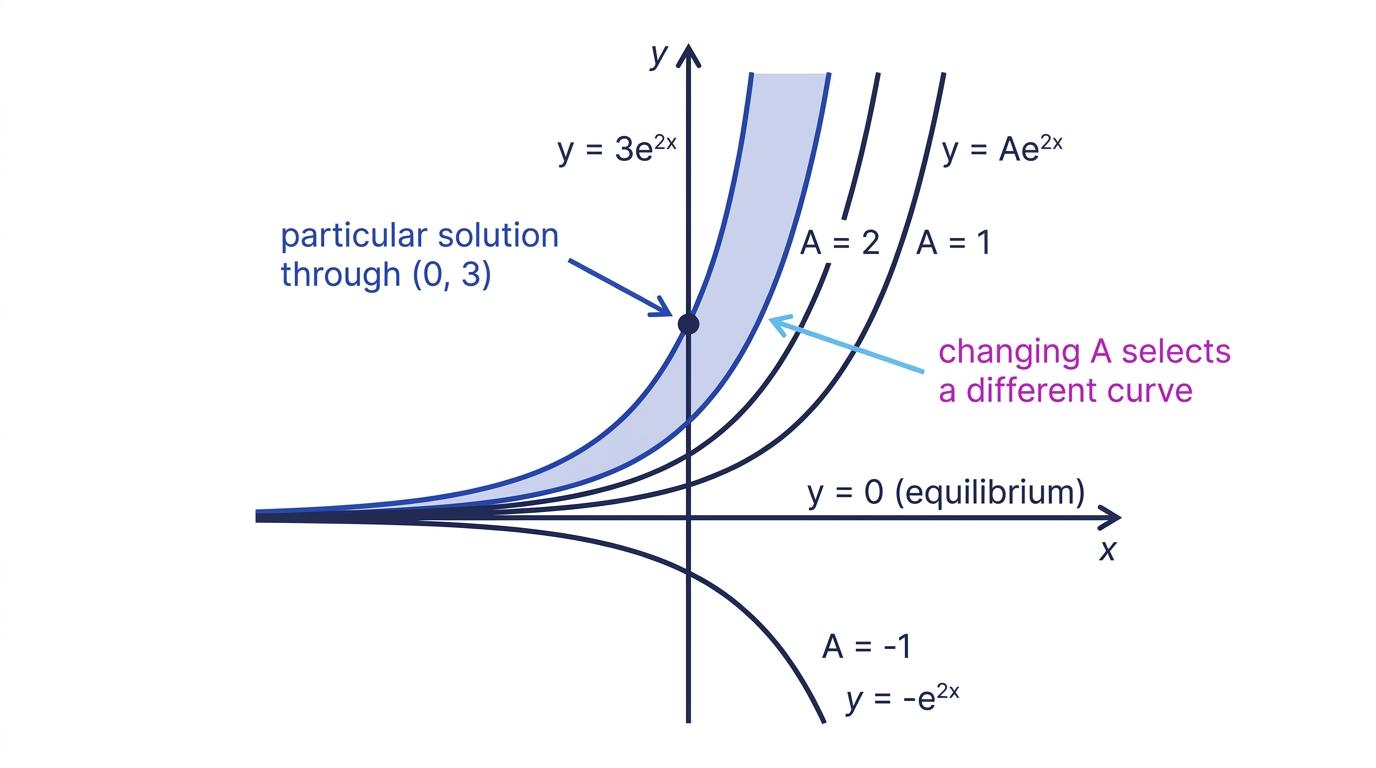
A condition such as y=3y=3y=3 when x=0x=0x=0 identifies one curve from this family. This is often called an initial condition, even when the variables do not represent time.
Particular solution
A particular solution is obtained when the arbitrary constant has been determined using a given condition.
The graph shows how the condition (0,3)(0,3)(0,3) selects one member of the family y=Ae2xy=Ae^{2x}y=Ae2x.
Using an initial condition
Given that
dydx=2y\frac{dy}{dx}=2ydxdy=2yand y=3y=3y=3 when x=0x=0x=0, find the particular solution.
-
Separate and integrate:
1y dy=2 dxln∣y∣=2x+C\begin{aligned} \frac{1}{y}\,dy&=2\,dx\\ \ln|y|&=2x+C \end{aligned}y1dyln∣y∣=2dx=2x+C -
Substitute the condition x=0x=0x=0, y=3y=3y=3 into the logarithmic form:
ln3=C\ln 3=Cln3=C -
Substitute this value and exponentiate:
lny=2x+ln3y=e2x+ln3y=3e2x\begin{aligned} \ln y&=2x+\ln 3\\ y&=e^{2x+\ln 3}\\ y&=3e^{2x} \end{aligned}lnyyy=2x+ln3=e2x+ln3=3e2x
Use the condition early
You can often substitute the initial condition immediately after integrating. This may be simpler than first rearranging the general solution into an explicit formula for yyy.
Factorising before separation
A differential equation may not initially look separable. You may first need to take out a common factor.
For example:
dydx=xy+x\frac{dy}{dx}=xy+xdxdy=xy+xThe right-hand side has a common factor of xxx:
xy+x=x(y+1)xy+x=x(y+1)xy+x=x(y+1)The equation is now visibly separable.
Separating after factorisation
Solve:
dydx=xy+x\frac{dy}{dx}=xy+xdxdy=xy+x-
Factorise the right-hand side:
dydx=x(y+1)\frac{dy}{dx}=x(y+1)dxdy=x(y+1) -
Separate the variables:
1y+1 dy=x dx\frac{1}{y+1}\,dy=x\,dxy+11dy=xdx -
Integrate both sides:
∫1y+1 dy=∫x dxln∣y+1∣=x22+C\begin{aligned} \int\frac{1}{y+1}\,dy&=\int x\,dx\\ \ln|y+1|&=\frac{x^2}{2}+C \end{aligned}∫y+11dyln∣y+1∣=∫xdx=2x2+C -
Exponentiate and absorb the sign and eCe^CeC into a constant AAA:
y+1=Aex2/2y=Aex2/2−1\begin{aligned} y+1&=Ae^{x^2/2}\\ y&=Ae^{x^2/2}-1 \end{aligned}y+1y=Aex2/2=Aex2/2−1
Missing the common factor
The expression xy+xxy+xxy+x is not a sum that should be separated term by term. Factorise it as x(y+1)x(y+1)x(y+1) before rearranging.
Check for solutions lost by division
When you divide by an expression involving yyy, check whether that expression could equal zero.
In the previous equation, separation involved division by y+1y+1y+1. If y+1=0y+1=0y+1=0, then y=−1y=-1y=−1. Substituting this into the original equation gives:
dydx=0\frac{dy}{dx}=0dxdy=0and
xy+x=x(−1)+x=0xy+x=x(-1)+x=0xy+x=x(−1)+x=0Therefore, y=−1y=-1y=−1 is also a solution. It is called an equilibrium solution because its value remains constant.
Division can remove a solution
Before dividing by f(y)f(y)f(y), test the values satisfying f(y)=0f(y)=0f(y)=0 in the original differential equation. They may give constant solutions that must be stated separately.
In the form y=Aex2/2−1y=Ae^{x^2/2}-1y=Aex2/2−1, the equilibrium solution is recovered by allowing A=0A=0A=0, although the logarithmic working itself assumed y+1≠0y+1\neq0y+1=0.
Solutions involving powers
Not every separable equation produces logarithms. The result depends on the expression you integrate.
Finding a solution involving a square
Solve
dydx=xy\frac{dy}{dx}=\frac{x}{y}dxdy=yxgiven that y=2y=2y=2 when x=0x=0x=0.
-
Multiply by y dxy\,dxydx to separate the variables:
y dy=x dxy\,dy=x\,dxydy=xdx -
Integrate both sides:
∫y dy=∫x dxy22=x22+C\begin{aligned} \int y\,dy&=\int x\,dx\\ \frac{y^2}{2}&=\frac{x^2}{2}+C \end{aligned}∫ydy2y2=∫xdx=2x2+C -
Substitute x=0x=0x=0 and y=2y=2y=2:
222=C\frac{2^2}{2}=C222=Cso C=2C=2C=2.
-
Rearrange and choose the branch consistent with the condition y=2y=2y=2:
y2=x2+4y=x2+4\begin{aligned} y^2&=x^2+4\\ y&=\sqrt{x^2+4} \end{aligned}y2y=x2+4=x2+4
Forgetting the correct square-root branch
From y2=x2+4y^2=x^2+4y2=x2+4, the algebraic possibilities are y=±x2+4y=\pm\sqrt{x^2+4}y=±x2+4. The condition y=2y=2y=2 when x=0x=0x=0 selects the positive branch.
Checking your solution
Differentiate your final answer and compare it with the original differential equation.
For example, if
y=3e2x,y=3e^{2x},y=3e2x,then
dydx=6e2x.\frac{dy}{dx}=6e^{2x}.dxdy=6e2x.Also,
2y=2(3e2x)=6e2x.2y=2\left(3e^{2x}\right)=6e^{2x}.2y=2(3e2x)=6e2x.Therefore, dydx=2y\frac{dy}{dx}=2ydxdy=2y, as required.
A reliable final check
Verify both parts: your function must satisfy the differential equation and, for a particular solution, it must satisfy the given condition.
In the exam
- Factorise first if this allows the equation to be written as a product of an xxx-expression and a yyy-expression.
- Separate completely before integrating, keeping dydydy with the yyy-expression and dxdxdx with the xxx-expression.
- Include an arbitrary constant once, then use any given condition to find it.
- Check values excluded when you divide by an expression involving yyy.
- Differentiate your final answer to confirm that it satisfies the original equation.
Check yourself
- Can you solve dydx=x(1+y)\frac{dy}{dx}=x(1+y)dxdy=x(1+y) and state any equilibrium solution?
- How would you use the condition y=4y=4y=4 when x=1x=1x=1 to obtain a particular solution?
- Why must you be careful before dividing a differential equation by yyy or by y+1y+1y+1?
