

What you'll learn
- How the second derivative describes the shape of a curve.
- How to identify intervals where a curve is convex or concave.
- How to find and verify points of inflection.
- Why solving f′′(x)=0f''(x)=0f′′(x)=0 is not enough on its own.
Prerequisite: the first and second derivatives
For a function y=f(x)y=f(x)y=f(x), the first derivative f′(x)f'(x)f′(x) gives the gradient of the curve at each value of xxx.
The second derivative is obtained by differentiating again:
f′′(x)=ddx(f′(x))f''(x)=\frac{\mathrm{d}}{\mathrm{d}x}\left(f'(x)\right)f′′(x)=dxd(f′(x))It tells you how the gradient itself is changing.
- If f′′(x)>0f''(x)>0f′′(x)>0, the gradients are increasing as you move from left to right.
- If f′′(x)<0f''(x)<0f′′(x)<0, the gradients are decreasing as you move from left to right.
- If f′′(x)=0f''(x)=0f′′(x)=0, the gradient is momentarily not changing. This gives a possible boundary between different types of curvature.
Meaning of the second derivative
The sign of f′′(x)f''(x)f′′(x) describes how the curve bends, because it tells you whether the tangent gradients are increasing or decreasing.
Calculating a second derivative
Find the first and second derivatives of f(x)=2x4−5x3+3xf(x)=2x^4-5x^3+3xf(x)=2x4−5x3+3x.
-
Differentiate each term to find the gradient function:
f′(x)=8x3−15x2+3f'(x)=8x^3-15x^2+3f′(x)=8x3−15x2+3 -
Differentiate the gradient function:
f′′(x)=24x2−30xf''(x)=24x^2-30xf′′(x)=24x2−30x -
The expression 24x2−30x24x^2-30x24x2−30x can now be used to determine where the graph is convex or concave.
Convex curves
Convex
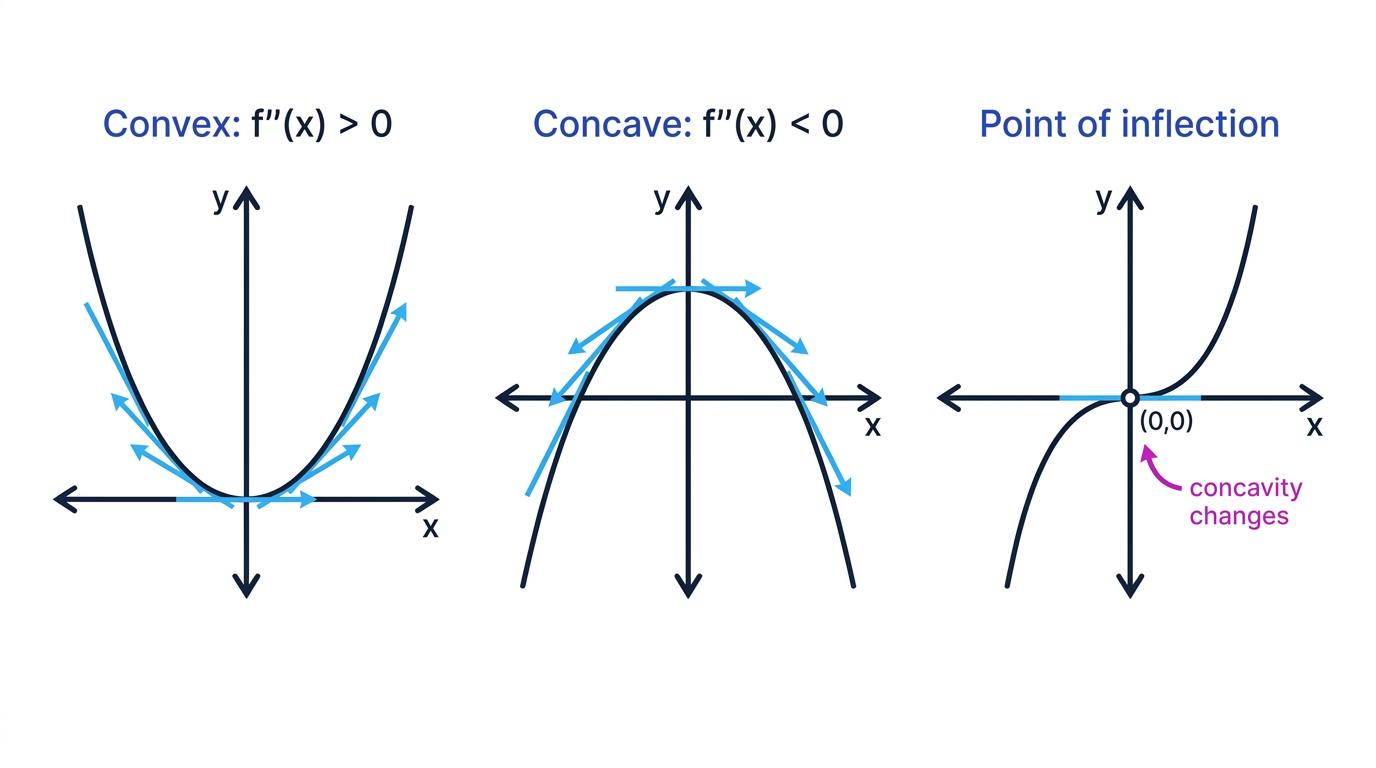
A section of a curve is convex when its tangent gradients increase as xxx increases. For a twice-differentiable function, this occurs where f′′(x)>0f''(x)>0f′′(x)>0.
A convex curve bends upwards, like a bowl. The gradients may still be negative, but they must be becoming more positive.
For example, on the left side of y=x2y=x^2y=x2, the gradient changes from a large negative value towards zero. On the right side, it changes from zero to increasingly positive values. In both cases, the gradient is increasing.
Concave curves
Concave
A section of a curve is concave when its tangent gradients decrease as xxx increases. For a twice-differentiable function, this occurs where f′′(x)<0f''(x)<0f′′(x)<0.
A concave curve bends downwards, like an upside-down bowl. The gradients might be positive or negative; what matters is that they are decreasing.
A quick visual check
Convex means “bowl-shaped” and f′′(x)>0f''(x)>0f′′(x)>0; concave means “cap-shaped” and f′′(x)<0f''(x)<0f′′(x)<0.
Finding convex and concave intervals
Determine where f(x)=x3−3x2−9xf(x)=x^3-3x^2-9xf(x)=x3−3x2−9x is convex and where it is concave.
-
Differentiate twice:
f′(x)=3x2−6x−9,f′′(x)=6x−6.\begin{aligned} f'(x)&=3x^2-6x-9,\\ f''(x)&=6x-6. \end{aligned}f′(x)f′′(x)=3x2−6x−9,=6x−6. -
Find where the second derivative could change sign:
6x−6=0⇒x=16x-6=0 \Rightarrow x=16x−6=0⇒x=1 -
For x<1x<1x<1, choose a test value such as x=0x=0x=0:
f′′(0)=−6<0f''(0)=-6<0f′′(0)=−6<0Therefore, the curve is concave when x<1x<1x<1.
-
For x>1x>1x>1, choose a test value such as x=2x=2x=2:
f′′(2)=6>0f''(2)=6>0f′′(2)=6>0Therefore, the curve is convex when x>1x>1x>1.
Confusing gradient with curvature
The sign of f′(x)f'(x)f′(x) tells you whether the function is increasing or decreasing. The sign of f′′(x)f''(x)f′′(x) tells you whether the gradient is increasing or decreasing, and hence whether the curve is convex or concave.
Points of inflection
Point of inflection
A point of inflection is a point on a curve where the concavity changes: from convex to concave, or from concave to convex.
If f′′(x)f''(x)f′′(x) is continuous near the point, a point of inflection is usually found by:
- solving f′′(x)=0f''(x)=0f′′(x)=0 to obtain candidate values;
- checking the sign of f′′(x)f''(x)f′′(x) on either side;
- confirming that the sign changes;
- substituting into f(x)f(x)f(x) to find the coordinate.
The direction of the sign change tells you how the curvature changes:
- Negative to positive: concave to convex.
- Positive to negative: convex to concave.
The essential test
A point is an inflection point only if the concavity changes there. The equation f′′(x)=0f''(x)=0f′′(x)=0 identifies candidates, not guaranteed points of inflection.
Finding two points of inflection
Find the points of inflection of f(x)=x4−4x3f(x)=x^4-4x^3f(x)=x4−4x3 and state the concavity on each interval.
-
Differentiate twice:
f′(x)=4x3−12x2,f′′(x)=12x2−24x=12x(x−2).\begin{aligned} f'(x)&=4x^3-12x^2,\\ f''(x)&=12x^2-24x\\ &=12x(x-2). \end{aligned}f′(x)f′′(x)=4x3−12x2,=12x2−24x=12x(x−2). -
Find the candidate values by solving f′′(x)=0f''(x)=0f′′(x)=0:
12x(x−2)=012x(x-2)=012x(x−2)=0Therefore, x=0x=0x=0 or x=2x=2x=2.
-
Check the sign of f′′(x)f''(x)f′′(x) in the three intervals:
- For x<0x<0x<0, use x=−1x=-1x=−1: f′′(−1)=36>0f''(-1)=36>0f′′(−1)=36>0, so the curve is convex.
- For 0<x<20<x<20<x<2, use x=1x=1x=1: f′′(1)=−12<0f''(1)=-12<0f′′(1)=−12<0, so the curve is concave.
- For x>2x>2x>2, use x=3x=3x=3: f′′(3)=36>0f''(3)=36>0f′′(3)=36>0, so the curve is convex.
-
The sign changes at both candidate values:
- At x=0x=0x=0, the sign changes from positive to negative.
- At x=2x=2x=2, the sign changes from negative to positive.
Both values therefore give points of inflection.
-
Find the corresponding coordinates:
f(0)=0f(0)=0f(0)=0and
f(2)=24−4(23)=−16.f(2)=2^4-4(2^3)=-16.f(2)=24−4(23)=−16.The points of inflection are (0,0)(0,0)(0,0) and (2,−16)(2,-16)(2,−16).
When f′′(x)=0f''(x)=0f′′(x)=0 is not enough
Consider f(x)=x4f(x)=x^4f(x)=x4. Its second derivative is
f′′(x)=12x2.f''(x)=12x^2.f′′(x)=12x2.Solving f′′(x)=0f''(x)=0f′′(x)=0 gives x=0x=0x=0. However, 12x212x^212x2 is positive on both sides of zero, so the curve remains convex.
Therefore, the origin is not a point of inflection.
Stopping after solving the equation
Do not conclude that every solution of f′′(x)=0f''(x)=0f′′(x)=0 is a point of inflection. Check that f′′(x)f''(x)f′′(x) changes sign across the candidate value.
Second derivative may be undefined
In some functions, concavity can change at a point where f′′(x)f''(x)f′′(x) does not exist. The definition is based on a change in concavity, not solely on the equation f′′(x)=0f''(x)=0f′′(x)=0.
Stationary and non-stationary inflection points
A stationary point is a point where f′(x)=0f'(x)=0f′(x)=0, so its tangent is horizontal.
A point of inflection may be either stationary or non-stationary:
- A stationary point of inflection has changing concavity and f′(x)=0f'(x)=0f′(x)=0.
- A non-stationary point of inflection has changing concavity but f′(x)≠0f'(x)\neq0f′(x)=0.
Classifying an inflection point
Classify the point of inflection of f(x)=x3+xf(x)=x^3+xf(x)=x3+x.
-
Differentiate twice:
f′(x)=3x2+1,f′′(x)=6x.f'(x)=3x^2+1,\qquad f''(x)=6x.f′(x)=3x2+1,f′′(x)=6x. -
Solve f′′(x)=0f''(x)=0f′′(x)=0, giving x=0x=0x=0. Since 6x6x6x is negative for x<0x<0x<0 and positive for x>0x>0x>0, the concavity changes and there is a point of inflection.
-
Evaluate the first derivative:
f′(0)=1≠0.f'(0)=1\neq0.f′(0)=1=0.The tangent is not horizontal, so this is a non-stationary point of inflection at (0,0)(0,0)(0,0).
In the exam
- Differentiate twice and solve f′′(x)=0f''(x)=0f′′(x)=0 to find candidate values.
- Test the sign of f′′(x)f''(x)f′′(x) on both sides of every candidate; show these tests clearly.
- State the convex and concave intervals using inequalities, then substitute into f(x)f(x)f(x) if point coordinates are required.
- If asked to classify an inflection point, also calculate f′(x)f'(x)f′(x) to decide whether it is stationary.
Check yourself
- What does the sign of f′′(x)f''(x)f′′(x) tell you about the tangent gradients and the shape of the curve?
- Why does f′′(a)=0f''(a)=0f′′(a)=0 not necessarily mean that x=ax=ax=a gives a point of inflection?
- How would you distinguish a stationary point of inflection from a non-stationary one?
