

What you'll learn
- How to represent displacement, velocity and acceleration as two-dimensional vectors.
- How to extend the constant-acceleration formulae to vector form.
- How to solve motion separately in horizontal and vertical directions.
- How to model projectiles when gravity is the only acceleration.
Prerequisites: vectors and components
A vector is a quantity with both magnitude and direction. Displacement, velocity and acceleration are all vectors, so they may be written using column vectors.
For example,
u=(68) m s−1\mathbf{u}= \begin{pmatrix} 6\\ 8 \end{pmatrix} \text{ m s}^{-1}u=(68) m s−1means that the initial velocity has a horizontal component of 6 m s⁻¹ and a vertical component of 8 m s⁻¹.
The letters i\mathbf{i}i and j\mathbf{j}j can also represent unit vectors in the positive horizontal and vertical directions:
u=6i+8j m s−1.\mathbf{u}=6\mathbf{i}+8\mathbf{j}\text{ m s}^{-1}.u=6i+8j m s−1.These two forms mean exactly the same thing.
Vector components
The components of a vector are its effects in chosen perpendicular directions, usually the horizontal xxx-direction and vertical yyy-direction.
The magnitude of a two-dimensional vector
v=(vxvy)\mathbf{v}= \begin{pmatrix} v_x\\ v_y \end{pmatrix}v=(vxvy)is found using Pythagoras:
∣v∣=vx2+vy2.|\mathbf{v}|=\sqrt{v_x^2+v_y^2}.∣v∣=vx2+vy2.For a velocity vector, this magnitude is the object's speed.
If θ\thetaθ is the direction measured anticlockwise from the positive horizontal direction, then
tanθ=vyvx.\tan\theta=\frac{v_y}{v_x}.tanθ=vxvy.You must use the signs of the components, or a sketch, to place the direction in the correct quadrant.
Finding speed and direction from velocity
An object has velocity v=5i+12j m s−1\mathbf{v}=5\mathbf{i}+12\mathbf{j}\text{ m s}^{-1}v=5i+12j m s−1. Find its speed and direction.
-
Use the magnitude formula to find the speed:
∣v∣=52+122=13 m s−1.|\mathbf{v}|=\sqrt{5^2+12^2}=13\text{ m s}^{-1}.∣v∣=52+122=13 m s−1. -
Since both components are positive, the velocity points up and to the right. Its direction above the horizontal satisfies
tanθ=125.\tan\theta=\frac{12}{5}.tanθ=512. -
Therefore,
θ=tan−1(125)≈67.4∘.\theta=\tan^{-1}\left(\frac{12}{5}\right)\approx67.4^\circ.θ=tan−1(512)≈67.4∘.The velocity is 13 m s⁻¹ at approximately 67.4∘67.4^\circ67.4∘ above the horizontal.
Velocity is not speed
Velocity is a vector, but speed is its scalar magnitude. Do not give a column vector when the question asks for speed.
Constant acceleration in vector form
Constant acceleration means that the acceleration vector remains unchanged in both magnitude and direction.
The familiar one-dimensional constant-acceleration formulae extend directly to vectors:
v=u+at,\mathbf{v}=\mathbf{u}+\mathbf{a}t,v=u+at, s=ut+12at2,\mathbf{s}=\mathbf{u}t+\frac{1}{2}\mathbf{a}t^2,s=ut+21at2, s=12(u+v)t,\mathbf{s}=\frac{1}{2}(\mathbf{u}+\mathbf{v})t,s=21(u+v)t,and
∣v∣2=∣u∣2+2a⋅s.|\mathbf{v}|^2=|\mathbf{u}|^2+2\mathbf{a}\cdot\mathbf{s}.∣v∣2=∣u∣2+2a⋅s.Here:
- u\mathbf{u}u is initial velocity.
- v\mathbf{v}v is velocity after time ttt.
- a\mathbf{a}a is constant acceleration.
- s\mathbf{s}s is displacement during the time interval.
- a⋅s\mathbf{a}\cdot\mathbf{s}a⋅s is the scalar product of acceleration and displacement.
The last equation uses a scalar product because acceleration and displacement may point in different directions. In components,
a⋅s=axsx+aysy.\mathbf{a}\cdot\mathbf{s}=a_xs_x+a_ys_y.a⋅s=axsx+aysy.One vector equation contains two scalar equations
A two-dimensional vector equation is equivalent to one equation for the horizontal components and another for the vertical components. The same time ttt appears in both because both parts describe the same moving object.
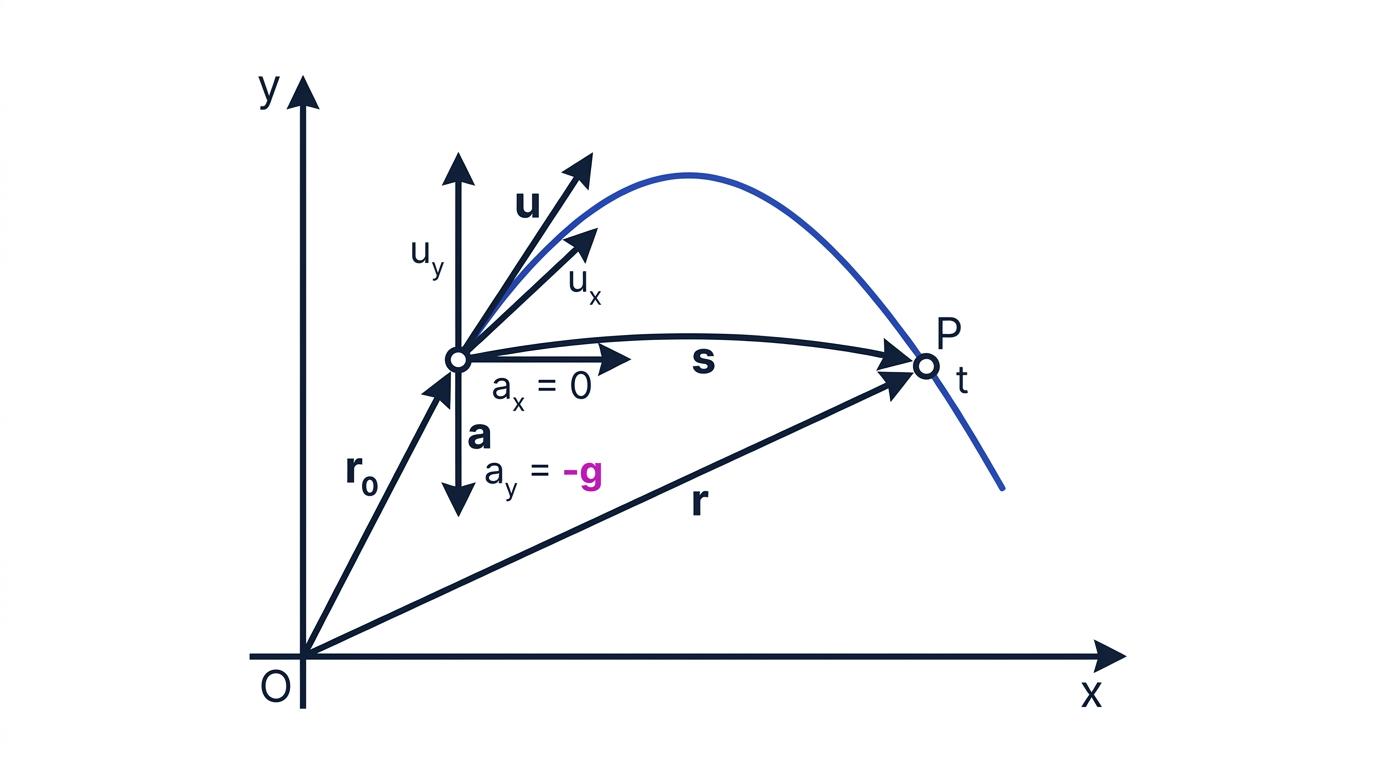
Finding velocity and displacement
If the initial velocity and constant acceleration are known, use
v=u+at\mathbf{v}=\mathbf{u}+\mathbf{a}tv=u+atto find velocity and
s=ut+12at2\mathbf{s}=\mathbf{u}t+\frac{1}{2}\mathbf{a}t^2s=ut+21at2to find displacement from the initial position.
Motion with a constant acceleration vector
A particle has initial velocity
u=(4−1) m s−1\mathbf{u}= \begin{pmatrix} 4\\ -1 \end{pmatrix} \text{ m s}^{-1}u=(4−1) m s−1and constant acceleration
a=(23) m s−2.\mathbf{a}= \begin{pmatrix} 2\\ 3 \end{pmatrix} \text{ m s}^{-2}.a=(23) m s−2.Find its velocity and displacement after 4 seconds.
-
Substitute into v=u+at\mathbf{v}=\mathbf{u}+\mathbf{a}tv=u+at:
v=(4−1)+4(23)=(1211) m s−1.\begin{aligned} \mathbf{v} &= \begin{pmatrix} 4\\ -1 \end{pmatrix} + 4\begin{pmatrix} 2\\ 3 \end{pmatrix}\\ &= \begin{pmatrix} 12\\ 11 \end{pmatrix} \text{ m s}^{-1}. \end{aligned}v=(4−1)+4(23)=(1211) m s−1. -
Substitute into s=ut+12at2\mathbf{s}=\mathbf{u}t+\frac{1}{2}\mathbf{a}t^2s=ut+21at2:
s=4(4−1)+12(42)(23)=(16−4)+(1624)=(3220) m.\begin{aligned} \mathbf{s} &= 4\begin{pmatrix} 4\\ -1 \end{pmatrix} +\frac{1}{2}(4^2) \begin{pmatrix} 2\\ 3 \end{pmatrix}\\ &= \begin{pmatrix} 16\\ -4 \end{pmatrix} + \begin{pmatrix} 16\\ 24 \end{pmatrix}\\ &= \begin{pmatrix} 32\\ 20 \end{pmatrix} \text{ m}. \end{aligned}s=4(4−1)+21(42)(23)=(16−4)+(1624)=(3220) m. -
Interpret the vectors: after 4 seconds, the particle is moving right and upwards, and it has moved 32 m horizontally and 20 m vertically from its initial position.
Position vectors
A position vector gives an object's position relative to a fixed origin.
If its initial position vector is r0\mathbf{r}_0r0 and its displacement after time ttt is s\mathbf{s}s, then its new position vector is
r=r0+s.\mathbf{r}=\mathbf{r}_0+\mathbf{s}.r=r0+s.Therefore, under constant acceleration,
r=r0+ut+12at2.\mathbf{r}=\mathbf{r}_0+\mathbf{u}t+\frac{1}{2}\mathbf{a}t^2.r=r0+ut+21at2.Position and displacement
The expression ut+12at2\mathbf{u}t+\frac{1}{2}\mathbf{a}t^2ut+21at2 gives displacement from the starting point. Add r0\mathbf{r}_0r0 if the question asks for position relative to an origin.
Projectiles
A projectile is an object moving freely under gravity after it has been launched. Air resistance is usually ignored.
Taking upwards as positive, its acceleration is
a=(0−g),\mathbf{a}= \begin{pmatrix} 0\\ -g \end{pmatrix},a=(0−g),where g=9.8 m s−2g=9.8\text{ m s}^{-2}g=9.8 m s−2 unless stated otherwise.
This means:
- Horizontal acceleration is zero, so horizontal velocity is constant.
- Vertical acceleration is −g-g−g, so vertical velocity changes with time.
If an object is projected with speed UUU at angle α\alphaα above the horizontal, its initial velocity components are
u=(UcosαUsinα).\mathbf{u}= \begin{pmatrix} U\cos\alpha\\ U\sin\alpha \end{pmatrix}.u=(UcosαUsinα).Hence its displacement after time ttt is
s=(Ucosα tUsinα t−12gt2),\mathbf{s}= \begin{pmatrix} U\cos\alpha\,t\\ U\sin\alpha\,t-\frac{1}{2}gt^2 \end{pmatrix},s=(UcosαtUsinαt−21gt2),and its velocity is
v=(UcosαUsinα−gt).\mathbf{v}= \begin{pmatrix} U\cos\alpha\\ U\sin\alpha-gt \end{pmatrix}.v=(UcosαUsinα−gt).At the highest point
At the highest point, the vertical velocity is zero, but the horizontal velocity is usually not zero. The projectile is still moving.
Finding a projectile's maximum height
A ball is projected from ground level at 20 m s⁻¹ at an angle of 30∘30^\circ30∘ above the horizontal. Find the time taken to reach its highest point and its maximum height.
-
Resolve the initial velocity. The vertical component is
uy=20sin30∘=10 m s−1.u_y=20\sin30^\circ=10\text{ m s}^{-1}.uy=20sin30∘=10 m s−1. -
At maximum height, vy=0v_y=0vy=0. Apply vy=uy−gtv_y=u_y-gtvy=uy−gt:
0=10−9.8t,0=10-9.8t,0=10−9.8t,so
t=109.8=5049 s.t=\frac{10}{9.8}=\frac{50}{49}\text{ s}.t=9.810=4950 s. -
Use the vertical displacement formula:
y=10(5049)−12(9.8)(5049)2=25049 m.\begin{aligned} y &=10\left(\frac{50}{49}\right) -\frac{1}{2}(9.8)\left(\frac{50}{49}\right)^2\\ &=\frac{250}{49}\text{ m}. \end{aligned}y=10(4950)−21(9.8)(4950)2=49250 m.The maximum height is 25049 m\frac{250}{49}\text{ m}49250 m, approximately 5.10 m.
Forming and solving component equations
Many problems give a condition such as:
- the particle reaches a particular point;
- the particle returns to its initial height;
- its velocity is parallel or perpendicular to a given vector;
- its speed has a specified value.
Write the relevant vector equation, then compare components.
For example, if
(xy)=(3t8t−4.9t2),\begin{pmatrix} x\\ y \end{pmatrix} = \begin{pmatrix} 3t\\ 8t-4.9t^2 \end{pmatrix},(xy)=(3t8t−4.9t2),then x=3tx=3tx=3t and y=8t−4.9t2y=8t-4.9t^2y=8t−4.9t2. A condition on height gives an equation in ttt using the second component.
Two possible times
A projectile can pass through the same height once while rising and again while falling. A quadratic equation may therefore produce two valid positive times.
In the exam
- Define positive horizontal and vertical directions, then keep the signs consistent.
- Resolve any angled velocity into components before using the constant-acceleration formulae.
- Use the same time in both component equations and check whether every positive solution is physically relevant.
- Distinguish carefully between displacement, position, velocity and speed.
- Include vector notation and SI units, and keep exact values until a decimal answer is requested.
Check yourself
- How would you find the speed and direction from a velocity column vector?
- Why is the horizontal velocity of a projectile constant when air resistance is ignored?
- What condition would you use to find when a projectile reaches its maximum height?
