

What you'll learn
- How displacement, velocity and acceleration describe motion in a straight line.
- How to derive the constant acceleration formulae from definitions and a velocity–time graph.
- How to choose and use the correct formula for a problem.
- How to handle signs, stopping, changing direction and vertical motion.
The quantities used in kinematics
Kinematics is the study of motion without considering the forces causing it. Here, motion takes place along a straight line, so one direction can be chosen as positive and the opposite direction as negative.
The five quantities used in constant-acceleration problems are often called the SUVAT variables:
- sss is the displacement, measured in metres (m).
- uuu is the initial velocity, measured in m s⁻¹.
- vvv is the final velocity, measured in m s⁻¹.
- aaa is the constant acceleration, measured in m s⁻².
- ttt is the elapsed time, measured in seconds (s).
Displacement and velocity
Displacement is the change in position in a specified direction. Velocity is the rate of change of displacement, so it also has a direction. Distance and speed, by contrast, are scalar quantities and have no direction.
Constant acceleration
Constant acceleration means that velocity changes by equal amounts in equal time intervals. The acceleration has one fixed value throughout the period being modelled.
Choosing a positive direction
Before calculating, choose one direction as positive. Every displacement, velocity and acceleration must then use signs consistent with that choice.
For example, if upwards is positive, a falling object's velocity is negative and its acceleration is −9.8 m s−2-9.8\text{ m s}^{-2}−9.8 m s−2.
Interpreting signed motion
A particle has initial velocity u=12 m s−1u=12\text{ m s}^{-1}u=12 m s−1 and acceleration a=−3 m s−2a=-3\text{ m s}^{-2}a=−3 m s−2.
- The positive initial velocity means that the particle initially moves in the chosen positive direction.
- Acceleration has the opposite sign to velocity, so the particle's velocity decreases by 3 m s−13\text{ m s}^{-1}3 m s−1 each second.
- After 4 seconds, its velocity reaches zero. If the same acceleration continues, the velocity then becomes negative, meaning that the particle reverses direction.
Negative acceleration
Negative acceleration does not automatically mean slowing down. An object slows down only when its velocity and acceleration have opposite signs.
Deriving the first formula
Acceleration is the rate of change of velocity. For constant acceleration,
a=v−ut.a=\frac{v-u}{t}.a=tv−u.Rearranging gives the first constant acceleration formula:
v=u+at.\boxed{v=u+at}.v=u+at.This tells you how the velocity changes after time ttt.
Finding the velocity
A train travels at 18 m s−118\text{ m s}^{-1}18 m s−1 and accelerates uniformly at 1.5 m s−21.5\text{ m s}^{-2}1.5 m s−2 for 8 seconds. Find its final velocity.
-
Identify u=18u=18u=18, a=1.5a=1.5a=1.5 and t=8t=8t=8.
-
Use the formula containing uuu, vvv, aaa and ttt:
v=u+at.v=u+at.v=u+at. -
Substitute:
v=18+1.5(8)=30.v=18+1.5(8)=30.v=18+1.5(8)=30.The final velocity is 30 m s−130\text{ m s}^{-1}30 m s−1.
Displacement from a velocity–time graph
On a velocity–time graph:
- the gradient represents acceleration;
- the signed area between the graph and the time axis represents displacement.
For constant acceleration, velocity changes linearly, so the graph is a straight line.
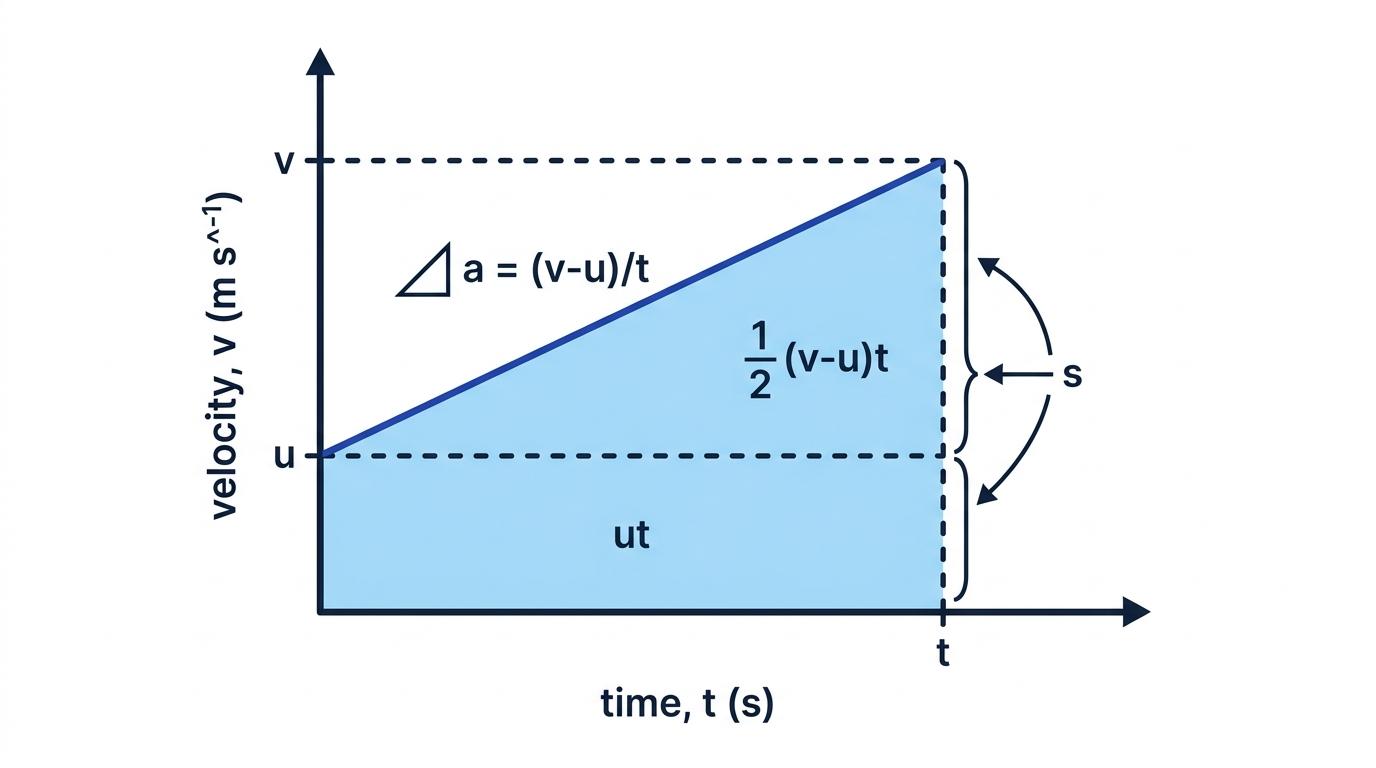
The area under the graph is a rectangle plus a triangle:
s=ut+12(v−u)t=ut+12at2.\begin{aligned} s&=ut+\frac{1}{2}(v-u)t \\ &=ut+\frac{1}{2}at^2. \end{aligned}s=ut+21(v−u)t=ut+21at2.Therefore,
s=ut+12at2.\boxed{s=ut+\frac{1}{2}at^2}.s=ut+21at2.Alternatively, the graph is a trapezium whose parallel sides have lengths uuu and vvv. This gives
s=12(u+v)t.\boxed{s=\frac{1}{2}(u+v)t}.s=21(u+v)t.The quantity u+v2\frac{u+v}{2}2u+v is the average velocity during constant acceleration.
Graph meaning
For constant acceleration, the velocity–time graph is a straight line: its gradient gives acceleration and its signed area gives displacement.
Finding displacement
A cyclist has initial velocity 4 m s−14\text{ m s}^{-1}4 m s−1 and accelerates uniformly at 2 m s−22\text{ m s}^{-2}2 m s−2 for 6 seconds. Find the displacement.
-
The known quantities are u=4u=4u=4, a=2a=2a=2 and t=6t=6t=6, so use
s=ut+12at2.s=ut+\frac{1}{2}at^2.s=ut+21at2. -
Substitute the values:
s=4(6)+12(2)(62).s=4(6)+\frac{1}{2}(2)(6^2).s=4(6)+21(2)(62). -
Calculate:
s=24+36=60.s=24+36=60.s=24+36=60.The cyclist's displacement is 60 m.
Eliminating time
Sometimes time is not given and is not required. We can eliminate ttt from the formulae.
Starting with
v=u+at,v=u+at,v=u+at,we have
t=v−ua.t=\frac{v-u}{a}.t=av−u.Substitute this into s=12(u+v)ts=\frac{1}{2}(u+v)ts=21(u+v)t:
s=12(u+v)v−ua2as=(u+v)(v−u)2as=v2−u2.\begin{aligned} s&=\frac{1}{2}(u+v)\frac{v-u}{a} \\ 2as&=(u+v)(v-u) \\ 2as&=v^2-u^2. \end{aligned}s2as2as=21(u+v)av−u=(u+v)(v−u)=v2−u2.Hence,
v2=u2+2as.\boxed{v^2=u^2+2as}.v2=u2+2as.Calculating a stopping distance
A car travels at 24 m s−124\text{ m s}^{-1}24 m s−1 and brakes with constant acceleration −6 m s−2-6\text{ m s}^{-2}−6 m s−2. Find its displacement before it stops.
-
At the stopping instant, v=0v=0v=0. The known quantities are therefore u=24u=24u=24, v=0v=0v=0 and a=−6a=-6a=−6.
-
Since time is neither known nor needed, use
v2=u2+2as.v^2=u^2+2as.v2=u2+2as. -
Substitute and solve:
02=242+2(−6)s0=576−12ss=48.\begin{aligned} 0^2&=24^2+2(-6)s \\ 0&=576-12s \\ s&=48. \end{aligned}020s=242+2(−6)s=576−12s=48.The stopping displacement is 48 m.
The five formulae
The standard constant acceleration formulae are:
v=u+at,s=ut+12at2,s=vt−12at2,s=12(u+v)t,v2=u2+2as.\begin{aligned} v&=u+at, \\ s&=ut+\frac{1}{2}at^2, \\ s&=vt-\frac{1}{2}at^2, \\ s&=\frac{1}{2}(u+v)t, \\ v^2&=u^2+2as. \end{aligned}vsssv2=u+at,=ut+21at2,=vt−21at2,=21(u+v)t,=u2+2as.The formula s=vt−12at2s=vt-\frac{1}{2}at^2s=vt−21at2 follows by writing u=v−atu=v-atu=v−at and substituting into s=12(u+v)ts=\frac{1}{2}(u+v)ts=21(u+v)t.
Choosing a formula
Each formula omits one SUVAT variable. List what you know, identify what you need, and choose the formula that excludes the remaining unwanted quantity.
- v=u+atv=u+atv=u+at excludes sss.
- s=ut+12at2s=ut+\frac{1}{2}at^2s=ut+21at2 excludes vvv.
- s=vt−12at2s=vt-\frac{1}{2}at^2s=vt−21at2 excludes uuu.
- s=12(u+v)ts=\frac{1}{2}(u+v)ts=21(u+v)t excludes aaa.
- v2=u2+2asv^2=u^2+2asv2=u2+2as excludes ttt.
Selecting efficiently
Write down the five symbols s,u,v,a,ts,u,v,a,ts,u,v,a,t, fill in the known values with signs and circle the required quantity. The best formula contains those quantities but not the unused unknown.
Finding the duration of motion
A particle travels 45 m while accelerating uniformly from 3 m s−13\text{ m s}^{-1}3 m s−1 to 12 m s−112\text{ m s}^{-1}12 m s−1. Find the time taken.
-
The known quantities are s=45s=45s=45, u=3u=3u=3 and v=12v=12v=12. Acceleration is unknown and unnecessary.
-
Choose the formula excluding aaa:
s=12(u+v)t.s=\frac{1}{2}(u+v)t.s=21(u+v)t. -
Substitute and solve:
45=12(3+12)t45=7.5tt=6.\begin{aligned} 45&=\frac{1}{2}(3+12)t \\ 45&=7.5t \\ t&=6. \end{aligned}4545t=21(3+12)t=7.5t=6.The motion lasts 6 seconds.
Solving quadratic equations in time
Using s=ut+12at2s=ut+\frac{1}{2}at^2s=ut+21at2 can produce a quadratic equation. Two positive roots may represent two genuine times at which a particle passes the same position, usually once in each direction.
Returning to the starting point
A particle starts with velocity 14 m s−114\text{ m s}^{-1}14 m s−1 and constant acceleration −2 m s−2-2\text{ m s}^{-2}−2 m s−2. Find when it returns to its starting point.
-
Returning to the starting point means its displacement from that point is s=0s=0s=0. Use
s=ut+12at2.s=ut+\frac{1}{2}at^2.s=ut+21at2. -
Substitute:
0=14t+12(−2)t2=14t−t2.0=14t+\frac{1}{2}(-2)t^2=14t-t^2.0=14t+21(−2)t2=14t−t2. -
Factorise:
t(14−t)=0,t(14-t)=0,t(14−t)=0,giving t=0t=0t=0 or t=14t=14t=14.
-
The root t=0t=0t=0 is the starting instant. Therefore, the particle returns after 14 seconds.
Discarding roots too quickly
Do not automatically reject one root of a quadratic. Check what each root means physically, although negative time is normally outside the model.
Vertical motion under gravity
Near Earth's surface, an object in free flight is modelled with constant downward acceleration of magnitude g=9.8 m s−2g=9.8\text{ m s}^{-2}g=9.8 m s−2.
If upwards is positive, use a=−9.8 m s−2a=-9.8\text{ m s}^{-2}a=−9.8 m s−2. At the highest point, the instantaneous velocity is zero, but the acceleration is still −9.8 m s−2-9.8\text{ m s}^{-2}−9.8 m s−2.
Finding maximum height
A ball is projected vertically upwards at 19.6 m s−119.6\text{ m s}^{-1}19.6 m s−1. Find the maximum height above its launch point.
-
Choose upwards as positive. Then u=19.6u=19.6u=19.6, a=−9.8a=-9.8a=−9.8 and, at maximum height, v=0v=0v=0.
-
Time is not required, so use
v2=u2+2as.v^2=u^2+2as.v2=u2+2as. -
Substitute:
02=19.62+2(−9.8)s.0^2=19.6^2+2(-9.8)s.02=19.62+2(−9.8)s. -
Solve:
s=19.6219.6=19.6.s=\frac{19.6^2}{19.6}=19.6.s=19.619.62=19.6.The maximum height above the launch point is 19.6 m.
When SUVAT does not apply
These formulae require constant acceleration throughout the chosen interval. Do not apply one SUVAT equation across stages with different accelerations; model each stage separately.
In the exam
- Choose a positive direction and attach signs to sss, uuu, vvv and aaa before substituting.
- List the known and required SUVAT variables, then select the formula that omits the unused unknown.
- State special conditions explicitly, such as v=0v=0v=0 at a stopping point or maximum height, and check that roots and units make physical sense.
- Keep exact values during your working and round only at the end if the question requests a decimal.
Check yourself
- Can you derive s=ut+12at2s=ut+\frac{1}{2}at^2s=ut+21at2 from the area under a velocity–time graph?
- Which formula would you choose if time were unknown and not required?
- If upwards is positive, what signs should velocity and acceleration have while an object is falling?
