

What you'll learn
- What conditional probability means and how to calculate it.
- How to use tree diagrams, Venn diagrams and two-way tables.
- How conditional probability connects with intersections and independence.
- How to choose an efficient method for a given problem.
Probability language you need
An event is a set of possible outcomes. For example, when rolling a fair die, the event “even number” is the set {2,4,6}\{2,4,6\}{2,4,6}.
The sample space is the set of all possible outcomes.
If AAA and BBB are events, their intersection, written A∩BA\cap BA∩B, is the event that both AAA and BBB occur.
Their union, written A∪BA\cup BA∪B, is the event that at least one of AAA or BBB occurs, including the possibility that both occur.
For any two events,
P(A∪B)=P(A)+P(B)−P(A∩B).P(A\cup B)=P(A)+P(B)-P(A\cap B).P(A∪B)=P(A)+P(B)−P(A∩B).The intersection is subtracted because outcomes in both events were counted twice.
What is conditional probability?
Sometimes you are given extra information that reduces the possible outcomes. A conditional probability is a probability calculated using this restricted sample space.
The notation P(A∣B)P(A\mid B)P(A∣B) means:
the probability that AAA occurs, given that BBB has occurred.
The vertical line is read as “given”.
Conditional probability
Provided P(B)>0P(B)>0P(B)>0,
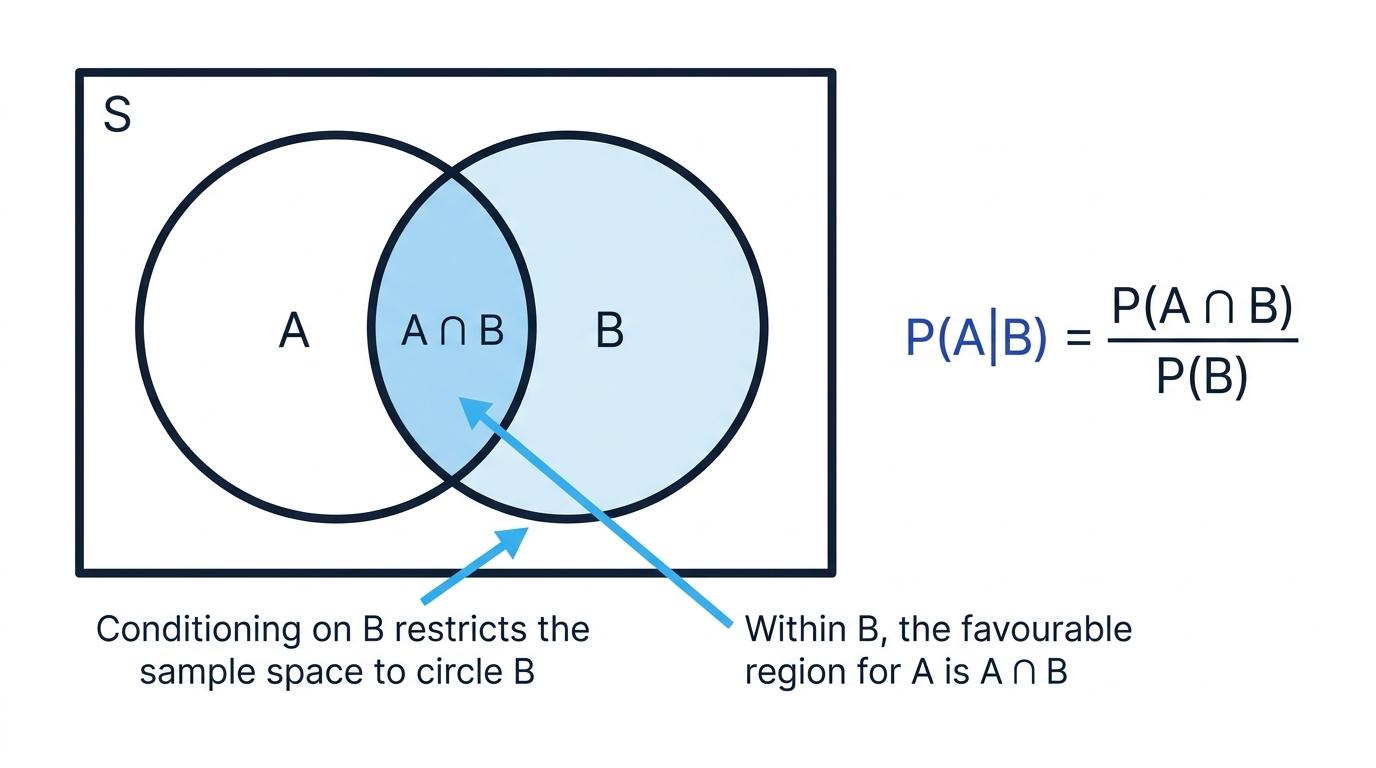
P(A∣B)=P(A∩B)P(B).P(A\mid B)=\frac{P(A\cap B)}{P(B)}.P(A∣B)=P(B)P(A∩B).The denominator is the probability of the event you are given, while the numerator is the probability that both events occur.
Conditioning on BBB means that you ignore everything outside BBB. Within this smaller sample space, the favourable region for AAA is A∩BA\cap BA∩B.
Finding a conditional probability from event probabilities
Suppose P(A)=0.6P(A)=0.6P(A)=0.6, P(B)=0.5P(B)=0.5P(B)=0.5 and P(A∩B)=0.3P(A\cap B)=0.3P(A∩B)=0.3. Find P(A∣B)P(A\mid B)P(A∣B).
-
Since the condition is BBB, use P(B)P(B)P(B) as the denominator:
P(A∣B)=P(A∩B)P(B).P(A\mid B)=\frac{P(A\cap B)}{P(B)}.P(A∣B)=P(B)P(A∩B). -
Substitute the given probabilities:
P(A∣B)=0.30.5.P(A\mid B)=\frac{0.3}{0.5}.P(A∣B)=0.50.3. -
Simplify to obtain:
P(A∣B)=0.6.P(A\mid B)=0.6.P(A∣B)=0.6.
Reversing the condition
In general, P(A∣B)≠P(B∣A)P(A\mid B)\neq P(B\mid A)P(A∣B)=P(B∣A). The event after the vertical line determines the restricted sample space and therefore the denominator.
The multiplication rule
Rearranging the conditional probability formula gives the multiplication rule:
P(A∩B)=P(B)P(A∣B).P(A\cap B)=P(B)P(A\mid B).P(A∩B)=P(B)P(A∣B).Equally, by conditioning the other way,
P(A∩B)=P(A)P(B∣A).P(A\cap B)=P(A)P(B\mid A).P(A∩B)=P(A)P(B∣A).These expressions calculate the same intersection, so you can use whichever contains the information available.
Along means multiply
When events happen along one complete route, multiply their probabilities. In symbols, the probability that AAA occurs and then BBB occurs is P(A)P(B∣A)P(A)P(B\mid A)P(A)P(B∣A).
Using the multiplication rule
A college reports that 55% of its students study mathematics. Of the students who study mathematics, 40% also study physics. Find the probability that a randomly selected student studies both subjects.
-
Let MMM be the event “studies mathematics” and FFF be the event “studies physics”. The information gives P(M)=0.55P(M)=0.55P(M)=0.55 and P(F∣M)=0.40P(F\mid M)=0.40P(F∣M)=0.40.
-
Apply the multiplication rule:
P(M∩F)=P(M)P(F∣M).P(M\cap F)=P(M)P(F\mid M).P(M∩F)=P(M)P(F∣M). -
Calculate:
P(M∩F)=0.55×0.40=0.22.P(M\cap F)=0.55\times 0.40=0.22.P(M∩F)=0.55×0.40=0.22.Therefore, the probability is 0.22, or 22%.
Conditional probability in tree diagrams
A tree diagram displays probabilities through a sequence of stages.
Each set of branches leaving one point must have probabilities that add to 1. To find the probability of a complete route, multiply along its branches. To combine mutually exclusive routes leading to the same required event, add their probabilities.
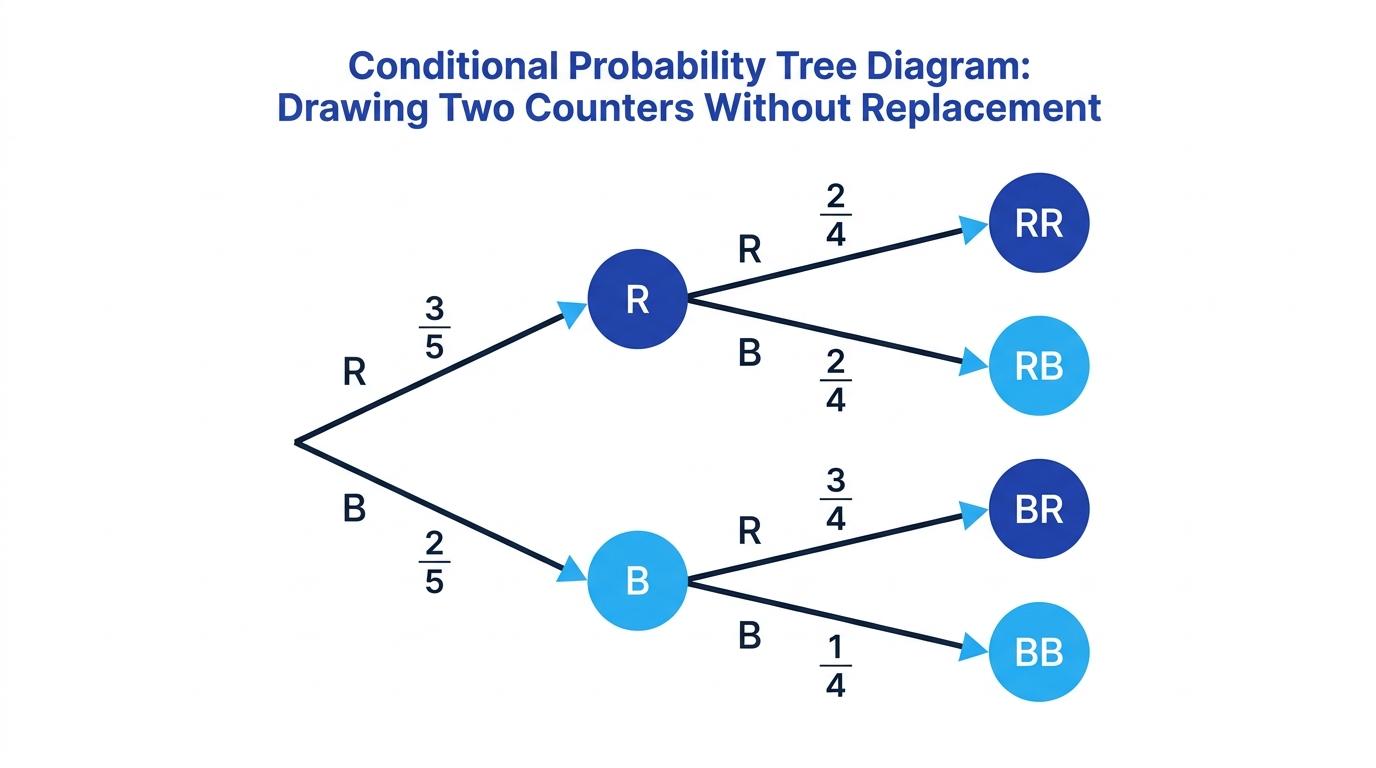
When sampling without replacement, the first outcome changes what remains, so the probabilities on the second set of branches are conditional probabilities.
The diagram below shows two counters drawn without replacement from a bag containing three red and two blue counters.
Using a tree diagram without replacement
Two counters are drawn without replacement from a bag containing three red and two blue counters. Find the probability that the counters are different colours.
-
There are two possible routes to different colours: red then blue, or blue then red.
-
Multiply along each route:
P(R then B)=35×24=310,P(R\text{ then }B)=\frac35\times\frac24=\frac3{10},P(R then B)=53×42=103, P(B then R)=25×34=310.P(B\text{ then }R)=\frac25\times\frac34=\frac3{10}.P(B then R)=52×43=103. -
The routes are mutually exclusive, so add their probabilities:
P(different colours)=310+310=35.P(\text{different colours})=\frac3{10}+\frac3{10}=\frac35.P(different colours)=103+103=53.
Updating probabilities without replacement
After an object is removed, reduce the total number of objects by one and also reduce the relevant category count. Do this before writing the next branch probabilities.
Conditional probability in Venn diagrams
A Venn diagram is useful when events overlap. The intersection A∩BA\cap BA∩B lies inside both circles.
To find P(A∣B)P(A\mid B)P(A∣B), treat the whole of BBB as the new sample space. Compare the part of BBB that also lies in AAA with the total size of BBB.
If a diagram contains frequencies rather than probabilities, the same idea gives
P(A∣B)=frequency in A∩Bfrequency in B.P(A\mid B)=\frac{\text{frequency in }A\cap B}{\text{frequency in }B}.P(A∣B)=frequency in Bfrequency in A∩B.Using frequencies in a Venn diagram
In a group of students, 18 study French, and 10 study both French and Spanish. One student is chosen from those who study French. Find the probability that the student also studies Spanish.
-
The phrase “chosen from those who study French” makes French the condition, so the denominator is 18.
-
Of those 18 students, 10 are in the intersection and also study Spanish.
-
Therefore,
P(Spanish∣French)=1018=59.P(\text{Spanish}\mid\text{French})=\frac{10}{18}=\frac59.P(Spanish∣French)=1810=95.
Conditional probability in two-way tables
A two-way table organises frequencies using two categories. Row and column totals help you identify the restricted group.
Suppose a survey gives the following results:
| Cycles | Does not cycle | Total | |
|---|---|---|---|
| Student | 24 | 36 | 60 |
| Staff | 16 | 24 | 40 |
| Total | 40 | 60 | 100 |
Using a two-way table
One person is selected from the staff. Find the probability that this person cycles.
-
“Selected from the staff” restricts the sample space to the staff row, which contains 40 people.
-
The relevant intersection is “staff and cycles”, containing 16 people.
-
Hence,
P(cycles∣staff)=1640=25.P(\text{cycles}\mid\text{staff})=\frac{16}{40}=\frac25.P(cycles∣staff)=4016=52.
Using the grand total
For a conditional probability, do not automatically divide by the grand total. Divide by the total of the group named after “given” or implied by “selected from”.
Conditional probability and independence
Two events are independent if the occurrence of one does not change the probability of the other.
Provided the conditioning event has non-zero probability, independence means
P(A∣B)=P(A).P(A\mid B)=P(A).P(A∣B)=P(A).Equivalent tests are
P(B∣A)=P(B)P(B\mid A)=P(B)P(B∣A)=P(B)and
P(A∩B)=P(A)P(B).P(A\cap B)=P(A)P(B).P(A∩B)=P(A)P(B).If these equalities do not hold, the events are dependent.
Testing whether events are independent
Suppose P(A)=0.4P(A)=0.4P(A)=0.4, P(B)=0.7P(B)=0.7P(B)=0.7 and P(A∩B)=0.28P(A\cap B)=0.28P(A∩B)=0.28. Determine whether AAA and BBB are independent.
-
Calculate the product of the individual probabilities:
P(A)P(B)=0.4×0.7=0.28.P(A)P(B)=0.4\times0.7=0.28.P(A)P(B)=0.4×0.7=0.28. -
Compare this with the given intersection probability. Since
P(A∩B)=P(A)P(B),P(A\cap B)=P(A)P(B),P(A∩B)=P(A)P(B),the independence condition is satisfied.
-
Therefore, AAA and BBB are independent.
Mutually exclusive is not independent
If two events with non-zero probabilities are mutually exclusive, one occurring prevents the other from occurring. They are therefore dependent, not independent.
In the exam
- Translate “given” into a condition and identify the restricted sample space before calculating.
- On a tree, multiply along branches and add separate routes; update branch probabilities when sampling without replacement.
- In a Venn diagram or two-way table, use the total of the conditioned group as the denominator.
- Keep intersections precise: “both” means A∩BA\cap BA∩B, while “at least one” means A∪BA\cup BA∪B.
- Test independence using P(A∩B)=P(A)P(B)P(A\cap B)=P(A)P(B)P(A∩B)=P(A)P(B) when all three probabilities are available.
Check yourself
- Can you explain why P(A∣B)P(A\mid B)P(A∣B) and P(B∣A)P(B\mid A)P(B∣A) usually have different denominators?
- How would the second-stage probabilities on a tree change when sampling without replacement?
- Which equality could you use to decide whether two events are independent?
