

What you'll learn
- How the equation of a circle encodes its centre and radius.
- How to complete the square separately in xxx and yyy.
- How to rewrite an expanded circle equation in standard form.
- How to recognise equations that do not represent a real circle.
The standard equation of a circle
A circle is the set of all points that are a fixed distance from one particular point. That fixed point is the centre, and the fixed distance is the radius.
If a circle has centre (a,b)(a,b)(a,b) and radius rrr, its equation is
(x−a)2+(y−b)2=r2.(x-a)^2+(y-b)^2=r^2.(x−a)2+(y−b)2=r2.This is called the standard form of the equation of a circle.
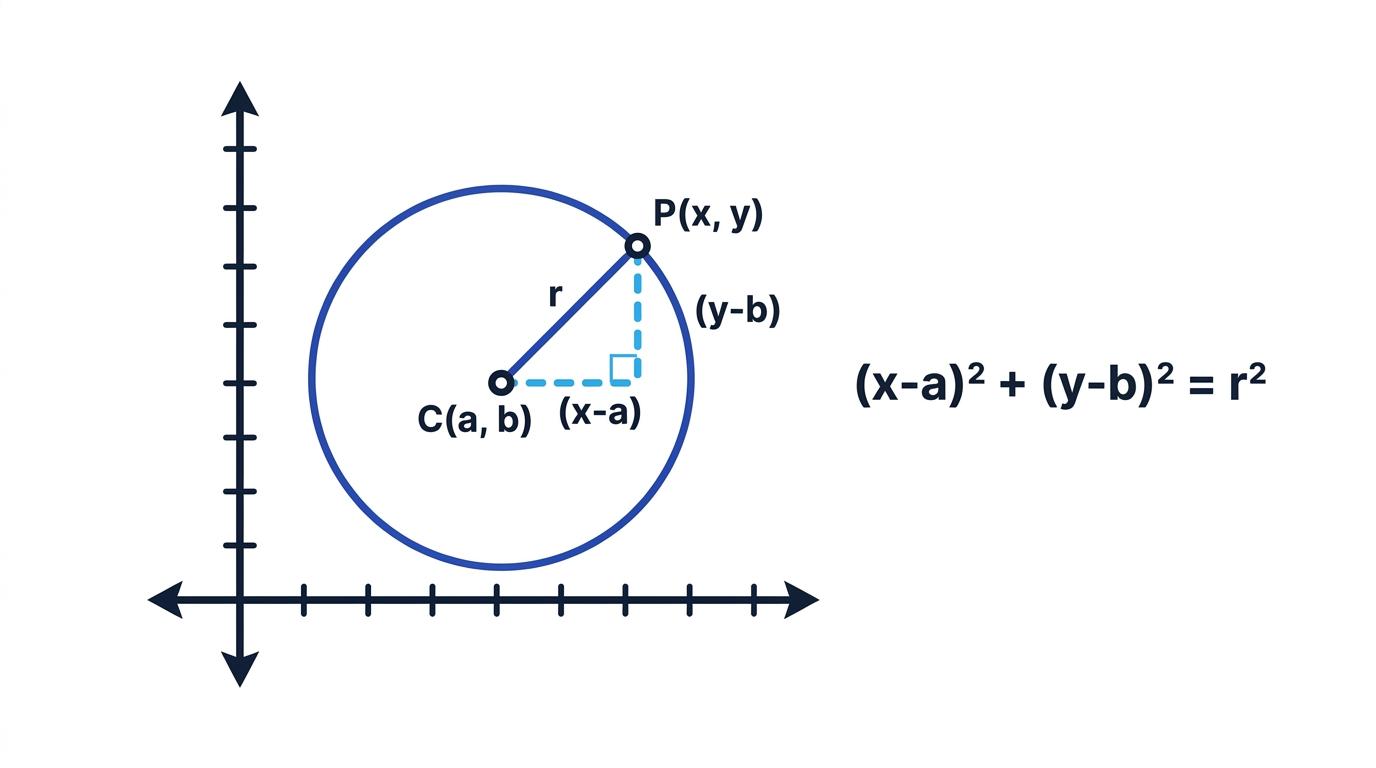
The equation follows from Pythagoras' theorem. For any point (x,y)(x,y)(x,y) on the circle:
- the horizontal displacement from the centre is x−ax-ax−a;
- the vertical displacement from the centre is y−by-by−b;
- the distance from the centre is rrr.
Therefore,
(x−a)2+(y−b)2=r2.(x-a)^2+(y-b)^2=r^2.(x−a)2+(y−b)2=r2.Reading standard form
From (x−a)2+(y−b)2=r2(x-a)^2+(y-b)^2=r^2(x−a)2+(y−b)2=r2, the centre is (a,b)(a,b)(a,b) and the radius is the positive value rrr.
Reading the centre and radius
Find the centre and radius of
(x−4)2+(y+3)2=49.(x-4)^2+(y+3)^2=49.(x−4)2+(y+3)2=49.-
Compare the equation with (x−a)2+(y−b)2=r2(x-a)^2+(y-b)^2=r^2(x−a)2+(y−b)2=r2.
-
Since x−4=x−ax-4=x-ax−4=x−a, we have a=4a=4a=4. Write y+3y+3y+3 as y−(−3)y-(-3)y−(−3), so b=−3b=-3b=−3.
-
Since r2=49r^2=49r2=49 and a radius is positive, r=7r=7r=7. The centre is (4,−3)(4,-3)(4,−3) and the radius is 7.
The signs of the centre
The signs inside the brackets are opposite to the coordinates of the centre. For example, (x+5)2(x+5)^2(x+5)2 gives an xxx-coordinate of −5-5−5, not 5.
The prerequisite: completing the square
An expression such as x2+6xx^2+6xx2+6x is not yet a perfect square. To complete the square means rewriting a quadratic expression using a squared bracket.
The key identity is
x2+px=(x+p2)2−(p2)2.x^2+px=\left(x+\frac{p}{2}\right)^2-\left(\frac{p}{2}\right)^2.x2+px=(x+2p)2−(2p)2.You halve the coefficient of xxx to form the bracket, then subtract the square of that number to keep the expression unchanged.
For example,
x2+6x=(x+3)2−9,x^2+6x=(x+3)^2-9,x2+6x=(x+3)2−9,because expanding (x+3)2(x+3)^2(x+3)2 produces x2+6x+9x^2+6x+9x2+6x+9, so 9 must be subtracted again.
Half, then square
To complete the square for x2+pxx^2+pxx2+px, halve ppp for the bracket and subtract the square of the number you inserted.
Completing two quadratic expressions
Complete the square for x2−8x+y2+10yx^2-8x+y^2+10yx2−8x+y2+10y.
-
For x2−8xx^2-8xx2−8x, halve −8-8−8 to get −4-4−4:
x2−8x=(x−4)2−16.x^2-8x=(x-4)^2-16.x2−8x=(x−4)2−16. -
For y2+10yy^2+10yy2+10y, halve 10 to get 5:
y2+10y=(y+5)2−25.y^2+10y=(y+5)^2-25.y2+10y=(y+5)2−25. -
Combining the results gives
x2−8x+y2+10y=(x−4)2+(y+5)2−41.x^2-8x+y^2+10y=(x-4)^2+(y+5)^2-41.x2−8x+y2+10y=(x−4)2+(y+5)2−41.
Finding the centre and radius
A circle may initially be given in the expanded form
x2+y2+Dx+Ey+F=0.x^2+y^2+Dx+Ey+F=0.x2+y2+Dx+Ey+F=0.To identify its centre and radius, complete the square in xxx and yyy separately, then rearrange into standard form.
A reliable method
- Group the xxx-terms and the yyy-terms.
- Move the constant term to the other side.
- Complete the square in xxx.
- Complete the square in yyy.
- Rearrange into (x−a)2+(y−b)2=r2(x-a)^2+(y-b)^2=r^2(x−a)2+(y−b)2=r2.
- Read off the centre and take the positive square root to find the radius.
Finding a centre and radius
Find the centre and radius of the circle
x2+y2−6x+4y−12=0.x^2+y^2-6x+4y-12=0.x2+y2−6x+4y−12=0.-
Group the variable terms and move the constant:
(x2−6x)+(y2+4y)=12.(x^2-6x)+(y^2+4y)=12.(x2−6x)+(y2+4y)=12. -
Complete the square in xxx:
x2−6x=(x−3)2−9.x^2-6x=(x-3)^2-9.x2−6x=(x−3)2−9. -
Complete the square in yyy:
y2+4y=(y+2)2−4.y^2+4y=(y+2)^2-4.y2+4y=(y+2)2−4. -
Substitute these forms into the equation:
(x−3)2−9+(y+2)2−4=12.(x-3)^2-9+(y+2)^2-4=12.(x−3)2−9+(y+2)2−4=12. -
Add 13 to both sides:
(x−3)2+(y+2)2=25.(x-3)^2+(y+2)^2=25.(x−3)2+(y+2)2=25. -
Comparing with standard form, the centre is (3,−2)(3,-2)(3,−2) and r2=25r^2=25r2=25, so the radius is 5.
Check by expanding
After completing the square, expand your final equation mentally or on paper. The linear terms and constant should reproduce the original equation.
When the squared terms have a coefficient
The standard circle equation has coefficients of 1 for both x2x^2x2 and y2y^2y2. If both squared terms have the same non-zero coefficient, divide the entire equation by that coefficient before completing the square.
Removing a common coefficient
Find the centre and radius of
2x2+2y2+8x−12y−10=0.2x^2+2y^2+8x-12y-10=0.2x2+2y2+8x−12y−10=0.-
Divide every term by 2:
x2+y2+4x−6y−5=0.x^2+y^2+4x-6y-5=0.x2+y2+4x−6y−5=0. -
Move the constant and complete both squares:
(x2+4x)+(y2−6y)=5,(x+2)2−4+(y−3)2−9=5.\begin{aligned} (x^2+4x)+(y^2-6y)&=5,\\ (x+2)^2-4+(y-3)^2-9&=5. \end{aligned}(x2+4x)+(y2−6y)(x+2)2−4+(y−3)2−9=5,=5. -
Move the correction terms to the right:
(x+2)2+(y−3)2=18.(x+2)^2+(y-3)^2=18.(x+2)2+(y−3)2=18. -
The centre is (−2,3)(-2,3)(−2,3) and
r=18=32.r=\sqrt{18}=3\sqrt{2}.r=18=32.
Checking that it is a circle
For a circle, the coefficients of x2x^2x2 and y2y^2y2 must be equal after simplification, and there must be no xyxyxy term. Unequal coefficients usually describe a different curve.
A direct formula
Completing the square in the general equation
x2+y2+Dx+Ey+F=0x^2+y^2+Dx+Ey+F=0x2+y2+Dx+Ey+F=0gives
(x+D2)2+(y+E2)2=D24+E24−F.\left(x+\frac{D}{2}\right)^2+ \left(y+\frac{E}{2}\right)^2 = \frac{D^2}{4}+\frac{E^2}{4}-F.(x+2D)2+(y+2E)2=4D2+4E2−F.Therefore, the centre is
(−D2,−E2),\left(-\frac{D}{2},-\frac{E}{2}\right),(−2D,−2E),and the radius is
r=D24+E24−F.r=\sqrt{\frac{D^2}{4}+\frac{E^2}{4}-F}.r=4D2+4E2−F.This formula is useful for checking your answer, but completing the square shows your reasoning clearly and is less likely to produce sign errors.
Does the equation represent a real circle?
Once the equation is in the form
(x−a)2+(y−b)2=R,(x-a)^2+(y-b)^2=R,(x−a)2+(y−b)2=R,the value of RRR determines what the equation represents:
- If R>0R>0R>0, it is a circle with radius R\sqrt{R}R.
- If R=0R=0R=0, the equation represents only the single point (a,b)(a,b)(a,b).
- If R<0R<0R<0, there are no real points satisfying the equation, because a sum of two squares cannot be negative.
Recognising that no real circle exists
Determine what is represented by
x2+y2−4x+6y+20=0.x^2+y^2-4x+6y+20=0.x2+y2−4x+6y+20=0.-
Complete both squares:
(x−2)2−4+(y+3)2−9+20=0.(x-2)^2-4+(y+3)^2-9+20=0.(x−2)2−4+(y+3)2−9+20=0. -
Collect the constants and rearrange:
(x−2)2+(y+3)2=−7.(x-2)^2+(y+3)^2=-7.(x−2)2+(y+3)2=−7. -
The left-hand side is a sum of squares, so it cannot be negative for real xxx and yyy. Therefore, the equation has no real points and does not represent a real circle.
In the exam
- Make the coefficients of x2x^2x2 and y2y^2y2 equal to 1 before completing the square.
- Complete the square separately for the xxx-terms and yyy-terms, showing the correction constants.
- Check the signs when reading the centre, and take the positive square root when finding the radius.
- Inspect the value of r2r^2r2: a negative value means there is no real circle.
Check yourself
- What are the centre and radius of (x+2)2+(y−7)2=36(x+2)^2+(y-7)^2=36(x+2)2+(y−7)2=36?
- Can you rewrite x2+y2+10x−2y−10=0x^2+y^2+10x-2y-10=0x2+y2+10x−2y−10=0 in standard circle form?
- What does it mean if completing the square produces (x−a)2+(y−b)2=−4(x-a)^2+(y-b)^2=-4(x−a)2+(y−b)2=−4?
