

What you'll learn
- How to add vectors using diagrams and components.
- How multiplying a vector by a scalar changes its length and direction.
- How vector subtraction follows from adding a negative vector.
- How to interpret vector calculations geometrically and check that your answers are sensible.
Starting Point: What Is a Vector?
A vector is a quantity with both magnitude and direction. Its magnitude is its size or length.
For example, a displacement of 5 m east is a vector because it specifies both a distance and a direction. By contrast, a distance of 5 m is a scalar, because it has magnitude but no direction.
Vectors are often written in bold, such as a\mathbf{a}a, or as a column vector:
a=(32).\mathbf{a}= \begin{pmatrix} 3\\ 2 \end{pmatrix}.a=(32).The top component gives the movement in the horizontal direction, while the bottom component gives the movement in the vertical direction. Therefore, this vector represents a movement of 3 units to the right and 2 units upwards.
A negative component reverses the movement along that axis. For example,
(−41)\begin{pmatrix} -4\\ 1 \end{pmatrix}(−41)represents 4 units to the left and 1 unit upwards.
Equal vectors
Two vectors are equal if they have the same magnitude and the same direction. They do not need to begin at the same point.
This means that you may slide a vector parallel to itself without changing the vector, provided you do not rotate it or change its length. This is important when adding vectors diagrammatically.
Adding Vectors Diagrammatically
Vectors describe movements, so adding vectors means carrying out one movement followed by another.
To construct a+b\mathbf{a}+\mathbf{b}a+b:
- Draw a\mathbf{a}a.
- Place the tail of b\mathbf{b}b at the head of a\mathbf{a}a.
- Draw the resultant vector from the tail of a\mathbf{a}a to the head of b\mathbf{b}b.
This is called the head-to-tail rule. The direct vector is known as the resultant, meaning the single vector with the same overall effect as the two original vectors.
The same addition can also be shown using the parallelogram rule. Draw a\mathbf{a}a and b\mathbf{b}b from the same starting point, complete a parallelogram, and draw its diagonal from the common starting point. That diagonal is a+b\mathbf{a}+\mathbf{b}a+b.
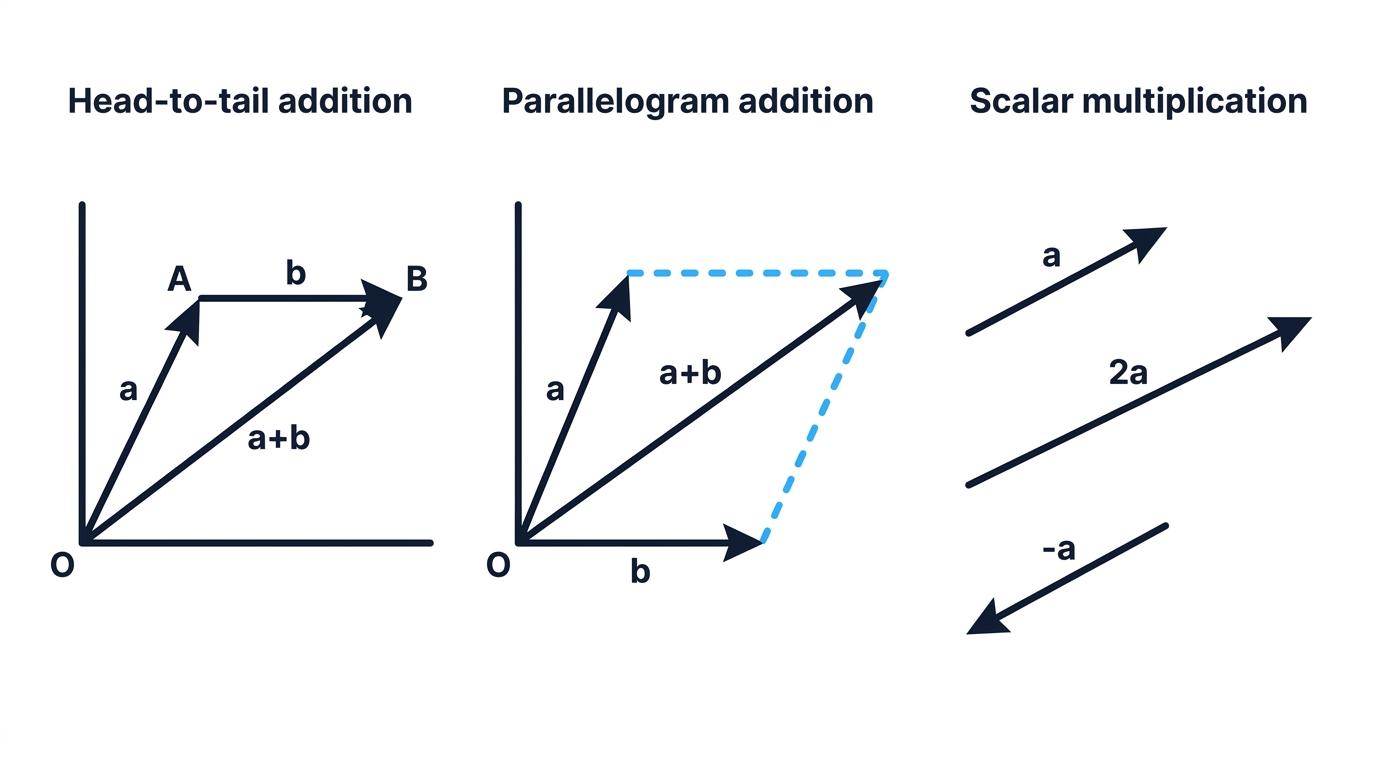
Adding two displacements
A particle moves along vector a\mathbf{a}a and then along vector b\mathbf{b}b. Describe how to construct its resultant displacement.
- Draw a\mathbf{a}a with its arrow showing the direction of the first movement.
- Translate b\mathbf{b}b without rotating or resizing it, placing its tail at the head of a\mathbf{a}a.
- Join the starting point of a\mathbf{a}a to the finishing point of b\mathbf{b}b. The resulting arrow is a+b\mathbf{a}+\mathbf{b}a+b.
Joining the wrong points
For head-to-tail addition, the resultant runs from the start of the first vector to the end of the second vector. Reversing these points gives −(a+b)-(\mathbf{a}+\mathbf{b})−(a+b).
Adding Vectors Using Components
To add vectors algebraically, add corresponding components:
(ab)+(cd)=(a+cb+d).\begin{pmatrix} a\\ b \end{pmatrix} + \begin{pmatrix} c\\ d \end{pmatrix} = \begin{pmatrix} a+c\\ b+d \end{pmatrix}.(ab)+(cd)=(a+cb+d).You add the horizontal components together and independently add the vertical components together.
Adding column vectors
Given
a=(4−3),b=(−15),\mathbf{a}= \begin{pmatrix} 4\\ -3 \end{pmatrix}, \qquad \mathbf{b}= \begin{pmatrix} -1\\ 5 \end{pmatrix},a=(4−3),b=(−15),find a+b\mathbf{a}+\mathbf{b}a+b.
- Add the horizontal components: 4+(−1)=34+(-1)=34+(−1)=3.
- Add the vertical components: −3+5=2-3+5=2−3+5=2.
- Combine the results in the original component order:
Vector addition is commutative, so changing the order does not change the resultant:
a+b=b+a.\mathbf{a}+\mathbf{b}=\mathbf{b}+\mathbf{a}.a+b=b+a.Geometrically, either order takes you to the same final point. The two possible routes form adjacent sides of a parallelogram.
Vector addition is also associative:
(a+b)+c=a+(b+c).(\mathbf{a}+\mathbf{b})+\mathbf{c} = \mathbf{a}+(\mathbf{b}+\mathbf{c}).(a+b)+c=a+(b+c).This means that when adding three or more vectors, the way in which you group them does not affect the result.
The Zero Vector and Negative Vectors
The zero vector has magnitude zero and no particular direction. In two dimensions it is written as
0=(00).\mathbf{0}= \begin{pmatrix} 0\\ 0 \end{pmatrix}.0=(00).Adding the zero vector has no effect:
a+0=a.\mathbf{a}+\mathbf{0}=\mathbf{a}.a+0=a.The negative of a\mathbf{a}a, written −a-\mathbf{a}−a, has the same magnitude as a\mathbf{a}a but points in the opposite direction. Component by component,
−(ab)=(−a−b).-\begin{pmatrix} a\\ b \end{pmatrix} = \begin{pmatrix} -a\\ -b \end{pmatrix}.−(ab)=(−a−b).A vector and its negative cancel:
a+(−a)=0.\mathbf{a}+(-\mathbf{a})=\mathbf{0}.a+(−a)=0.Reversing a vector
If AB→=a\overrightarrow{AB}=\mathbf{a}AB=a, then reversing the start and end points gives BA→=−a\overrightarrow{BA}=-\mathbf{a}BA=−a.
Subtracting Vectors
Subtracting a vector means adding its negative:
a−b=a+(−b).\mathbf{a}-\mathbf{b} = \mathbf{a}+(-\mathbf{b}).a−b=a+(−b).Using components, subtract corresponding entries:
(ab)−(cd)=(a−cb−d).\begin{pmatrix} a\\ b \end{pmatrix} - \begin{pmatrix} c\\ d \end{pmatrix} = \begin{pmatrix} a-c\\ b-d \end{pmatrix}.(ab)−(cd)=(a−cb−d).Geometrically, if a\mathbf{a}a and b\mathbf{b}b are drawn from the same starting point, then a−b\mathbf{a}-\mathbf{b}a−b points from the head of b\mathbf{b}b to the head of a\mathbf{a}a.
Finding a vector between two points
From a common origin OOO,
OA→=(61),OB→=(2−3).\overrightarrow{OA}= \begin{pmatrix} 6\\ 1 \end{pmatrix}, \qquad \overrightarrow{OB}= \begin{pmatrix} 2\\ -3 \end{pmatrix}.OA=(61),OB=(2−3).Find AB→\overrightarrow{AB}AB.
- Travelling from AAA to BBB can be viewed as travelling from AAA back to OOO, then from OOO to BBB:
- Therefore, subtract the position vector of the starting point from that of the finishing point:
- Subtract corresponding components:
Vector from one point to another
For a vector from AAA to BBB, use finish minus start: AB→=OB→−OA→\overrightarrow{AB}=\overrightarrow{OB}-\overrightarrow{OA}AB=OB−OA.
Multiplying a Vector by a Scalar
A scalar multiple of a vector is produced by multiplying the vector by an ordinary number, called a scalar.
For a scalar kkk,
k(ab)=(kakb).k \begin{pmatrix} a\\ b \end{pmatrix} = \begin{pmatrix} ka\\ kb \end{pmatrix}.k(ab)=(kakb).Geometrically:
- If k>0k>0k>0, then kak\mathbf{a}ka points in the same direction as a\mathbf{a}a.
- If k<0k<0k<0, then kak\mathbf{a}ka points in the opposite direction.
- Its magnitude is multiplied by ∣k∣|k|∣k∣.
- If k=0k=0k=0, the result is the zero vector.
Therefore, 2a2\mathbf{a}2a is twice as long as a\mathbf{a}a in the same direction, while −12a-\frac{1}{2}\mathbf{a}−21a is half as long and points in the opposite direction.
Combining scalar multiples
Given
a=(3−2),b=(−14),\mathbf{a}= \begin{pmatrix} 3\\ -2 \end{pmatrix}, \qquad \mathbf{b}= \begin{pmatrix} -1\\ 4 \end{pmatrix},a=(3−2),b=(−14),find 2a−3b2\mathbf{a}-3\mathbf{b}2a−3b.
- Multiply every component of a\mathbf{a}a by 2:
- Multiply every component of b\mathbf{b}b by 3:
- Subtract corresponding components:
Scaling only one component
A scalar multiplies every component of the vector. For example, 3(ab)=(3a3b)3\begin{pmatrix}a\\b\end{pmatrix}=\begin{pmatrix}3a\\3b\end{pmatrix}3(ab)=(3a3b).
Scalar multiplication distributes over vector addition:
k(a+b)=ka+kb.k(\mathbf{a}+\mathbf{b})=k\mathbf{a}+k\mathbf{b}.k(a+b)=ka+kb.It also satisfies
(k+m)a=ka+ma.(k+m)\mathbf{a}=k\mathbf{a}+m\mathbf{a}.(k+m)a=ka+ma.These rules allow you to expand and simplify vector expressions in much the same way as ordinary algebra.
Parallel Vectors
Non-zero vectors are parallel when one is a scalar multiple of the other:
b=ka\mathbf{b}=k\mathbf{a}b=kafor some scalar kkk.
If kkk is positive, the vectors point in the same direction. If kkk is negative, they point in opposite directions.
Checking whether vectors are parallel
Determine whether
p=(−69),q=(2−3)\mathbf{p}= \begin{pmatrix} -6\\ 9 \end{pmatrix}, \qquad \mathbf{q}= \begin{pmatrix} 2\\ -3 \end{pmatrix}p=(−69),q=(2−3)are parallel.
- Compare the first components: to change 2 into negative 6, multiply by negative 3.
- Check the same scalar against the second components: −3×(−3)=9-3\times(-3)=9−3×(−3)=9.
- The same scalar works for both components, so p=−3q\mathbf{p}=-3\mathbf{q}p=−3q. The vectors are parallel and point in opposite directions.
In the exam
- Keep components vertically aligned, and operate on corresponding components only.
- For a vector between two points, use finish minus start and check the arrow direction.
- Use the diagram as a sense check: a negative scalar reverses direction, while vector addition should represent consecutive movements.
- Keep answers exact unless the question specifically asks for a decimal.
Check yourself
- How would you construct a+b\mathbf{a}+\mathbf{b}a+b using the head-to-tail rule?
- Given a=(2−5)\mathbf{a}=\begin{pmatrix}2\\-5\end{pmatrix}a=(2−5) and b=(−31)\mathbf{b}=\begin{pmatrix}-3\\1\end{pmatrix}b=(−31), can you find 3a−2b3\mathbf{a}-2\mathbf{b}3a−2b?
- What does a negative scalar do to the magnitude and direction of a vector?
