

What you'll learn
- How to recognise and interpret normal notation such as X∼N(μ,σ2)X \sim N(\mu,\sigma^2)X∼N(μ,σ2).
- How to standardise values and find probabilities from a normal distribution.
- How to work backwards from percentages to find cut-off values, means or standard deviations.
- How the normal distribution is used in hypothesis tests for a population mean.
1. The normal model
A random variable is a quantity whose value depends on chance. For example, the weight of coffee in a jar, a journey time, or a battery lifetime.
A continuous random variable can take any value in an interval, not just whole-number values. For continuous variables, probabilities are represented by areas under a curve.
Normal distribution
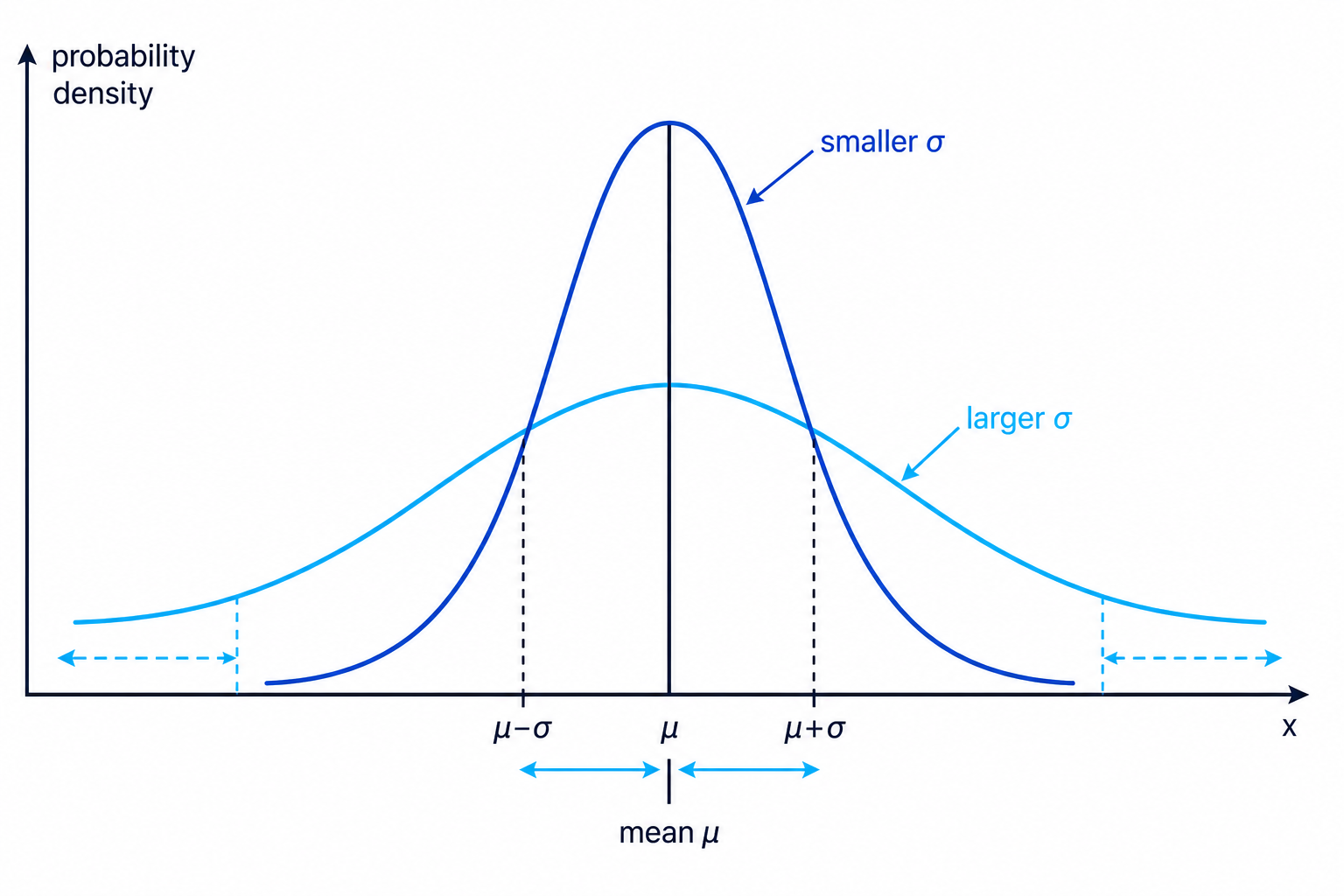
A normal distribution is a continuous probability model with a symmetric bell-shaped curve. If X∼N(μ,σ2)X \sim N(\mu,\sigma^2)X∼N(μ,σ2), then μ\muμ is the mean, σ\sigmaσ is the standard deviation, and σ2\sigma^2σ2 is the variance.
The mean is the centre of the curve. The standard deviation measures the spread: larger σ\sigmaσ means a wider, flatter curve.
Strict or non-strict inequalities
For a continuous normal variable, P(X<a)=P(X≤a)P(X<a)=P(X\le a)P(X<a)=P(X≤a) because the probability of getting exactly one value is zero.
Reading normal notation
Suppose the fill weight of a packet is modelled by W∼N(120,16)W \sim N(120, 16)W∼N(120,16).
-
Identify the mean from the first number:
μ=120\mu = 120μ=120 -
The second number is the variance, so take the square root to get the standard deviation:
σ=16=4\sigma = \sqrt{16}=4σ=16=4 -
By symmetry, half the values lie below the mean:
P(W<120)=0.5P(W<120)=0.5P(W<120)=0.5
Do not use the variance as sigma
In X∼N(20,25)X \sim N(20,25)X∼N(20,25), the standard deviation is 5, not 25. The second number is σ2\sigma^2σ2.
2. Standardising to the standard normal
The standard normal distribution is the normal distribution with mean 0 and standard deviation 1. We write this as Z∼N(0,1)Z \sim N(0,1)Z∼N(0,1).
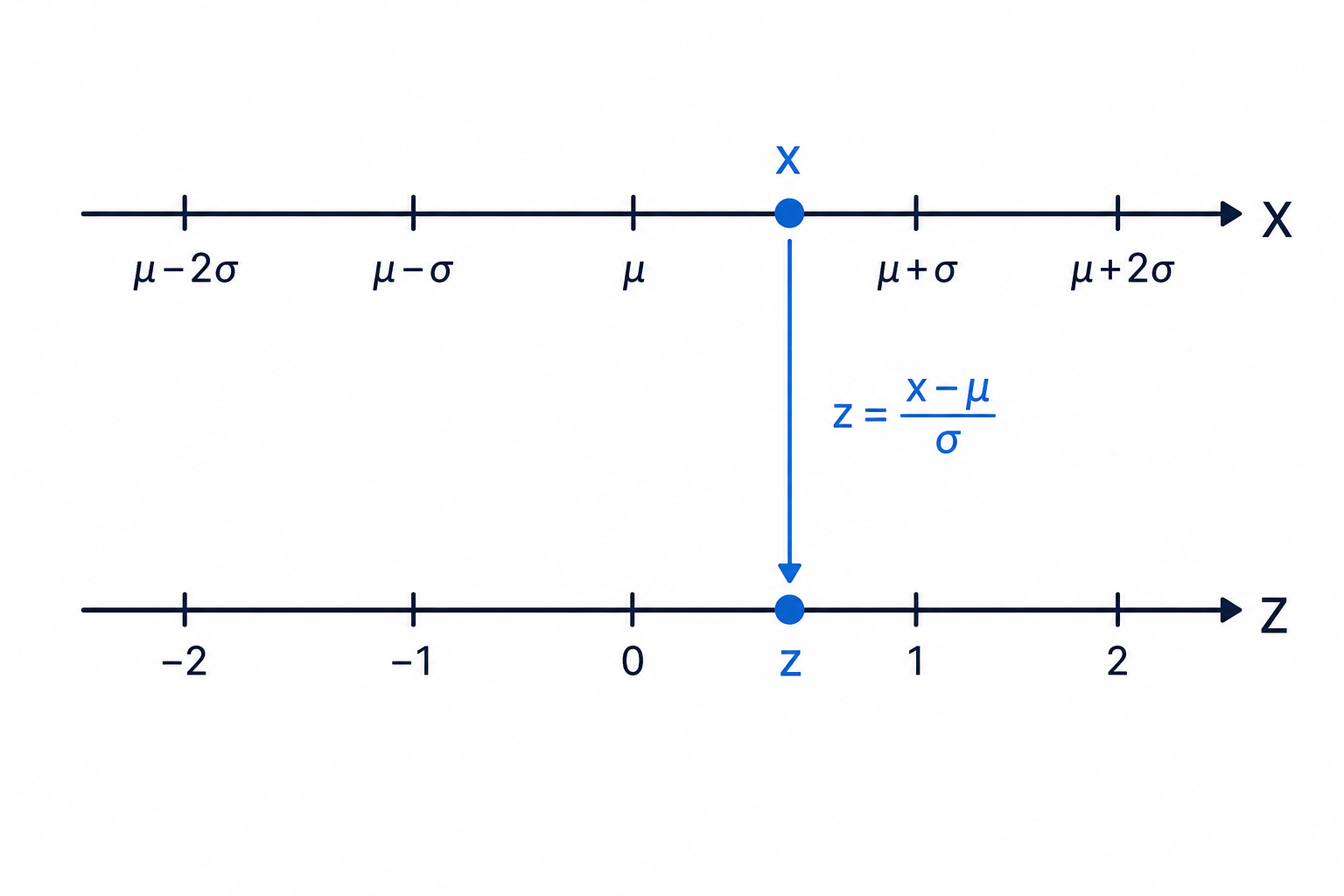
To convert a value of XXX into a standard normal value, use:
Z=X−μσZ=\frac{X-\mu}{\sigma}Z=σX−μThis tells you how many standard deviations above or below the mean the value is.
Standardising
Most normal probability questions become much easier once you convert the boundary value into a zzz-value.
Finding normal probabilities
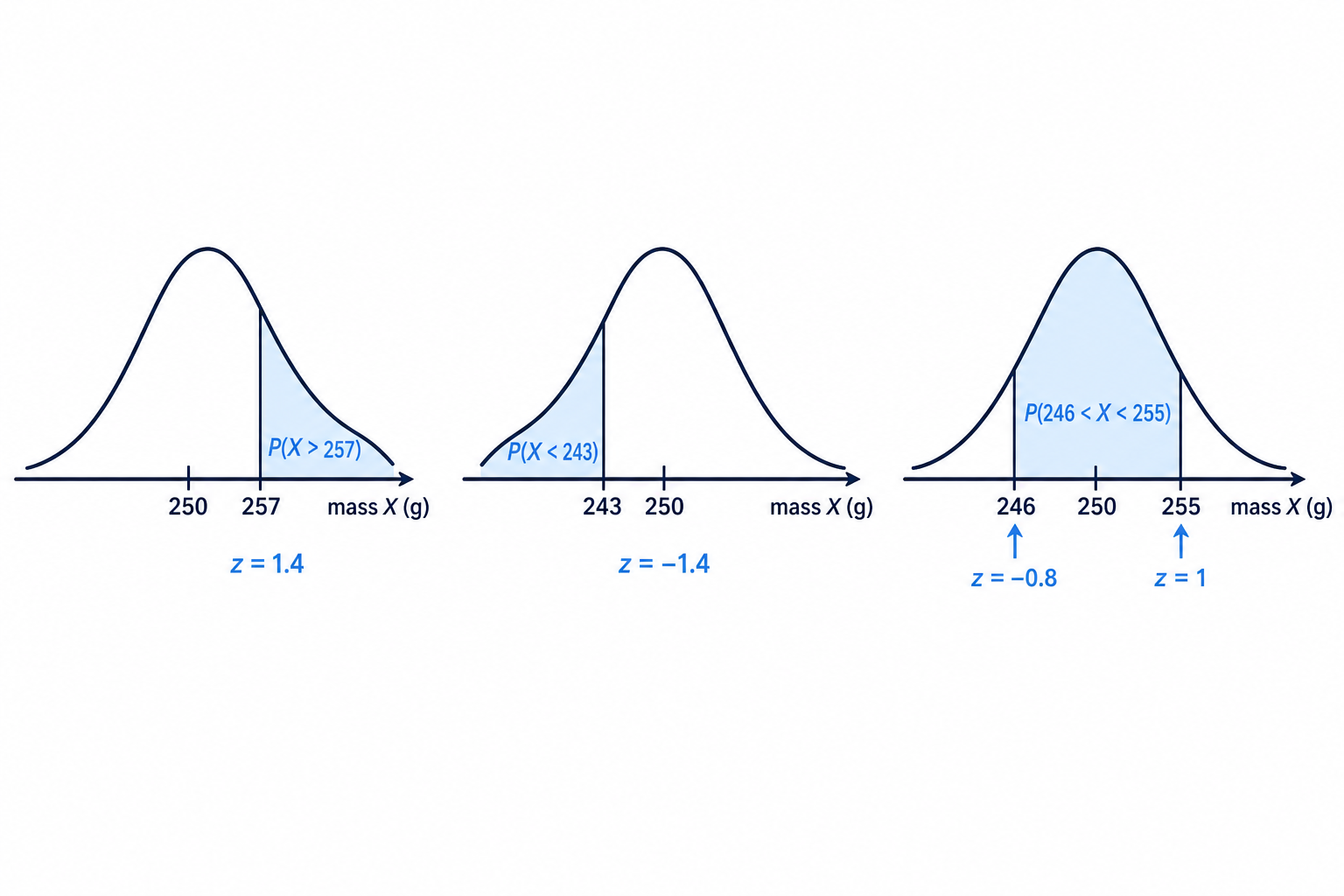
The mass of cereal in a box is normally distributed with mean 250 g and standard deviation 5 g. Find the probability that a box contains: more than 257 g, less than 243 g, and between 246 g and 255 g.
-
Write the distribution carefully:
X∼N(250,52)X \sim N(250,5^2)X∼N(250,52) -
For more than 257 g, standardise 257:
z=257−2505=1.4z=\frac{257-250}{5}=1.4z=5257−250=1.4 -
Use the upper tail of the standard normal distribution:
P(X>257)=P(Z>1.4)≈0.0808P(X>257)=P(Z>1.4)\approx 0.0808P(X>257)=P(Z>1.4)≈0.0808 -
For less than 243 g, standardise 243:
z=243−2505=−1.4z=\frac{243-250}{5}=-1.4z=5243−250=−1.4 -
Use the lower tail:
P(X<243)=P(Z<−1.4)≈0.0808P(X<243)=P(Z<-1.4)\approx 0.0808P(X<243)=P(Z<−1.4)≈0.0808 -
For the interval, standardise both ends:
P(246<X<255)=P(−0.8<Z<1)≈0.629P(246<X<255)=P(-0.8<Z<1)\approx 0.629P(246<X<255)=P(−0.8<Z<1)≈0.629
3. Working backwards with inverse normal
Sometimes you are given a probability and asked for the value of the variable. This is an inverse normal question.
A percentile is a cut-off value. For example, the 90th percentile is the value below which 90% of observations lie.
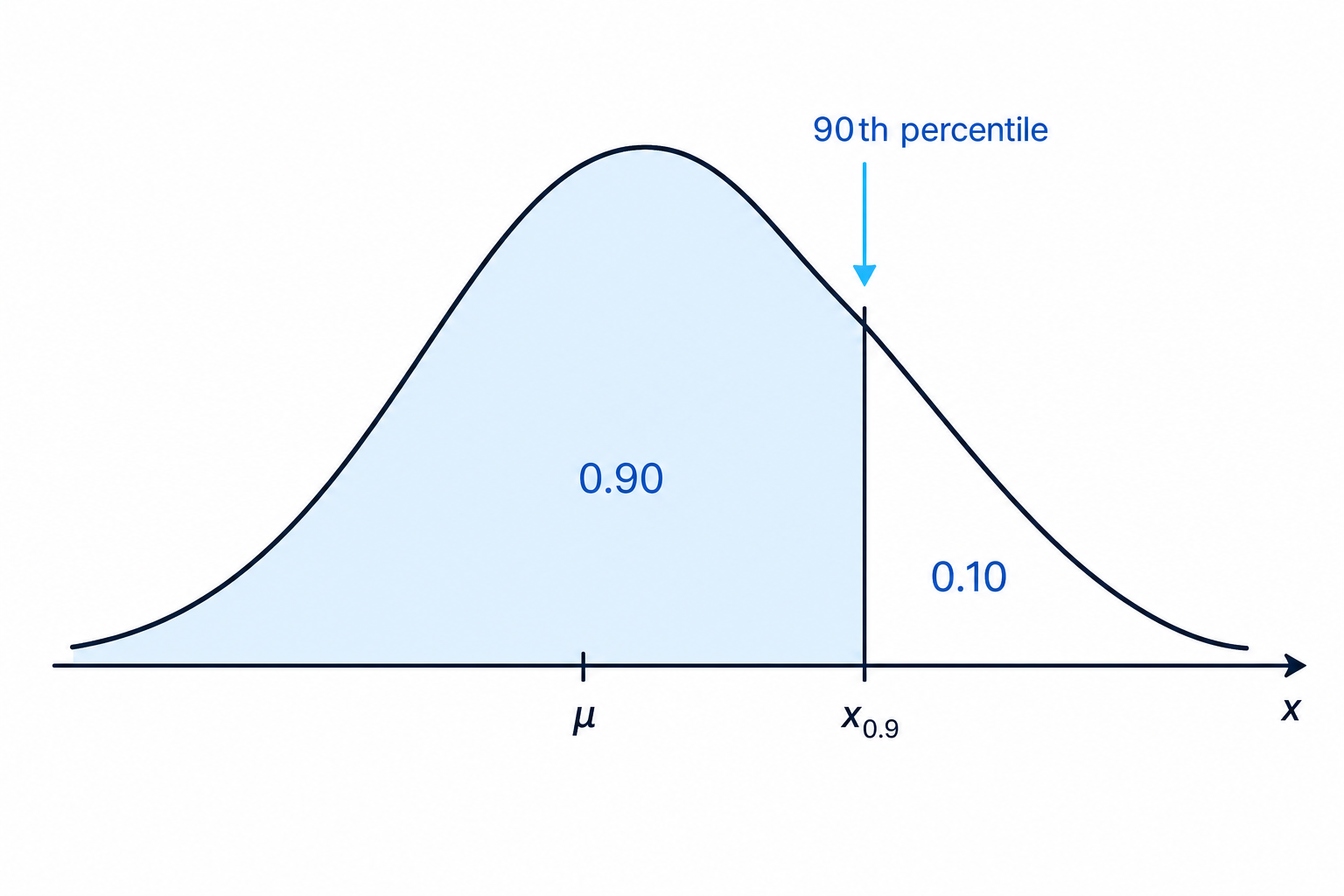
If zpz_pzp is the standard normal value with P(Z<zp)=pP(Z<z_p)=pP(Z<zp)=p, then:
x=μ+σzpx=\mu+\sigma z_px=μ+σzpFinding a cut-off time
The time taken to complete an online task is normally distributed with mean 62 minutes and standard deviation 10 minutes. Find the time by which 90% of people complete the task.
-
The phrase “by which 90% complete” means a lower-tail probability of 0.90:
P(T<t)=0.90P(T<t)=0.90P(T<t)=0.90 -
Use inverse normal to find the standard normal value:
P(Z<z)=0.90⇒z≈1.282P(Z<z)=0.90 \Rightarrow z\approx 1.282P(Z<z)=0.90⇒z≈1.282 -
Convert back to the original scale:
t=62+10(1.282)≈74.8t=62+10(1.282)\approx 74.8t=62+10(1.282)≈74.8 -
So the required time is about 75 minutes.
4. Finding a missing mean or standard deviation
If a question gives you a percentage and asks for μ\muμ or σ\sigmaσ, turn the percentage into a zzz-value first.
The key equation is:
x=μ+σzx=\mu+\sigma zx=μ+σzIf you have one unknown, you need one equation. If both μ\muμ and σ\sigmaσ are unknown, you need two probability statements and therefore two equations.
Finding a standard deviation
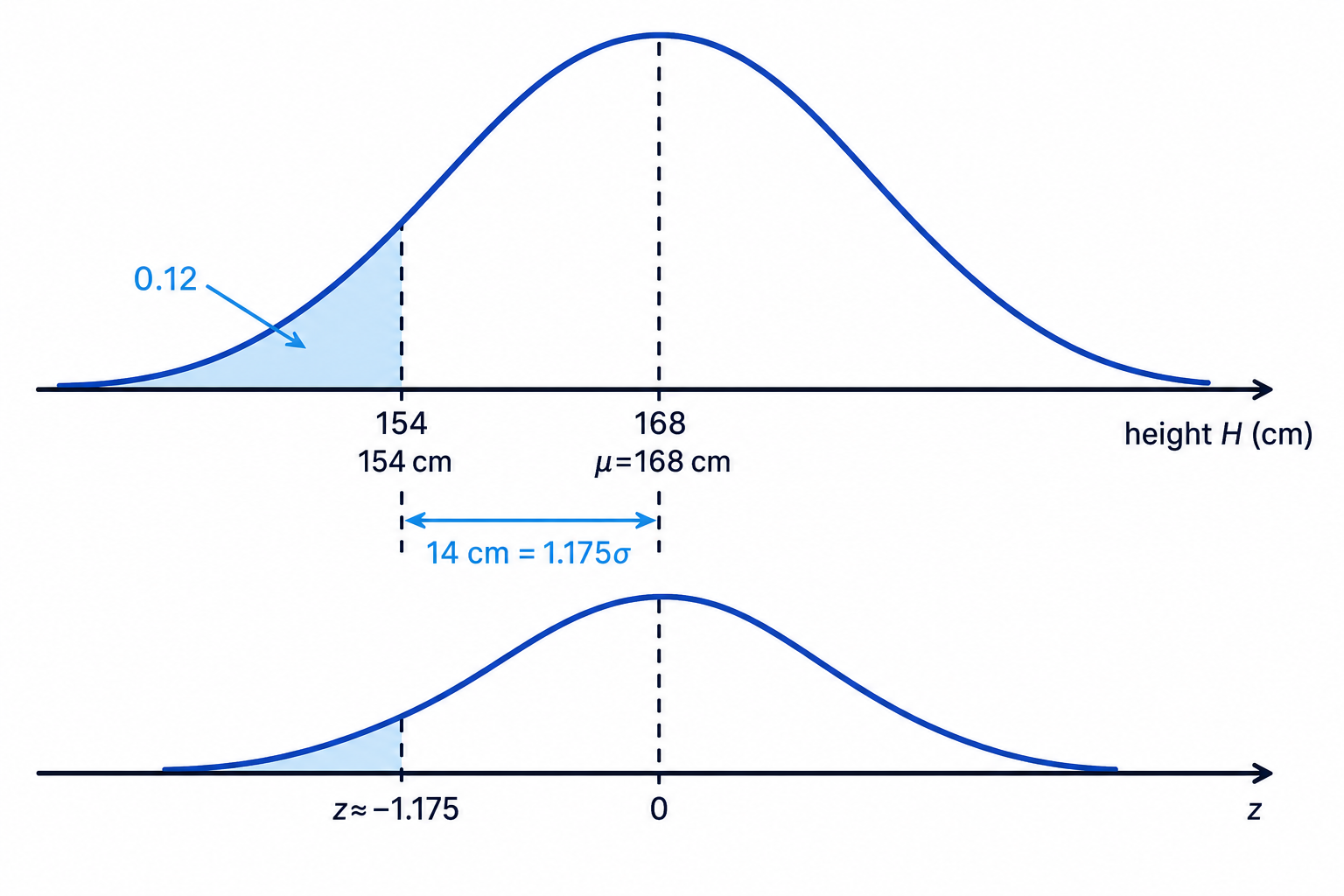
The heights of a group are normally distributed with mean 168 cm. It is known that 12% of the group are shorter than 154 cm. Find the standard deviation.
-
Translate the sentence into probability notation:
P(H<154)=0.12P(H<154)=0.12P(H<154)=0.12 -
Use inverse normal on the standard normal distribution:
P(Z<z)=0.12⇒z≈−1.175P(Z<z)=0.12 \Rightarrow z\approx -1.175P(Z<z)=0.12⇒z≈−1.175 -
Substitute into x=μ+σzx=\mu+\sigma zx=μ+σz:
154=168+σ(−1.175)154=168+\sigma(-1.175)154=168+σ(−1.175) -
Solve for the positive standard deviation:
σ=141.175≈11.9\sigma=\frac{14}{1.175}\approx 11.9σ=1.17514≈11.9
Finding both the mean and standard deviation
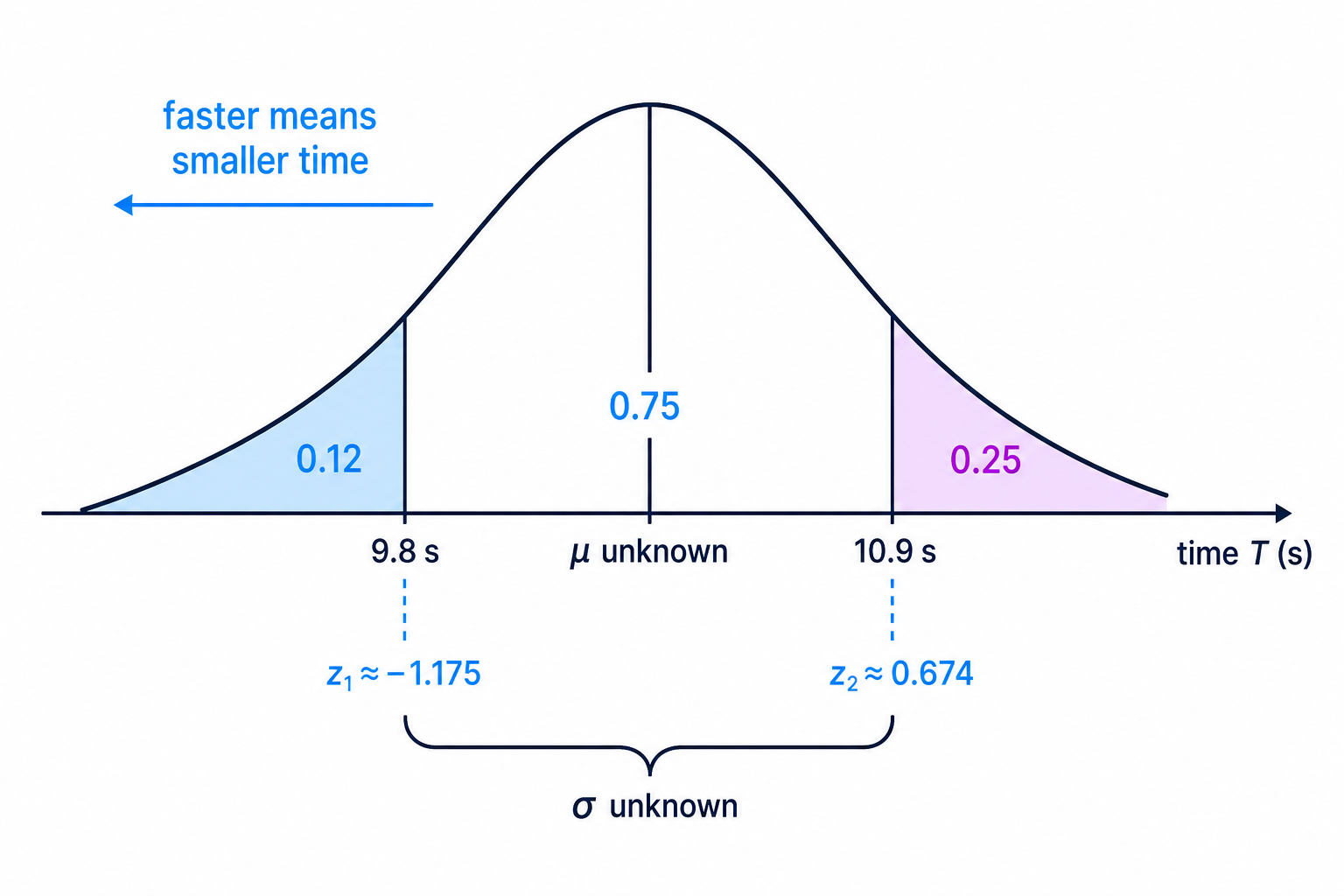
A sprinter’s 100 m times are normally distributed. The sprinter runs faster than 9.8 seconds on 12% of attempts, and slower than 10.9 seconds on 25% of attempts. Find the mean and standard deviation.
-
“Faster than 9.8 seconds” means the time is less than 9.8:
P(T<9.8)=0.12P(T<9.8)=0.12P(T<9.8)=0.12 -
“Slower than 10.9 seconds” means the time is greater than 10.9, so:
P(T<10.9)=0.75P(T<10.9)=0.75P(T<10.9)=0.75 -
Convert both probabilities to zzz-values:
z1≈−1.175,z2≈0.674z_1\approx -1.175,\qquad z_2\approx 0.674z1≈−1.175,z2≈0.674 -
Form two equations:
9.8−μσ=−1.175,10.9−μσ=0.674\frac{9.8-\mu}{\sigma}=-1.175,\qquad \frac{10.9-\mu}{\sigma}=0.674σ9.8−μ=−1.175,σ10.9−μ=0.674 -
Rearrange:
9.8=μ−1.175σ,10.9=μ+0.674σ9.8=\mu-1.175\sigma,\qquad 10.9=\mu+0.674\sigma9.8=μ−1.175σ,10.9=μ+0.674σ -
Subtract the first equation from the second:
1.1=1.849σ⇒σ≈0.5951.1=1.849\sigma \Rightarrow \sigma\approx 0.5951.1=1.849σ⇒σ≈0.595 -
Substitute back to find the mean:
μ=10.9−0.674(0.595)≈10.5\mu=10.9-0.674(0.595)\approx 10.5μ=10.9−0.674(0.595)≈10.5
Faster means smaller
For race times, “faster than 10 seconds” means T<10T<10T<10, not T>10T>10T>10.
5. Conditional probability with normal variables
A conditional probability is the probability of an event happening given that another event has already happened.
P(A∣B)=P(A∩B)P(B)P(A\mid B)=\frac{P(A\cap B)}{P(B)}P(A∣B)=P(B)P(A∩B)For lifetimes, “lasts another 10 hours after already lasting 45 hours” is not just P(X>55)P(X>55)P(X>55). You must condition on the fact it has already lasted 45 hours.
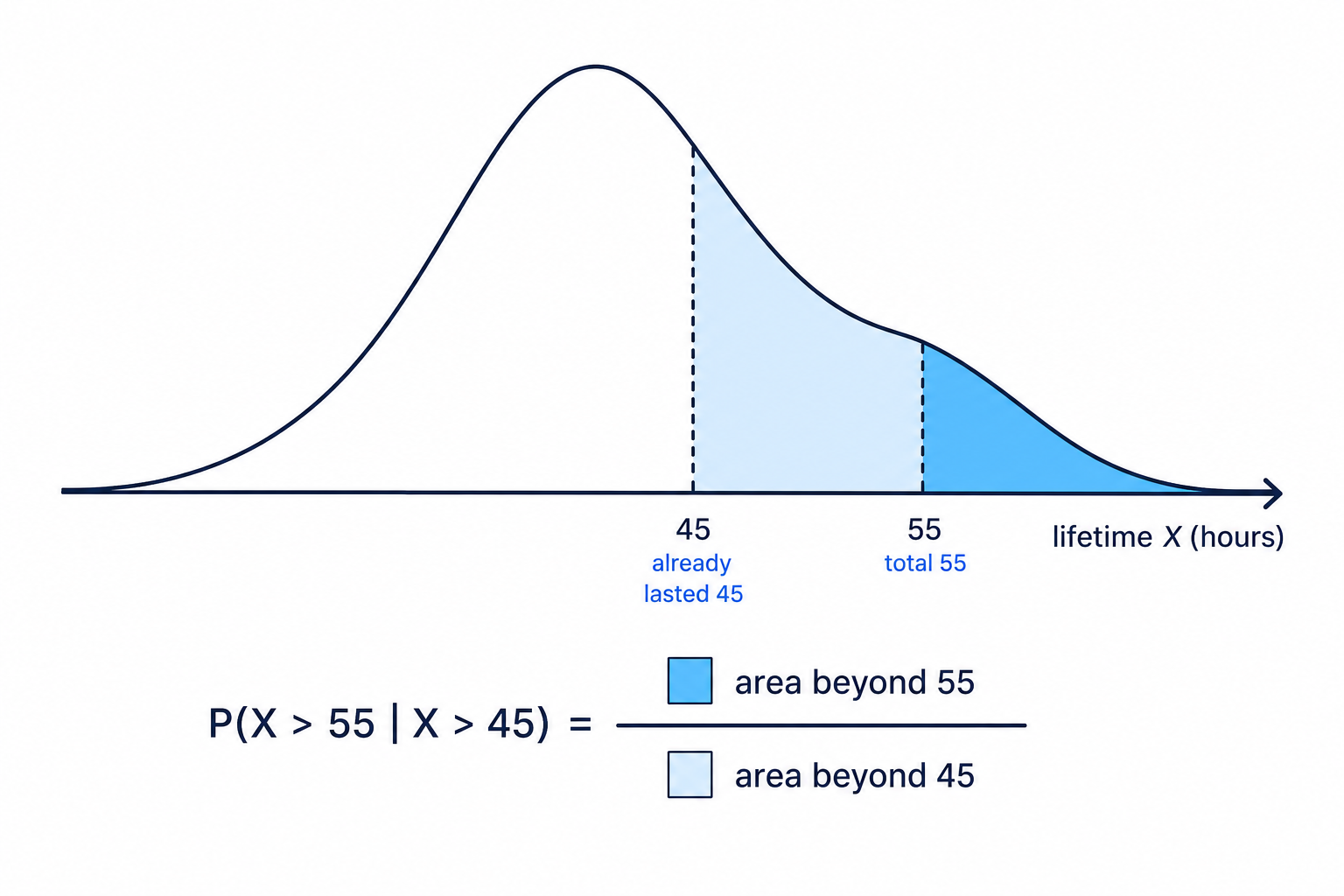
Battery lasting longer after use
A battery lifetime BBB is normally distributed with mean 60 hours and standard deviation 8 hours. Given that a battery has already lasted 55 hours, find the probability that it lasts at least another 12 hours.
-
Lasting another 12 hours means the total lifetime must exceed 67 hours:
P(B>67∣B>55)P(B>67\mid B>55)P(B>67∣B>55) -
Since B>67B>67B>67 is inside the event B>55B>55B>55, use:
P(B>67∣B>55)=P(B>67)P(B>55)P(B>67\mid B>55)=\frac{P(B>67)}{P(B>55)}P(B>67∣B>55)=P(B>55)P(B>67) -
Calculate the numerator:
P(B>67)=P(Z>67−608)=P(Z>0.875)≈0.1908P(B>67)=P\left(Z>\frac{67-60}{8}\right)=P(Z>0.875)\approx 0.1908P(B>67)=P(Z>867−60)=P(Z>0.875)≈0.1908 -
Calculate the denominator:
P(B>55)=P(Z>55−608)=P(Z>−0.625)≈0.7340P(B>55)=P\left(Z>\frac{55-60}{8}\right)=P(Z>-0.625)\approx 0.7340P(B>55)=P(Z>855−60)=P(Z>−0.625)≈0.7340 -
Divide:
P(B>67∣B>55)≈0.19080.7340≈0.260P(B>67\mid B>55)\approx \frac{0.1908}{0.7340}\approx 0.260P(B>67∣B>55)≈0.73400.1908≈0.260
6. Hypothesis tests using the normal distribution
A hypothesis test checks whether sample evidence is strong enough to challenge a claim about a population.
- The null hypothesis, H0H_0H0, is the starting assumption.
- The alternative hypothesis, H1H_1H1, is what you are testing for.
- The significance level is the cut-off probability for deciding that the evidence is unusually extreme.
- A p-value is the probability, assuming H0H_0H0 is true, of getting a result at least as extreme as the sample result.
If the population standard deviation is σ\sigmaσ and the sample size is nnn, then the sample mean has distribution:
Xˉ∼N(μ,σ2n)\bar X \sim N\left(\mu,\frac{\sigma^2}{n}\right)Xˉ∼N(μ,nσ2)The standard deviation of Xˉ\bar XXˉ is called the standard error:
σn\frac{\sigma}{\sqrt n}nσTesting whether a mean has decreased
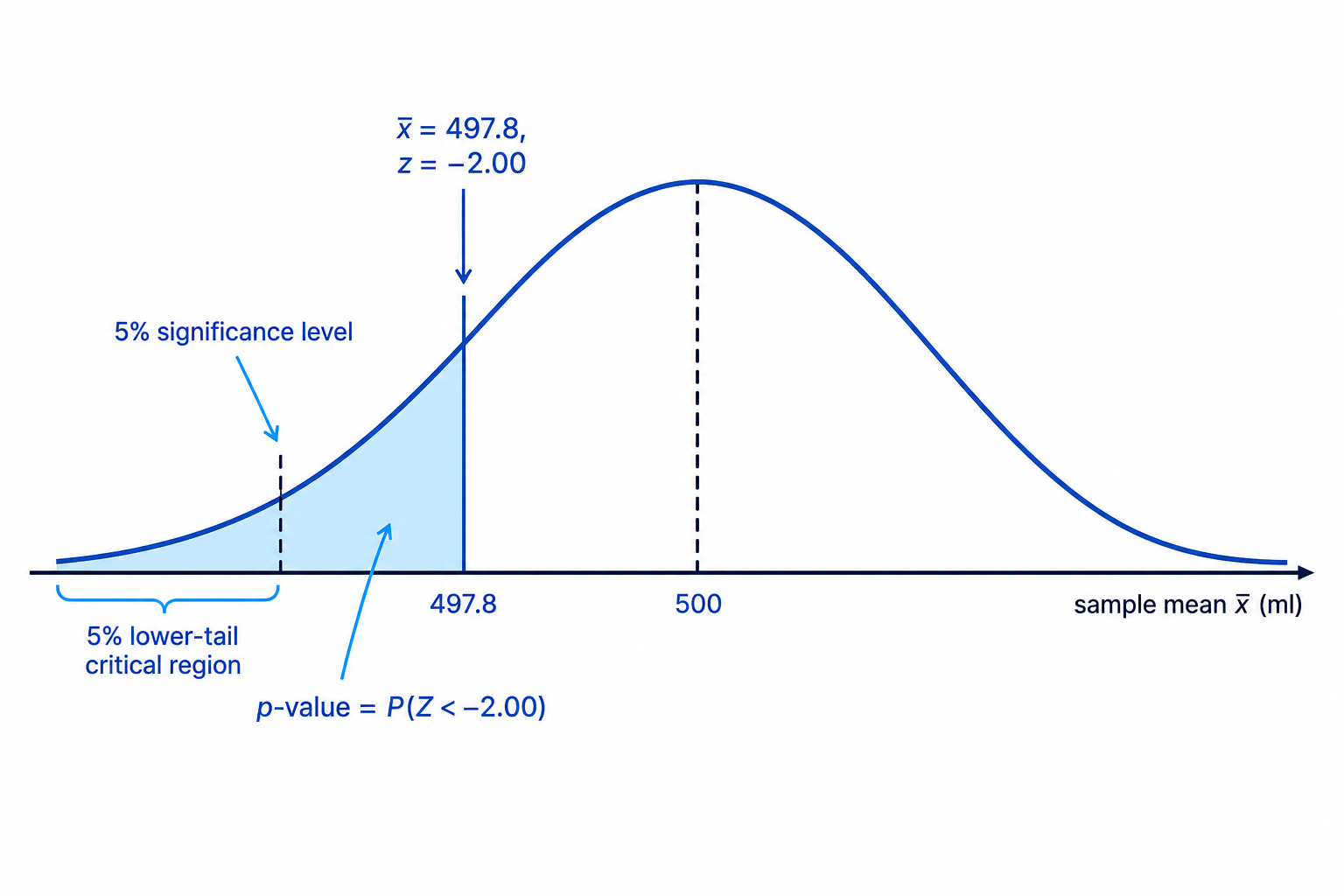
A machine is set to fill bottles with mean 500 ml. The standard deviation is known to be 5.5 ml. A manager suspects the mean fill has decreased. A random sample of 25 bottles has mean 497.8 ml. Test at the 5% significance level.
-
State the hypotheses:
H0:μ=500,H1:μ<500H_0:\mu=500,\qquad H_1:\mu<500H0:μ=500,H1:μ<500 -
Under H0H_0H0, write the sampling distribution:
Xˉ∼N(500,5.5225)\bar X \sim N\left(500,\frac{5.5^2}{25}\right)Xˉ∼N(500,255.52) -
Calculate the test statistic:
z=497.8−5005.5/25=−2.00z=\frac{497.8-500}{5.5/\sqrt{25}}=-2.00z=5.5/25497.8−500=−2.00 -
Find the lower-tail p-value:
P(Z<−2.00)≈0.0228P(Z<-2.00)\approx 0.0228P(Z<−2.00)≈0.0228 -
Compare with 5%:
0.0228<0.050.0228<0.050.0228<0.05 -
Reject H0H_0H0. There is evidence at the 5% level that the mean fill has decreased.
If you are given summary statistics, use:
xˉ=∑xn\bar x=\frac{\sum x}{n}xˉ=n∑xFor a large sample where the population standard deviation is not known, you may estimate it using the sample standard deviation sss:
s=∑x2−(∑x)2nn−1s=\sqrt{\frac{\sum x^2-\frac{(\sum x)^2}{n}}{n-1}}s=n−1∑x2−n(∑x)2One-tailed or two-tailed
Words like “less than” or “more than” give a one-tailed test. Words like “changed” or “different” usually mean a two-tailed test.
In the exam
-
Read N(μ,σ2)N(\mu,\sigma^2)N(μ,σ2) carefully and take the square root of the second number to get σ\sigmaσ.
-
Draw a quick bell curve and shade the required region before using your calculator.
-
Convert “more than” probabilities into lower-tail probabilities when using inverse normal.
-
In hypothesis tests, always state H0H_0H0, H1H_1H1, the sampling distribution, your p-value or critical comparison, and a conclusion in context.
Check yourself
-
If X∼N(40,16)X \sim N(40,16)X∼N(40,16), what are the mean and standard deviation?
-
How would you rewrite P(X>70)=0.2P(X>70)=0.2P(X>70)=0.2 as a lower-tail probability?
-
If a manager believes the mean has decreased, what should the alternative hypothesis be?
