

What you'll learn
- What dydx\frac{dy}{dx}dxdy means: the gradient of a curve at a point.
- How to use the power, chain, product and quotient rules.
- How to find tangents, normals and stationary points.
- How to deal with implicit and parametric curves.
The derivative: gradient at a point
A straight line has one constant gradient. A curve has a changing gradient, so we need a way to find the gradient at one particular point.
Derivative
The derivative of yyy with respect to xxx, written dydx\frac{dy}{dx}dxdy, is the instantaneous rate of change of yyy as xxx changes. If y=f(x)y=f(x)y=f(x), the derivative can also be written as f′(x)f'(x)f′(x).
From first principles, the derivative is defined by
f′(x)=limh→0f(x+h)−f(x)hf'(x)=\lim_{h\to 0}\frac{f(x+h)-f(x)}{h}f′(x)=h→0limhf(x+h)−f(x)This means: find the gradient of a tiny chord, then let the chord shrink until it becomes a tangent.
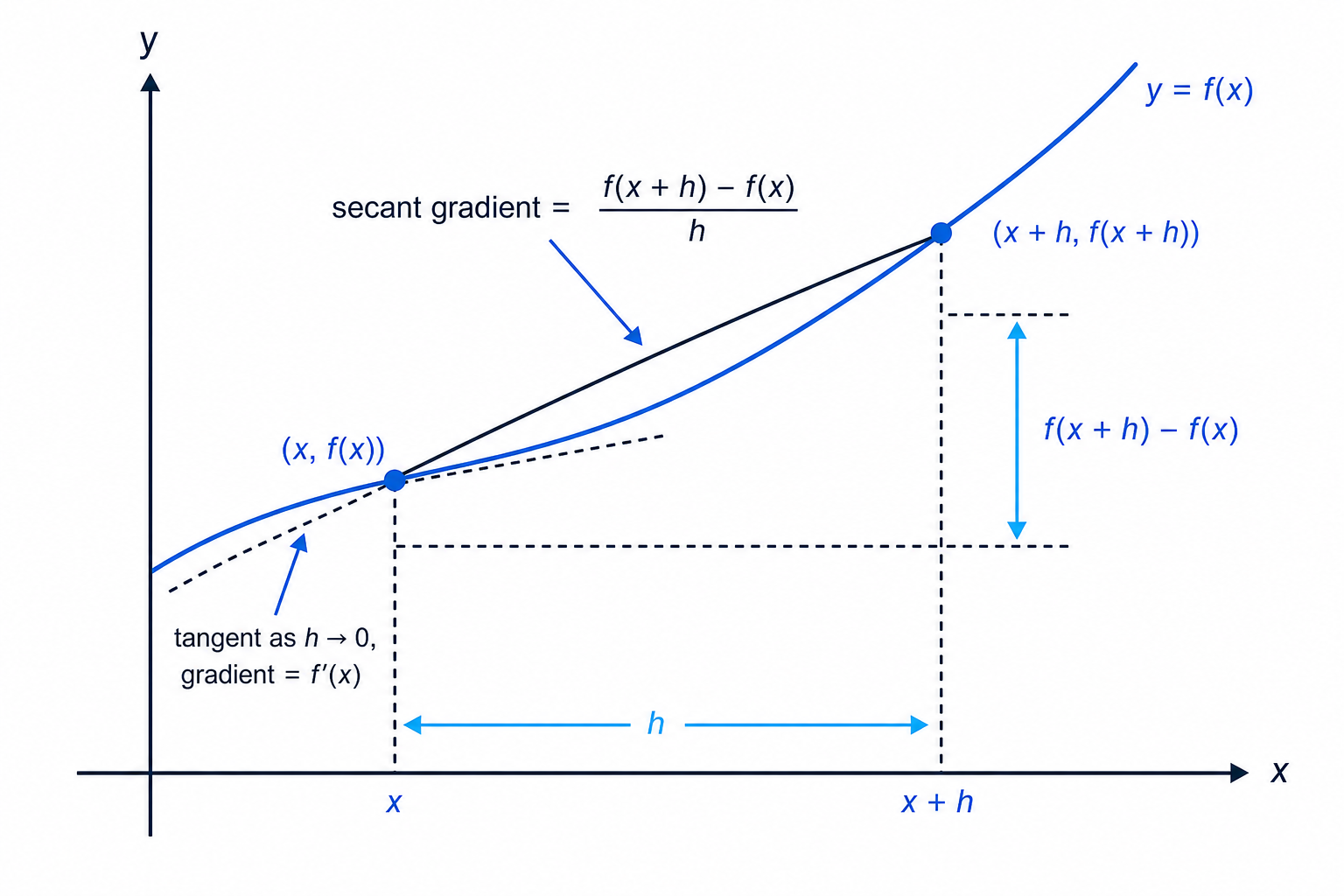
Differentiating from first principles
Let f(x)=x2+5xf(x)=x^2+5xf(x)=x2+5x. Show that f′(x)=2x+5f'(x)=2x+5f′(x)=2x+5.
-
Start with f(x+h)f(x+h)f(x+h):
f(x+h)=(x+h)2+5(x+h)f(x+h)=(x+h)^2+5(x+h)f(x+h)=(x+h)2+5(x+h) -
Form the difference quotient and simplify:
f(x+h)−f(x)h=x2+2xh+h2+5x+5h−(x2+5x)h=2x+h+5\frac{f(x+h)-f(x)}{h} = \frac{x^2+2xh+h^2+5x+5h-(x^2+5x)}{h} = 2x+h+5hf(x+h)−f(x)=hx2+2xh+h2+5x+5h−(x2+5x)=2x+h+5 -
Let h→0h\to 0h→0:
f′(x)=2x+5f'(x)=2x+5f′(x)=2x+5
Standard derivatives and rewriting first
Before differentiating, it often helps to rewrite roots and fractions using indices:
- x=x12\sqrt{x}=x^{\frac12}x=x21
- 1x2=x−2\frac{1}{x^2}=x^{-2}x21=x−2
- 22x+1=2(2x+1)−12\frac{2}{\sqrt{2x+1}}=2(2x+1)^{-\frac12}2x+12=2(2x+1)−21
The main standard results are:
- Power rule: if y=xny=x^ny=xn, then dydx=nxn−1\frac{dy}{dx}=nx^{n-1}dxdy=nxn−1.
- ddx(ex)=ex\frac{d}{dx}(e^x)=e^xdxd(ex)=ex
- ddx(lnx)=1x\frac{d}{dx}(\ln x)=\frac1xdxd(lnx)=x1, for x>0x>0x>0
- ddx(sinx)=cosx\frac{d}{dx}(\sin x)=\cos xdxd(sinx)=cosx
- ddx(cosx)=−sinx\frac{d}{dx}(\cos x)=-\sin xdxd(cosx)=−sinx
- ddx(tanx)=sec2x\frac{d}{dx}(\tan x)=\sec^2 xdxd(tanx)=sec2x
- ddx(ax)=axlna\frac{d}{dx}(a^x)=a^x\ln adxd(ax)=axlna, for a>0a>0a>0
Radians only
The standard trigonometric derivatives assume angles are measured in radians. This is why A-Level differentiation questions involving trig usually work in radians.
Finding first and second derivatives
Let f(x)=lnx+ex+4x3f(x)=\ln x+e^x+4x^3f(x)=lnx+ex+4x3. Find f′(x)f'(x)f′(x) and f′′(x)f''(x)f′′(x).
-
Differentiate each term separately:
f′(x)=1x+ex+12x2f'(x)=\frac1x+e^x+12x^2f′(x)=x1+ex+12x2 -
Differentiate again to get the second derivative:
f′′(x)=−1x2+ex+24xf''(x)=-\frac{1}{x^2}+e^x+24xf′′(x)=−x21+ex+24x
Second derivative
The second derivative, written d2ydx2\frac{d^2y}{dx^2}dx2d2y or f′′(x)f''(x)f′′(x), is the derivative of the derivative. It tells you how the gradient is changing.
The chain rule
A composite function is a function inside another function, such as (x2+4)3(x^2+4)^3(x2+4)3 or ex2e^{x^2}ex2.
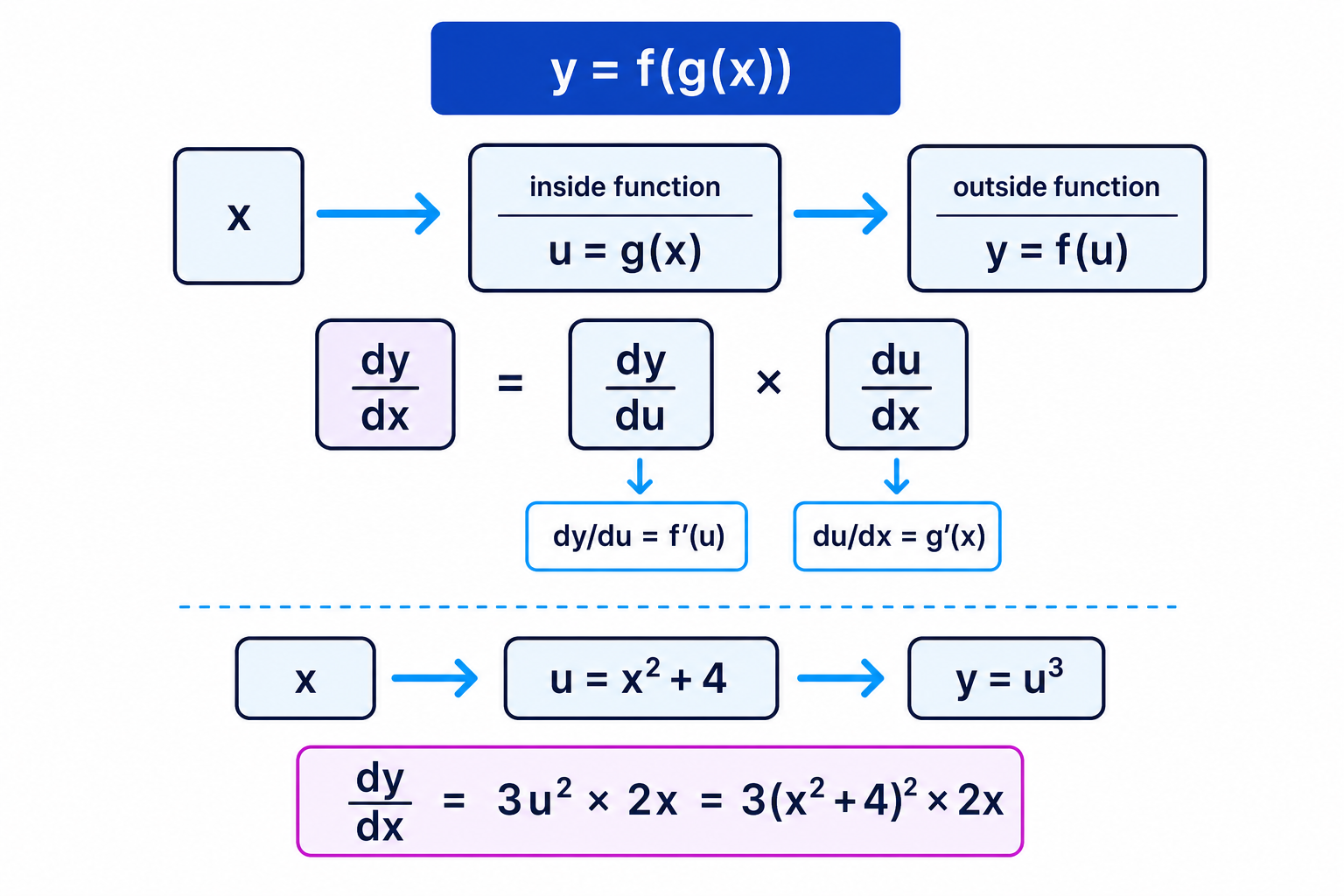
Chain rule
Differentiate the outside function, keep the inside unchanged, then multiply by the derivative of the inside.
If y=f(g(x))y=f(g(x))y=f(g(x)), then
dydx=f′(g(x))g′(x)\frac{dy}{dx}=f'(g(x))g'(x)dxdy=f′(g(x))g′(x)Using the chain rule
Differentiate y=(x2+4)3y=(x^2+4)^3y=(x2+4)3 and z=6+ex2z=6+e^{x^2}z=6+ex2.
-
For y=(x2+4)3y=(x^2+4)^3y=(x2+4)3, the outside is “cube” and the inside is x2+4x^2+4x2+4:
dydx=3(x2+4)2⋅2x=6x(x2+4)2\frac{dy}{dx}=3(x^2+4)^2\cdot 2x=6x(x^2+4)^2dxdy=3(x2+4)2⋅2x=6x(x2+4)2 -
For z=6+ex2z=6+e^{x^2}z=6+ex2, the constant differentiates to zero and the inside of the exponential is x2x^2x2:
dzdx=ex2⋅2x=2xex2\frac{dz}{dx}=e^{x^2}\cdot 2x=2xe^{x^2}dxdz=ex2⋅2x=2xex2
Forgetting the inside derivative
For ex2e^{x^2}ex2, the derivative is 2xex22xe^{x^2}2xex2, not just ex2e^{x^2}ex2. The extra 2x2x2x comes from differentiating the inside.
Product and quotient rules
Use the product rule when two expressions involving xxx are multiplied.
ddx(uv)=u′v+uv′\frac{d}{dx}(uv)=u'v+uv'dxd(uv)=u′v+uv′Use the quotient rule when one expression involving xxx is divided by another.
ddx(uv)=u′v−uv′v2\frac{d}{dx}\left(\frac{u}{v}\right)=\frac{u'v-uv'}{v^2}dxd(vu)=v2u′v−uv′Here, uuu and vvv are functions of xxx, and v≠0v\neq 0v=0.
Product and quotient rule practice
Differentiate y=2xexy=2xe^xy=2xex and z=ln(x2+1)2x+3z=\frac{\ln(x^2+1)}{2x+3}z=2x+3ln(x2+1).
-
For y=2xexy=2xe^xy=2xex, take u=2xu=2xu=2x and v=exv=e^xv=ex:
dydx=2ex+2xex=2ex(x+1)\frac{dy}{dx}=2e^x+2xe^x=2e^x(x+1)dxdy=2ex+2xex=2ex(x+1) -
For z=ln(x2+1)2x+3z=\frac{\ln(x^2+1)}{2x+3}z=2x+3ln(x2+1), take u=ln(x2+1)u=\ln(x^2+1)u=ln(x2+1) and v=2x+3v=2x+3v=2x+3:
u′=2xx2+1,v′=2u'=\frac{2x}{x^2+1}, \qquad v'=2u′=x2+12x,v′=2 -
Substitute into the quotient rule:
dzdx=2xx2+1(2x+3)−2ln(x2+1)(2x+3)2\frac{dz}{dx} = \frac{\frac{2x}{x^2+1}(2x+3)-2\ln(x^2+1)}{(2x+3)^2}dxdz=(2x+3)2x2+12x(2x+3)−2ln(x2+1)
Simplify first if you can
If a quotient can be simplified algebraically before differentiating, do that first. It often saves time and reduces mistakes.
Tangents and normals
A tangent is a straight line that has the same gradient as the curve at a point.
A normal is a straight line perpendicular to the tangent. If the tangent gradient is mmm, then the normal gradient is −1m-\frac1m−m1, as long as m≠0m\neq 0m=0.
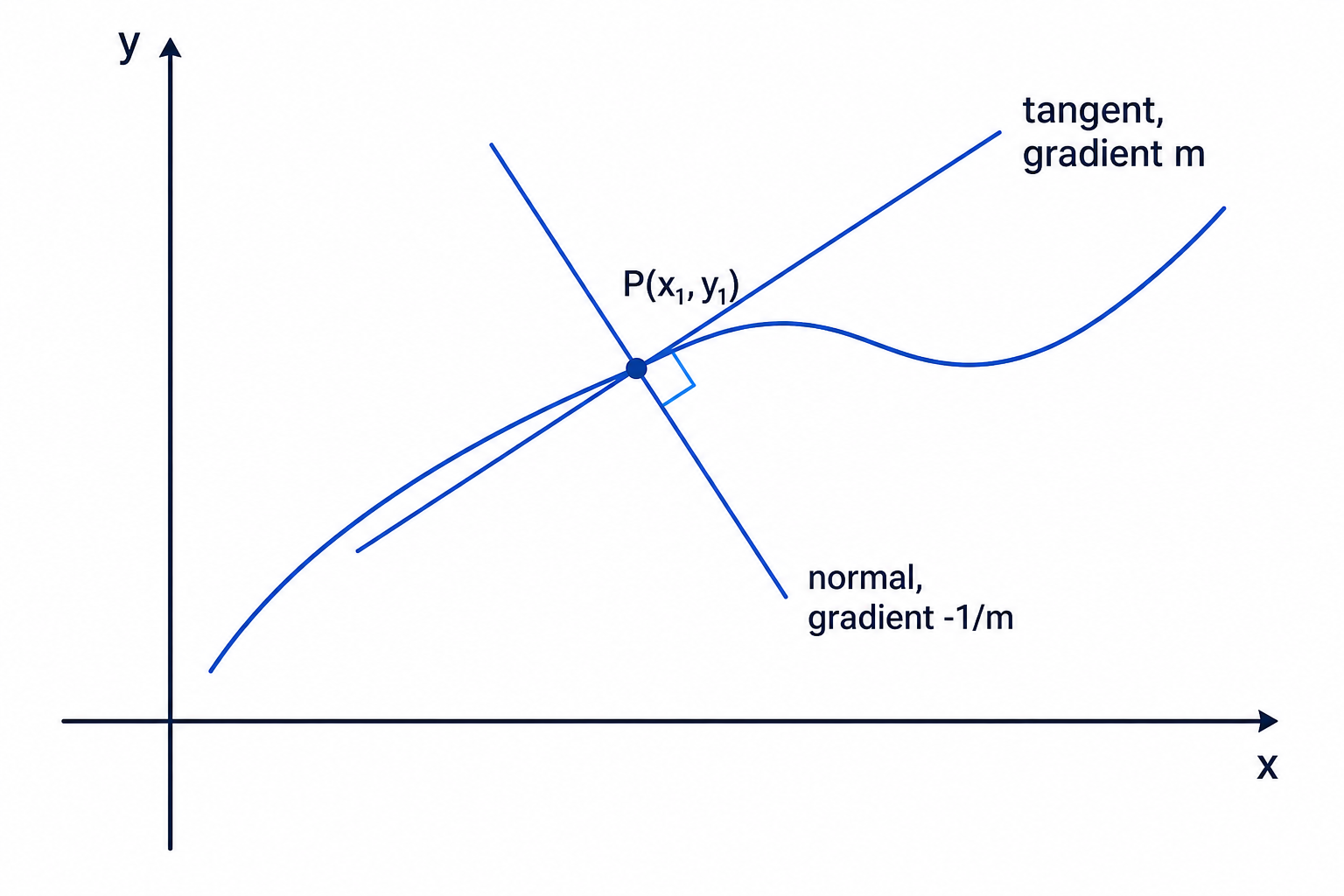
The equation of a straight line through (x1,y1)(x_1,y_1)(x1,y1) with gradient mmm is
y−y1=m(x−x1)y-y_1=m(x-x_1)y−y1=m(x−x1)Finding an equation of a normal
The point PPP lies on the curve y=42x+1y=\frac{4}{2x+1}y=2x+14 with xxx-coordinate 1. Find an equation of the normal at PPP.
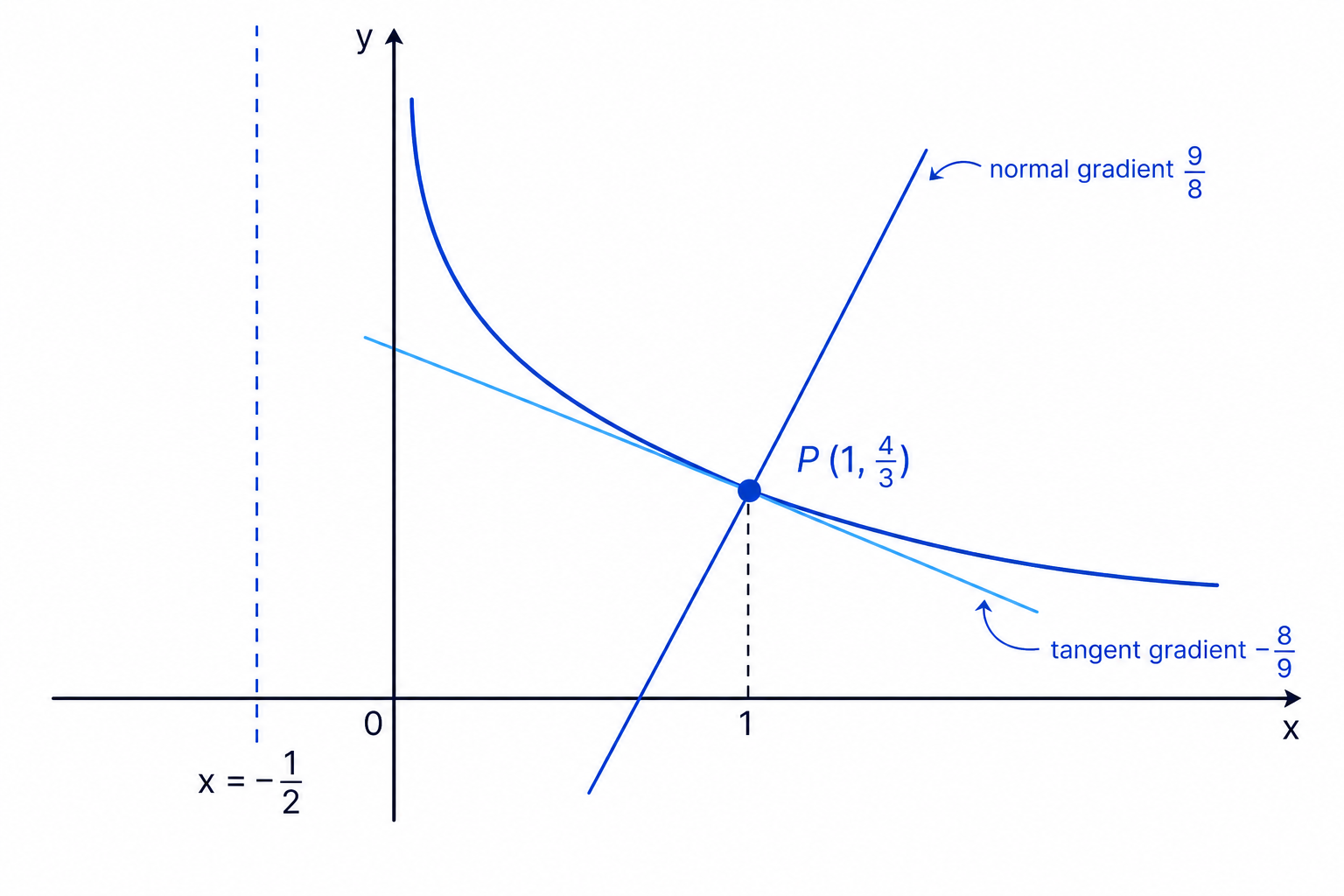
-
Find the coordinates of PPP:
y=42(1)+1=43y=\frac{4}{2(1)+1}=\frac43y=2(1)+14=34 -
Differentiate by rewriting the curve as y=4(2x+1)−1y=4(2x+1)^{-1}y=4(2x+1)−1:
dydx=4(−1)(2x+1)−2⋅2=−8(2x+1)2\frac{dy}{dx}=4(-1)(2x+1)^{-2}\cdot 2=-\frac{8}{(2x+1)^2}dxdy=4(−1)(2x+1)−2⋅2=−(2x+1)28 -
Find the tangent gradient at x=1x=1x=1:
mtangent=−89m_{\text{tangent}}=-\frac{8}{9}mtangent=−98 -
Use the negative reciprocal for the normal gradient:
mnormal=98m_{\text{normal}}=\frac98mnormal=89 -
Use y−y1=m(x−x1)y-y_1=m(x-x_1)y−y1=m(x−x1):
y−43=98(x−1)y-\frac43=\frac98(x-1)y−34=89(x−1)
Stationary points and nature
Stationary point
A stationary point is a point on a curve where dydx=0\frac{dy}{dx}=0dxdy=0. It could be a local maximum, a local minimum, or a stationary point of inflection.
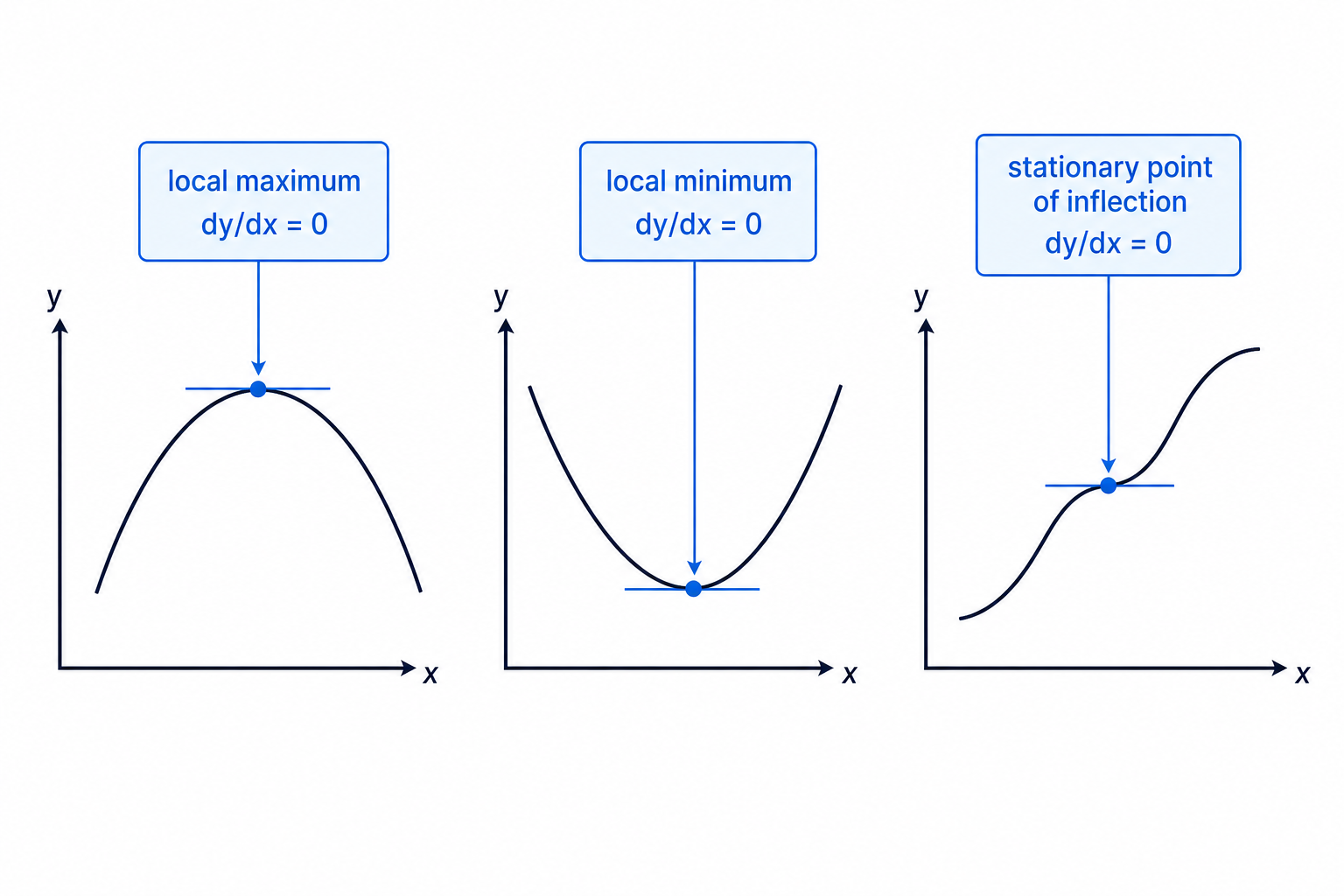
To classify stationary points:
- If d2ydx2>0\frac{d^2y}{dx^2}>0dx2d2y>0, the point is a local minimum.
- If d2ydx2<0\frac{d^2y}{dx^2}<0dx2d2y<0, the point is a local maximum.
- If d2ydx2=0\frac{d^2y}{dx^2}=0dx2d2y=0, the test is inconclusive, so check the sign of dydx\frac{dy}{dx}dxdy around the point.
Finding stationary points and their nature
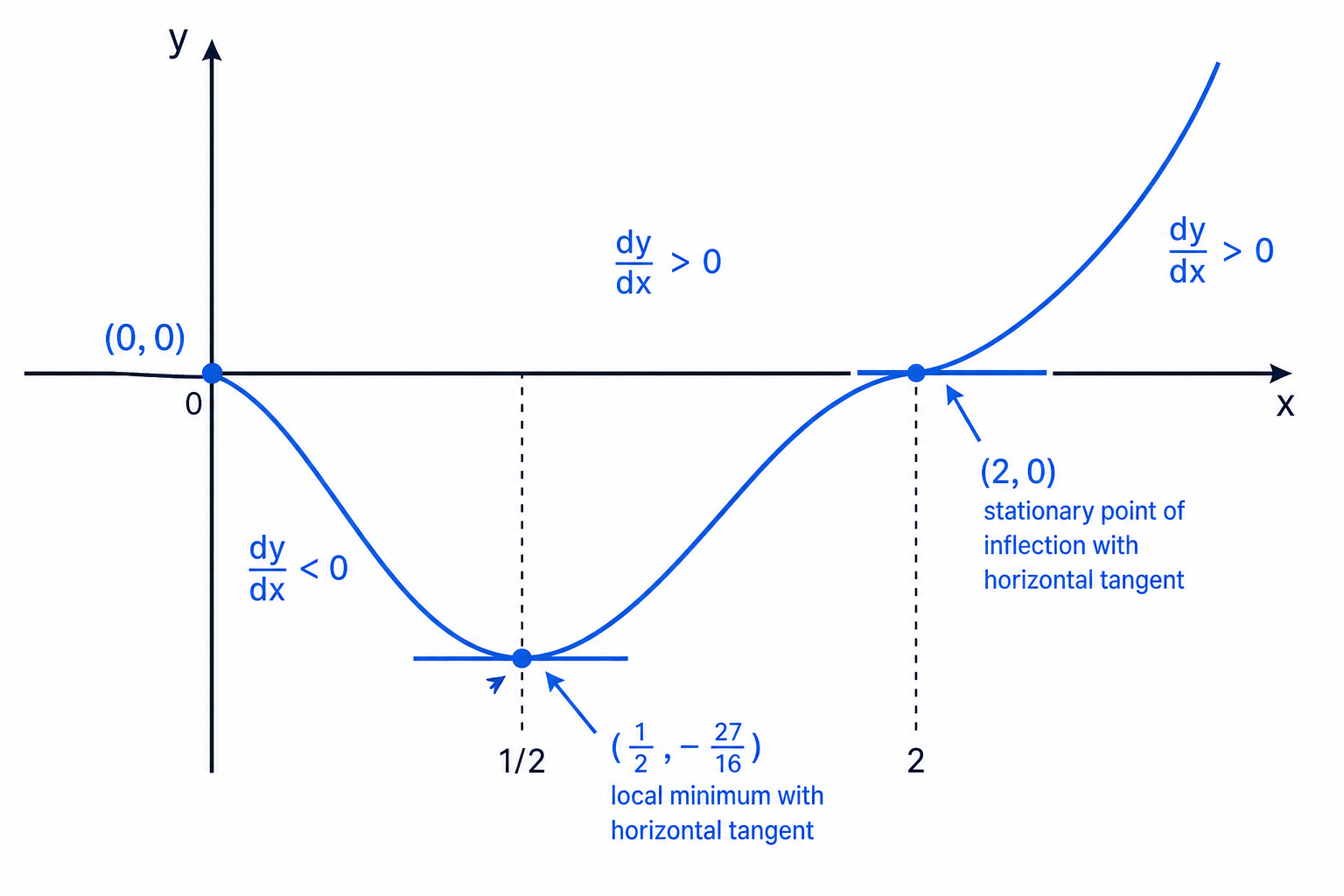
Find the stationary points of y=x(x−2)3y=x(x-2)^3y=x(x−2)3 and determine their nature.
-
Differentiate using the product rule:
dydx=(x−2)3+3x(x−2)2=(x−2)2(4x−2)\frac{dy}{dx}=(x-2)^3+3x(x-2)^2=(x-2)^2(4x-2)dxdy=(x−2)3+3x(x−2)2=(x−2)2(4x−2) -
Set the derivative equal to zero:
(x−2)2(4x−2)=0(x-2)^2(4x-2)=0(x−2)2(4x−2)=0 -
Solve for xxx:
x=2orx=12x=2 \quad \text{or} \quad x=\frac12x=2orx=21 -
Find the corresponding yyy-coordinates:
y(2)=0,y(12)=12(−32)3=−2716y(2)=0, \qquad y\left(\frac12\right)=\frac12\left(-\frac32\right)^3=-\frac{27}{16}y(2)=0,y(21)=21(−23)3=−1627 -
Differentiate again:
d2ydx2=12(x−2)(x−1)\frac{d^2y}{dx^2}=12(x-2)(x-1)dx2d2y=12(x−2)(x−1) -
At x=12x=\frac12x=21, d2ydx2>0\frac{d^2y}{dx^2}>0dx2d2y>0, so (12,−2716)\left(\frac12,-\frac{27}{16}\right)(21,−1627) is a local minimum.
-
At x=2x=2x=2, the second derivative test is inconclusive. Since dydx=(x−2)2(4x−2)\frac{dy}{dx}=(x-2)^2(4x-2)dxdy=(x−2)2(4x−2) is positive on both sides of x=2x=2x=2, (2,0)(2,0)(2,0) is a stationary point of inflection.
Implicit differentiation
An implicit equation links xxx and yyy without necessarily making yyy the subject, such as x2+xy+2y2=23x^2+xy+2y^2=23x2+xy+2y2=23.
When differentiating terms involving yyy, remember that yyy is a function of xxx.
For example:
ddx(y2)=2ydydx\frac{d}{dx}(y^2)=2y\frac{dy}{dx}dxd(y2)=2ydxdyand, using the product rule,
ddx(xy)=xdydx+y\frac{d}{dx}(xy)=x\frac{dy}{dx}+ydxd(xy)=xdxdy+yImplicit differentiation and a normal
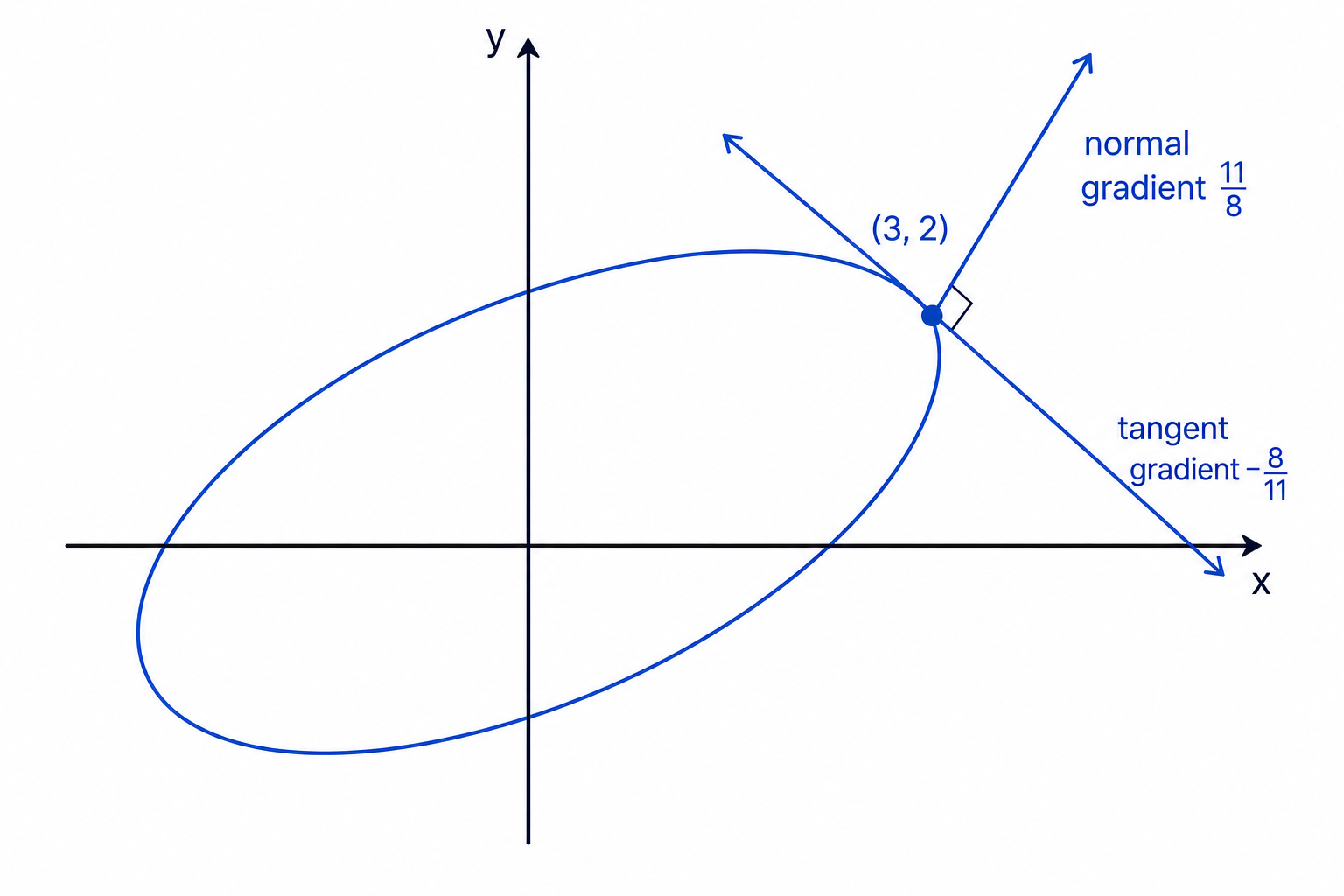
A curve has equation x2+xy+2y2=23x^2+xy+2y^2=23x2+xy+2y2=23. Find an equation of the normal at (3,2)(3,2)(3,2).
-
Differentiate each term with respect to xxx:
2x+(xdydx+y)+4ydydx=02x+\left(x\frac{dy}{dx}+y\right)+4y\frac{dy}{dx}=02x+(xdxdy+y)+4ydxdy=0 -
Collect the dydx\frac{dy}{dx}dxdy terms:
(x+4y)dydx=−(2x+y)(x+4y)\frac{dy}{dx}=-(2x+y)(x+4y)dxdy=−(2x+y) -
Substitute (3,2)(3,2)(3,2) to find the tangent gradient:
mtangent=−2(3)+23+4(2)=−811m_{\text{tangent}}=-\frac{2(3)+2}{3+4(2)}=-\frac{8}{11}mtangent=−3+4(2)2(3)+2=−118 -
Find the normal gradient:
mnormal=118m_{\text{normal}}=\frac{11}{8}mnormal=811 -
Use the line equation:
y−2=118(x−3)y-2=\frac{11}{8}(x-3)y−2=811(x−3)
Parametric differentiation
A curve is given parametrically when both xxx and yyy are written in terms of another variable, usually ttt. This variable is called a parameter.
If x=x(t)x=x(t)x=x(t) and y=y(t)y=y(t)y=y(t), then
dydx=dydtdxdt\frac{dy}{dx}=\frac{\frac{dy}{dt}}{\frac{dx}{dt}}dxdy=dtdxdtdyprovided dxdt≠0\frac{dx}{dt}\neq 0dtdx=0.
A parametric tangent
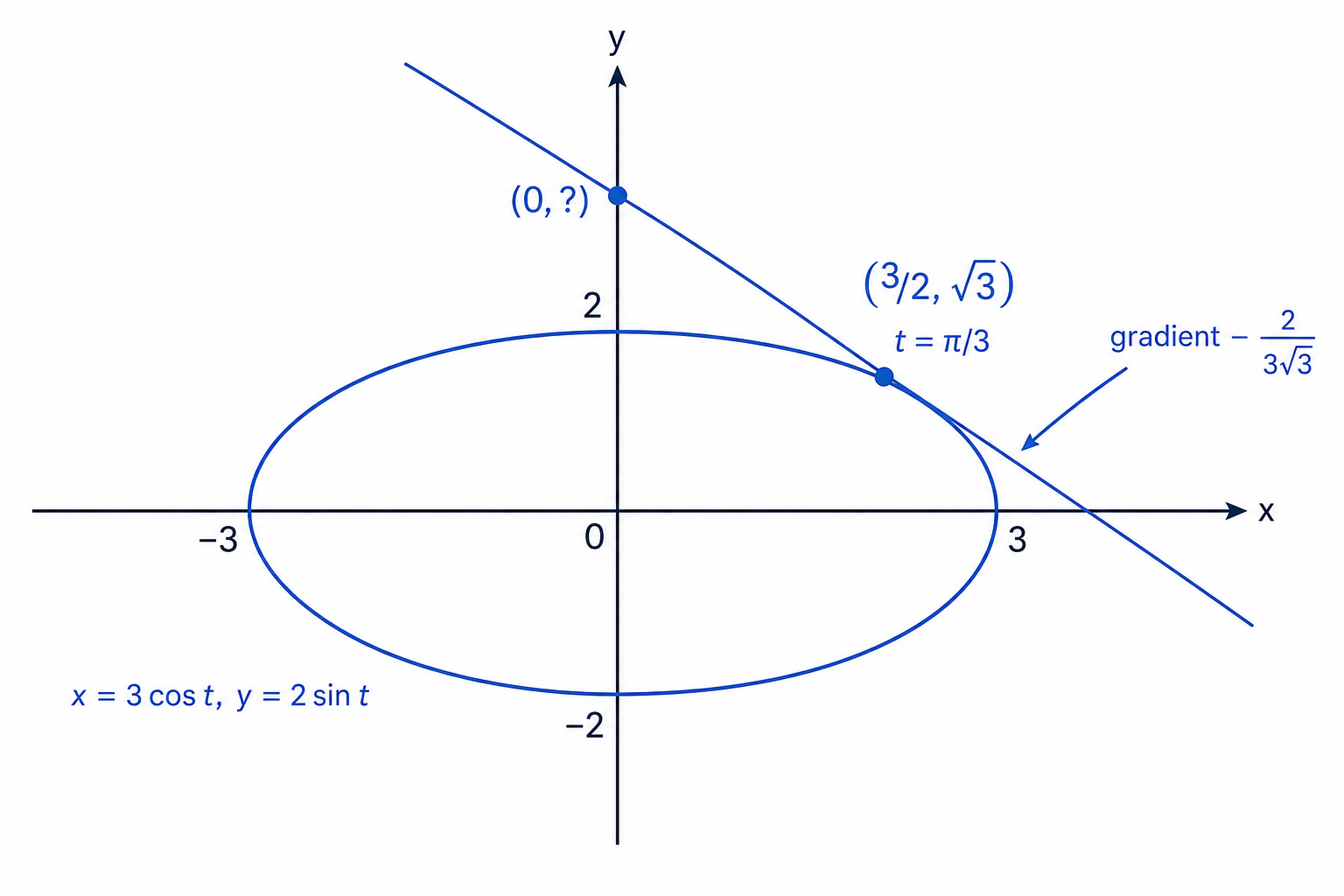
A curve has parametric equations x=3costx=3\cos tx=3cost and y=2sinty=2\sin ty=2sint. Find where the tangent at t=π3t=\frac{\pi}{3}t=3π cuts the yyy-axis.
-
Differentiate both parametric equations:
dxdt=−3sint,dydt=2cost\frac{dx}{dt}=-3\sin t, \qquad \frac{dy}{dt}=2\cos tdtdx=−3sint,dtdy=2cost -
Divide to find dydx\frac{dy}{dx}dxdy:
dydx=2cost−3sint=−23cott\frac{dy}{dx}=\frac{2\cos t}{-3\sin t}=-\frac23\cot tdxdy=−3sint2cost=−32cott -
At t=π3t=\frac{\pi}{3}t=3π, find the point and gradient:
(x,y)=(32,3),m=−233(x,y)=\left(\frac32,\sqrt3\right), \qquad m=-\frac{2}{3\sqrt3}(x,y)=(23,3),m=−332 -
Write the tangent equation:
y−3=−233(x−32)y-\sqrt3=-\frac{2}{3\sqrt3}\left(x-\frac32\right)y−3=−332(x−23) -
Set x=0x=0x=0 to find the intercept on the yyy-axis:
y=3+13=433y=\sqrt3+\frac{1}{\sqrt3}=\frac{4\sqrt3}{3}y=3+31=343
In the exam
-
Rewrite roots and fractions as powers before choosing a rule.
-
For tangents and normals, always find both the point and the gradient.
-
For stationary points, solve dydx=0\frac{dy}{dx}=0dxdy=0 and then justify the nature using d2ydx2\frac{d^2y}{dx^2}dx2d2y or a sign test.
-
For implicit differentiation, collect all dydx\frac{dy}{dx}dxdy terms on one side before factorising.
-
For parametric curves, find dydx\frac{dy}{dx}dxdy by dividing dydt\frac{dy}{dt}dtdy by dxdt\frac{dx}{dt}dtdx, not the other way round.
Check yourself
- Can you explain why differentiating ex2e^{x^2}ex2 gives an extra factor of 2x2x2x?
- When finding a normal, why do you need the negative reciprocal of the tangent gradient?
- How would you prove that a function is decreasing over its whole domain?
