

What you'll learn
- How to recognise and use arithmetic and geometric sequences.
- How to find sums of finite series and sums to infinity.
- How to handle recurrence relations, periodic sequences, and sigma notation.
- How to approach worded modelling questions involving salaries, savings, production, and training plans.
1. The basic language
A sequence is a list of terms in order: for example, 4, 7, 10, 13, ...
A series is what you get when you add the terms of a sequence.
Sequences, terms and series
- A sequence is an ordered list of numbers.
- A term is one number in the sequence.
- The notation unu_nun means the nnnth term of a sequence.
- A series is the sum of terms in a sequence.
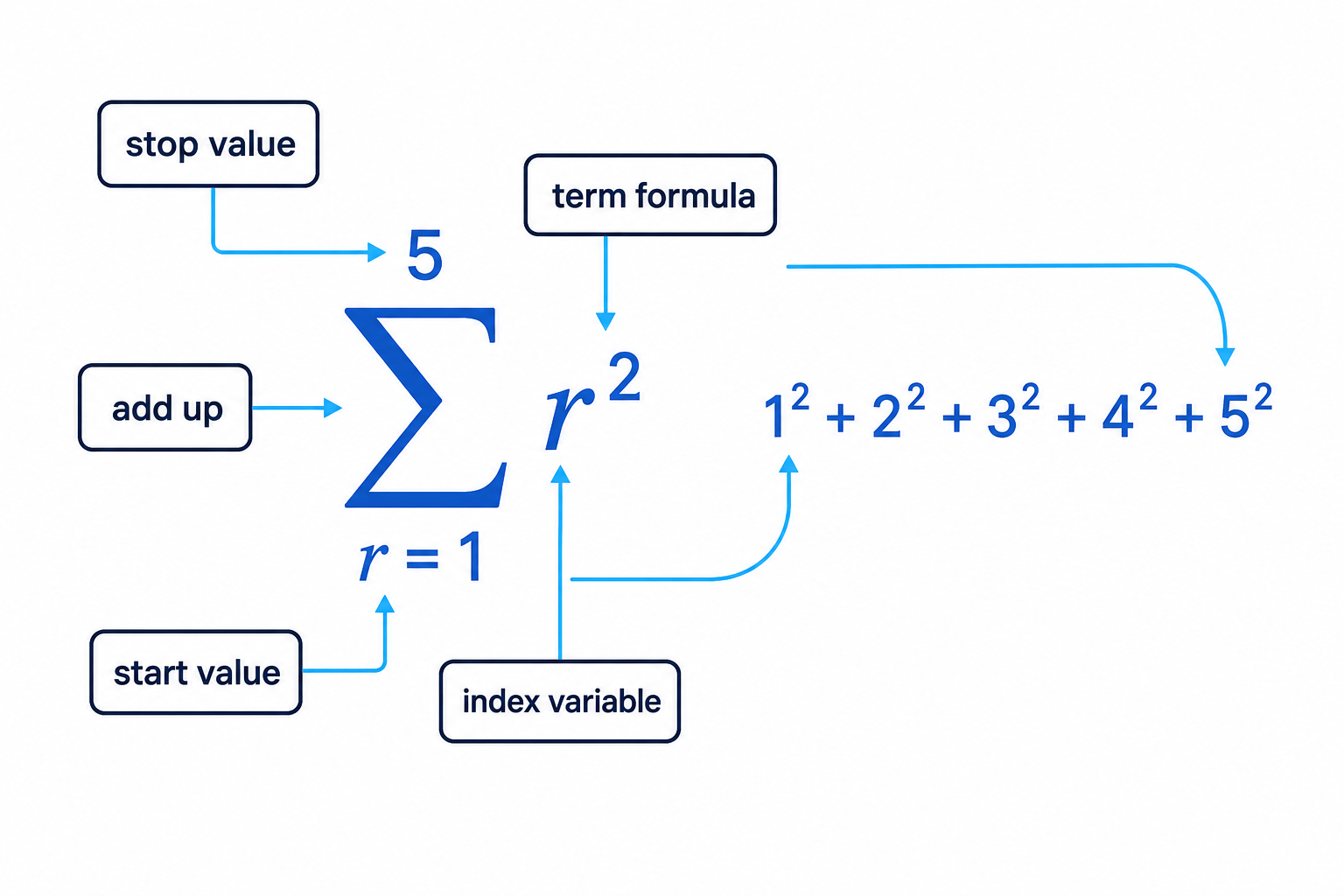
- The notation ∑\sum∑ means “add up”.
For example,
∑r=15r2\sum_{r=1}^{5} r^2r=1∑5r2means
12+22+32+42+521^2+2^2+3^2+4^2+5^212+22+32+42+52The lower number tells you where to start; the upper number tells you where to stop.
Reading a sigma series
A series is given by ∑r=418(5r−1)\sum_{r=4}^{18}(5r-1)∑r=418(5r−1). Find the first term, the common difference, and the number of terms.
-
The first term comes from the lower limit, so substitute r=4r=4r=4: 5(4)−1=195(4)-1=195(4)−1=19.
-
The next term comes from r=5r=5r=5: 5(5)−1=245(5)-1=245(5)−1=24, so the common difference is 5.
-
Count the terms inclusively: 18−4+1=1518-4+1=1518−4+1=15.
Starting at the wrong value
In ∑r=418(5r−1)\sum_{r=4}^{18}(5r-1)∑r=418(5r−1), the first term uses r=4r=4r=4, not r=1r=1r=1. Always check the lower limit.
2. Arithmetic sequences and series
An arithmetic sequence is one where you add the same amount each time.
Arithmetic sequence
-
The first term is usually called aaa.
-
The common difference is called ddd.
-
The nnnth term is
un=a+(n−1)du_n=a+(n-1)dun=a+(n−1)d
So if the first term is 6 and the common difference is 4, the sequence is 6, 10, 14, 18, ...
The arithmetic sum formula
For an arithmetic series,
Sn=a+(a+d)+(a+2d)+⋯+(a+(n−1)d)S_n=a+(a+d)+(a+2d)+\cdots+\bigl(a+(n-1)d\bigr)Sn=a+(a+d)+(a+2d)+⋯+(a+(n−1)d)where SnS_nSn means the sum of the first nnn terms.
Write the sum forwards and backwards:
Sn=a+(a+d)+⋯+(a+(n−1)d)Sn=(a+(n−1)d)+⋯+(a+d)+a\begin{aligned} S_n&=a+(a+d)+\cdots+\bigl(a+(n-1)d\bigr)\\ S_n&=\bigl(a+(n-1)d\bigr)+\cdots+(a+d)+a \end{aligned}SnSn=a+(a+d)+⋯+(a+(n−1)d)=(a+(n−1)d)+⋯+(a+d)+aAdding these gives nnn identical pairs:
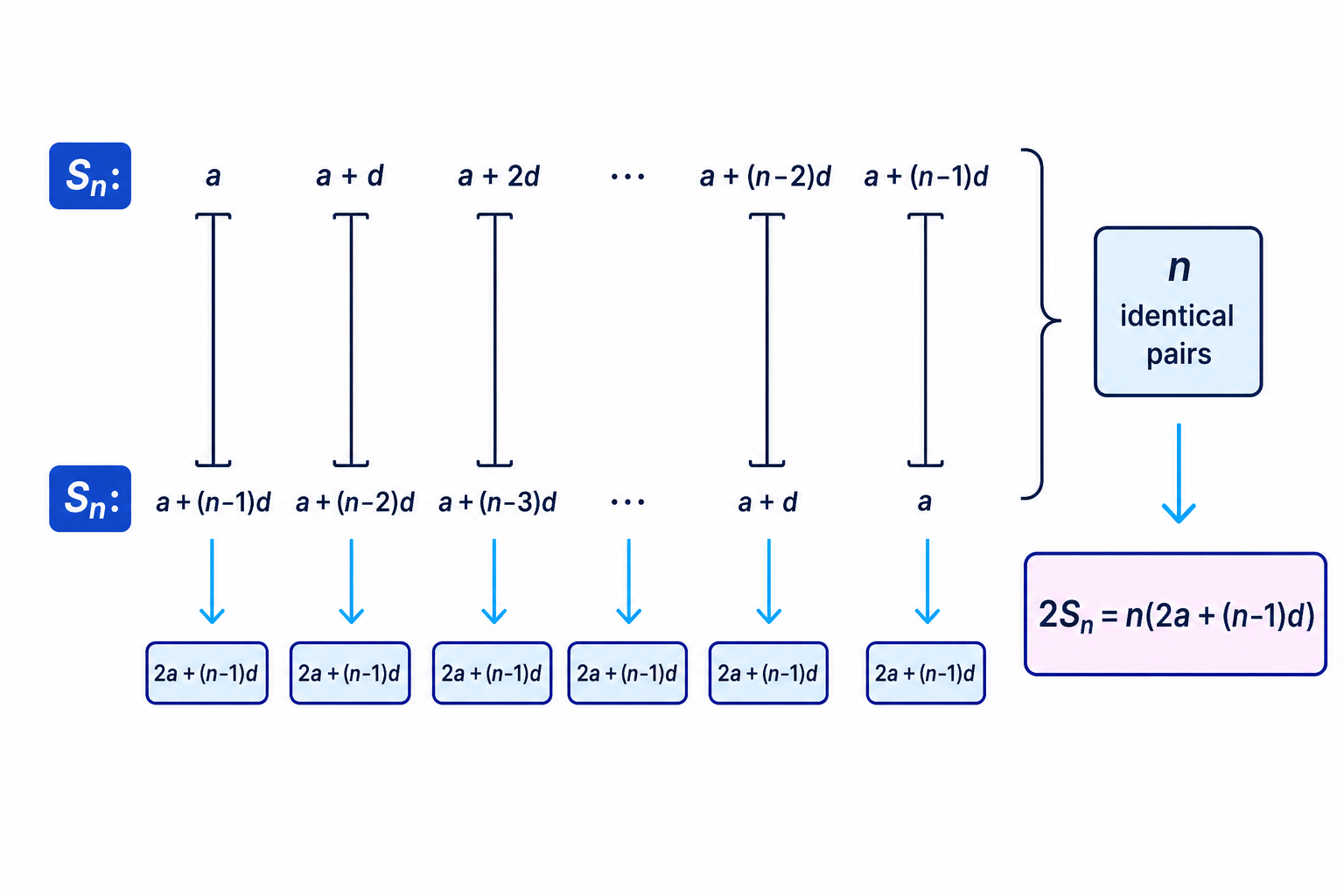
Therefore,
Sn=n2(2a+(n−1)d)S_n=\frac{n}{2}\bigl(2a+(n-1)d\bigr)Sn=2n(2a+(n−1)d)Arithmetic formulae
- Use un=a+(n−1)du_n=a+(n-1)dun=a+(n−1)d for a single term.
- Use Sn=n2(2a+(n−1)d)S_n=\frac{n}{2}\bigl(2a+(n-1)d\bigr)Sn=2n(2a+(n−1)d) for a total.
Finding an arithmetic sequence and a limit
The third term of an arithmetic sequence is -2. The sum of the first eight terms is 44. Find aaa and ddd, then find the greatest value of nnn for which Sn<250S_n<250Sn<250.
-
Use the third term condition:
a+2d=−2a+2d=-2a+2d=−2 -
Use the sum condition with n=8n=8n=8:
S8=82(2a+7d)44=4(2a+7d)2a+7d=11\begin{aligned} S_8&=\frac{8}{2}(2a+7d)\\ 44&=4(2a+7d)\\ 2a+7d&=11 \end{aligned}S8442a+7d=28(2a+7d)=4(2a+7d)=11 -
Solve the simultaneous equations:
a+2d=−22a+7d=11d=5,a=−12\begin{aligned} a+2d&=-2\\ 2a+7d&=11\\ d&=5,\quad a=-12 \end{aligned}a+2d2a+7dd=−2=11=5,a=−12 -
Write a formula for SnS_nSn:
Sn=n2(2(−12)+(n−1)5)Sn=n2(5n−29)\begin{aligned} S_n&=\frac{n}{2}\bigl(2(-12)+(n-1)5\bigr)\\ S_n&=\frac{n}{2}(5n-29) \end{aligned}SnSn=2n(2(−12)+(n−1)5)=2n(5n−29) -
Test the boundary: S13=234S_{13}=234S13=234 and S14=287S_{14}=287S14=287, so the greatest value is 13.
Single term or total?
If the question asks “amount in week 100”, use u100u_{100}u100. If it asks “total over 100 weeks”, use S100S_{100}S100.
Maximum arithmetic sums
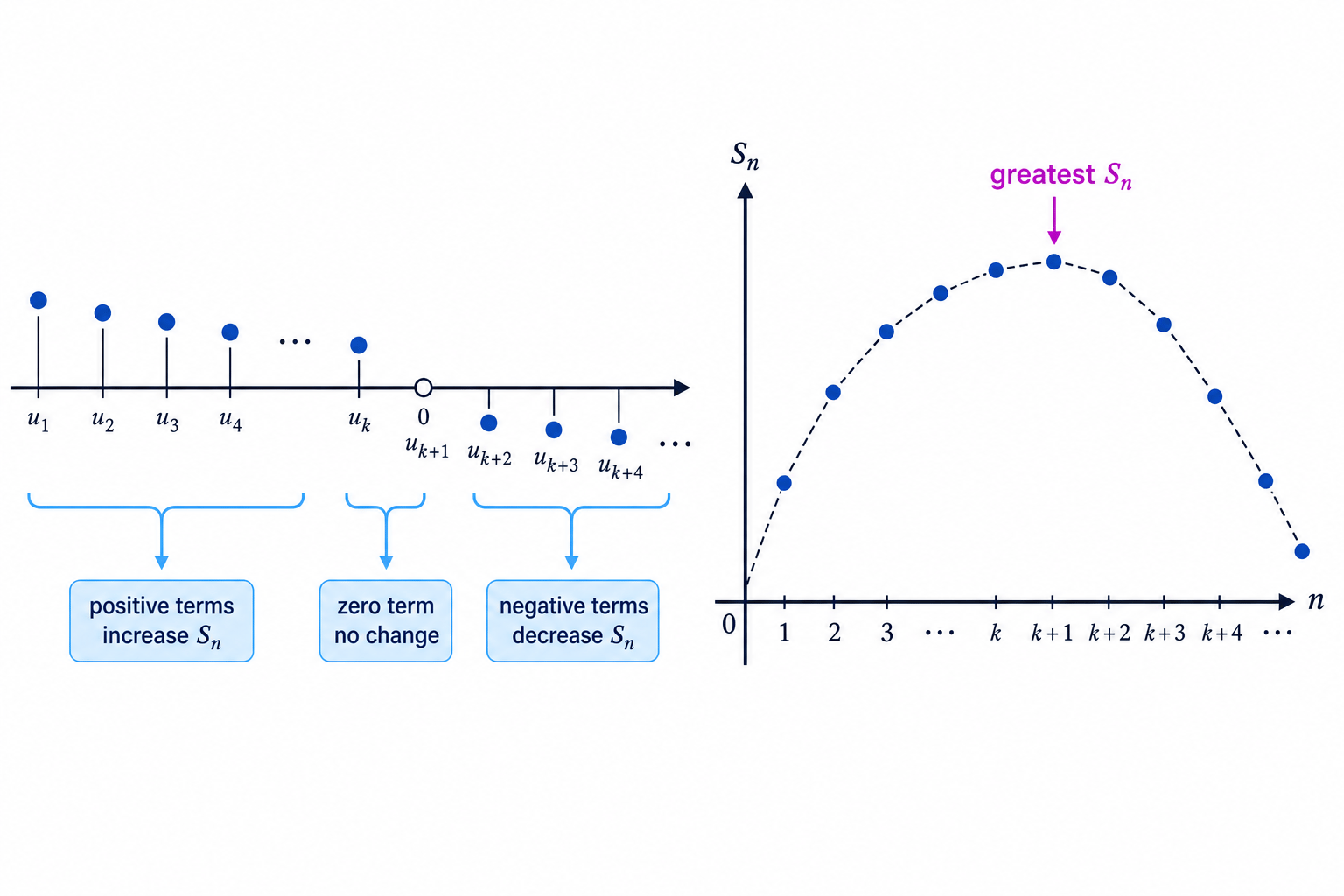
If d<0d<0d<0, the terms eventually become negative. The running total increases while you are adding positive terms, then decreases once you start adding negative terms.
Greatest value of an arithmetic sum
An arithmetic series has first term 500 and sixth term 250. Find the greatest possible value of SnS_nSn.
-
Use the sixth term to find ddd:
500+5d=250500+5d=250500+5d=250 -
Solve for the common difference:
d=−50d=-50d=−50 -
The nnnth term is therefore un=500+(n−1)(−50)=550−50nu_n=500+(n-1)(-50)=550-50nun=500+(n−1)(−50)=550−50n.
-
Find when the terms stop being positive: u10=50u_{10}=50u10=50 and u11=0u_{11}=0u11=0, so adding term 11 does not change the sum.
-
The greatest sum is S10S_{10}S10 or S11S_{11}S11:
S10=102(500+50)=2750S_{10}=\frac{10}{2}(500+50)=2750S10=210(500+50)=2750
3. Geometric sequences and series
A geometric sequence is one where you multiply by the same amount each time.
Geometric sequence
-
The first term is aaa.
-
The common ratio is rrr.
-
The nnnth term is
un=arn−1u_n=ar^{n-1}un=arn−1
For example, 3, 6, 12, 24, ... has common ratio 2.
The finite geometric sum is
Sn=a(1−rn)1−rS_n=\frac{a(1-r^n)}{1-r}Sn=1−ra(1−rn)provided r≠1r\neq1r=1.
Finding a geometric sequence from two terms
The fifth term of a geometric sequence is 18 and the eighth term is 144. Find the common ratio, the first term, and the sum of the first 12 terms to the nearest whole number.
-
Write the two pieces of information using un=arn−1u_n=ar^{n-1}un=arn−1: ar4=18ar^4=18ar4=18 and ar7=144ar^7=144ar7=144.
-
Divide the second equation by the first: r3=8r^3=8r3=8, so r=2r=2r=2.
-
Substitute into ar4=18ar^4=18ar4=18: a⋅24=18a\cdot2^4=18a⋅24=18, so a=98a=\frac{9}{8}a=89.
-
Use the geometric sum formula:
S12=98(212−1)2−1=368558≈4607S_{12}=\frac{\frac{9}{8}(2^{12}-1)}{2-1}=\frac{36855}{8}\approx4607S12=2−189(212−1)=836855≈4607
Sum to infinity
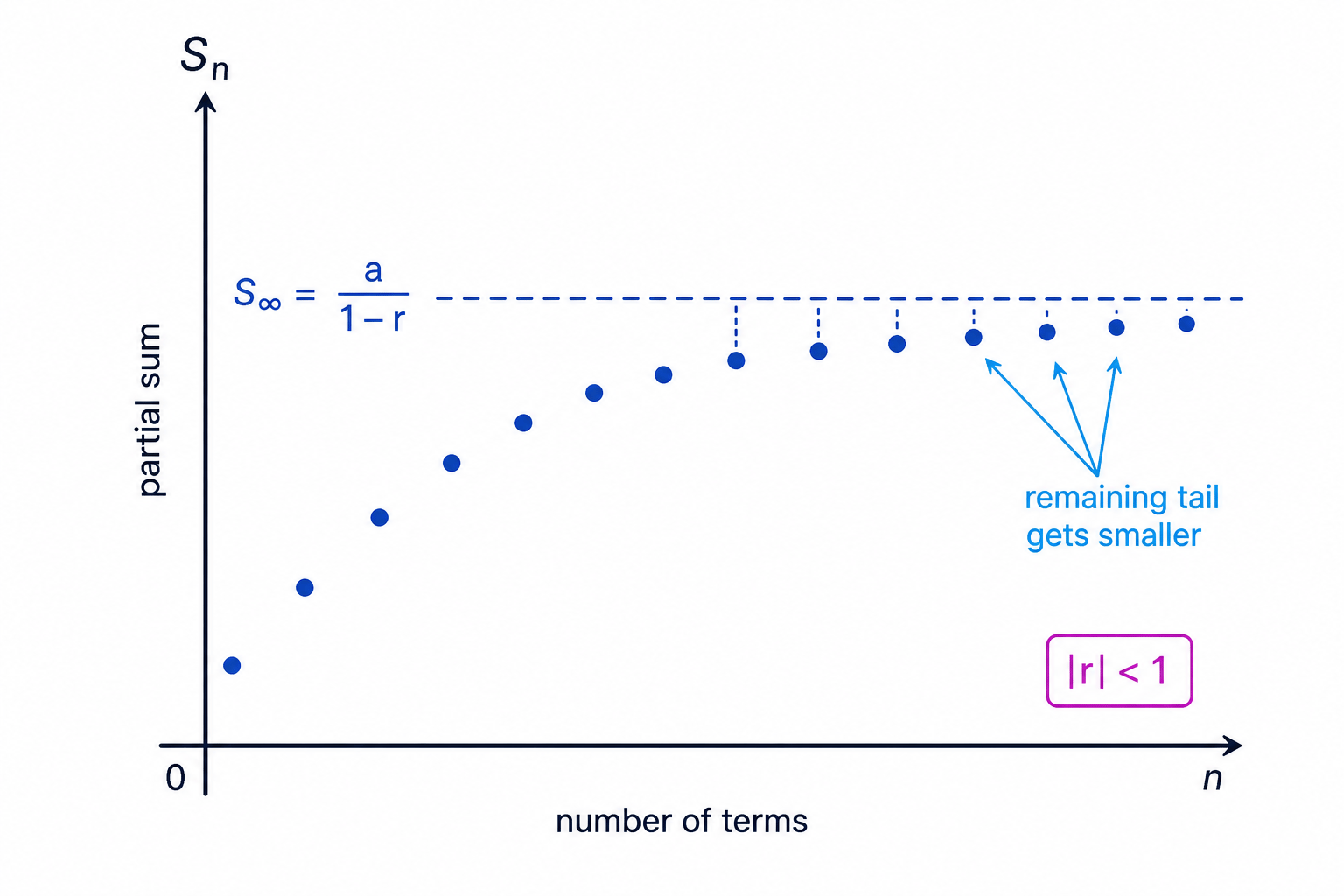
Some geometric series get closer and closer to a fixed total.
Sum to infinity
For a geometric series with ∣r∣<1|r|<1∣r∣<1, the sum to infinity is
S∞=a1−rS_\infty=\frac{a}{1-r}S∞=1−raWhen exists
The formula for S∞S_\inftyS∞ only works when ∣r∣<1|r|<1∣r∣<1. If the ratio has magnitude at least 1, the terms do not settle to zero.
Using sum to infinity
A convergent geometric series has second term 6 and sum to infinity 27. Find the possible values of rrr and aaa. For the larger value of rrr, find the smallest nnn such that Sn>26S_n>26Sn>26.
-
The second term gives ar=6ar=6ar=6, and the sum to infinity gives a1−r=27\frac{a}{1-r}=271−ra=27.
-
Substitute a=6ra=\frac{6}{r}a=r6:
6r(1−r)=279r2−9r+2=0(3r−1)(3r−2)=0\begin{aligned} \frac{6}{r(1-r)}&=27\\ 9r^2-9r+2&=0\\ (3r-1)(3r-2)&=0 \end{aligned}r(1−r)69r2−9r+2(3r−1)(3r−2)=27=0=0 -
Hence r=13r=\frac{1}{3}r=31 or r=23r=\frac{2}{3}r=32. The corresponding values of aaa are 18 and 9.
-
For the larger ratio, a=9a=9a=9 and r=23r=\frac{2}{3}r=32. We need 27(1−(23)n)>2627\left(1-\left(\frac{2}{3}\right)^n\right)>2627(1−(32)n)>26, so (23)n<127\left(\frac{2}{3}\right)^n<\frac{1}{27}(32)n<271.
-
Use logarithms: n>log(1/27)log(2/3)≈8.13n>\frac{\log(1/27)}{\log(2/3)}\approx8.13n>log(2/3)log(1/27)≈8.13, so the smallest integer is 9.
Percentage multipliers
A 4% increase means multiply by 1.04 each time. A 15% decrease means multiply by 0.85 each time.
4. Recurrence relations and periodic sequences
Some sequences are defined by a rule that uses previous terms.
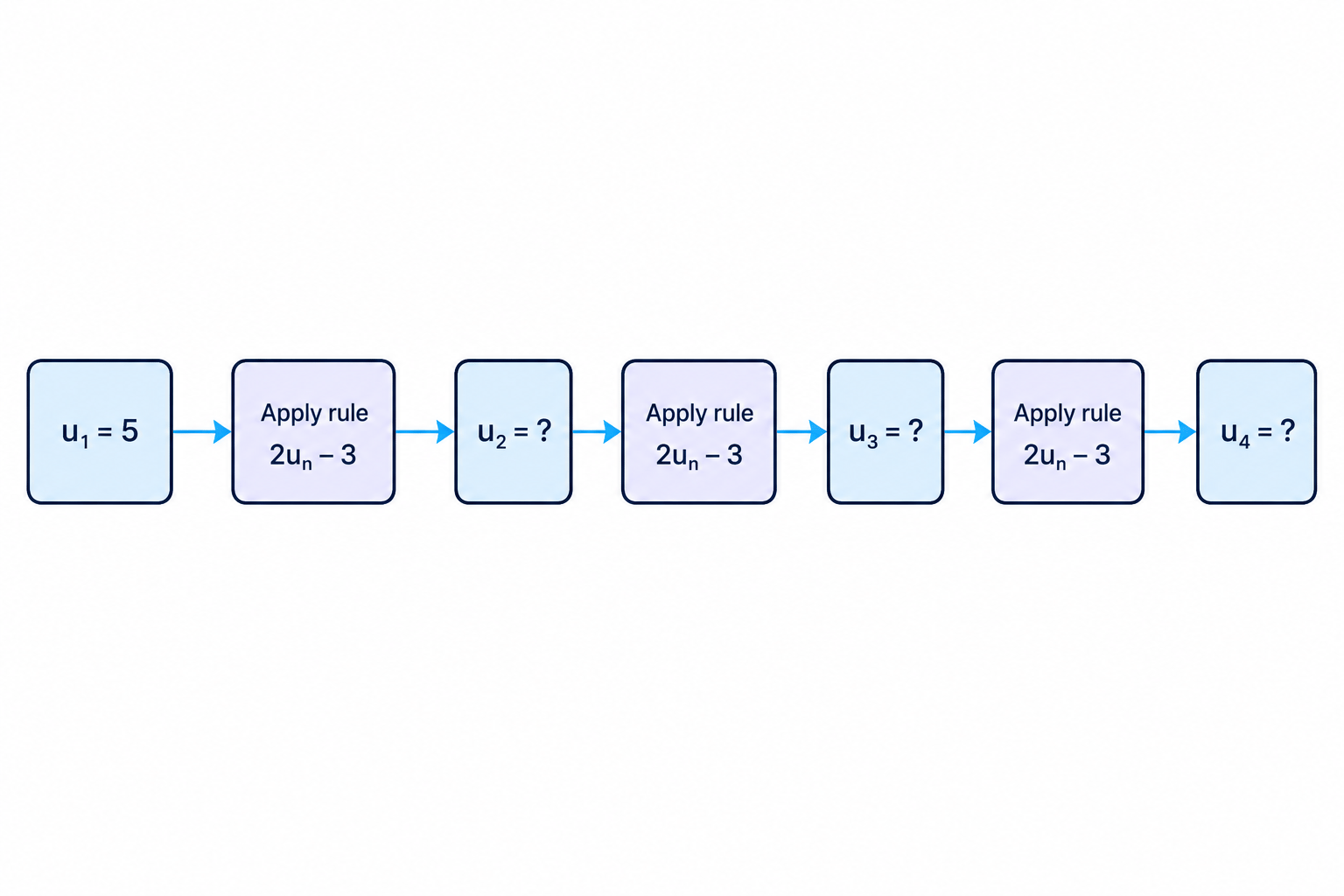
Recurrence relation
A recurrence relation defines a term using earlier terms, such as un+1=2un−3u_{n+1}=2u_n-3un+1=2un−3. You also need starting value information, such as u1=5u_1=5u1=5.
Working with a recurrence relation
A sequence is defined by x1=3x_1=3x1=3 and xn+1=bxn−4x_{n+1}=bx_n-4xn+1=bxn−4. Find x2x_2x2, show that x3=3b2−4b−4x_3=3b^2-4b-4x3=3b2−4b−4, and find bbb if x3=8x_3=8x3=8.
-
Substitute x1=3x_1=3x1=3 into the rule: x2=3b−4x_2=3b-4x2=3b−4.
-
Substitute x2x_2x2 into the rule again:
x3=b(3b−4)−4=3b2−4b−4x_3=b(3b-4)-4=3b^2-4b-4x3=b(3b−4)−4=3b2−4b−4 -
Set this equal to 8 and solve:
3b2−4b−4=83b2−4b−12=0b=2±2103\begin{aligned} 3b^2-4b-4&=8\\ 3b^2-4b-12&=0\\ b&=\frac{2\pm2\sqrt{10}}{3} \end{aligned}3b2−4b−43b2−4b−12b=8=0=32±210
Periodic sequence
A periodic sequence repeats its values in a cycle. The period is the length of the shortest repeating block.
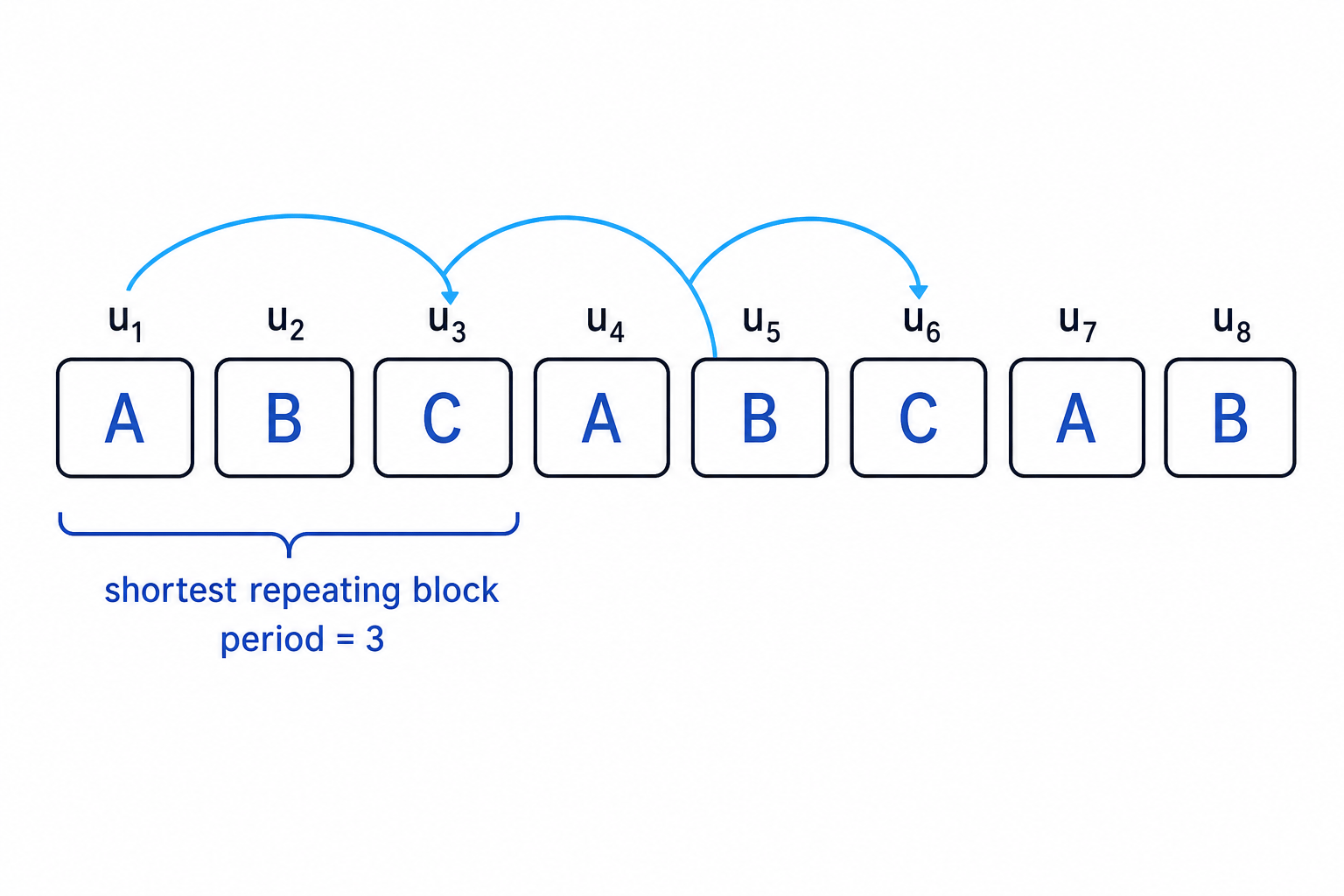
Spotting a periodic sequence
A sequence is defined by u1=35u_1=\frac{3}{5}u1=53 and un+1=1unu_{n+1}=\frac{1}{u_n}un+1=un1. Find ∑r=1100ur\sum_{r=1}^{100}u_r∑r=1100ur.
-
Work out the first few terms: u1=35u_1=\frac{3}{5}u1=53, u2=53u_2=\frac{5}{3}u2=35, and u3=35u_3=\frac{3}{5}u3=53.
-
The sequence repeats every 2 terms, so the first 100 terms form 50 identical pairs.
-
Each pair sums to 35+53=3415\frac{3}{5}+\frac{5}{3}=\frac{34}{15}53+35=1534.
-
Therefore the total is 50⋅3415=340350\cdot\frac{34}{15}=\frac{340}{3}50⋅1534=3340.
5. Telescoping sums
Some sums collapse because most middle terms cancel.
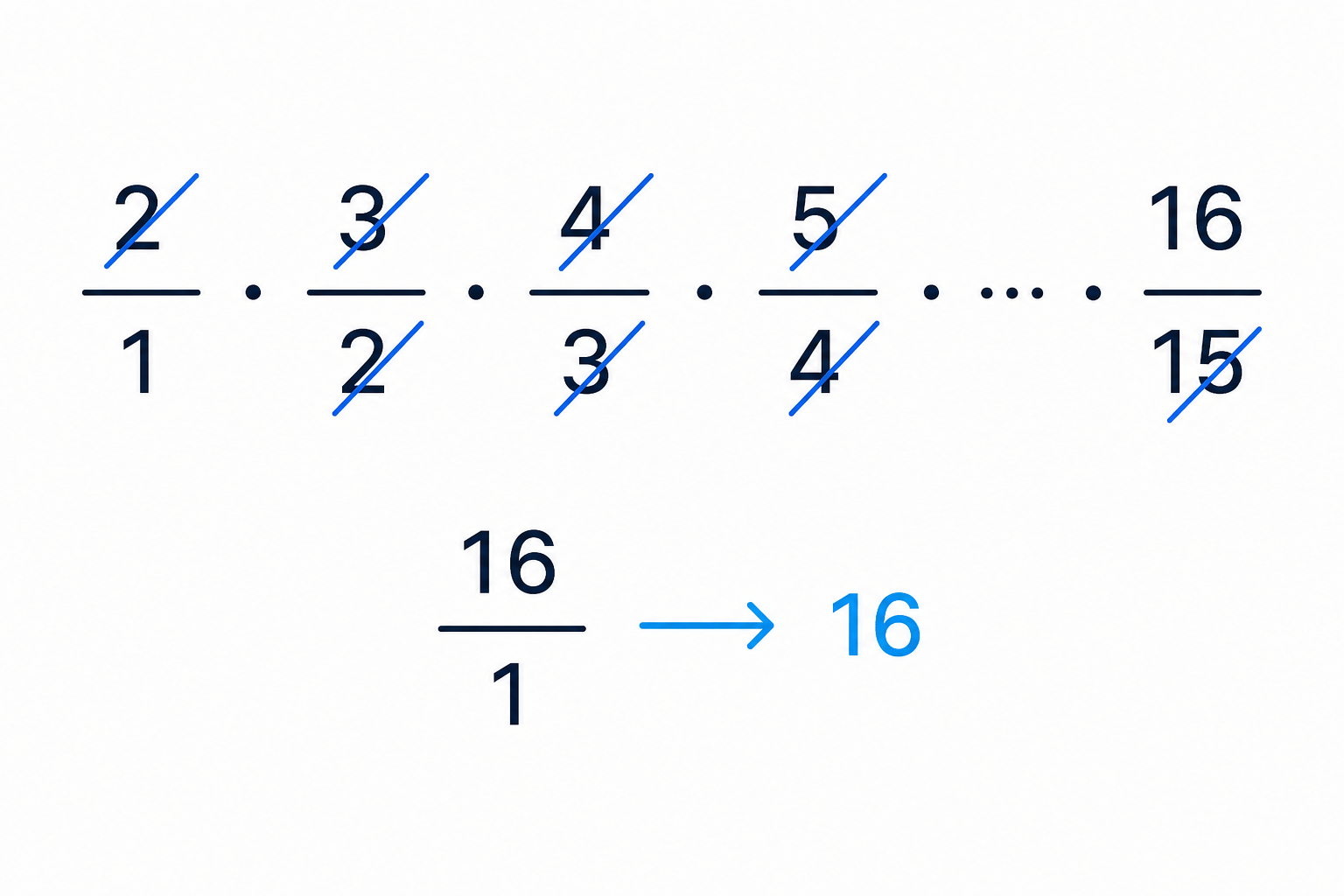
Telescoping sum
A telescoping sum is a sum where consecutive terms cancel, leaving only a few terms at the start and end.
A logarithmic telescoping sum
Show that ∑r=115log2(r+1r)=4\sum_{r=1}^{15}\log_2\left(\frac{r+1}{r}\right)=4∑r=115log2(rr+1)=4.
-
Use the log rule that a sum of logs is the log of a product:
∑r=115log2(r+1r)=log2(21⋅32⋅43⋯1615)\sum_{r=1}^{15}\log_2\left(\frac{r+1}{r}\right) = \log_2\left(\frac{2}{1}\cdot\frac{3}{2}\cdot\frac{4}{3}\cdots\frac{16}{15}\right)r=1∑15log2(rr+1)=log2(12⋅23⋅34⋯1516) -
Most factors cancel, leaving log2(16)\log_2(16)log2(16).
-
Since 24=162^4=1624=16, the sum is 4.
Nearly identical sigma sums
If you see ∑k=0nf(k)−∑k=0n−1f(k)\sum_{k=0}^{n}f(k)-\sum_{k=0}^{n-1}f(k)∑k=0nf(k)−∑k=0n−1f(k), everything cancels except the final term, so the result is f(n)f(n)f(n).
In the exam
-
Decide first whether the question is asking for a term, unu_nun, or a total, SnS_nSn.
-
For worded questions, define the first term carefully and count how many terms are included.
-
For inequalities involving nnn, solve algebraically if possible, then check the nearest integers.
Check yourself
- Can you explain the difference between an arithmetic sequence and a geometric sequence?
- When does a geometric series have a sum to infinity?
- If a sigma sum starts at r=5r=5r=5, what value of rrr gives the first term?
