

What you'll learn
- How to write 3D vectors using i\mathbf{i}i, j\mathbf{j}j and k\mathbf{k}k.
- How to find vectors between points, lengths and midpoints.
- How to add vectors and find resultants.
- How to prove lines are parallel and identify simple shapes using vectors.
1. Vectors as components
A vector describes a movement: how far, and in which direction. In 3D, we usually split that movement into three perpendicular directions: the xxx-, yyy- and zzz-directions.
For example, 3i−2j+5k3\mathbf{i}-2\mathbf{j}+5\mathbf{k}3i−2j+5k means:
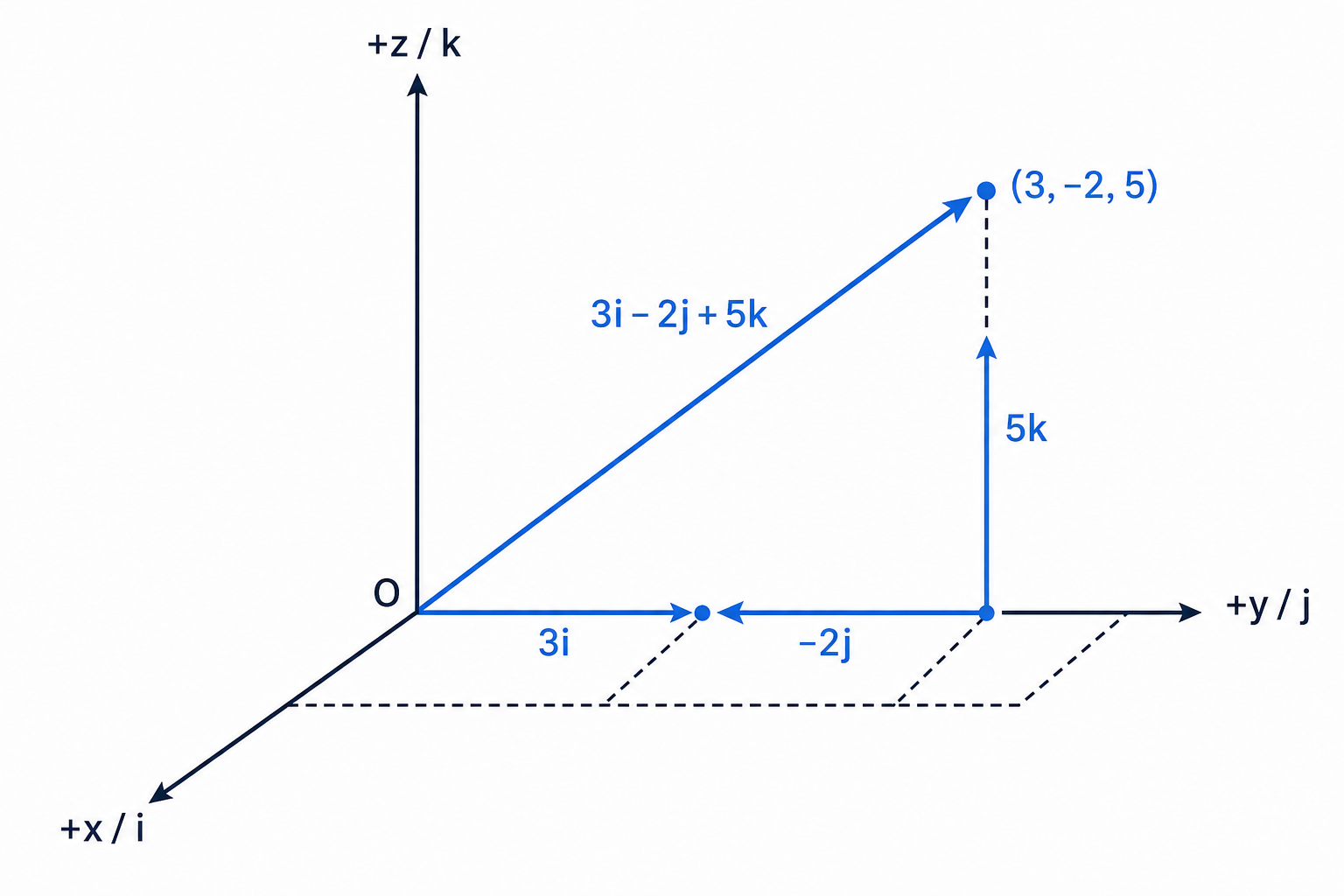
- 3 units in the i\mathbf{i}i direction,
- 2 units in the negative j\mathbf{j}j direction,
- 5 units in the k\mathbf{k}k direction.
The same vector can also be written as a column vector:
(3−25)\begin{pmatrix} 3\\ -2\\ 5 \end{pmatrix}3−25Vector, scalar and components
- A vector has size and direction.
- A scalar has size only.
- A unit vector has length one; i\mathbf{i}i, j\mathbf{j}j and k\mathbf{k}k are unit vectors in the positive xxx, yyy and zzz directions.
- A component tells you how far the vector goes in one coordinate direction.
Work component by component
To add or subtract vectors, deal with the i\mathbf{i}i, j\mathbf{j}j and k\mathbf{k}k components separately. The resultant is the single vector found by adding several vectors together.
Finding a resultant force
Three forces act on a particle:
F1=−2i+5j+3k,F2=6i−j−4k,F3=i+2j+7k\mathbf{F}_1=-2\mathbf{i}+5\mathbf{j}+3\mathbf{k},\quad \mathbf{F}_2=6\mathbf{i}-\mathbf{j}-4\mathbf{k},\quad \mathbf{F}_3=\mathbf{i}+2\mathbf{j}+7\mathbf{k}F1=−2i+5j+3k,F2=6i−j−4k,F3=i+2j+7kFind the resultant force.
-
Add the three vectors component by component:
R=(−2i+5j+3k)+(6i−j−4k)+(i+2j+7k)=(−2+6+1)i+(5−1+2)j+(3−4+7)k=5i+6j+6k\begin{aligned} \mathbf{R} &=(-2\mathbf{i}+5\mathbf{j}+3\mathbf{k})+(6\mathbf{i}-\mathbf{j}-4\mathbf{k})+(\mathbf{i}+2\mathbf{j}+7\mathbf{k})\\ &=(-2+6+1)\mathbf{i}+(5-1+2)\mathbf{j}+(3-4+7)\mathbf{k}\\ &=5\mathbf{i}+6\mathbf{j}+6\mathbf{k} \end{aligned}R=(−2i+5j+3k)+(6i−j−4k)+(i+2j+7k)=(−2+6+1)i+(5−1+2)j+(3−4+7)k=5i+6j+6k -
The resultant force is 5i+6j+6k5\mathbf{i}+6\mathbf{j}+6\mathbf{k}5i+6j+6k.
2. Position vectors, displacement and length
A position vector tells you where a point is relative to a fixed origin, usually called OOO.
If point AAA has position vector a\mathbf{a}a, then OA⃗=a\vec{OA}=\mathbf{a}OA=a.
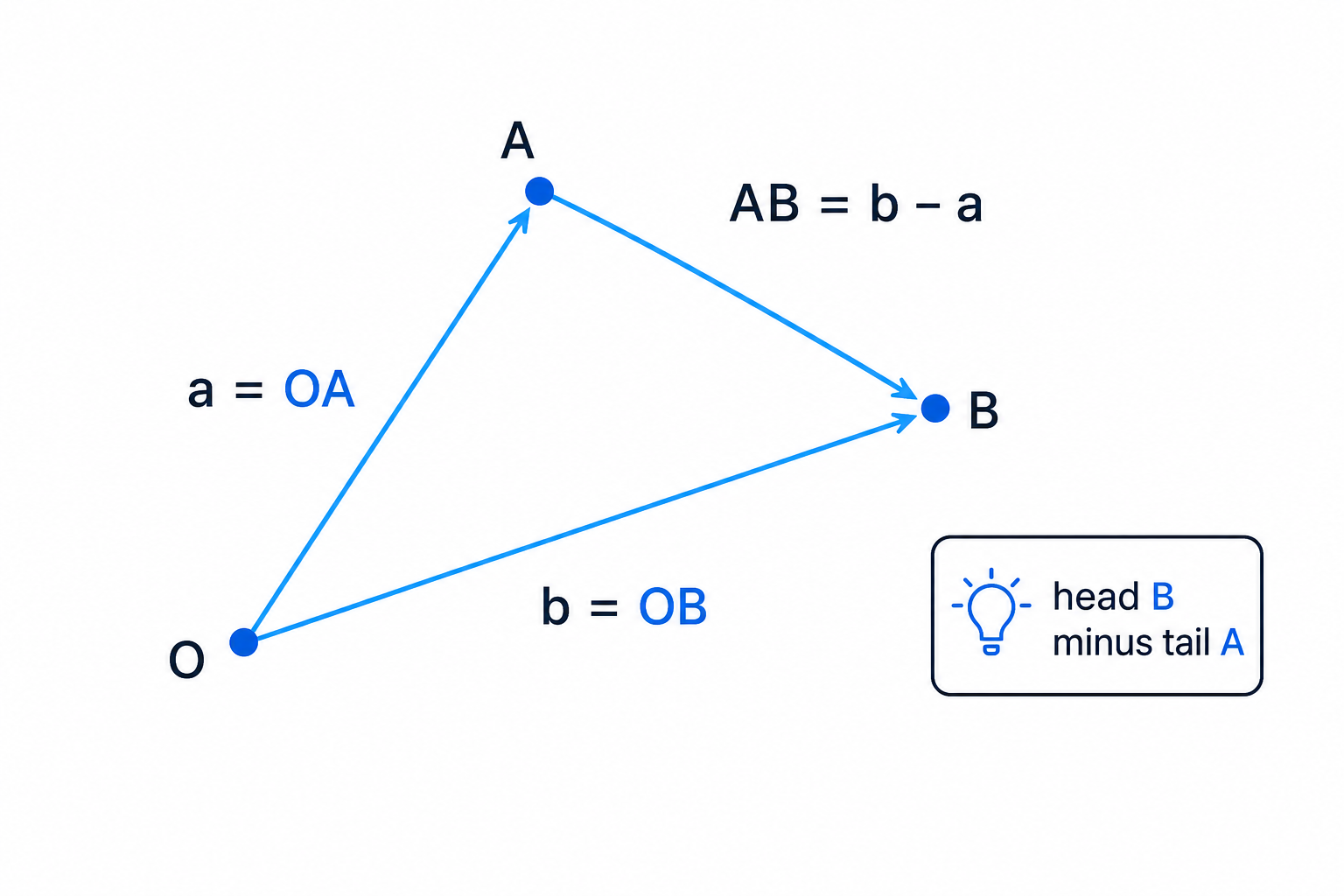
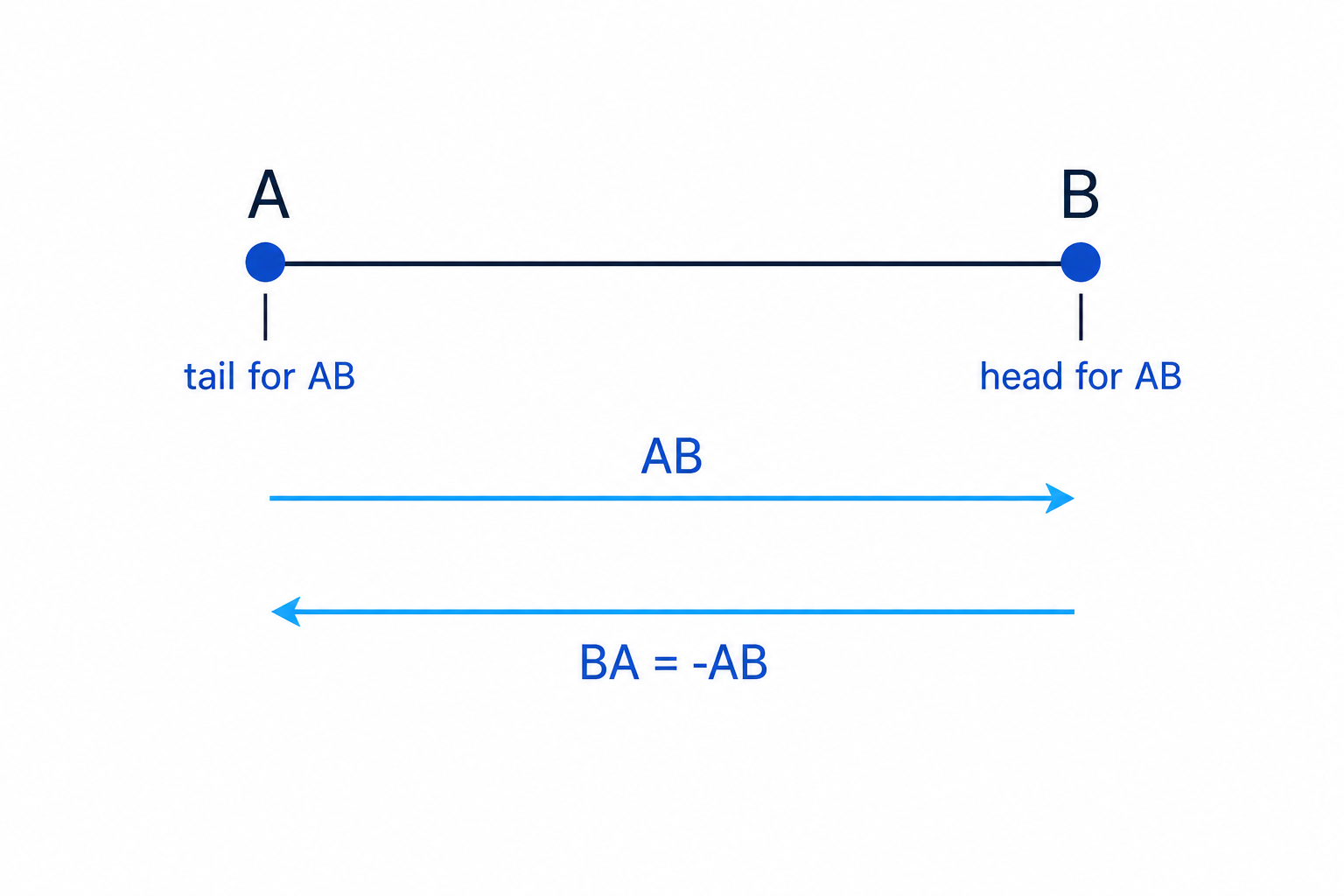
A displacement vector tells you how to move from one point to another. For example, AB⃗\vec{AB}AB means “the vector from AAA to BBB”.
Position vector and magnitude
-
If AAA has position vector a\mathbf{a}a and BBB has position vector b\mathbf{b}b, then AB⃗=b−a\vec{AB}=\mathbf{b}-\mathbf{a}AB=b−a.
-
The magnitude of a vector is its length. For v=xi+yj+zk\mathbf{v}=x\mathbf{i}+y\mathbf{j}+z\mathbf{k}v=xi+yj+zk,
∣v∣=x2+y2+z2|\mathbf{v}|=\sqrt{x^2+y^2+z^2}∣v∣=x2+y2+z2
Head minus tail
To find AB⃗\vec{AB}AB, subtract the position vector of the starting point AAA from the position vector of the finishing point BBB.
Finding a vector and its length
Point AAA has position vector 2i−3j+4k2\mathbf{i}-3\mathbf{j}+4\mathbf{k}2i−3j+4k and point BBB has position vector −5i+j+6k-5\mathbf{i}+\mathbf{j}+6\mathbf{k}−5i+j+6k. Find AB⃗\vec{AB}AB and ∣AB⃗∣|\vec{AB}|∣AB∣.
-
Use head minus tail:
AB⃗=b−a\vec{AB}=\mathbf{b}-\mathbf{a}AB=b−a -
Subtract the components:
AB⃗=(−5i+j+6k)−(2i−3j+4k)=−7i+4j+2k\begin{aligned} \vec{AB} &=(-5\mathbf{i}+\mathbf{j}+6\mathbf{k})-(2\mathbf{i}-3\mathbf{j}+4\mathbf{k})\\ &=-7\mathbf{i}+4\mathbf{j}+2\mathbf{k} \end{aligned}AB=(−5i+j+6k)−(2i−3j+4k)=−7i+4j+2k -
Use 3D Pythagoras for the length:
∣AB⃗∣=(−7)2+42+22=69|\vec{AB}|=\sqrt{(-7)^2+4^2+2^2}=\sqrt{69}∣AB∣=(−7)2+42+22=69
Subtracting the wrong way round
If you calculate a−b\mathbf{a}-\mathbf{b}a−b, you have found BA⃗\vec{BA}BA instead of AB⃗\vec{AB}AB. The length is the same, but the direction is reversed.
3. Unknown components from a magnitude
Sometimes you are given the length of a vector and asked to find an unknown component. The key move is to use the magnitude formula, then square both sides.
Finding possible values of an unknown component
Given that ∣2i+mj−3k∣=7|2\mathbf{i}+m\mathbf{j}-3\mathbf{k}|=7∣2i+mj−3k∣=7, find the possible values of mmm.
-
Apply the magnitude formula:
22+m2+(−3)2=7\sqrt{2^2+m^2+(-3)^2}=722+m2+(−3)2=7 -
Square both sides:
22+m2+(−3)2=722^2+m^2+(-3)^2=7^222+m2+(−3)2=72 -
Simplify:
m2+13=49m^2+13=49m2+13=49 -
Solve for mmm:
m2=36⇒m=±6m^2=36\Rightarrow m=\pm 6m2=36⇒m=±6 -
The possible values are m=6m=6m=6 and m=−6m=-6m=−6.
Expect two signs
A magnitude only measures length, not direction. So a positive component and the matching negative component can give the same length.
4. Routes, midpoints and extending a line
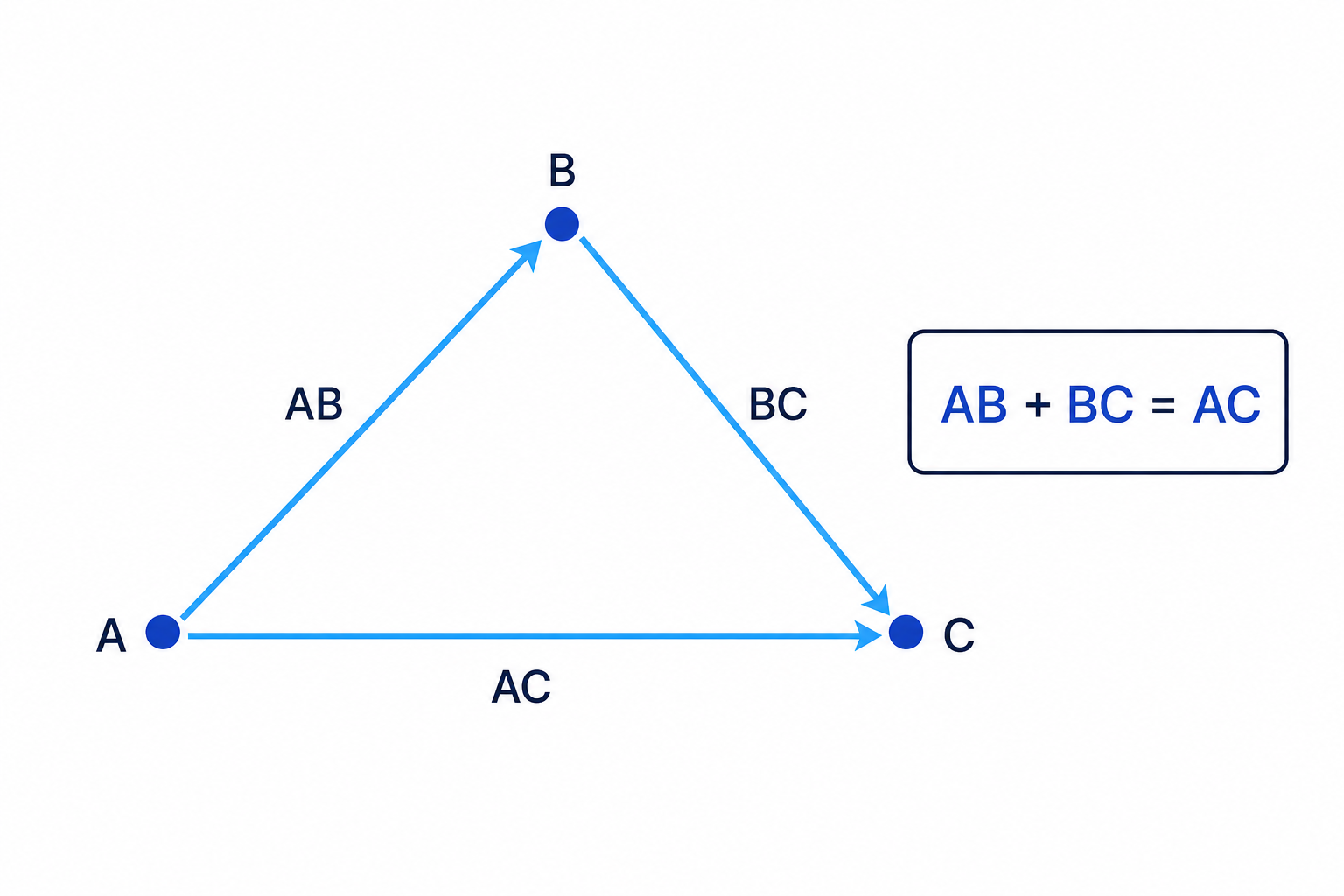
Vectors can be chained together like a journey. If you go from AAA to BBB, then from BBB to CCC, the total journey is from AAA to CCC:
A midpoint is the point halfway between two points. If AAA has position vector a\mathbf{a}a and BBB has position vector b\mathbf{b}b, then the midpoint has position vector
a+b2\frac{\mathbf{a}+\mathbf{b}}{2}2a+bUsing a route in a triangle
In triangle ABCABCABC, suppose AB⃗=5i+2j−k\vec{AB}=5\mathbf{i}+2\mathbf{j}-\mathbf{k}AB=5i+2j−k and AC⃗=7i−4j+3k\vec{AC}=7\mathbf{i}-4\mathbf{j}+3\mathbf{k}AC=7i−4j+3k. Find BC⃗\vec{BC}BC and the length of ABABAB.
-
Use the route from AAA to CCC through BBB:
AB⃗+BC⃗=AC⃗\vec{AB}+\vec{BC}=\vec{AC}AB+BC=AC -
Rearrange to find BC⃗\vec{BC}BC:
BC⃗=AC⃗−AB⃗=(7i−4j+3k)−(5i+2j−k)=2i−6j+4k\begin{aligned} \vec{BC} &=\vec{AC}-\vec{AB}\\ &=(7\mathbf{i}-4\mathbf{j}+3\mathbf{k})-(5\mathbf{i}+2\mathbf{j}-\mathbf{k})\\ &=2\mathbf{i}-6\mathbf{j}+4\mathbf{k} \end{aligned}BC=AC−AB=(7i−4j+3k)−(5i+2j−k)=2i−6j+4k -
Find the length of ABABAB:
∣AB⃗∣=52+22+(−1)2=30|\vec{AB}|=\sqrt{5^2+2^2+(-1)^2}=\sqrt{30}∣AB∣=52+22+(−1)2=30
Extending a line segment
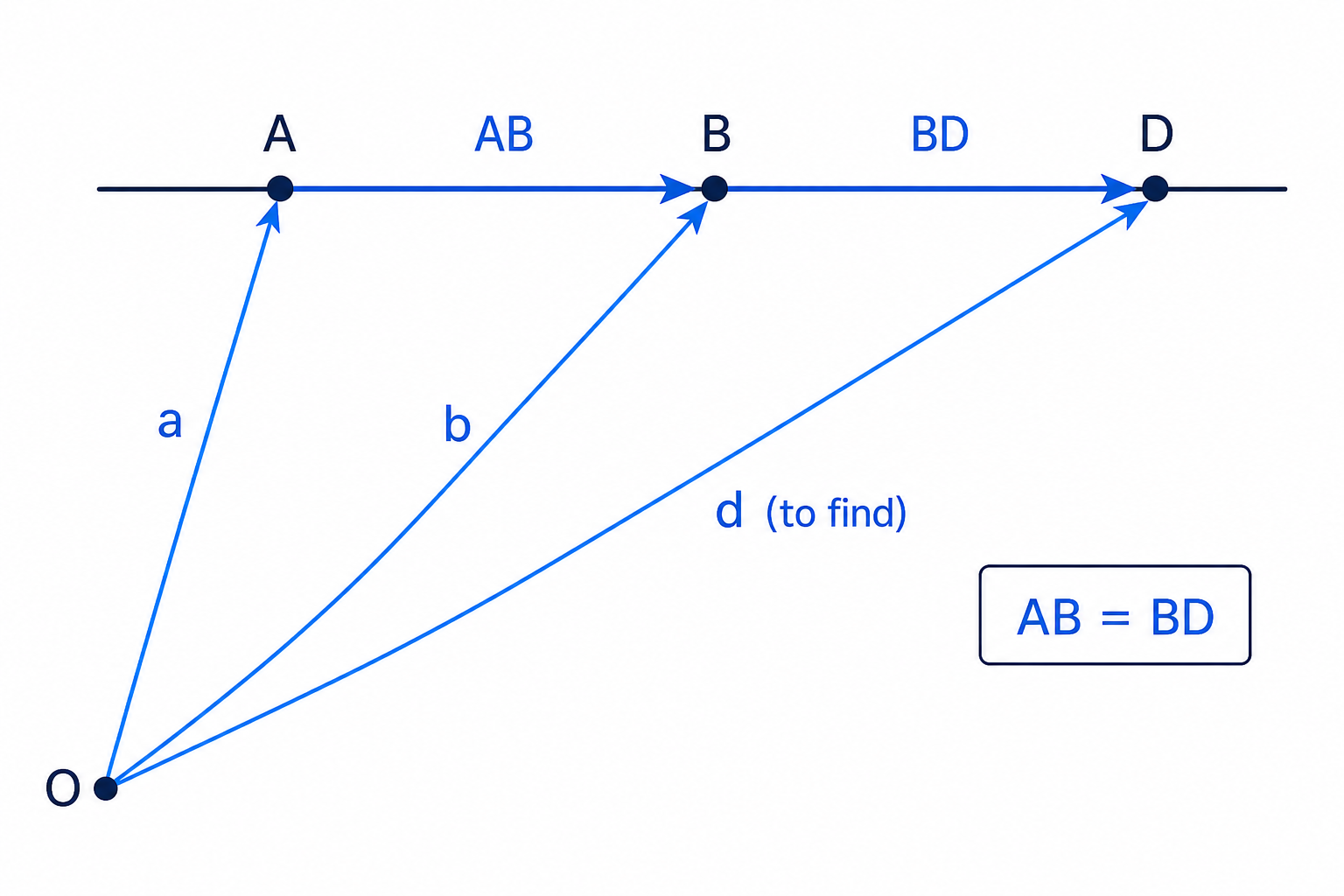
Point AAA has position vector i+2j−k\mathbf{i}+2\mathbf{j}-\mathbf{k}i+2j−k and point BBB has position vector 4i−j+5k4\mathbf{i}-\mathbf{j}+5\mathbf{k}4i−j+5k. Point DDD is such that AB⃗=BD⃗\vec{AB}=\vec{BD}AB=BD. Find the position vector of DDD.
-
First find AB⃗\vec{AB}AB:
AB⃗=(4i−j+5k)−(i+2j−k)=3i−3j+6k\begin{aligned} \vec{AB} &=(4\mathbf{i}-\mathbf{j}+5\mathbf{k})-(\mathbf{i}+2\mathbf{j}-\mathbf{k})\\ &=3\mathbf{i}-3\mathbf{j}+6\mathbf{k} \end{aligned}AB=(4i−j+5k)−(i+2j−k)=3i−3j+6k -
Since BD⃗\vec{BD}BD is the same vector, add it to the position vector of BBB:
d=(4i−j+5k)+(3i−3j+6k)=7i−4j+11k\begin{aligned} \mathbf{d} &=(4\mathbf{i}-\mathbf{j}+5\mathbf{k})+(3\mathbf{i}-3\mathbf{j}+6\mathbf{k})\\ &=7\mathbf{i}-4\mathbf{j}+11\mathbf{k} \end{aligned}d=(4i−j+5k)+(3i−3j+6k)=7i−4j+11k -
So the position vector of DDD is 7i−4j+11k7\mathbf{i}-4\mathbf{j}+11\mathbf{k}7i−4j+11k.
5. Parallel vectors and shapes
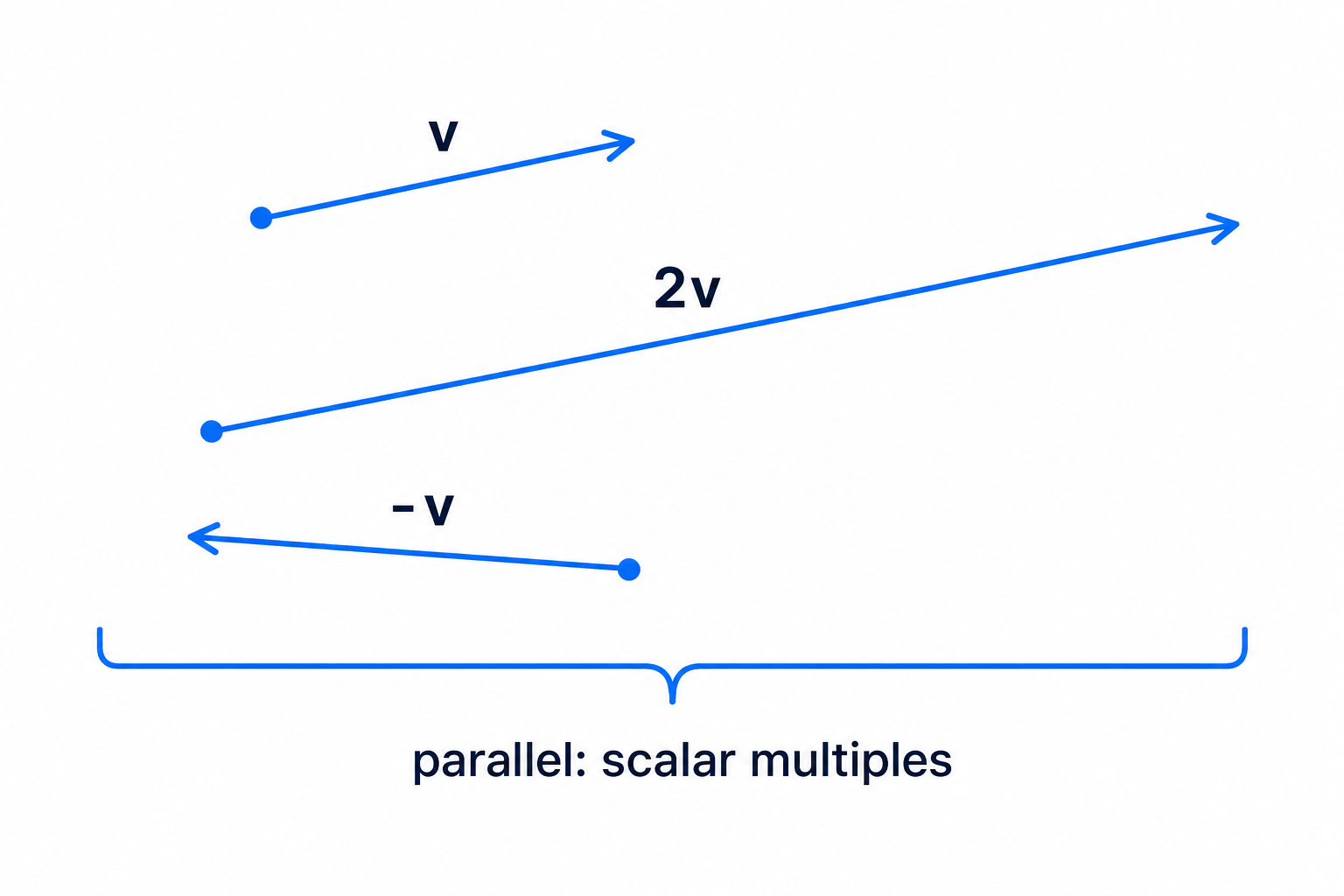
Two vectors are parallel when they point in the same or exactly opposite direction. In component form, this means one vector is a multiple of the other.
Parallel vectors
Two non-zero vectors u\mathbf{u}u and v\mathbf{v}v are parallel if there is a scalar λ\lambdaλ such that u=λv\mathbf{u}=\lambda\mathbf{v}u=λv. This means every component is multiplied by the same number.
For coordinate shape questions, calculate side vectors. A quadrilateral is a four-sided shape. A parallelogram has both pairs of opposite sides parallel. A trapezium has one pair of opposite sides parallel.
Showing a quadrilateral is a trapezium
Relative to origin OOO, points AAA, BBB and CCC have position vectors
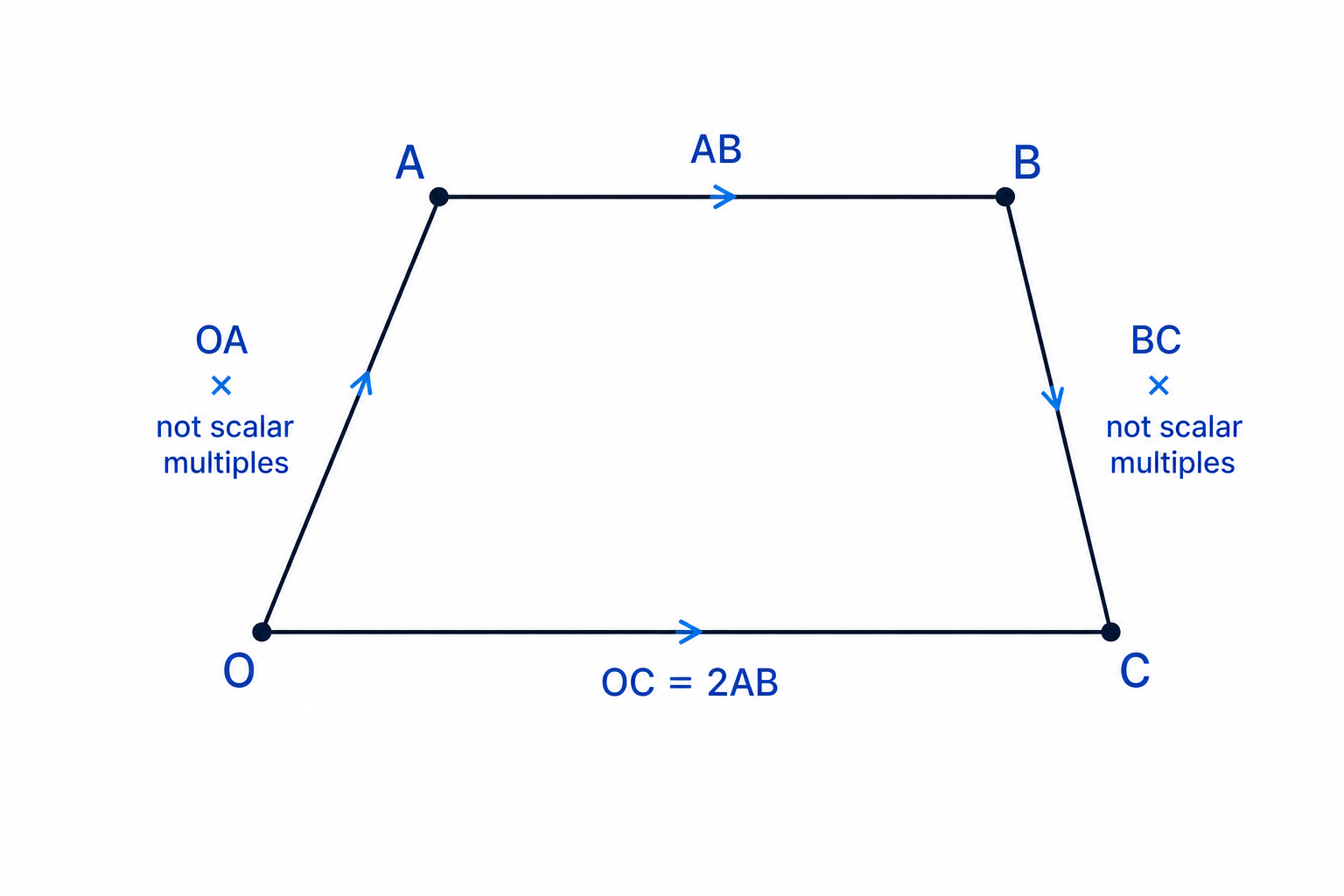
2i+j−3k,5i−j−2k,6i−4j+2k2\mathbf{i}+\mathbf{j}-3\mathbf{k},\quad 5\mathbf{i}-\mathbf{j}-2\mathbf{k},\quad 6\mathbf{i}-4\mathbf{j}+2\mathbf{k}2i+j−3k,5i−j−2k,6i−4j+2krespectively. Show that OABCOABCOABC is a trapezium.
-
Find AB⃗\vec{AB}AB:
AB⃗=(5i−j−2k)−(2i+j−3k)=3i−2j+k\begin{aligned} \vec{AB} &=(5\mathbf{i}-\mathbf{j}-2\mathbf{k})-(2\mathbf{i}+\mathbf{j}-3\mathbf{k})\\ &=3\mathbf{i}-2\mathbf{j}+\mathbf{k} \end{aligned}AB=(5i−j−2k)−(2i+j−3k)=3i−2j+k -
Compare this with OC⃗\vec{OC}OC:
OC⃗=6i−4j+2k=2(3i−2j+k)=2AB⃗\vec{OC}=6\mathbf{i}-4\mathbf{j}+2\mathbf{k}=2(3\mathbf{i}-2\mathbf{j}+\mathbf{k})=2\vec{AB}OC=6i−4j+2k=2(3i−2j+k)=2AB -
So ABABAB is parallel to OCOCOC, meaning one pair of opposite sides is parallel.
-
Check the other pair:
BC⃗=(6i−4j+2k)−(5i−j−2k)=i−3j+4k\vec{BC}=(6\mathbf{i}-4\mathbf{j}+2\mathbf{k})-(5\mathbf{i}-\mathbf{j}-2\mathbf{k})=\mathbf{i}-3\mathbf{j}+4\mathbf{k}BC=(6i−4j+2k)−(5i−j−2k)=i−3j+4k -
BC⃗\vec{BC}BC is not a scalar multiple of OA⃗=2i+j−3k\vec{OA}=2\mathbf{i}+\mathbf{j}-3\mathbf{k}OA=2i+j−3k, so exactly one pair of opposite sides is parallel. Therefore OABCOABCOABC is a trapezium.
6. A harder mixed geometry problem
Some vector questions combine several ideas: equal lengths, midpoints and area. The trick is to turn each geometric statement into an equation.
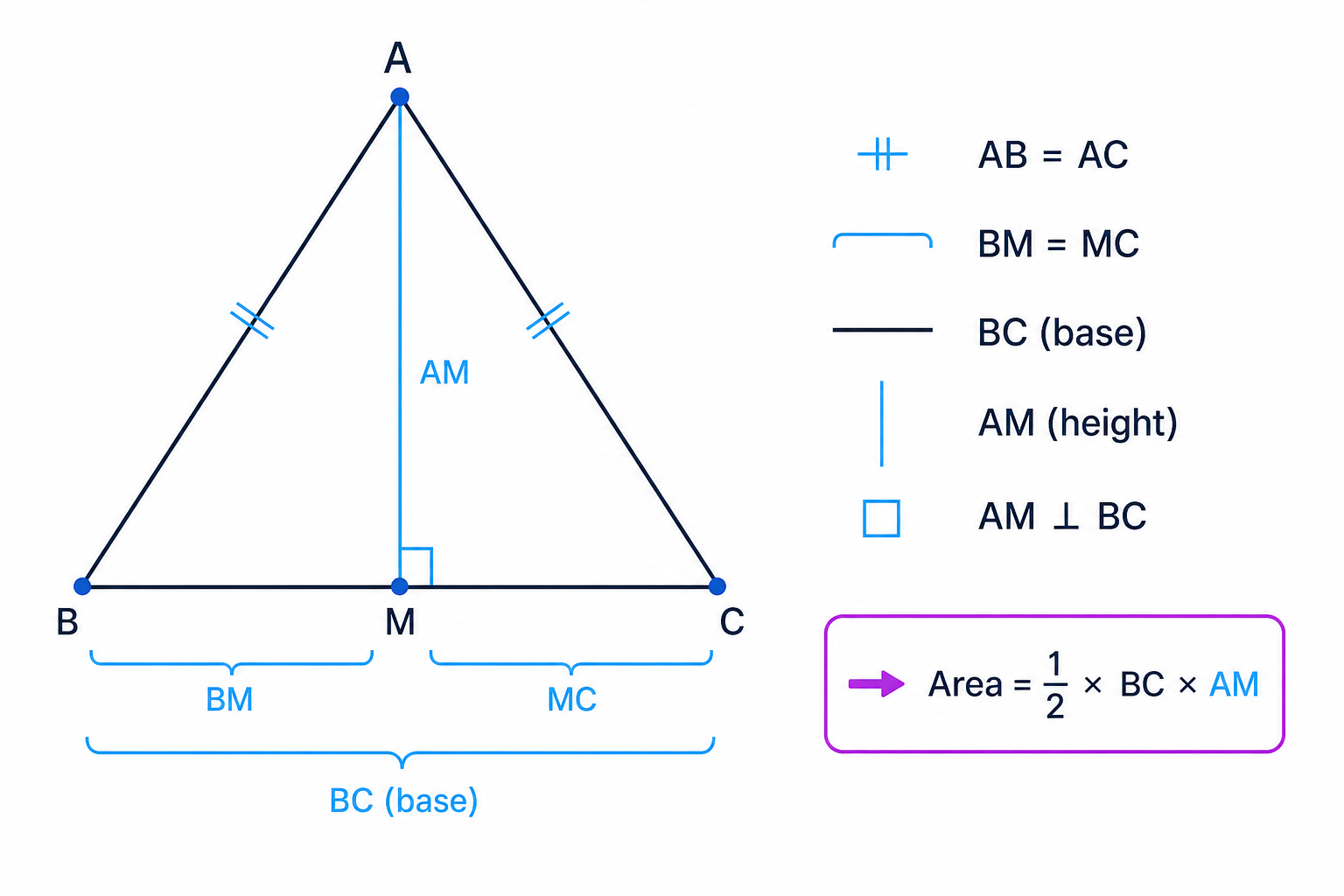
If a triangle is isosceles with AB=ACAB=ACAB=AC, then the line from AAA to the midpoint of BCBCBC is the perpendicular height.
Using equal lengths and area
Point AAA has position vector (ab3)\begin{pmatrix} a\\ b\\ 3 \end{pmatrix}ab3, where aaa and bbb are positive constants. Points BBB and CCC have position vectors
(324)and(102)\begin{pmatrix} 3\\2\\4 \end{pmatrix} \quad\text{and}\quad \begin{pmatrix} 1\\0\\2 \end{pmatrix}324and102respectively. Given that AB=ACAB=ACAB=AC and the area of triangle ABCABCABC is 6\sqrt{6}6, find aaa and bbb.
-
Compare squared lengths to avoid square roots:
AB2=(3−a)2+(2−b)2+1AC2=(1−a)2+b2+1\begin{aligned} AB^2&=(3-a)^2+(2-b)^2+1\\ AC^2&=(1-a)^2+b^2+1 \end{aligned}AB2AC2=(3−a)2+(2−b)2+1=(1−a)2+b2+1 -
Since AB=ACAB=ACAB=AC, set these equal and simplify:
(3−a)2+(2−b)2+1=(1−a)2+b2+1⇒a+b=3(3-a)^2+(2-b)^2+1=(1-a)^2+b^2+1\Rightarrow a+b=3(3−a)2+(2−b)2+1=(1−a)2+b2+1⇒a+b=3 -
Find the midpoint MMM of BCBCBC:
m=12(3+12+04+2)=(213)\mathbf{m}=\frac{1}{2}\begin{pmatrix}3+1\\2+0\\4+2\end{pmatrix}=\begin{pmatrix}2\\1\\3\end{pmatrix}m=213+12+04+2=213 -
Use b=3−ab=3-ab=3−a to find the base and height:
∣BC⃗∣=(−2)2+(−2)2+(−2)2=23∣AM⃗∣=(a−2)2+(b−1)2=2∣a−2∣\begin{aligned} |\vec{BC}|&=\sqrt{(-2)^2+(-2)^2+(-2)^2}=2\sqrt{3}\\ |\vec{AM}|&=\sqrt{(a-2)^2+(b-1)^2}=\sqrt{2}|a-2| \end{aligned}∣BC∣∣AM∣=(−2)2+(−2)2+(−2)2=23=(a−2)2+(b−1)2=2∣a−2∣ -
Apply the area formula:
6=12(23)(2∣a−2∣)=6∣a−2∣\sqrt{6}=\frac{1}{2}(2\sqrt{3})(\sqrt{2}|a-2|)=\sqrt{6}|a-2|6=21(23)(2∣a−2∣)=6∣a−2∣ -
Hence ∣a−2∣=1|a-2|=1∣a−2∣=1. The candidates are a=1,b=2a=1,b=2a=1,b=2 or a=3,b=0a=3,b=0a=3,b=0; because aaa and bbb are positive, a=1a=1a=1 and b=2b=2b=2.
In the exam
-
For AB⃗\vec{AB}AB, always use head minus tail: position vector of BBB minus position vector of AAA.
-
For shape proofs, calculate the relevant side vectors and state the scalar multiple clearly.
-
For length conditions, square both sides early and remember that unknown components may have two signs.
Check yourself
-
If AAA and BBB have position vectors a\mathbf{a}a and b\mathbf{b}b, what is BA⃗\vec{BA}BA?
-
How can you tell from components that two non-zero vectors are parallel?
-
Why can a magnitude equation give two possible values for an unknown component?
