

What you'll learn
- How to split algebraic fractions into partial fractions.
- How to handle repeated factors and “top-heavy” algebraic fractions.
- How to use substitution and equating coefficients cleanly.
- How to write proof by contradiction arguments for integers, irrational numbers and primes.
The algebra you need first
A polynomial is an expression made from powers of xxx, such as 3x2−5x+13x^2-5x+13x2−5x+1. The degree of a polynomial is the highest power of xxx with a non-zero coefficient.
In this topic, you often create an equation that must be true for every allowed value of xxx. That is stronger than just solving for one value.
Identity
An identity is an equation that is true for all allowed values of the variable. We often write ≡\equiv≡ instead of === to emphasise that it is always true.
Equating coefficients means comparing the coefficient of each power of xxx on both sides of an identity.
Solving an identity
Find AAA and BBB if 5x+1≡A(x+2)+B(x−1)5x+1 \equiv A(x+2)+B(x-1)5x+1≡A(x+2)+B(x−1).
-
Choose values of xxx that make terms disappear. Put x=1x=1x=1:
6=3A⇒A=26 = 3A \Rightarrow A=26=3A⇒A=2 -
Put x=−2x=-2x=−2:
−9=−3B⇒B=3-9 = -3B \Rightarrow B=3−9=−3B⇒B=3 -
Check by expanding the right-hand side:
2(x+2)+3(x−1)=5x+12(x+2)+3(x-1)=5x+12(x+2)+3(x−1)=5x+1
Partial fractions
Partial fractions
A rational function is a fraction of polynomials. A partial fraction decomposition rewrites it as a sum of simpler algebraic fractions.
Partial fractions work backwards from putting fractions over a common denominator. They are useful later for integration, binomial expansions and simplifying algebraic expressions.
Distinct linear factors
A linear factor is a factor of degree one, such as x+4x+4x+4 or 3x−13x-13x−1.
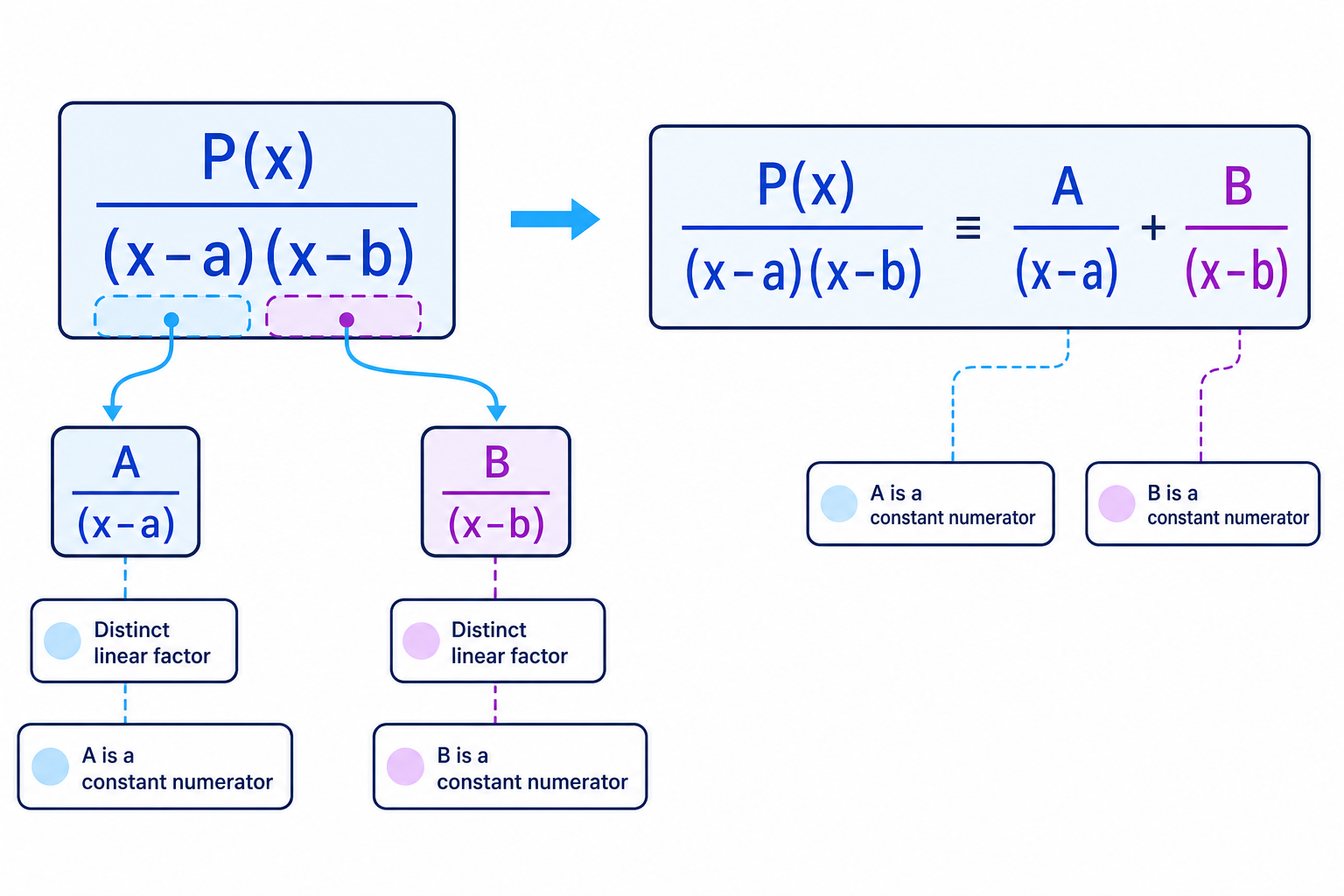
For a proper fraction with two different linear factors in the denominator, use one constant numerator above each factor.
Distinct linear factors
For a fraction with denominator (x−a)(x−b)(x-a)(x-b)(x−a)(x−b), try Ax−a+Bx−b\frac{A}{x-a}+\frac{B}{x-b}x−aA+x−bB. Multiply through by the full denominator, then substitute values that make factors zero.
Two distinct linear factors
Express 3x+11(x+2)(x+5)\frac{3x+11}{(x+2)(x+5)}(x+2)(x+5)3x+11 in partial fractions.
-
Write the correct form:
3x+11(x+2)(x+5)≡Ax+2+Bx+5\frac{3x+11}{(x+2)(x+5)} \equiv \frac{A}{x+2}+\frac{B}{x+5}(x+2)(x+5)3x+11≡x+2A+x+5B -
Multiply by (x+2)(x+5)(x+2)(x+5)(x+2)(x+5):
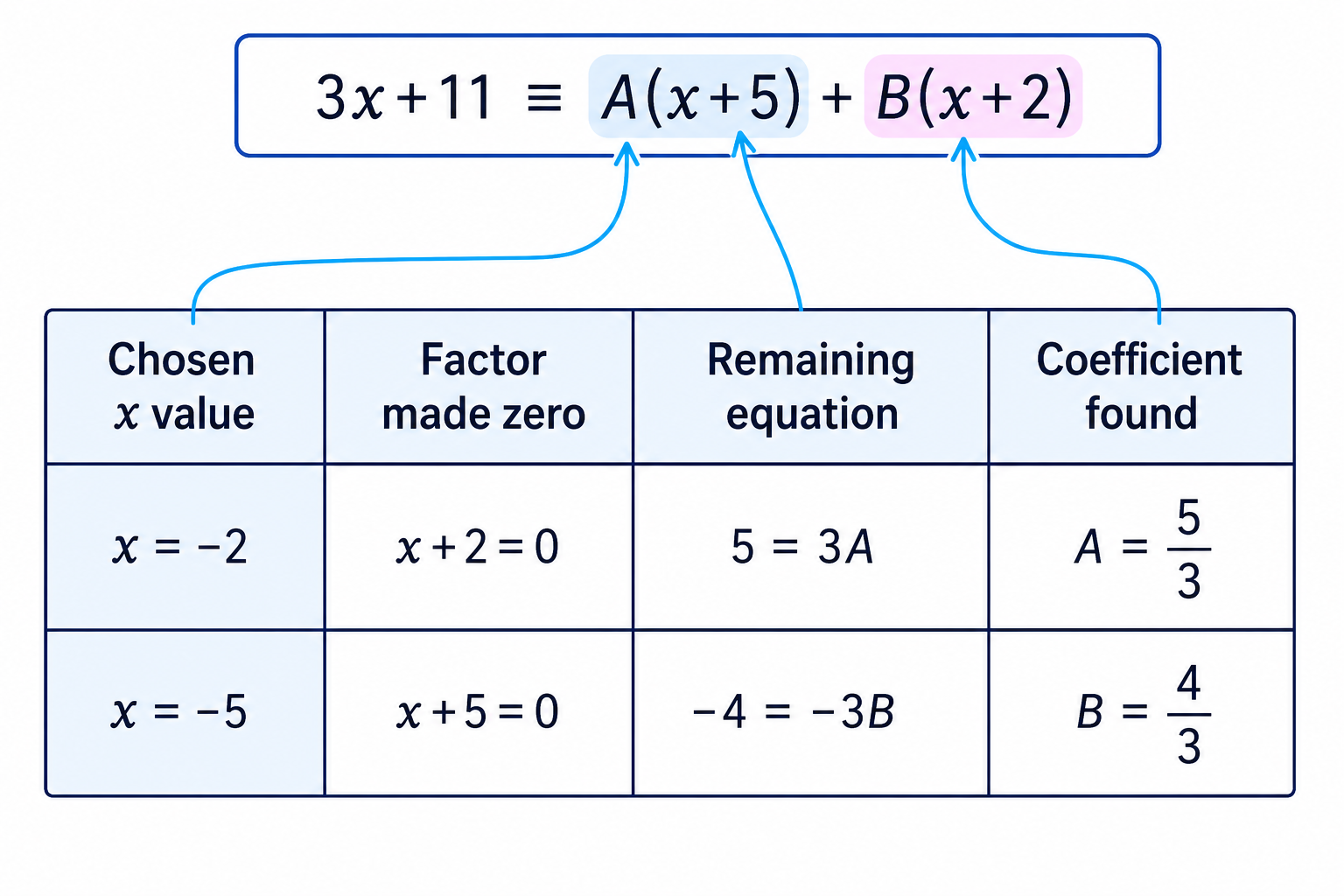
3x+11≡A(x+5)+B(x+2)3x+11 \equiv A(x+5)+B(x+2)3x+11≡A(x+5)+B(x+2) -
Put x=−2x=-2x=−2 to remove the BBB term:
5=3A⇒A=535 = 3A \Rightarrow A=\frac{5}{3}5=3A⇒A=35 -
Put x=−5x=-5x=−5 to remove the AAA term:
−4=−3B⇒B=43-4 = -3B \Rightarrow B=\frac{4}{3}−4=−3B⇒B=34 -
Write the final answer:
3x+11(x+2)(x+5)≡53(x+2)+43(x+5)\frac{3x+11}{(x+2)(x+5)} \equiv \frac{5}{3(x+2)}+\frac{4}{3(x+5)}(x+2)(x+5)3x+11≡3(x+2)5+3(x+5)4
Factors like
Use the value that makes the factor zero. For 3x−13x-13x−1, use x=13x=\frac{1}{3}x=31; for 2−x2-x2−x, use x=2x=2x=2.
Repeated linear factors
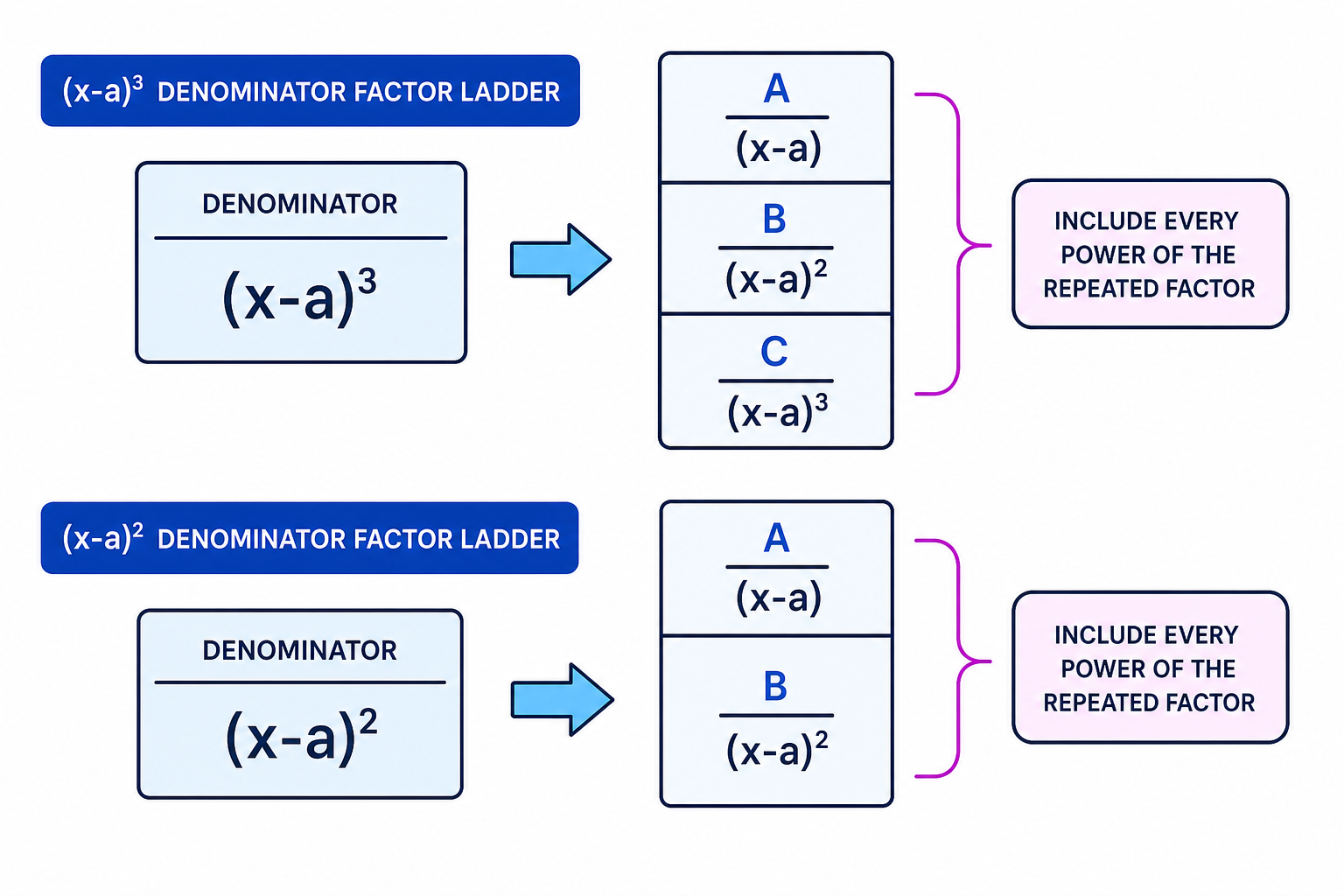
If a denominator contains a repeated factor, you must include every power of that factor.
So a denominator containing (x−a)2(x-a)^2(x−a)2 needs terms with both x−ax-ax−a and (x−a)2(x-a)^2(x−a)2.
Missing a repeated term
If the denominator contains (x−a)2(x-a)^2(x−a)2, do not write only C(x−a)2\frac{C}{(x-a)^2}(x−a)2C. You also need Bx−a\frac{B}{x-a}x−aB.
A repeated linear factor
Express 4x+1(x−1)(x+2)2\frac{4x+1}{(x-1)(x+2)^2}(x−1)(x+2)24x+1 in partial fractions.
-
Since (x+2)2(x+2)^2(x+2)2 is repeated, include both powers:
4x+1(x−1)(x+2)2≡Ax−1+Bx+2+C(x+2)2\frac{4x+1}{(x-1)(x+2)^2} \equiv \frac{A}{x-1}+\frac{B}{x+2}+\frac{C}{(x+2)^2}(x−1)(x+2)24x+1≡x−1A+x+2B+(x+2)2C -
Multiply by (x−1)(x+2)2(x-1)(x+2)^2(x−1)(x+2)2:
4x+1≡A(x+2)2+B(x−1)(x+2)+C(x−1)4x+1 \equiv A(x+2)^2+B(x-1)(x+2)+C(x-1)4x+1≡A(x+2)2+B(x−1)(x+2)+C(x−1) -
Put x=1x=1x=1:
5=9A⇒A=595=9A \Rightarrow A=\frac{5}{9}5=9A⇒A=95 -
Put x=−2x=-2x=−2:
−7=−3C⇒C=73-7=-3C \Rightarrow C=\frac{7}{3}−7=−3C⇒C=37 -
Put x=0x=0x=0 to find BBB:
1=4A−2B−C1=209−2B−73B=−59\begin{aligned} 1 &= 4A-2B-C \\ 1 &= \frac{20}{9}-2B-\frac{7}{3} \\ B &= -\frac{5}{9} \end{aligned}11B=4A−2B−C=920−2B−37=−95 -
Write the final answer:
4x+1(x−1)(x+2)2≡59(x−1)−59(x+2)+73(x+2)2\frac{4x+1}{(x-1)(x+2)^2} \equiv \frac{5}{9(x-1)}-\frac{5}{9(x+2)}+\frac{7}{3(x+2)^2}(x−1)(x+2)24x+1≡9(x−1)5−9(x+2)5+3(x+2)27
Improper rational functions
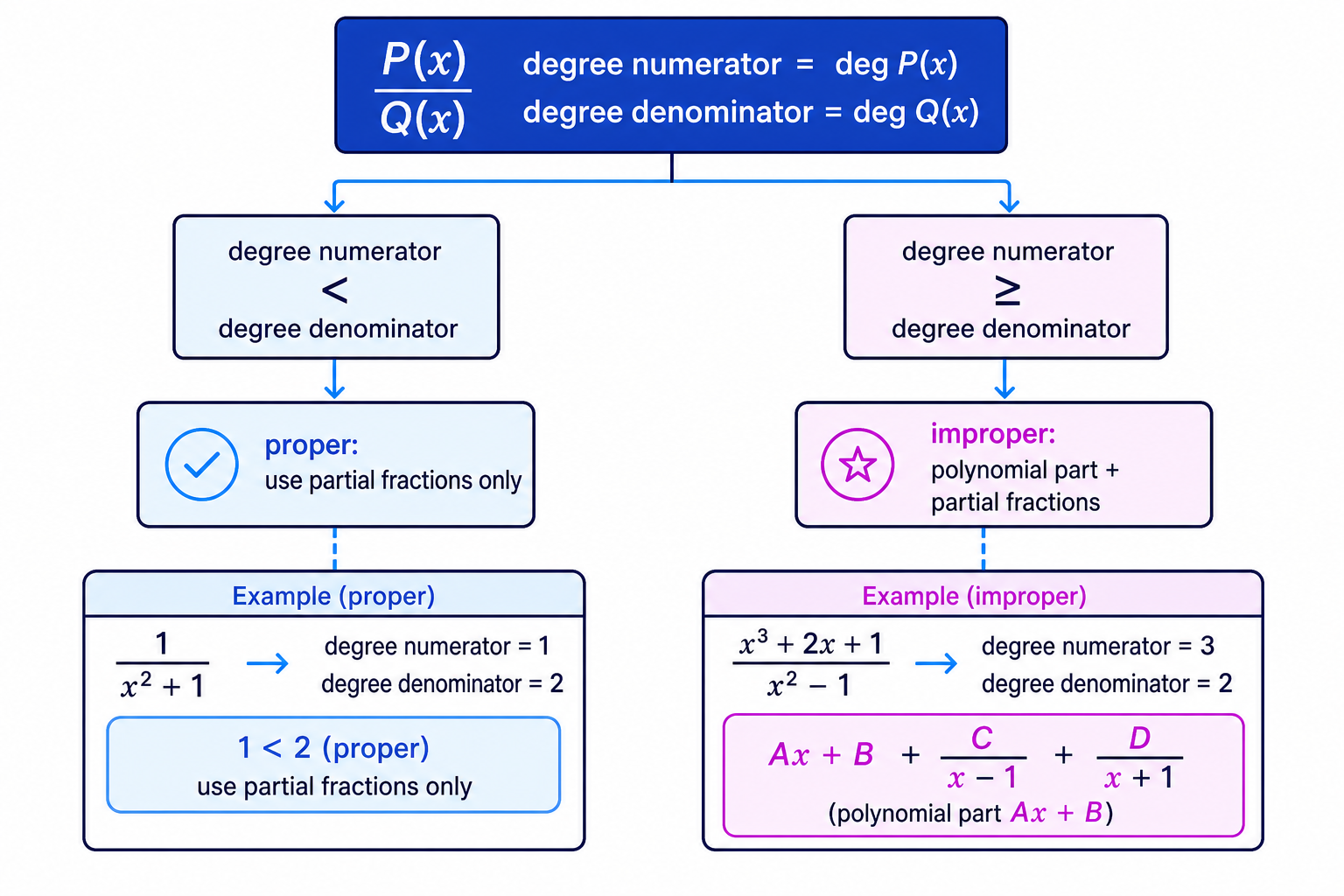
A rational function is proper if the degree of the numerator is less than the degree of the denominator.
If the numerator has degree greater than or equal to the denominator, the fraction is improper. You need a polynomial part first: a constant, a linear expression, or sometimes higher.
Top-heavy fractions
If the numerator is not smaller in degree, include a polynomial part before the partial fractions. If the numerator degree is one more than the denominator degree, use Ax+BAx+BAx+B.
An improper fraction with a linear part
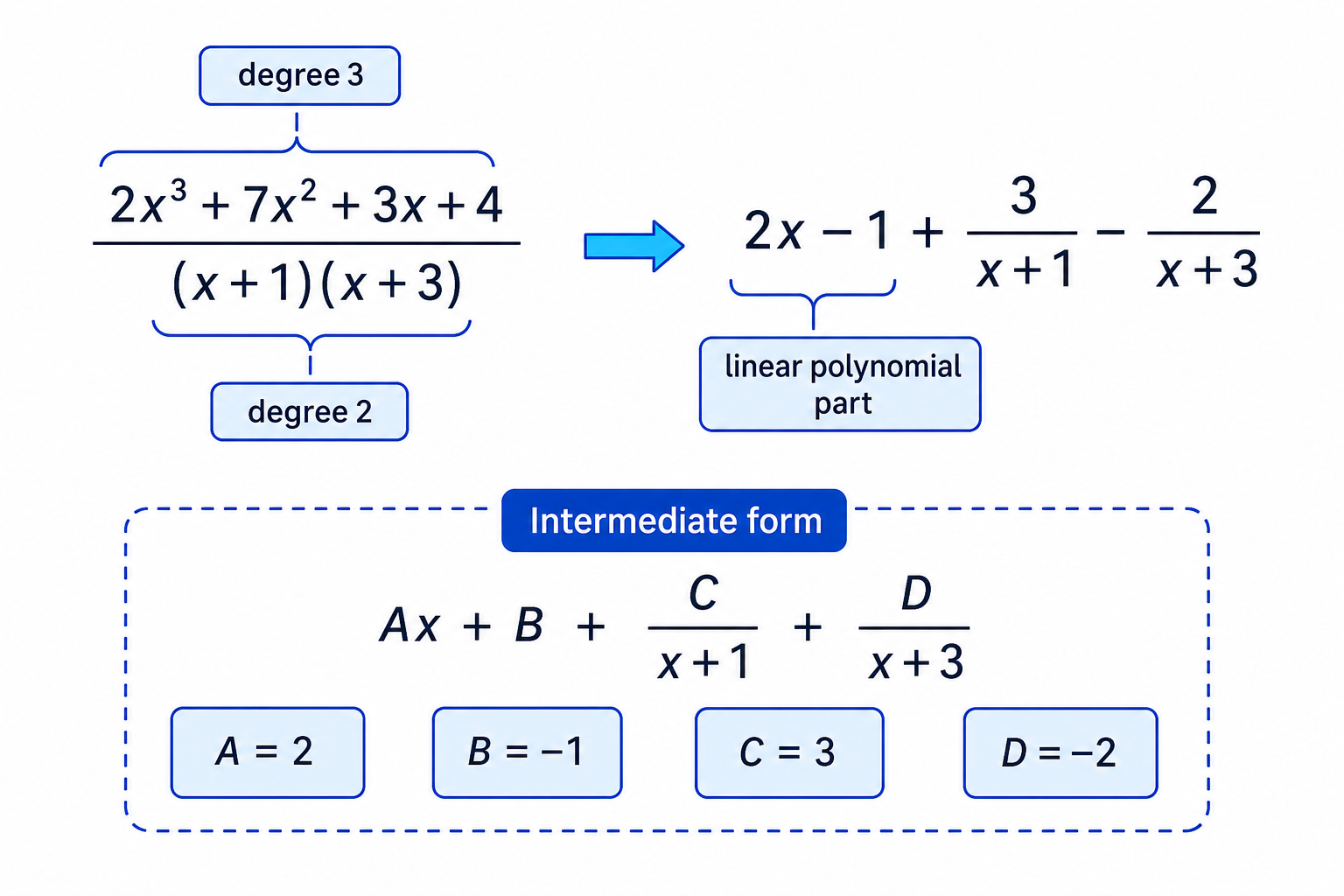
Express 2x3+7x2+3x+4(x+1)(x+3)\frac{2x^3+7x^2+3x+4}{(x+1)(x+3)}(x+1)(x+3)2x3+7x2+3x+4 in the form Ax+B+Cx+1+Dx+3Ax+B+\frac{C}{x+1}+\frac{D}{x+3}Ax+B+x+1C+x+3D.
-
Start with the required form:
2x3+7x2+3x+4(x+1)(x+3)≡Ax+B+Cx+1+Dx+3\frac{2x^3+7x^2+3x+4}{(x+1)(x+3)} \equiv Ax+B+\frac{C}{x+1}+\frac{D}{x+3}(x+1)(x+3)2x3+7x2+3x+4≡Ax+B+x+1C+x+3D -
Multiply by (x+1)(x+3)(x+1)(x+3)(x+1)(x+3):
2x3+7x2+3x+4≡(Ax+B)(x+1)(x+3)+C(x+3)+D(x+1)2x^3+7x^2+3x+4 \equiv (Ax+B)(x+1)(x+3)+C(x+3)+D(x+1)2x3+7x2+3x+4≡(Ax+B)(x+1)(x+3)+C(x+3)+D(x+1) -
Since (x+1)(x+3)=x2+4x+3(x+1)(x+3)=x^2+4x+3(x+1)(x+3)=x2+4x+3, compare the highest powers:
A=2,4A+B=7⇒B=−1A=2,\qquad 4A+B=7 \Rightarrow B=-1A=2,4A+B=7⇒B=−1 -
Put x=−1x=-1x=−1:
6=2C⇒C=36=2C \Rightarrow C=36=2C⇒C=3 -
Put x=−3x=-3x=−3:
4=−2D⇒D=−24=-2D \Rightarrow D=-24=−2D⇒D=−2 -
Write the final answer:
2x3+7x2+3x+4(x+1)(x+3)≡2x−1+3x+1−2x+3\frac{2x^3+7x^2+3x+4}{(x+1)(x+3)} \equiv 2x-1+\frac{3}{x+1}-\frac{2}{x+3}(x+1)(x+3)2x3+7x2+3x+4≡2x−1+x+13−x+32
Proof by contradiction
Proof by contradiction
A proof by contradiction starts by assuming the statement you want to prove is false. You then show that this assumption leads to an impossibility, so the original statement must be true.
The structure is usually:
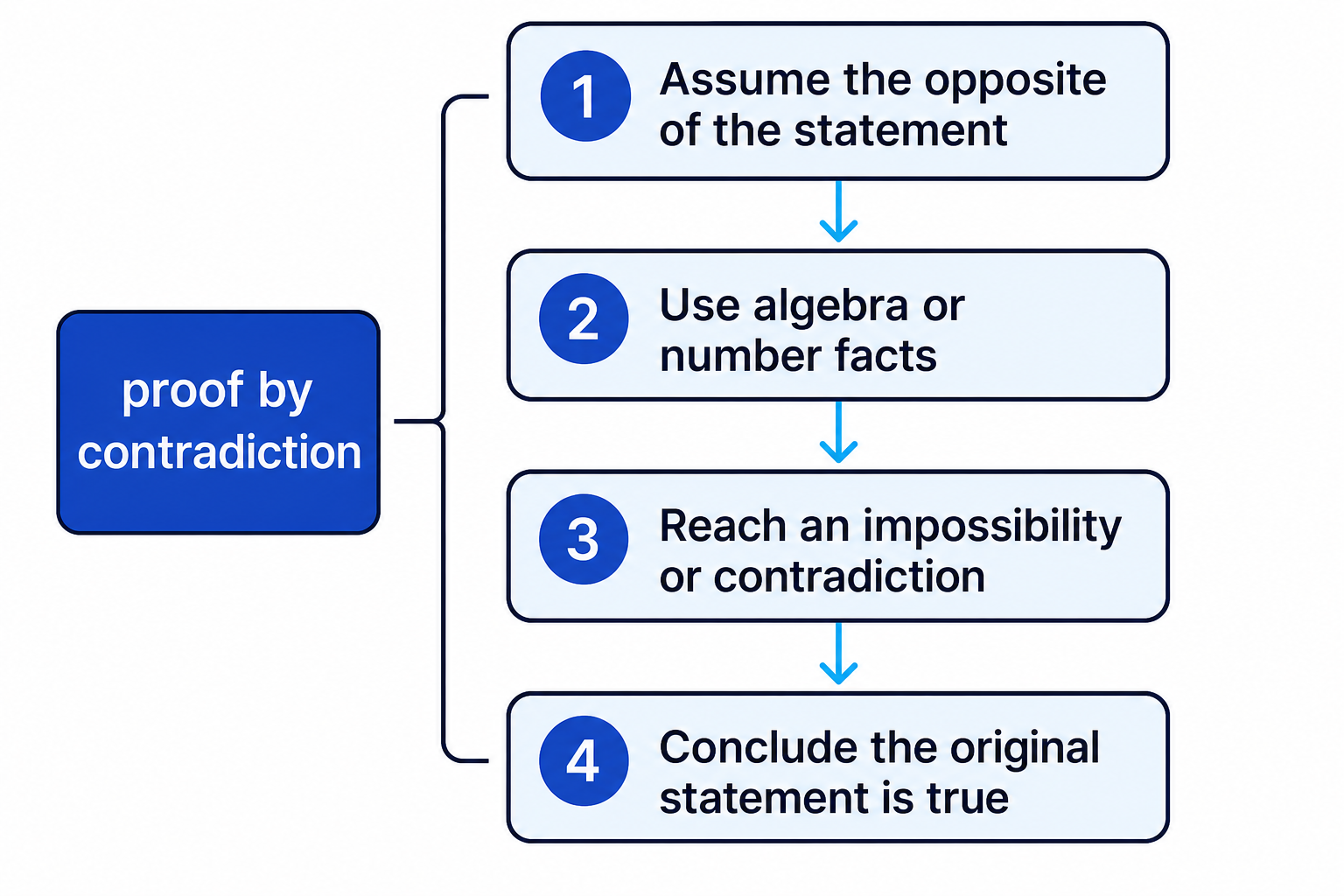
- Assume the opposite.
- Use algebra or number facts.
- Reach a contradiction.
- Clearly state the conclusion.
Divisibility contradictions
An integer is a whole number: positive, negative or zero.
Many integer contradiction proofs rely on divisibility. If every term on one side is a multiple of 7, then the whole side is a multiple of 7.
No integer solutions
Use contradiction to show that there are no integers mmm and nnn such that 14m+21n=514m+21n=514m+21n=5.
-
Assume, for contradiction, that integers mmm and nnn do satisfy 14m+21n=514m+21n=514m+21n=5.
-
Factor the left-hand side:
14m+21n=7(2m+3n)14m+21n=7(2m+3n)14m+21n=7(2m+3n) -
Since 2m+3n2m+3n2m+3n is an integer, the left-hand side is a multiple of 7.
-
The equation would therefore imply that 5 is a multiple of 7, which is impossible.
-
This contradiction shows that no such integers mmm and nnn exist.
Irrationality proofs
Rational and irrational numbers
A rational number can be written as ab\frac{a}{b}ba, where aaa and bbb are integers and b≠0b\neq0b=0. An irrational number cannot be written in this form.
When proving a square root is irrational, assume it equals a fraction in lowest terms. “Lowest terms” means the numerator and denominator are coprime, so they share no common factor greater than one.
Proving is irrational
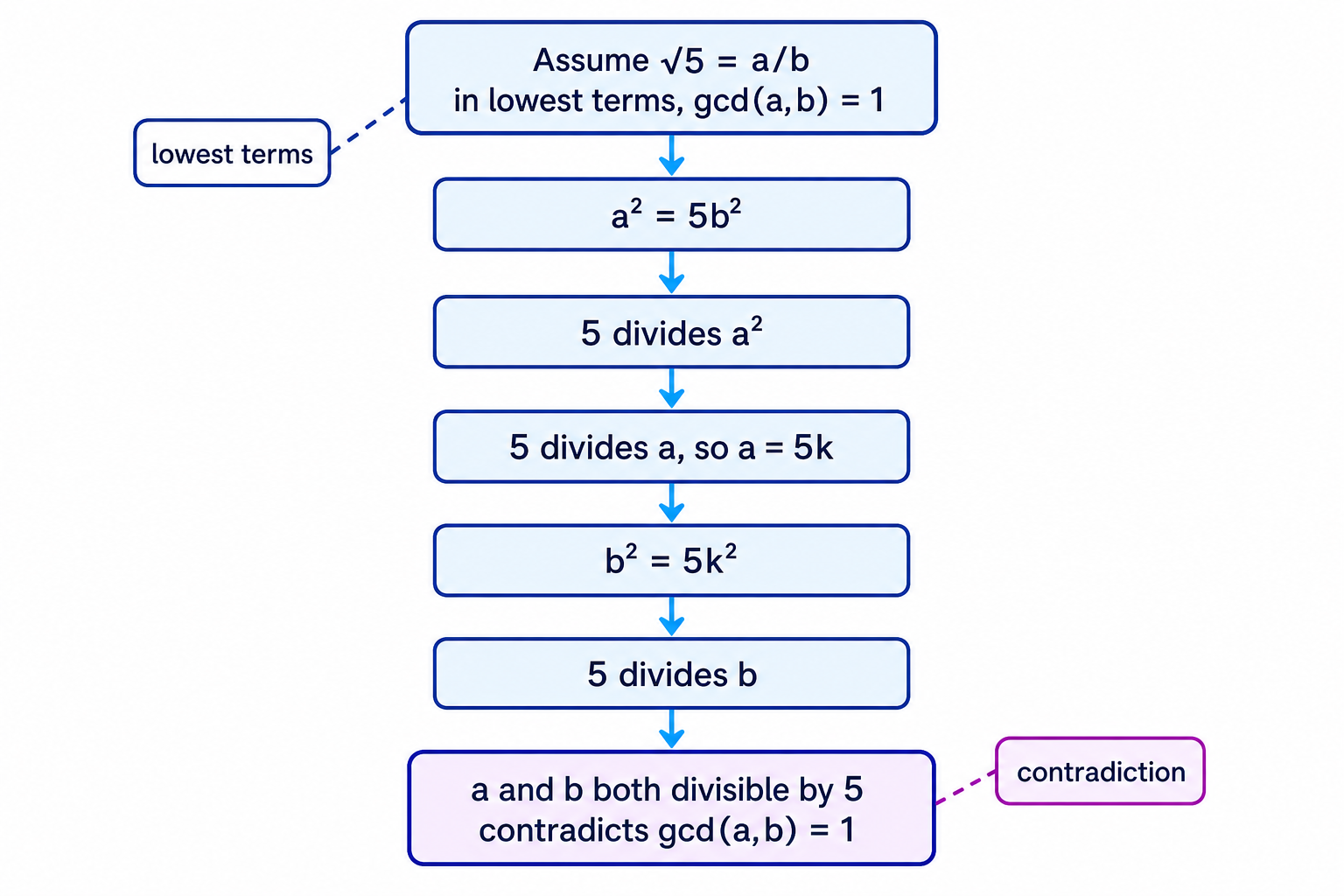
Prove by contradiction that 5\sqrt{5}5 is irrational.
-
Assume the opposite: 5\sqrt{5}5 is rational, so 5=ab\sqrt{5}=\frac{a}{b}5=ba for coprime integers aaa and bbb, with b≠0b\neq0b=0.
-
Square both sides:
a2=5b2a^2=5b^2a2=5b2 -
So 5 divides a2a^2a2. Since 5 is prime, 5 divides aaa, so write a=5ka=5ka=5k for some integer kkk.
-
Substitute a=5ka=5ka=5k:
25k2=5b2⇒b2=5k225k^2=5b^2 \Rightarrow b^2=5k^225k2=5b2⇒b2=5k2 -
So 5 divides bbb as well. This contradicts aaa and bbb being coprime.
-
Therefore 5\sqrt{5}5 is irrational.
Lowest terms matters
The contradiction is that the numerator and denominator share a factor. That only works if you first choose the fraction in lowest terms.
Other classic contradiction patterns
Rational plus irrational
Show that the sum of a rational number and an irrational number is irrational.
-
Let rrr be rational and sss be irrational.
-
Assume, for contradiction, that r+sr+sr+s is rational.
-
Since the difference of two rational numbers is rational, (r+s)−r(r+s)-r(r+s)−r would be rational.
-
But (r+s)−r=s(r+s)-r=s(r+s)−r=s, so sss would be rational, contradicting the fact that sss is irrational.
-
Therefore r+sr+sr+s is irrational.
Prime number
A prime number is an integer greater than one with exactly two positive factors: one and itself.
Infinitely many primes
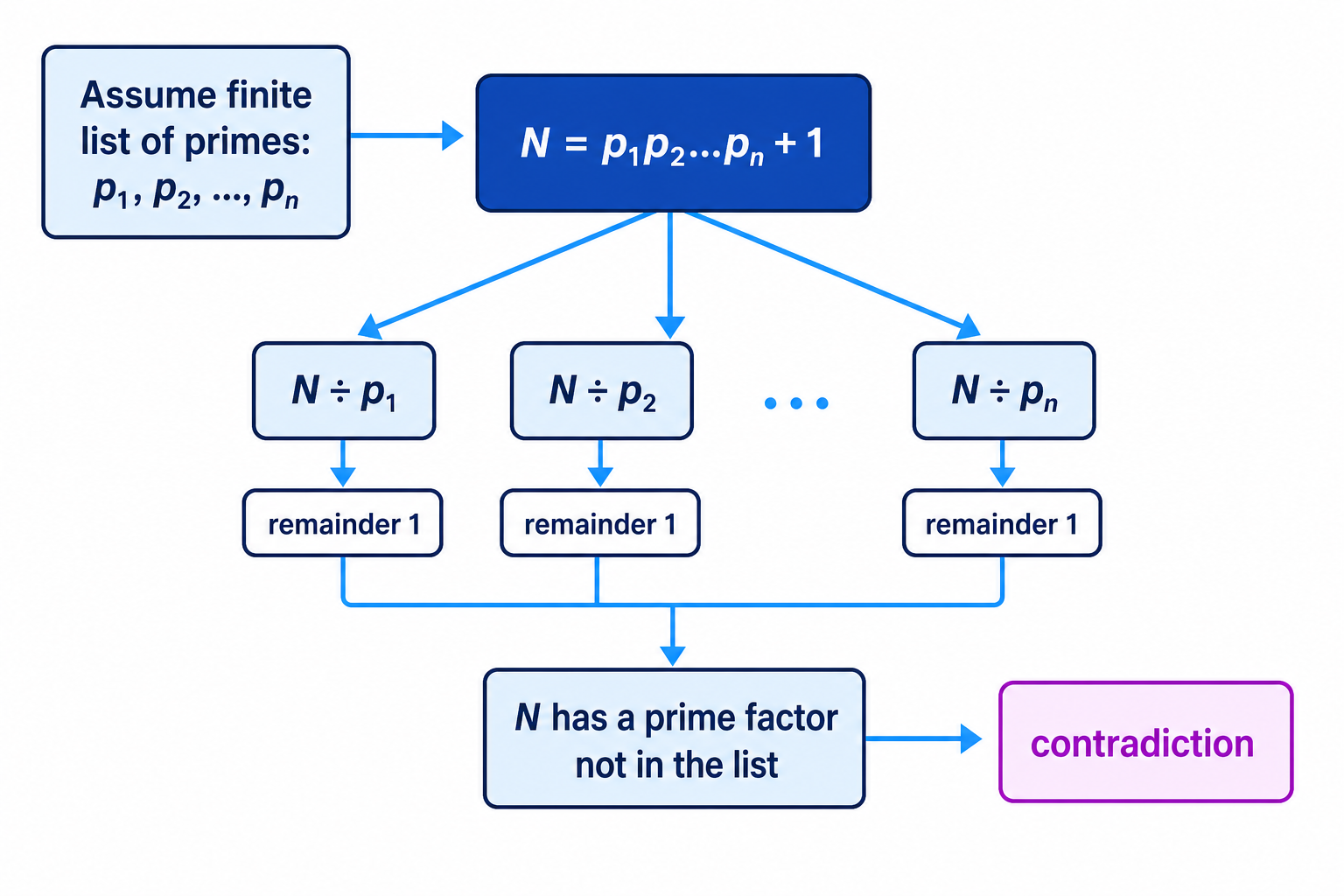
Prove by contradiction that there are infinitely many prime numbers.
-
Assume there are only finitely many primes, called p1,p2,…,pnp_1,p_2,\ldots,p_np1,p2,…,pn.
-
Form a new integer:
N=p1p2⋯pn+1N=p_1p_2\cdots p_n+1N=p1p2⋯pn+1 -
Dividing NNN by any listed prime pip_ipi leaves remainder one, so none of the listed primes divides NNN.
-
Since N>1N>1N>1, it must have at least one prime factor.
-
That prime factor is not in the list, which is a contradiction.
-
Therefore there are infinitely many prime numbers.
In the exam
-
For partial fractions, write the required form first; repeated factors need every power.
-
Multiply through by the full denominator before substituting values of xxx.
-
In contradiction proofs, clearly state the assumption, the contradiction, and the final conclusion.
Check yourself
-
If a denominator contains (x+4)3(x+4)^3(x+4)3, which partial fraction terms are needed?
-
Why must an improper rational function have a polynomial part?
-
In a proof that 7\sqrt{7}7 is irrational, why do you begin with a fraction in lowest terms?
