

What you'll learn
- How to draw clear force diagrams for rods, ladders, planks and particles.
- How to use equilibrium: resolving forces and taking moments.
- How to handle friction, especially “on the point of slipping”.
- How to set up connected-particle problems with pulleys and inclined planes.
1. Start with the force diagram
Most mistakes in this topic happen before the algebra starts. Your first job is to show every external force acting on the body you are studying.
Force diagram and modelling language
- A free-body diagram shows one object only, with all external forces acting on it.
- Weight is the force of gravity, with magnitude mgmgmg, acting vertically downwards.
- A normal reaction is the contact force perpendicular to a surface.
- Friction acts along a rough surface, opposing motion or the tendency to move.
- A smooth contact has no friction; a rough contact may have friction.
- A uniform rod has its weight acting at its midpoint.
- A light inextensible string has negligible mass and fixed length, so connected particles share the same acceleration while the string is taut.
Resolving on an inclined plane
If a plane is inclined at angle θ\thetaθ to the horizontal, the weight component:
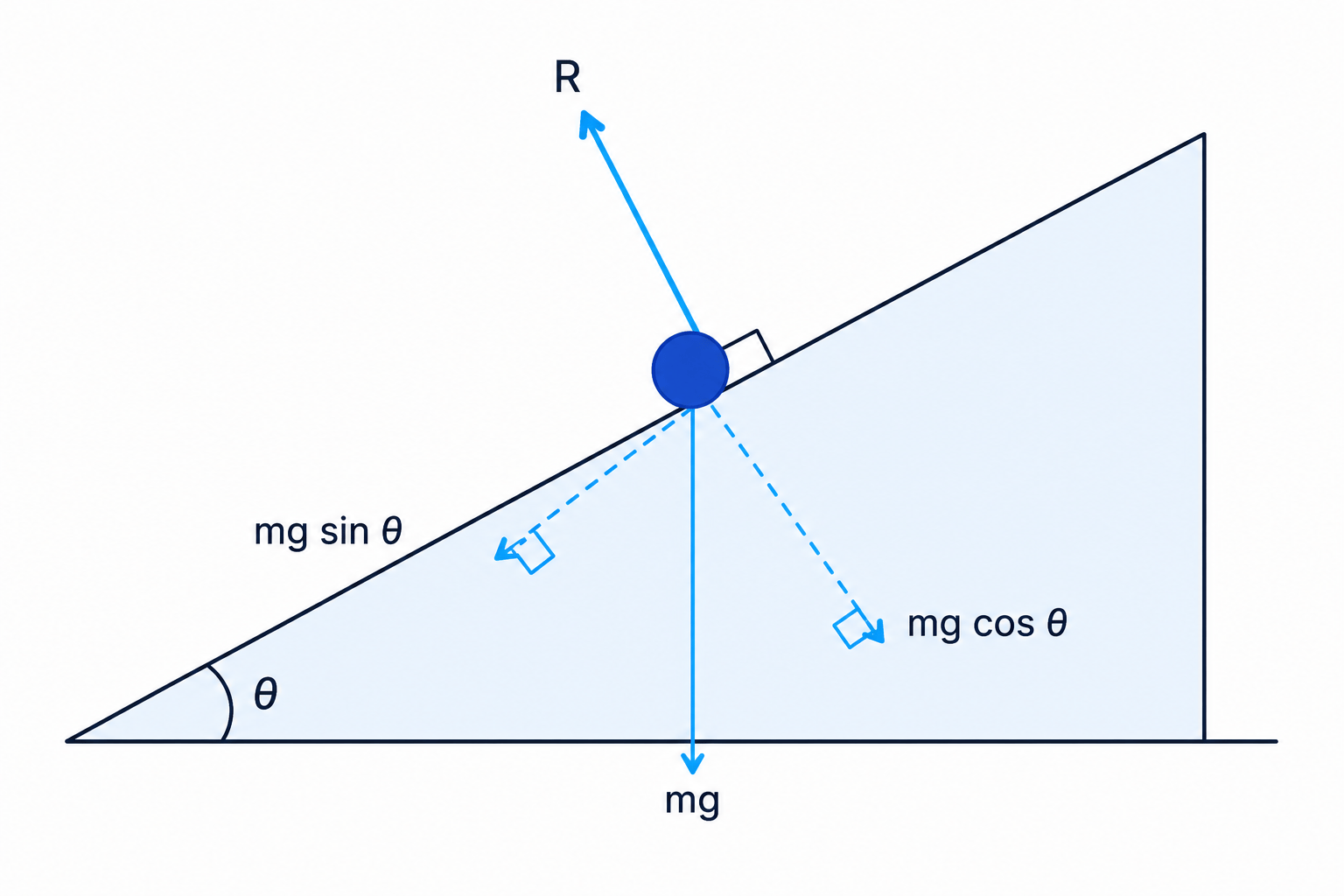
- down the plane is mgsinθmg\sin\thetamgsinθ,
- perpendicular to the plane is mgcosθmg\cos\thetamgcosθ.
Swapping sine and cosine
For an inclined plane, check with θ=0∘\theta=0^\circθ=0∘: the down-slope component should be zero, so it must be mgsinθmg\sin\thetamgsinθ.
Resolving forces on a rough plane
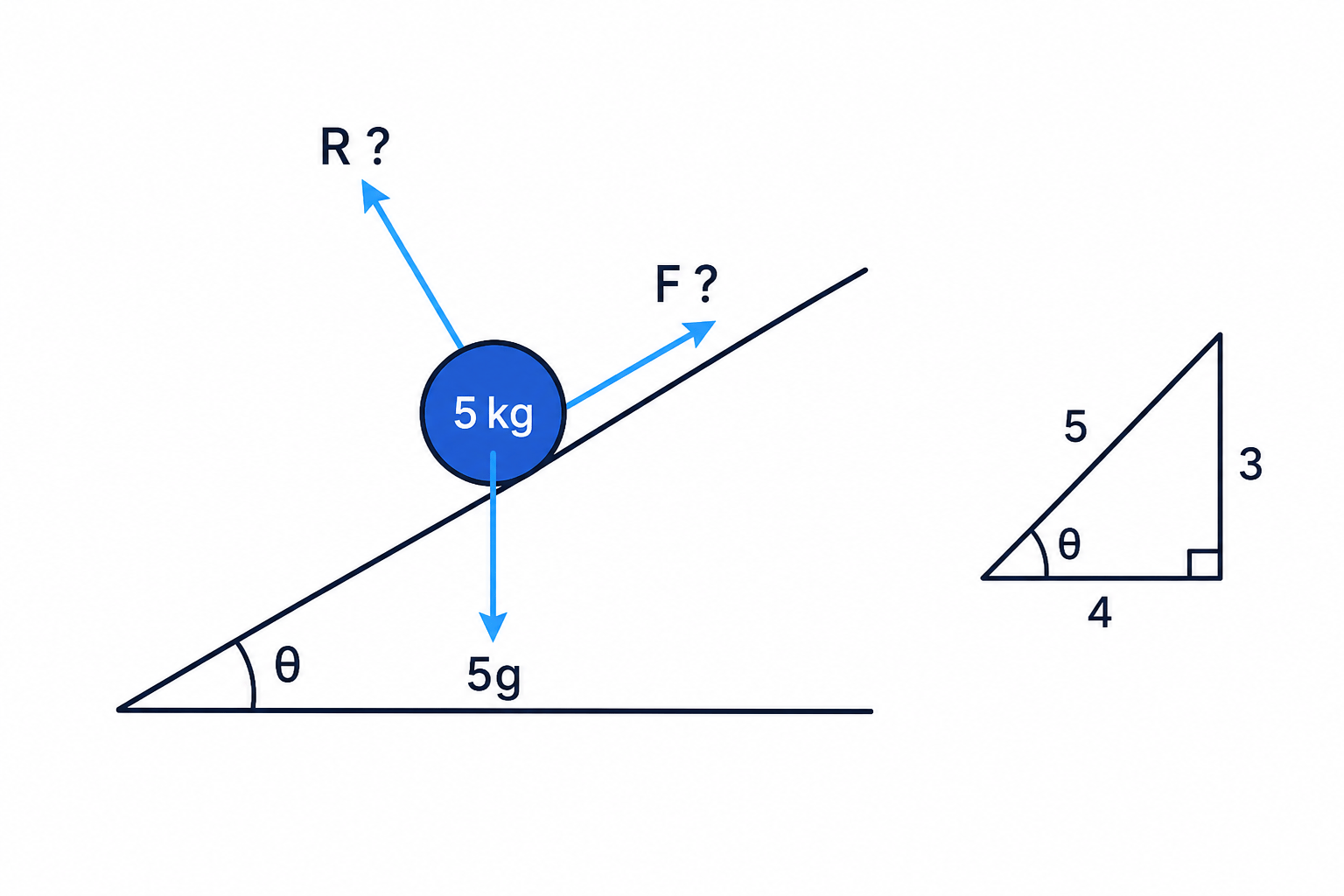
A 5 kg particle rests on a rough plane inclined at angle θ\thetaθ, where tanθ=34\tan\theta=\frac{3}{4}tanθ=43. Find the normal reaction and the frictional force.
-
Draw the forces: weight 5g5g5g vertically downwards, normal reaction RRR perpendicular to the plane, and friction FFF up the plane because the particle would tend to slide down.
-
Use the 3-4-5 triangle from tanθ=34\tan\theta=\frac{3}{4}tanθ=43:
sinθ=35,cosθ=45\sin\theta=\frac{3}{5},\qquad \cos\theta=\frac{4}{5}sinθ=53,cosθ=54 -
Resolve perpendicular to the plane to find the normal reaction, which is 39.2 N:
R=5gcosθ=5g⋅45=4gR=5g\cos\theta=5g\cdot\frac{4}{5}=4gR=5gcosθ=5g⋅54=4g -
Resolve parallel to the plane to find the frictional force, which is 29.4 N up the plane:
F=5gsinθ=5g⋅35=3gF=5g\sin\theta=5g\cdot\frac{3}{5}=3gF=5gsinθ=5g⋅53=3g
2. Equilibrium and moments
An object is in equilibrium when the resultant force is zero. For a rod, ladder or plank, you also need rotational equilibrium, meaning the resultant moment is zero.
Moment of a force
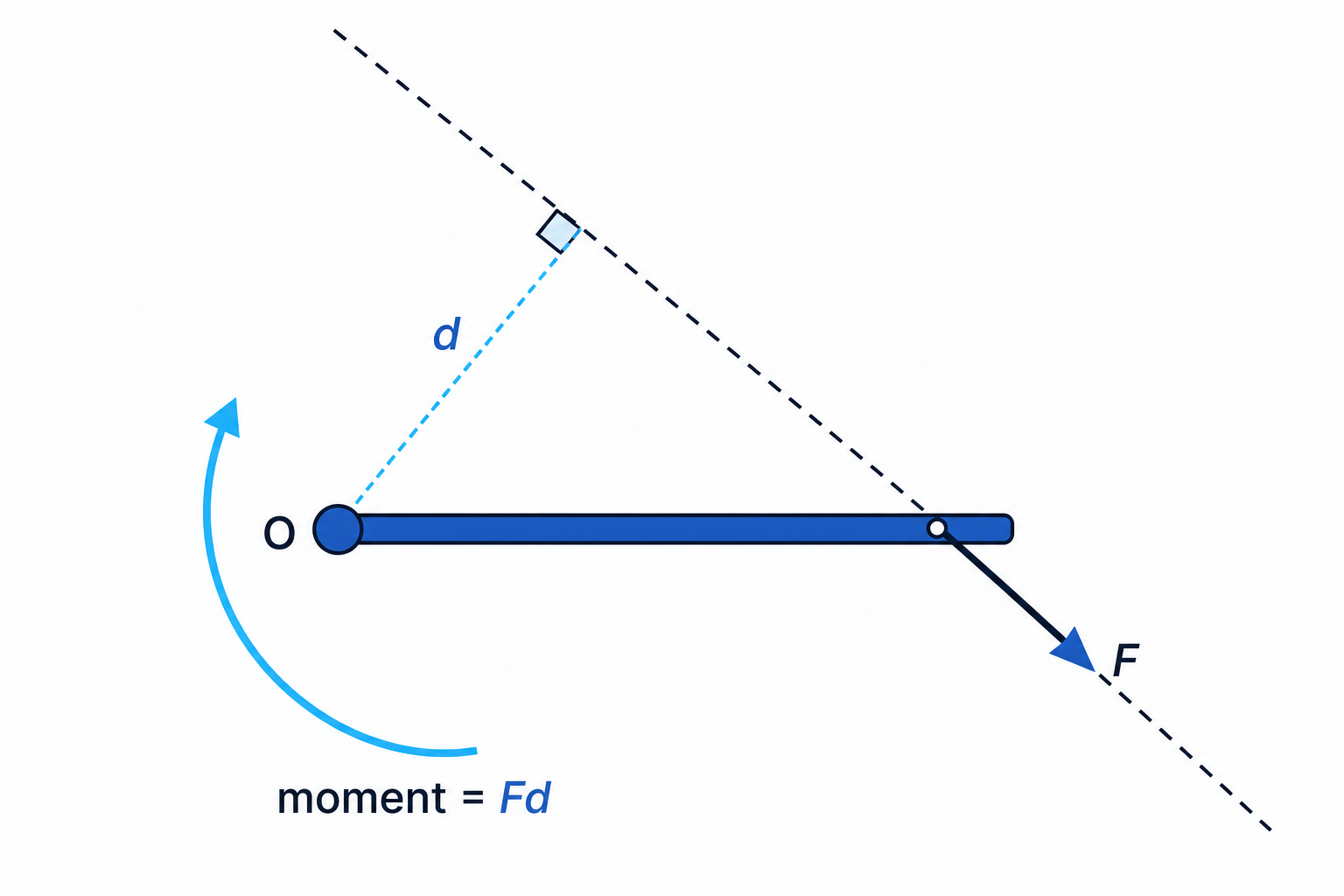
The moment of a force about a point is its turning effect. Its magnitude is force times perpendicular distance from the point to the force’s line of action.
For rods and planks, the best strategy is often:
- Resolve horizontally.
- Resolve vertically.
- Take moments about a point with unknown forces, such as a hinge, to eliminate them.
Choose the moment point wisely
Taking moments about a hinge or contact point removes any unknown forces acting there, because their perpendicular distance from that point is zero.
Horizontal rod held by a string
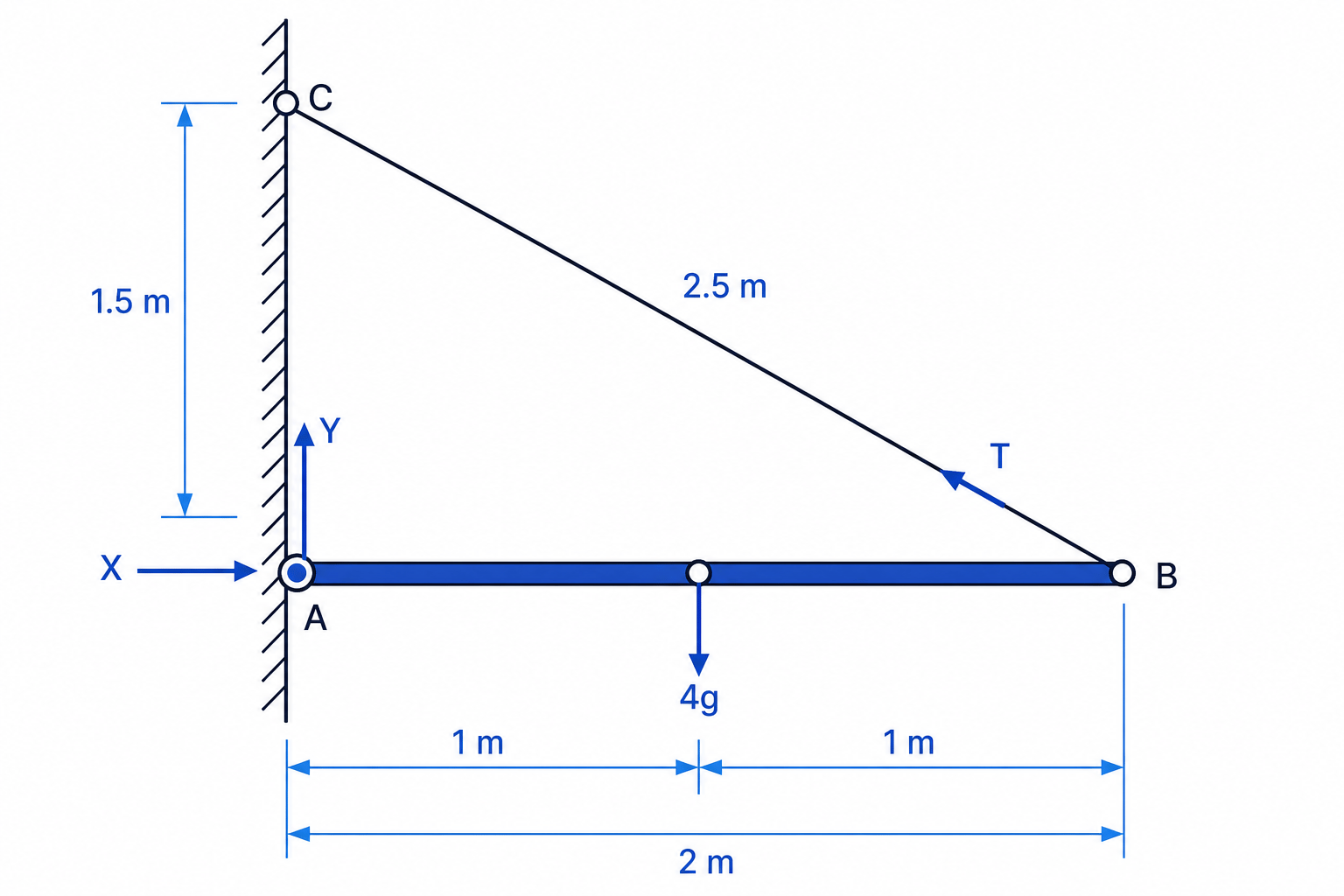
A uniform rod of length 2 m and mass 4 kg is hinged to a vertical wall at AAA. A string joins the free end BBB to a point CCC on the wall, where AC=1.5AC=1.5AC=1.5 m. The rod is horizontal. Find the tension and the force at the hinge.
-
The string forms a triangle with horizontal side 2 m, vertical side 1.5 m and hypotenuse 2.5 m. So the tension components at BBB are 4T5\frac{4T}{5}54T horizontally left and 3T5\frac{3T}{5}53T vertically up.
-
Take moments about AAA. The hinge force has no moment about AAA:
2(3T5)=4g⇒T=10g32\left(\frac{3T}{5}\right)=4g \quad\Rightarrow\quad T=\frac{10g}{3}2(53T)=4g⇒T=310g -
So the tension is 32.7 N. Let the hinge reaction have components XXX to the right and YYY upwards:
X=4T5,Y+3T5=4gX=\frac{4T}{5},\qquad Y+\frac{3T}{5}=4gX=54T,Y+53T=4g -
Substitute T=10g3T=\frac{10g}{3}T=310g:
X=8g3,Y=2gX=\frac{8g}{3},\qquad Y=2gX=38g,Y=2g -
The resultant hinge force has magnitude in newtons and direction ϕ\phiϕ above the horizontal:
magnitude=(8g3)2+(2g)2=10g3≈32.7,tanϕ=2g8g/3=34,ϕ≈36.9∘\begin{aligned} \text{magnitude} &= \sqrt{\left(\frac{8g}{3}\right)^2+(2g)^2}=\frac{10g}{3}\approx 32.7,\\ \tan\phi &= \frac{2g}{8g/3}=\frac{3}{4},\\ \phi &\approx 36.9^\circ \end{aligned}magnitudetanϕϕ=(38g)2+(2g)2=310g≈32.7,=8g/32g=43,≈36.9∘
3. Friction and limiting equilibrium
Coefficient of friction
For a rough contact, friction satisfies F≤μRF\le \mu RF≤μR, where μ\muμ is the coefficient of friction and RRR is the normal reaction. In limiting equilibrium, the body is just about to slip, so F=μRF=\mu RF=μR.
“On the point of slipping” is a big clue: it tells you to use F=μRF=\mu RF=μR.
Ladder against a smooth wall
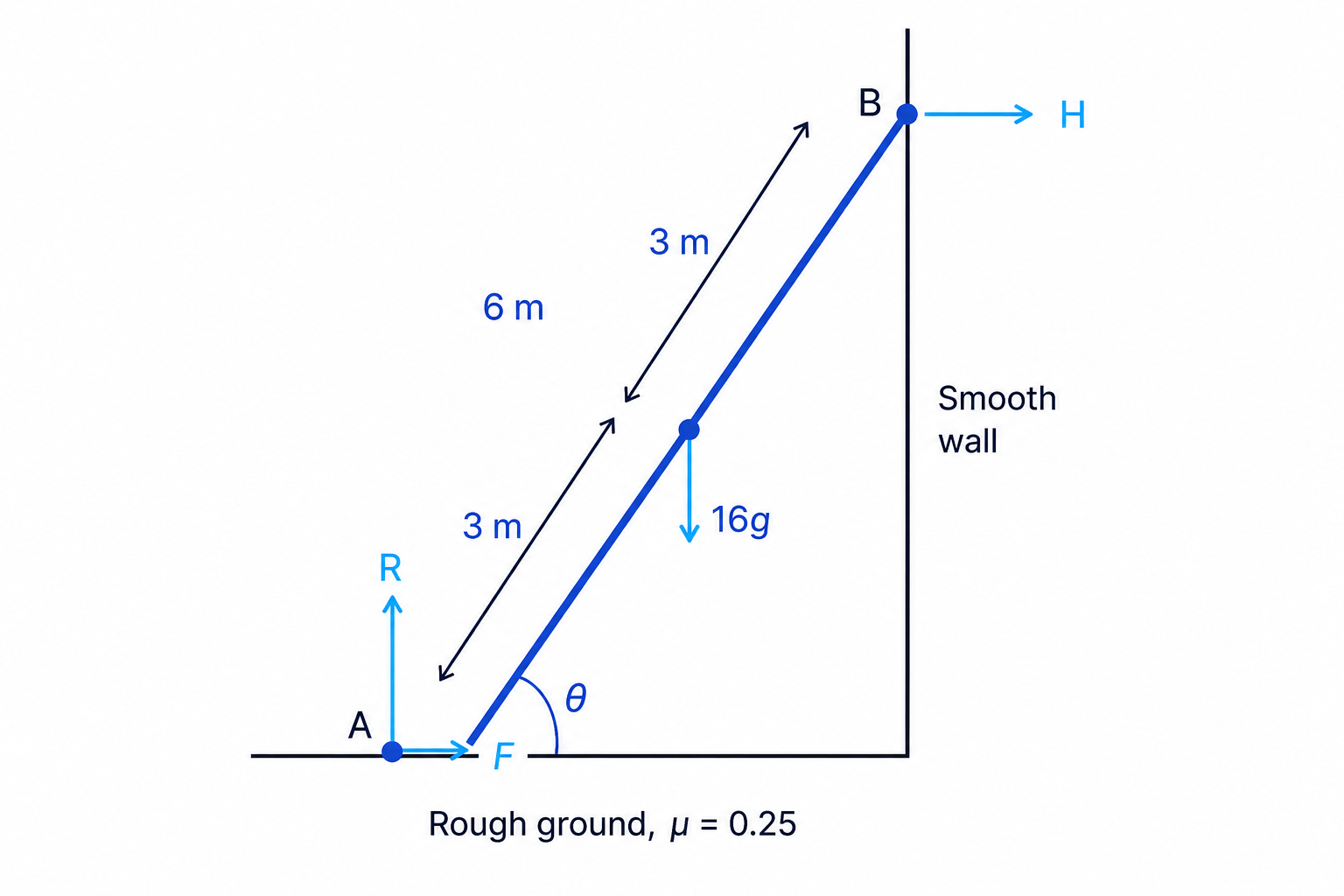
A uniform 6 m ladder of mass 16 kg rests with its foot on rough horizontal ground and its top against a smooth vertical wall. The coefficient of friction at the ground is 0.25. The ladder is on the point of slipping and makes angle θ\thetaθ with the ground. Find the friction and θ\thetaθ.
-
Forces: weight 16g16g16g at the midpoint, ground reaction RRR upwards, friction FFF at the ground, and wall reaction HHH horizontally at the top. The wall is smooth, so there is no friction at the wall.
-
Resolve vertically and use limiting friction. The friction is 39.2 N:
R=16g,F=0.25R=4gR=16g,\qquad F=0.25R=4gR=16g,F=0.25R=4g -
Resolve horizontally:
H=F=4gH=F=4gH=F=4g -
Take moments about the foot of the ladder. The wall reaction has perpendicular distance 6sinθ6\sin\theta6sinθ; the weight has perpendicular distance 3cosθ3\cos\theta3cosθ:
H(6sinθ)=16g(3cosθ)H(6\sin\theta)=16g(3\cos\theta)H(6sinθ)=16g(3cosθ) -
Substitute H=4gH=4gH=4g and solve:
4g(6sinθ)=48gcosθ⇒tanθ=2⇒θ≈63.4∘4g(6\sin\theta)=48g\cos\theta \quad\Rightarrow\quad \tan\theta=2 \quad\Rightarrow\quad \theta\approx63.4^\circ4g(6sinθ)=48gcosθ⇒tanθ=2⇒θ≈63.4∘
4. Connected particles and pulleys
For moving systems, use Newton’s second law: resultant force equals mass times acceleration, written as F=maF=maF=ma.
For a smooth pulley and light string:
- the tension is the same on both sides of the pulley,
- connected particles have the same magnitude of acceleration while the string is taut.
On a slope, the line of greatest slope means the straight up/down direction along the plane.
Rough inclined plane with a hanging particle
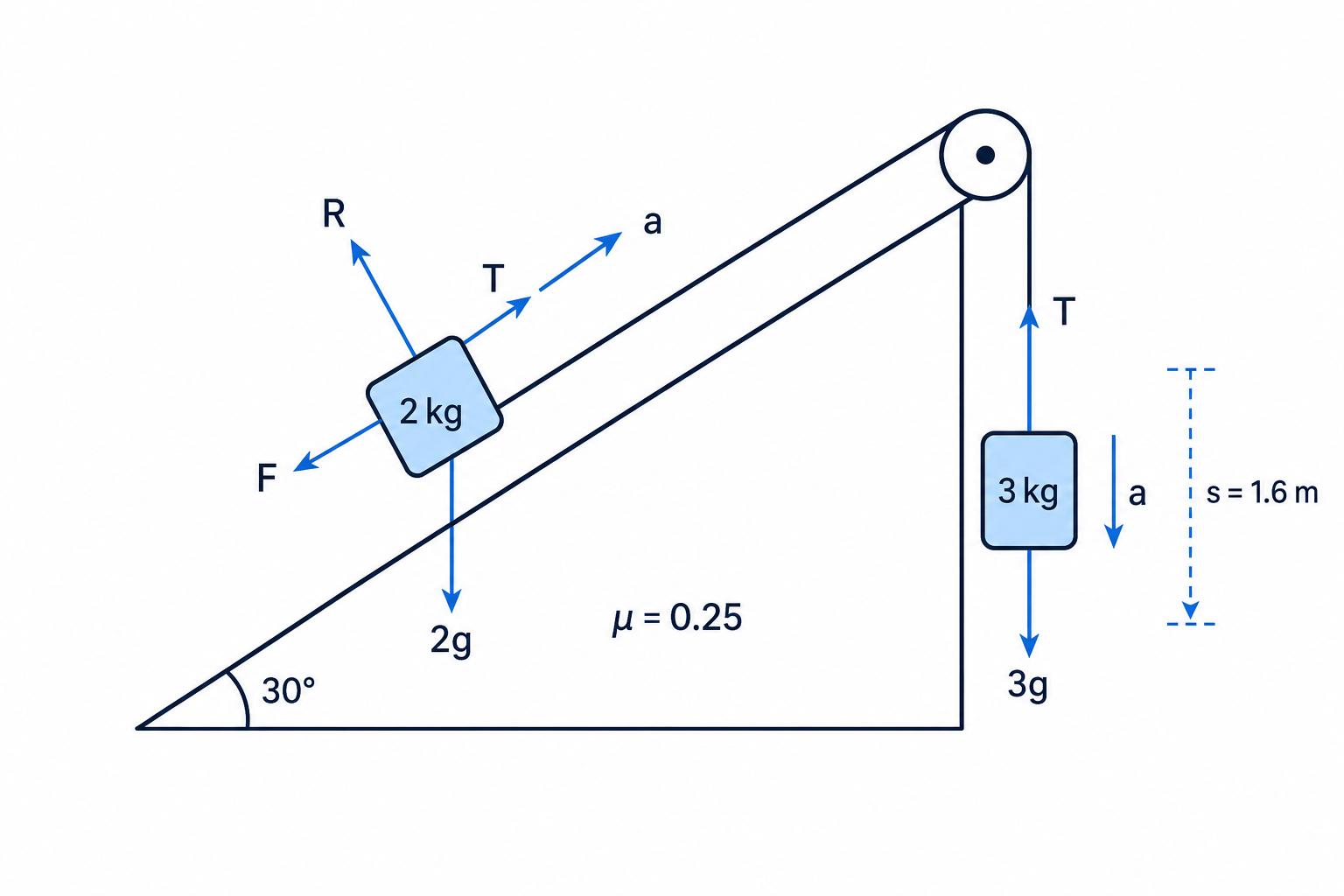
A 2 kg particle on a rough 30° plane is connected over a smooth pulley to a hanging 3 kg particle. The coefficient of friction on the plane is 0.25. The system is released, with the 3 kg particle moving downwards. Find the acceleration, tension, speed after the hanging particle descends 1.6 m, and the force on the pulley.
-
For the 2 kg particle, take up the plane as positive. Since it moves up the plane, friction acts down the plane. The normal reaction is R=2gcos30∘R=2g\cos30^\circR=2gcos30∘.
-
Write Newton’s second law for both particles:
T−2gsin30∘−0.25(2gcos30∘)=2a,3g−T=3a\begin{aligned} T-2g\sin30^\circ-0.25(2g\cos30^\circ)&=2a,\\ 3g-T&=3a \end{aligned}T−2gsin30∘−0.25(2gcos30∘)3g−T=2a,=3a -
Add the equations to eliminate TTT. The acceleration is about 3.07 m s⁻²:
a=3g−2gsin30∘−0.25(2gcos30∘)5≈3.07a=\frac{3g-2g\sin30^\circ-0.25(2g\cos30^\circ)}{5}\approx3.07a=53g−2gsin30∘−0.25(2gcos30∘)≈3.07 -
Use the hanging particle equation to find the tension, about 20.2 N:
T=3g−3a≈20.2T=3g-3a\approx20.2T=3g−3a≈20.2 -
Use v2=u2+2asv^2=u^2+2asv2=u2+2as with u=0u=0u=0 and s=1.6s=1.6s=1.6. The speed is about 3.14 m s⁻¹:
v2=02+2(3.07)(1.6),v≈3.14v^2=0^2+2(3.07)(1.6),\qquad v\approx3.14v2=02+2(3.07)(1.6),v≈3.14 -
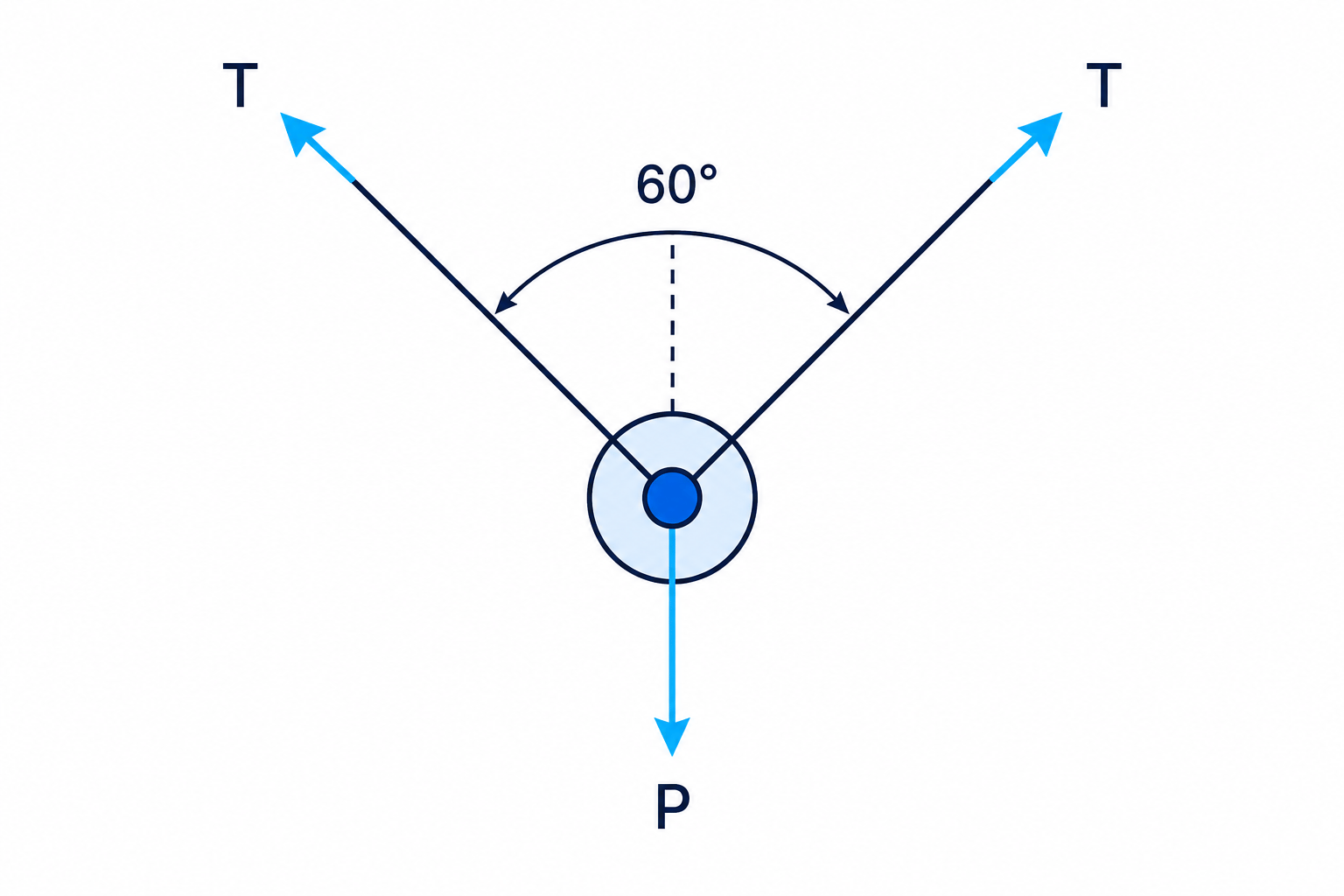
The force on the pulley is the resultant of two tensions. The angle between the string sections is 60°, so the magnitude is about 35.0 N, along the angle bisector:
$$
P=\sqrt{T^2+T^2+2T^2\cos60^\circ}=T\sqrt{3}\approx35.0
$$
Forgetting friction changes direction
Friction always opposes motion or impending motion. Decide the direction before writing equations, especially when a particle has just stopped.
5. When the string goes slack or contact changes
If a hanging particle hits the ground, the string may go slack. Then the tension becomes zero, and you must analyse the remaining particle again.
Do not keep the old equations
Once a string is slack, the particles no longer share an acceleration and the previous connected-particle equations no longer apply.
Will a particle remain at rest?
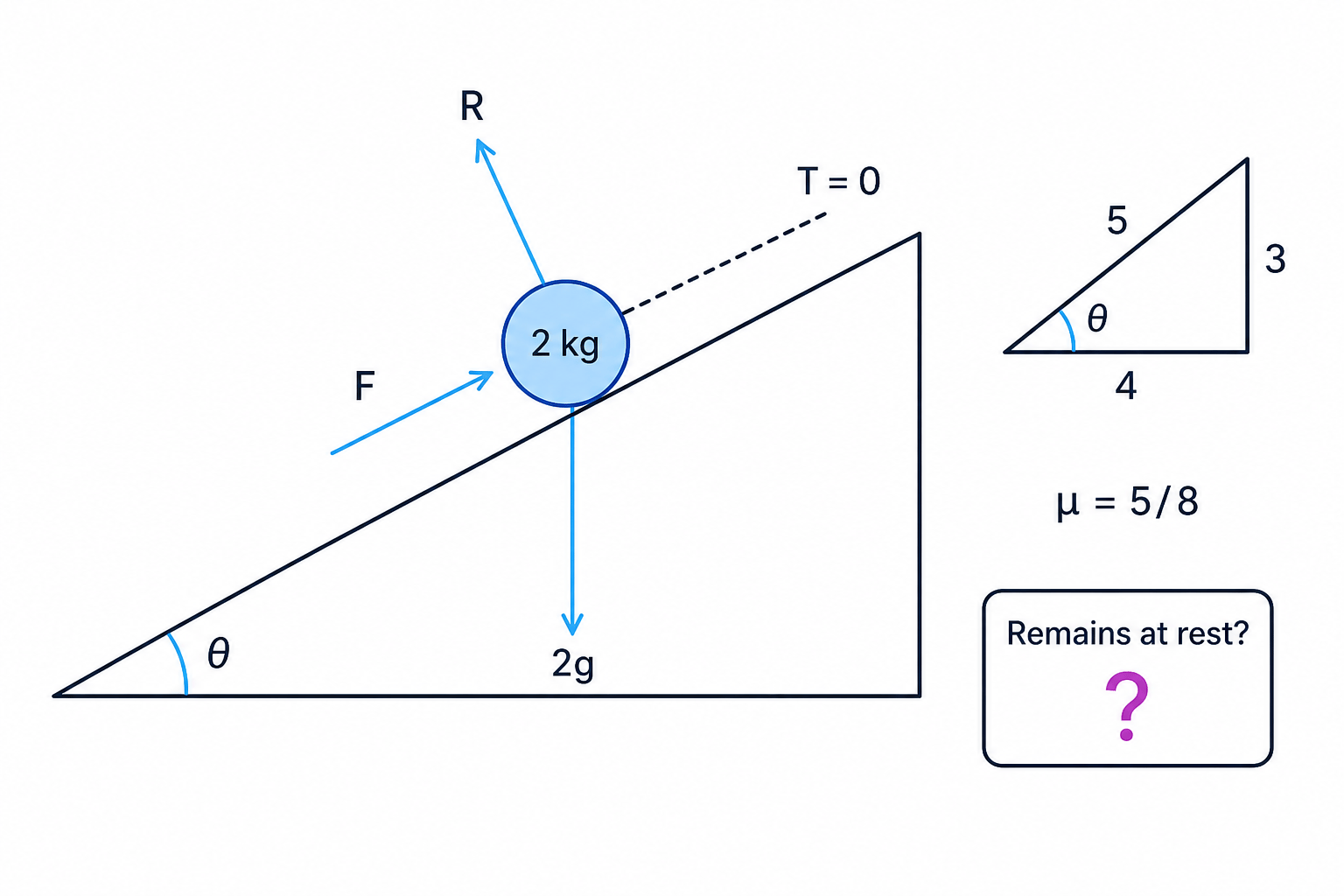
A 2 kg particle is on a rough plane with tanθ=34\tan\theta=\frac{3}{4}tanθ=43 and coefficient of friction 58\frac{5}{8}85. It has just come to rest after moving up the plane, and the string is now slack. Determine whether it remains at rest.
-
With the string slack, T=0T=0T=0. For the particle to remain at rest, friction must be able to balance the downhill component of weight.
-
Use sinθ=35\sin\theta=\frac{3}{5}sinθ=53 and cosθ=45\cos\theta=\frac{4}{5}cosθ=54:
Fneeded=2g⋅35=6g5,R=2g⋅45=8g5F_{\text{needed}}=2g\cdot\frac{3}{5}=\frac{6g}{5},\qquad R=2g\cdot\frac{4}{5}=\frac{8g}{5}Fneeded=2g⋅53=56g,R=2g⋅54=58g -
Find the maximum possible friction:
Fmax=μR=58⋅8g5=gF_{\max}=\mu R=\frac{5}{8}\cdot\frac{8g}{5}=gFmax=μR=85⋅58g=g -
Since Fmax<FneededF_{\max}<F_{\text{needed}}Fmax<Fneeded, friction is too small. The particle will not remain at rest; it will slide down the plane.
Modelling refinements
If asked for refinements, choose realistic changes linked to the situation: pulley friction, pulley mass, string elasticity, non-uniform rods, finite-sized blocks, or air resistance.
In the exam
-
Draw a separate force diagram for each body, then label unknown reactions, tensions and friction forces clearly.
-
For rods and ladders, take moments about a point with the most unknown forces; for inclined planes, resolve parallel and perpendicular to the plane.
-
Only use F=μRF=\mu RF=μR when the contact is limiting, and re-check the forces if a string goes slack or a particle hits the ground.
Check yourself
-
Why does a smooth wall exert only a normal reaction on a ladder?
-
In a ladder question, why is taking moments about the foot often a good choice?
-
If a particle on a plane changes direction or stops, how do you decide the new direction of friction?
