Revision notes for Edexcel A Level Maths Trigonometric Functions. Open each subtopic for explanations, worked examples, and summaries of 6.1 Secant, Cosecant and Cotangent, 6.2 Graphs of Sec x, Cosec x and Cot x, 6.3 Using Sec x, Cosec x and Cot x, 6.4 Trigonometric Identities, and 6.5 Inverse Trigonometric Functions. Written against the Edexcel A Level Maths (9MA0) specification, so the content matches what's examinable rather than general Maths background.
Trigonometric Functions
What you'll learn
- How the reciprocal functions sec\secsec, csc\csccsc and cot\cotcot connect to sin\sinsin, cos\coscos and tan\tantan.
- How to sketch reciprocal trig graphs using asymptotes and key points.
- How to prove and use the identities involving tan2x\tan^2 xtan2x, sec2x\sec^2 xsec2x, cot2x\cot^2 xcot2x and csc2x\csc^2 xcsc2x.
- How to solve trig equations over stated intervals in radians or degrees.
Foundations: units, signs and reciprocals
Trig questions may use radians or degrees. If the interval contains π\piπ, you are working in radians. If it uses 360° or 180°, you are working in degrees. A key conversion is:
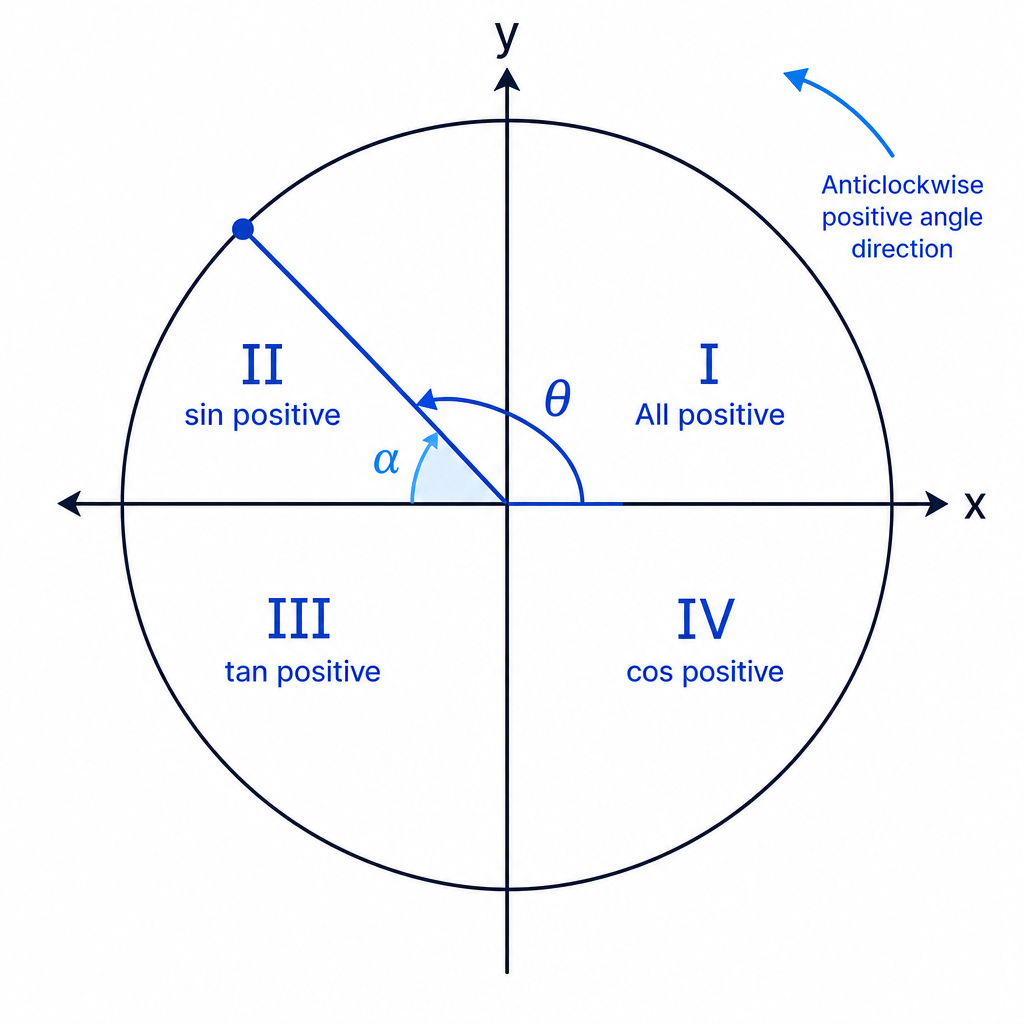
180∘=π radians180^\circ=\pi \text{ radians}180∘=π radiansThe unit circle is split into four quadrants. Moving anticlockwise from quadrant I, the positive functions are: All, Sin, Tan, Cos. This helps you find every solution, not just the calculator’s first answer.
A reference angle is the acute angle between the line and the nearest horizontal axis.
Definition
Reciprocal trigonometric functions
The reciprocal trig functions are defined by
secx=1cosx,cscx=1sinx,cotx=1tanx=cosxsinx\sec x=\frac{1}{\cos x},\qquad \csc x=\frac{1}{\sin x},\qquad \cot x=\frac{1}{\tan x}=\frac{\cos x}{\sin x}secx=cosx1,cscx=sinx1,cotx=tanx1=sinxcosxYou may see cscx\csc xcscx written as cosec x; they mean the same thing.
Because these are reciprocals, they are undefined when the denominator is zero. For example, secx\sec xsecx is undefined when cosx=0\cos x=0cosx=0.
Example
Solving a reciprocal equation in radians
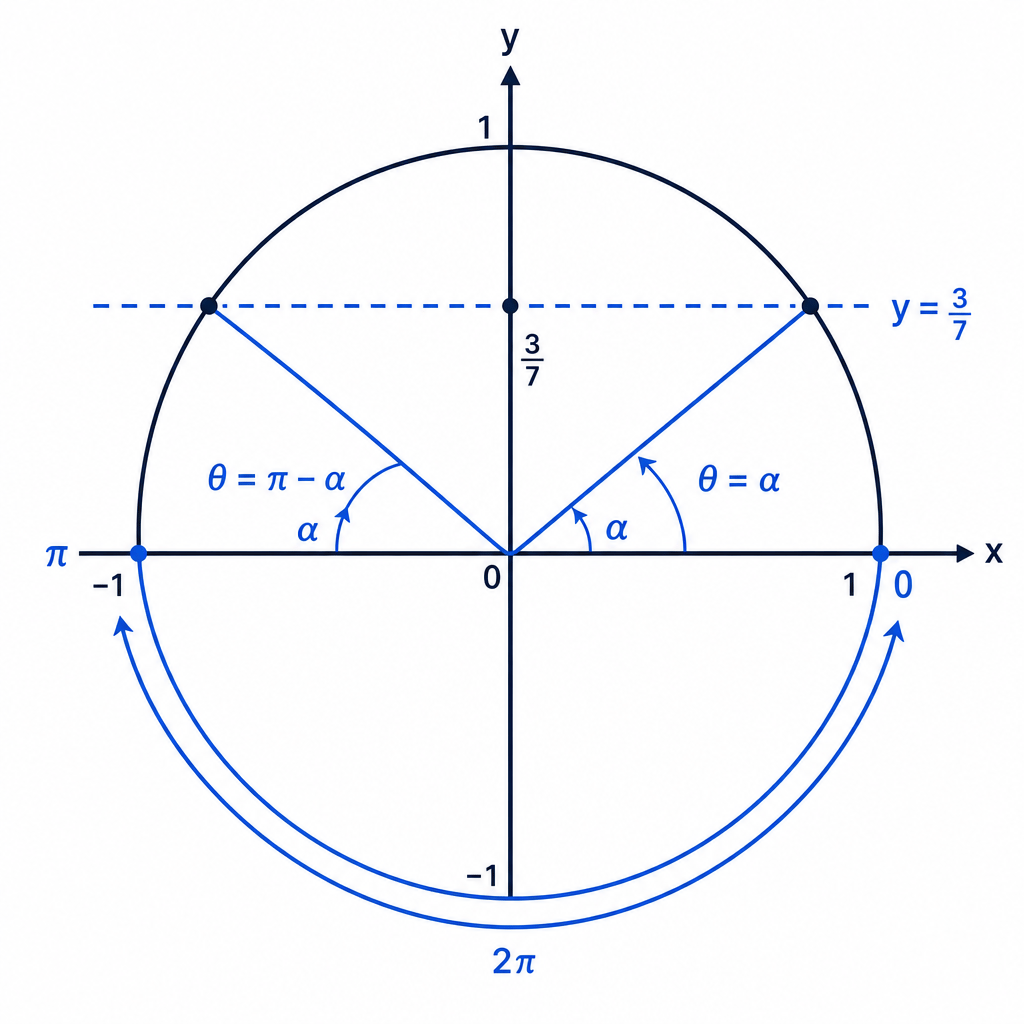
Solve 3cscθ=73\csc\theta=73cscθ=7 for 0≤θ≤2π0\le \theta\le 2\pi0≤θ≤2π, giving answers to 3 significant figures.
-
Rewrite using the reciprocal definition:
3cscθ=7⇒sinθ=373\csc\theta=7 \Rightarrow \sin\theta=\frac{3}{7}3cscθ=7⇒sinθ=73 -
Find the reference angle in radian mode:
α=arcsin(37)≈0.443\alpha=\arcsin\left(\frac{3}{7}\right)\approx 0.443α=arcsin(73)≈0.443 -
Since sine is positive in quadrants I and II, use θ=α\theta=\alphaθ=α and θ=π−α\theta=\pi-\alphaθ=π−α:
θ=0.443orθ≈2.70\theta=0.443 \quad \text{or} \quad \theta\approx 2.70θ=0.443orθ≈2.70 -
The solutions are θ=0.443, 2.70\theta=0.443,\ 2.70θ=0.443, 2.70.
Graphs of reciprocal functions
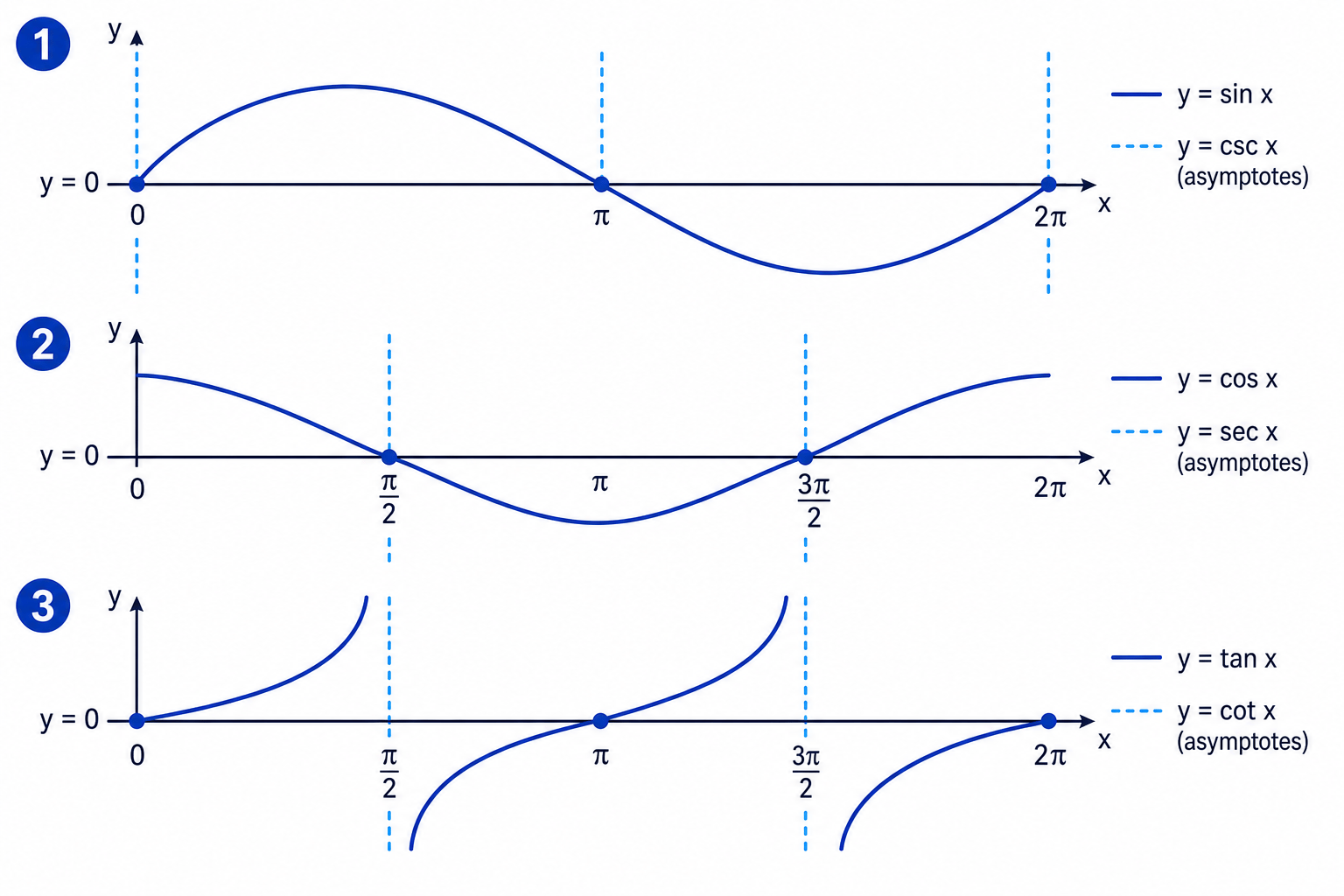
The period of a trig graph is the horizontal distance before it repeats. The graphs of sinx\sin xsinx, cosx\cos xcosx, secx\sec xsecx and cscx\csc xcscx have period 2π2\pi2π. The graphs of tanx\tan xtanx and cotx\cot xcotx have period π\piπ.
A vertical asymptote is a vertical line that a graph approaches but does not cross. Reciprocal graphs have vertical asymptotes where the original trig function is zero.
For sketching:
- y=secxy=\sec xy=secx is the reciprocal of y=cosxy=\cos xy=cosx.
- y=cscxy=\csc xy=cscx is the reciprocal of y=sinxy=\sin xy=sinx.
- y=cotxy=\cot xy=cotx is the reciprocal of y=tanxy=\tan xy=tanx, with asymptotes where sinx=0\sin x=0sinx=0.
Common Mistake
Joining across asymptotes
Never connect branches through a vertical asymptote. The function is undefined there, so the graph must break.
Example
Sketching and
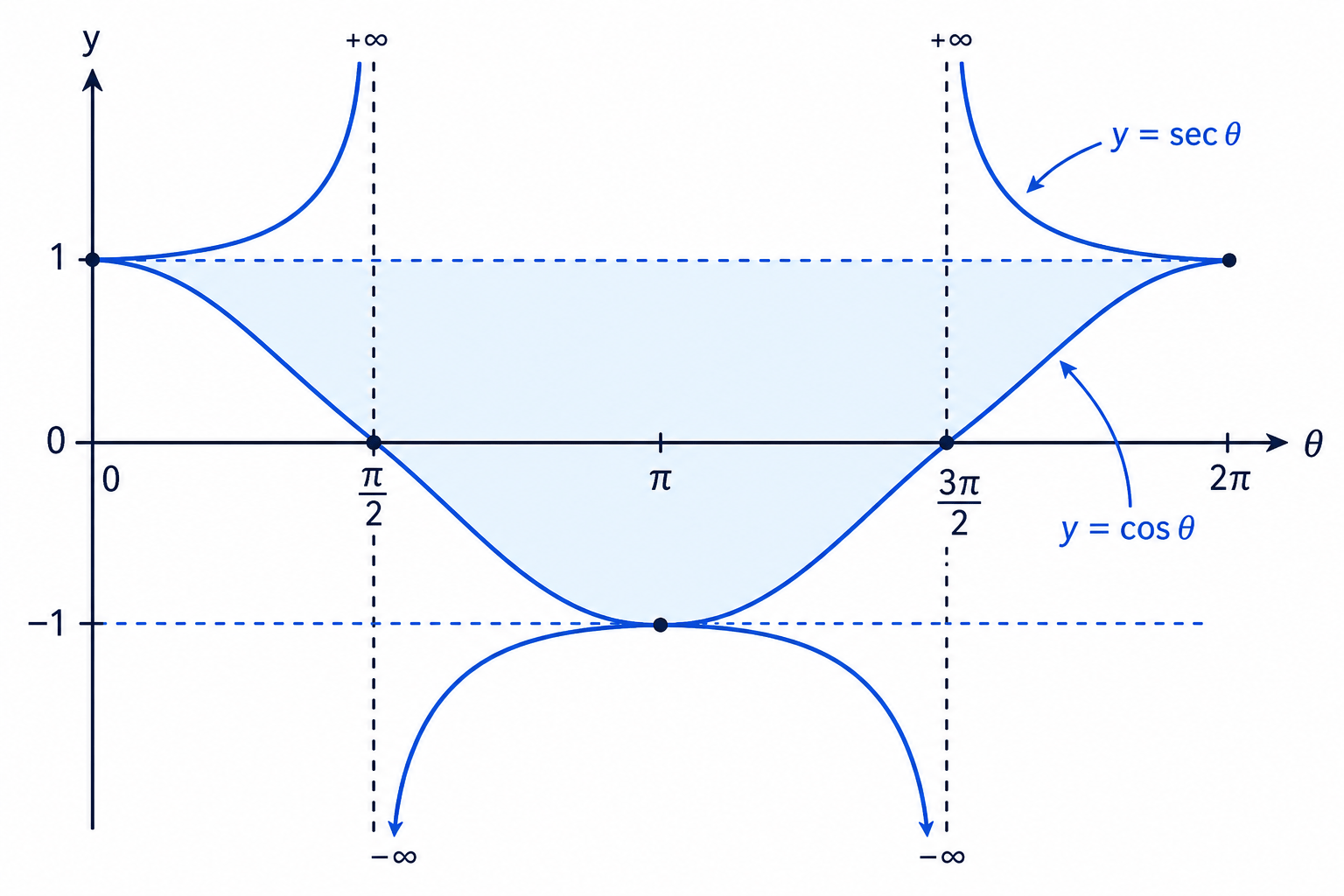
Sketch the two graphs on the same axes for 0≤θ≤2π0\le \theta\le 2\pi0≤θ≤2π.
-
Mark the key cosine points:
(0,1), (π2,0), (π,−1), (3π2,0), (2π,1)(0,1),\ \left(\frac{\pi}{2},0\right),\ (\pi,-1),\ \left(\frac{3\pi}{2},0\right),\ (2\pi,1)(0,1), (2π,0), (π,−1), (23π,0), (2π,1) -
Since secθ=1cosθ\sec\theta=\frac{1}{\cos\theta}secθ=cosθ1, the sec graph passes through y=1y=1y=1 when cosθ=1\cos\theta=1cosθ=1, and through y=−1y=-1y=−1 when cosθ=−1\cos\theta=-1cosθ=−1.
-
Put vertical asymptotes where cosθ=0\cos\theta=0cosθ=0:
θ=π2, 3π2\theta=\frac{\pi}{2},\ \frac{3\pi}{2}θ=2π, 23π -
Draw the sec branches outside the band between y=−1y=-1y=−1 and y=1y=1y=1: upper branches near θ=0\theta=0θ=0 and θ=2π\theta=2\piθ=2π, and a lower branch centred at θ=π\theta=\piθ=π.
Identities you need all the time
Definition
Identity
An identity is an equation that is true for every allowed value of the variable. The symbol ≡\equiv≡ means “identically equal to”.
Start from the fundamental identity:
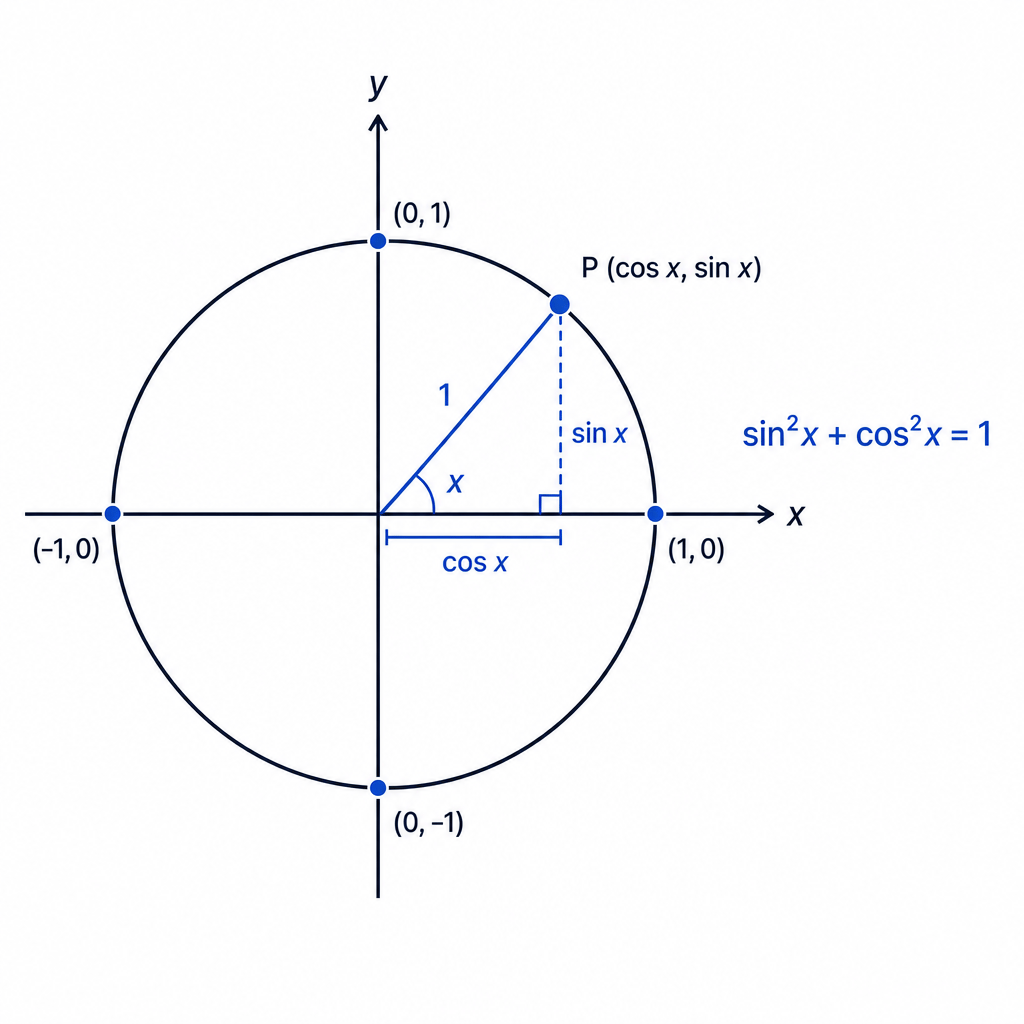
Dividing by cos2x\cos^2 xcos2x gives:
tan2x+1=sec2x\tan^2 x+1=\sec^2 xtan2x+1=sec2xDividing by sin2x\sin^2 xsin2x gives:
1+cot2x=csc2x1+\cot^2 x=\csc^2 x1+cot2x=csc2xKey Idea
Choose the identity that reduces the number of functions
If an equation contains tan2x\tan^2 xtan2x and secx\sec xsecx, use tan2x=sec2x−1\tan^2 x=\sec^2 x-1tan2x=sec2x−1 so everything becomes a quadratic in secx\sec xsecx.
Example
A prove-and-hence style example
Show that sinx+cosxcotx≡cscx\sin x+\cos x\cot x\equiv \csc xsinx+cosxcotx≡cscx. Hence solve sinx+cosxcotx=2sinx\sin x+\cos x\cot x=2\sin xsinx+cosxcotx=2sinx for 0<x<2π0<x<2\pi0<x<2π.
-
Replace cotx\cot xcotx with cosxsinx\frac{\cos x}{\sin x}sinxcosx:
sinx+cosxcotx=sinx+cos2xsinx\sin x+\cos x\cot x=\sin x+\frac{\cos^2 x}{\sin x}sinx+cosxcotx=sinx+sinxcos2x -
Put the terms over a common denominator:
sinx+cos2xsinx=sin2x+cos2xsinx\sin x+\frac{\cos^2 x}{\sin x}=\frac{\sin^2 x+\cos^2 x}{\sin x}sinx+sinxcos2x=sinxsin2x+cos2x -
Use sin2x+cos2x=1\sin^2 x+\cos^2 x=1sin2x+cos2x=1:
sin2x+cos2xsinx=1sinx=cscx\frac{\sin^2 x+\cos^2 x}{\sin x}=\frac{1}{\sin x}=\csc xsinxsin2x+cos2x=sinx1=cscx -
For the equation, replace the left-hand side with cscx\csc xcscx:
cscx=2sinx\csc x=2\sin xcscx=2sinx -
Multiply by sinx\sin xsinx and solve:
1=2sin2x⇒sin2x=121=2\sin^2 x \Rightarrow \sin^2 x=\frac{1}{2}1=2sin2x⇒sin2x=21 -
Therefore sinx=±22\sin x=\pm \frac{\sqrt{2}}{2}sinx=±22, so
x=π4, 3π4, 5π4, 7π4x=\frac{\pi}{4},\ \frac{3\pi}{4},\ \frac{5\pi}{4},\ \frac{7\pi}{4}x=4π, 43π, 45π, 47π
Solving equations by turning trig into algebra
A substitution means temporarily replacing a trig expression with a letter, such as u=secxu=\sec xu=secx, so the equation looks like a familiar quadratic.
Common Mistake
Range check
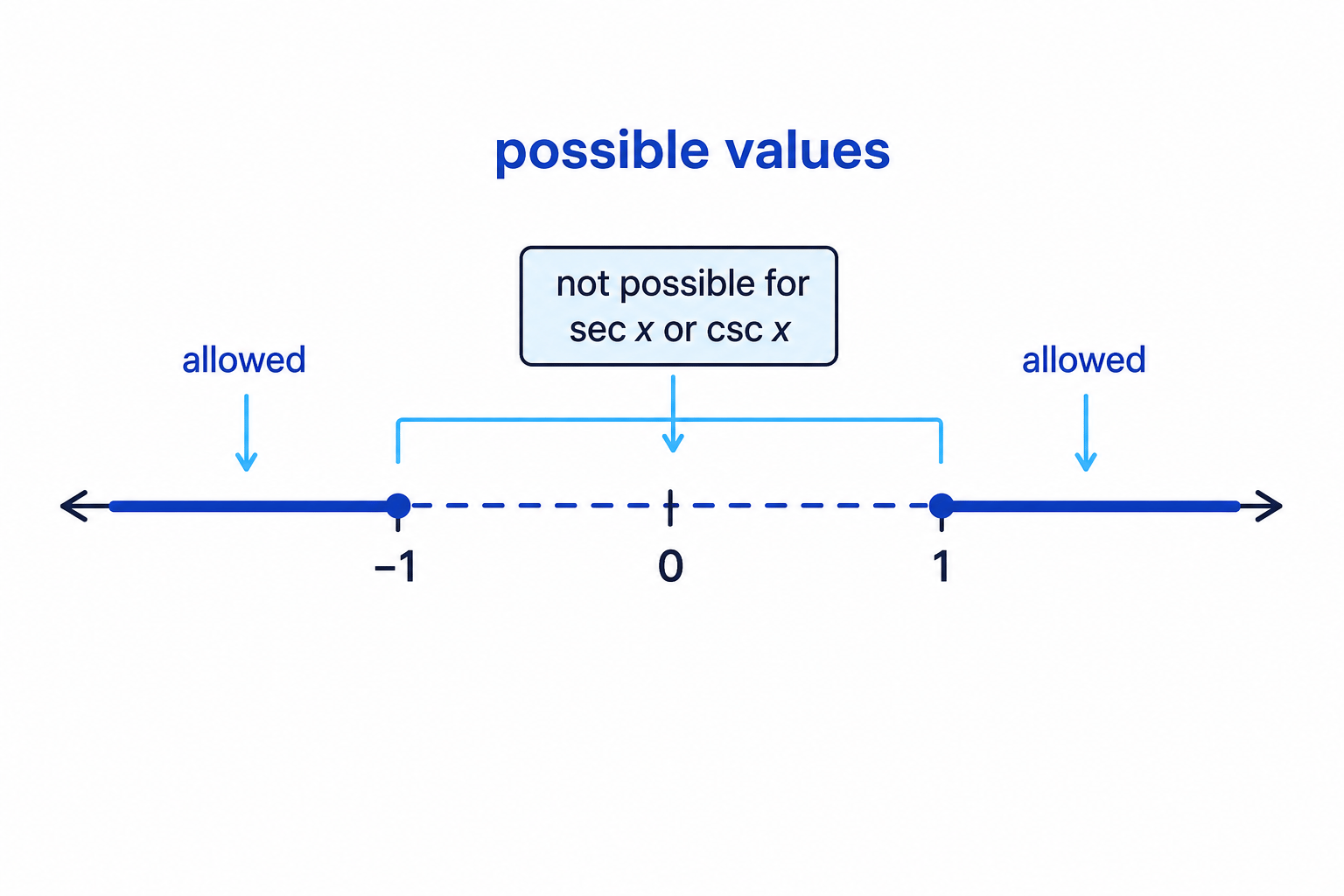
For real angles, sinx\sin xsinx and cosx\cos xcosx must lie between -1 and 1. Therefore secx\sec xsecx and cscx\csc xcscx cannot lie between -1 and 1, except that they also cannot be zero.
Example
Using an identity to form a quadratic
Solve tan2x+3secx−3=0\tan^2 x+3\sec x-3=0tan2x+3secx−3=0 for 0∘≤x≤360∘0^\circ\le x\le 360^\circ0∘≤x≤360∘, giving answers to 1 decimal place where needed.
-
Use tan2x=sec2x−1\tan^2 x=\sec^2 x-1tan2x=sec2x−1:
tan2x+3secx−3=0⇒sec2x+3secx−4=0\tan^2 x+3\sec x-3=0 \Rightarrow \sec^2 x+3\sec x-4=0tan2x+3secx−3=0⇒sec2x+3secx−4=0 -
Let u=secxu=\sec xu=secx:
u2+3u−4=0u^2+3u-4=0u2+3u−4=0 -
Factor to get u=−4u=-4u=−4 or u=1u=1u=1:
u2+3u−4=(u+4)(u−1)=0u^2+3u-4=(u+4)(u-1)=0u2+3u−4=(u+4)(u−1)=0 -
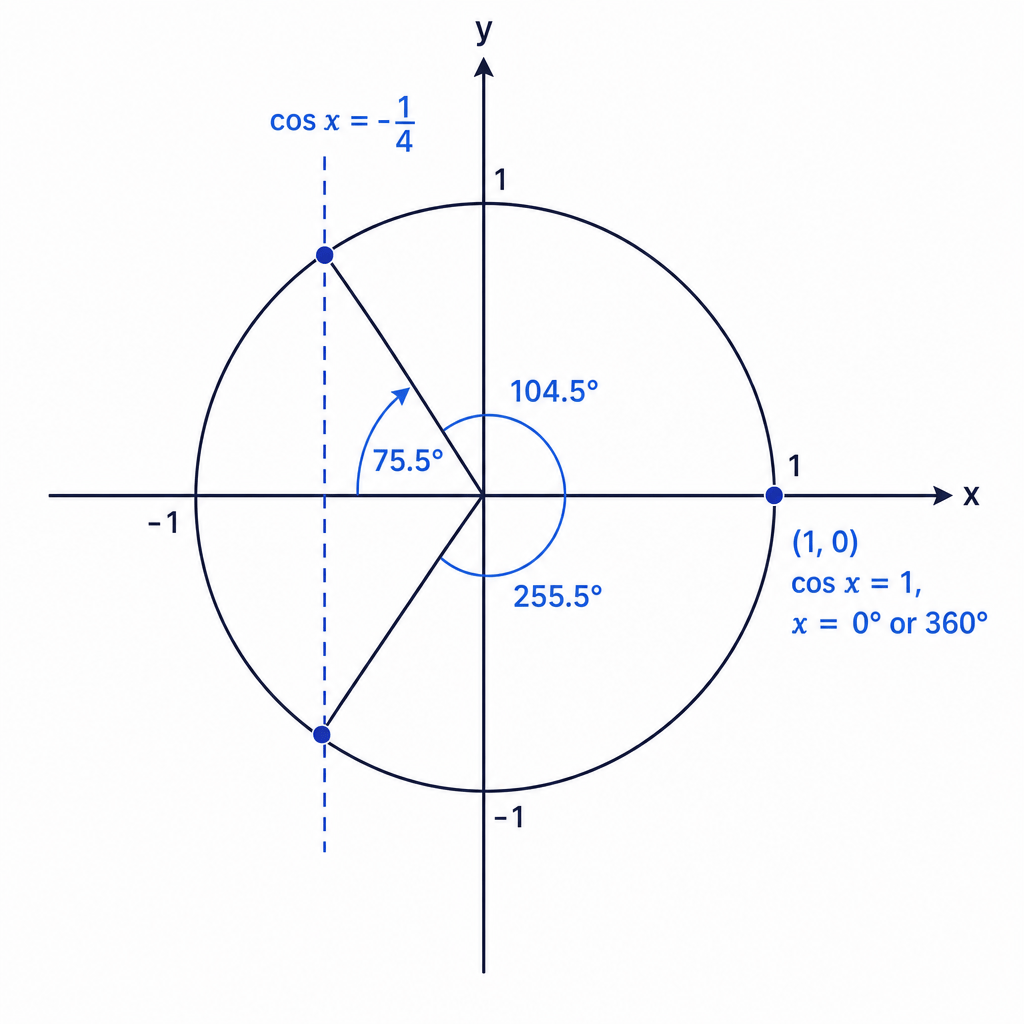
Convert back to cosine: secx=−4\sec x=-4secx=−4 gives cosx=−14\cos x=-\frac{1}{4}cosx=−41, and secx=1\sec x=1secx=1 gives cosx=1\cos x=1cosx=1.
-
For cosx=−14\cos x=-\frac{1}{4}cosx=−41, the reference angle is arccos(14)≈75.5∘\arccos\left(\frac{1}{4}\right)\approx 75.5^\circarccos(41)≈75.5∘, so the quadrant II and III angles are 104.5° and 255.5°.
-
For cosx=1\cos x=1cosx=1, include both endpoints in the interval:
x=0∘, 104.5∘, 255.5∘, 360∘x=0^\circ,\ 104.5^\circ,\ 255.5^\circ,\ 360^\circx=0∘, 104.5∘, 255.5∘, 360∘
Transformed angles
Sometimes the angle inside the trig function is not just xxx or θ\thetaθ. For example, sec(2θ−20∘)\sec(2\theta-20^\circ)sec(2θ−20∘) has an inside angle of 2θ−20∘2\theta-20^\circ2θ−20∘.
Tip
Inside angle first
Set the whole inside angle equal to a new letter, transform the interval, solve for that new letter, then convert back at the end.
Example
Solving with a transformed angle
Solve sec(2θ−20∘)=−1.25\sec(2\theta-20^\circ)=-1.25sec(2θ−20∘)=−1.25 for −180∘≤θ≤180∘-180^\circ\le \theta\le 180^\circ−180∘≤θ≤180∘, giving answers to 1 decimal place.
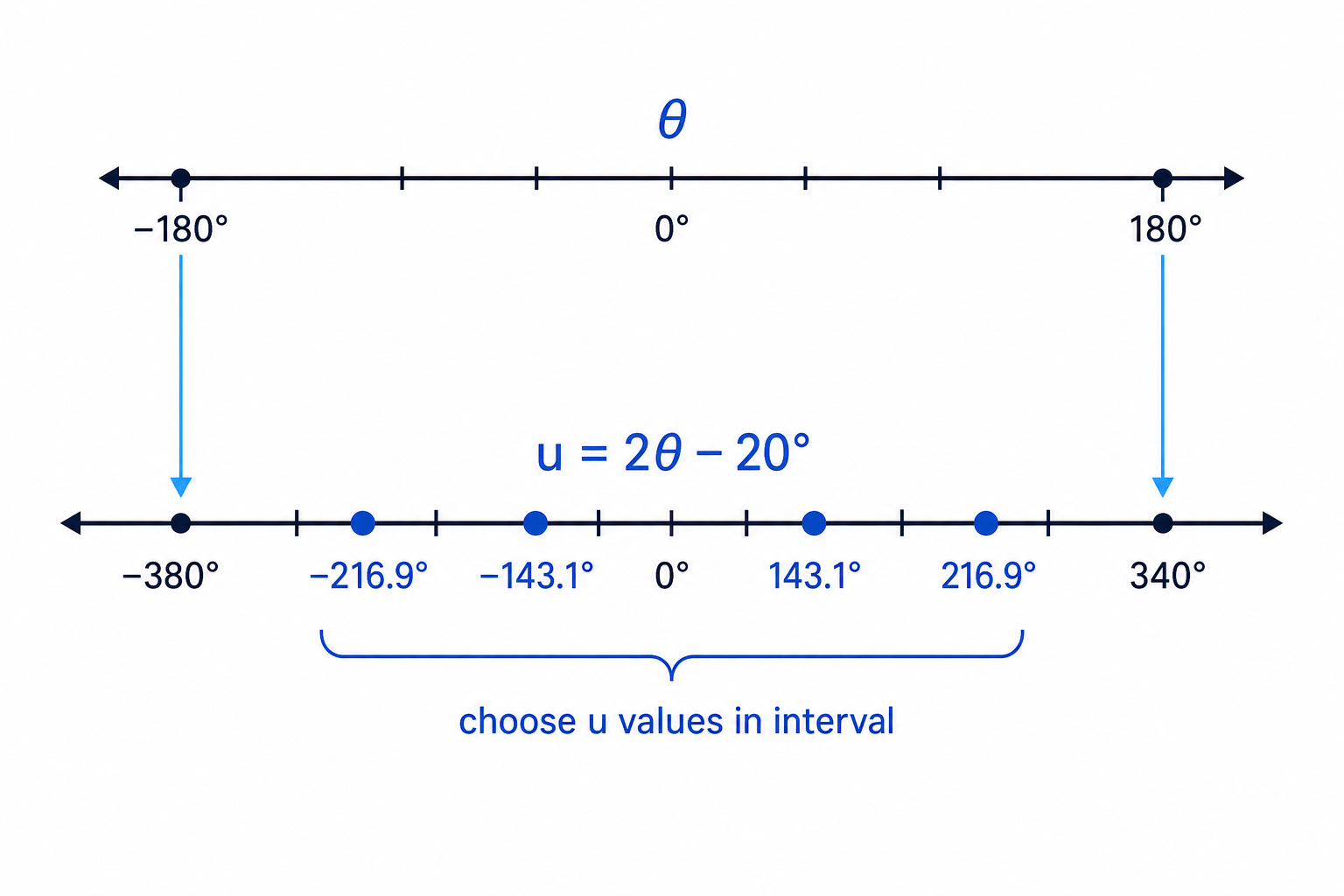
- Let u=2θ−20∘u=2\theta-20^\circu=2θ−20∘. Transform the interval:
$$
-380^\circ\le u\le 340^\circ
$$
2. Convert from sec to cos:
$$
\cos u=-0.8
$$
3. The reference angle is arccos(0.8)≈36.9∘\arccos(0.8)\approx 36.9^\circarccos(0.8)≈36.9∘. Since cosine is negative in quadrants II and III, use the general form with kkk an integer:
$$
u=180^\circ\pm 36.9^\circ+360^\circ k
$$
4. Choose the values in −380∘≤u≤340∘-380^\circ\le u\le 340^\circ−380∘≤u≤340∘:
$$
u=-216.9^\circ,\ -143.1^\circ,\ 143.1^\circ,\ 216.9^\circ
$$
5. Convert back using θ=u+20∘2\theta=\frac{u+20^\circ}{2}θ=2u+20∘:
$$
\theta=-98.4^\circ,\ -61.6^\circ,\ 81.6^\circ,\ 118.4^\circ
$$
Exam technique
In the exam
- Rewrite reciprocal functions in terms of sin\sinsin, cos\coscos and tan\tantan unless the question is asking for a sketch.
- Check the angle unit before using your calculator: radians for π\piπ intervals, degrees for 180° or 360° intervals.
- After solving algebraically, reject impossible values and check for undefined angles.
Self review
Check yourself
- Where are the vertical asymptotes of y=secxy=\sec xy=secx between 000 and 2π2\pi2π?
- How can you derive csc2x=1+cot2x\csc^2 x=1+\cot^2 xcsc2x=1+cot2x from sin2x+cos2x=1\sin^2 x+\cos^2 x=1sin2x+cos2x=1?
- If secx=−2\sec x=-2secx=−2 for 0∘≤x≤360∘0^\circ\le x\le 360^\circ0∘≤x≤360∘, which quadrants contain the solutions?

Recap questions
Test yourself with 5 quick questions on this guide. Answer them all correctly to complete it.
You've reached the end
Test yourself on this topic, or move on to the next guide.
How was this guide?