Revision notes for Edexcel A Level Maths Radians. Open each subtopic for explanations, worked examples, and summaries of 5.1 Radian Measure, 5.2 Arc Length, 5.3 Areas of Sectors and Segments, 5.4 Solving Trigonometric Equations, and 5.5 Small Angle Approximations. Written against the Edexcel A Level Maths (9MA0) specification, so the content matches what's examinable rather than general Maths background.
Radians
What you'll learn
- How radians measure angles, and how to convert between degrees and radians.
- How to use arc length and sector area formulae.
- How to handle chords, sectors, and circular segments.
- How to use small angle approximations safely in algebra and numerical estimates.
1. What is a radian?
You already know degrees. Radians are another way to measure angles, but they are built directly from circles, which is why they make A-Level formulae much neater.
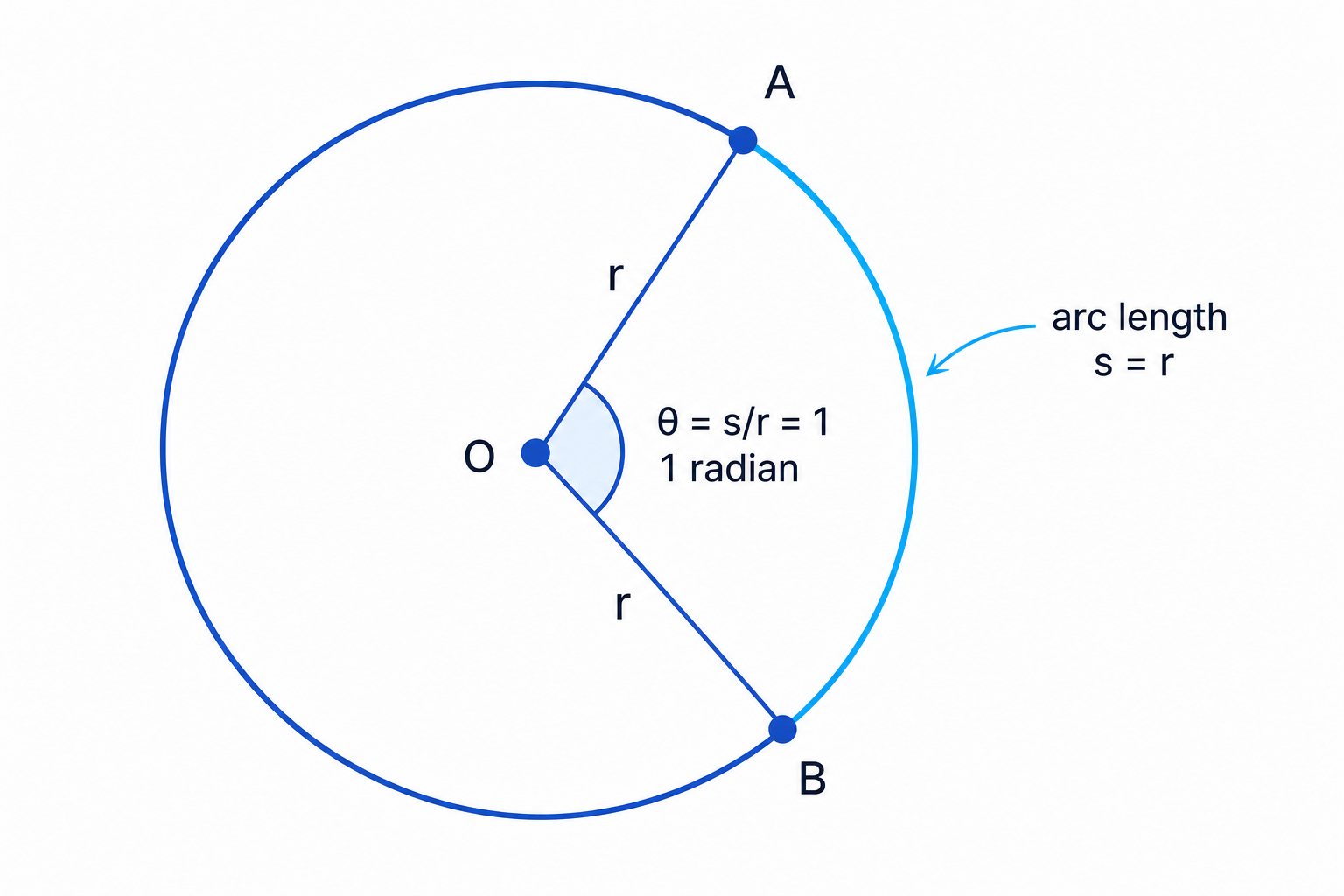
Definition
Radian and central angle
- A central angle is an angle whose vertex is at the centre of a circle.
- One radian is the central angle made when the arc length is equal to the radius.
- If the arc length is sss, the radius is rrr, and the angle is θ\thetaθ radians, then θ=sr\theta=\frac{s}{r}θ=rs.
A full turn has circumference 2πr2\pi r2πr, so the angle in a full turn is:
2πrr=2π\frac{2\pi r}{r}=2\pir2πr=2πSo:
360∘=2π radians,180∘=π radians360^\circ=2\pi \text{ radians}, \qquad 180^\circ=\pi \text{ radians}360∘=2π radians,180∘=π radiansTo convert:
- degrees to radians: multiply by π180\frac{\pi}{180}180π
- radians to degrees: multiply by 180π\frac{180}{\pi}π180
Example
Converting an angle before using it
-
Suppose an angle is 40°. Convert it to radians by multiplying by π180\frac{\pi}{180}180π:
40π180=2π9\frac{40\pi}{180}=\frac{2\pi}{9}18040π=92π -
So the radian angle is 2π9\frac{2\pi}{9}92π.
-
If a formula needs radians, use θ=2π9\theta=\frac{2\pi}{9}θ=92π, not 40.
Common Mistake
Leaving degrees in a radian formula
Formulae like s=rθs=r\thetas=rθ and A=12r2θA=\frac12 r^2\thetaA=21r2θ only work directly when θ\thetaθ is in radians. If the question gives degrees, convert first.
2. Arc length and sector area
A circle sector is like a slice of pizza: it is bounded by two radii and an arc.
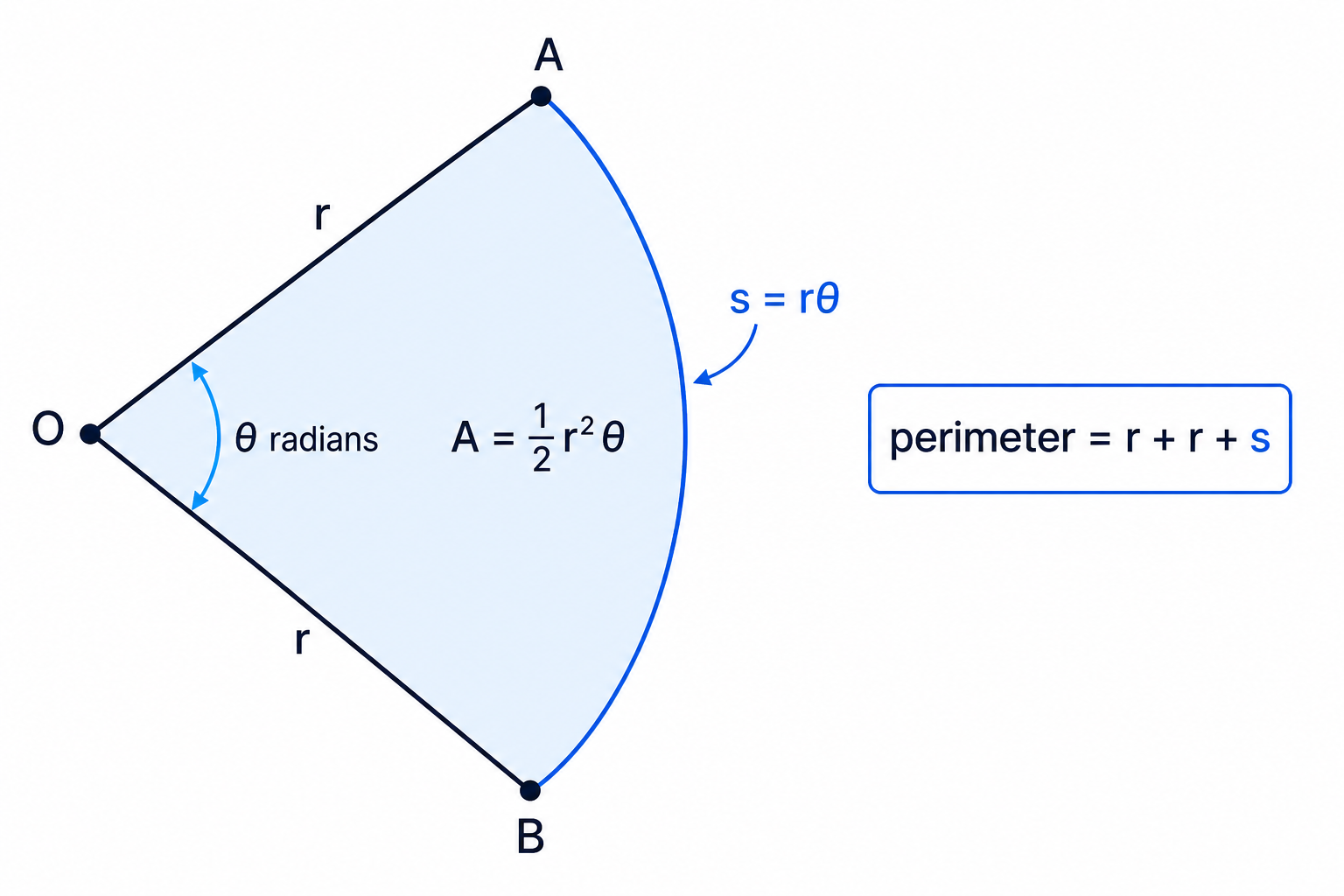
Definition
Sector and arc
- A sector is the region enclosed by two radii and the arc between them.
- An arc is part of the circumference of a circle.
For a sector with radius rrr and angle θ\thetaθ radians:
s=rθs=r\thetas=rθwhere sss is the arc length.
The area of the sector is:
A=12r2θA=\frac12 r^2\thetaA=21r2θThe perimeter of a sector is:
2r+s2r+s2r+sbecause it includes two radii and one arc.
Key Idea
Why radians are useful
When angles are in radians, arc length and sector area become simple: s=rθs=r\thetas=rθ and A=12r2θA=\frac12r^2\thetaA=21r2θ.
Example
Arc length and sector area
-
A sector has radius 9 cm and angle 1.2 radians. Use s=rθs=r\thetas=rθ for the arc length:
s=9⋅1.2=10.8s=9\cdot 1.2=10.8s=9⋅1.2=10.8 -
The arc length is 10.8 cm.
-
Use A=12r2θA=\frac12r^2\thetaA=21r2θ for the sector area:
A=12(9)2(1.2)=48.6A=\frac12(9)^2(1.2)=48.6A=21(9)2(1.2)=48.6 -
The sector area is 48.6 cm².
Example
Sector perimeter when the angle is hidden
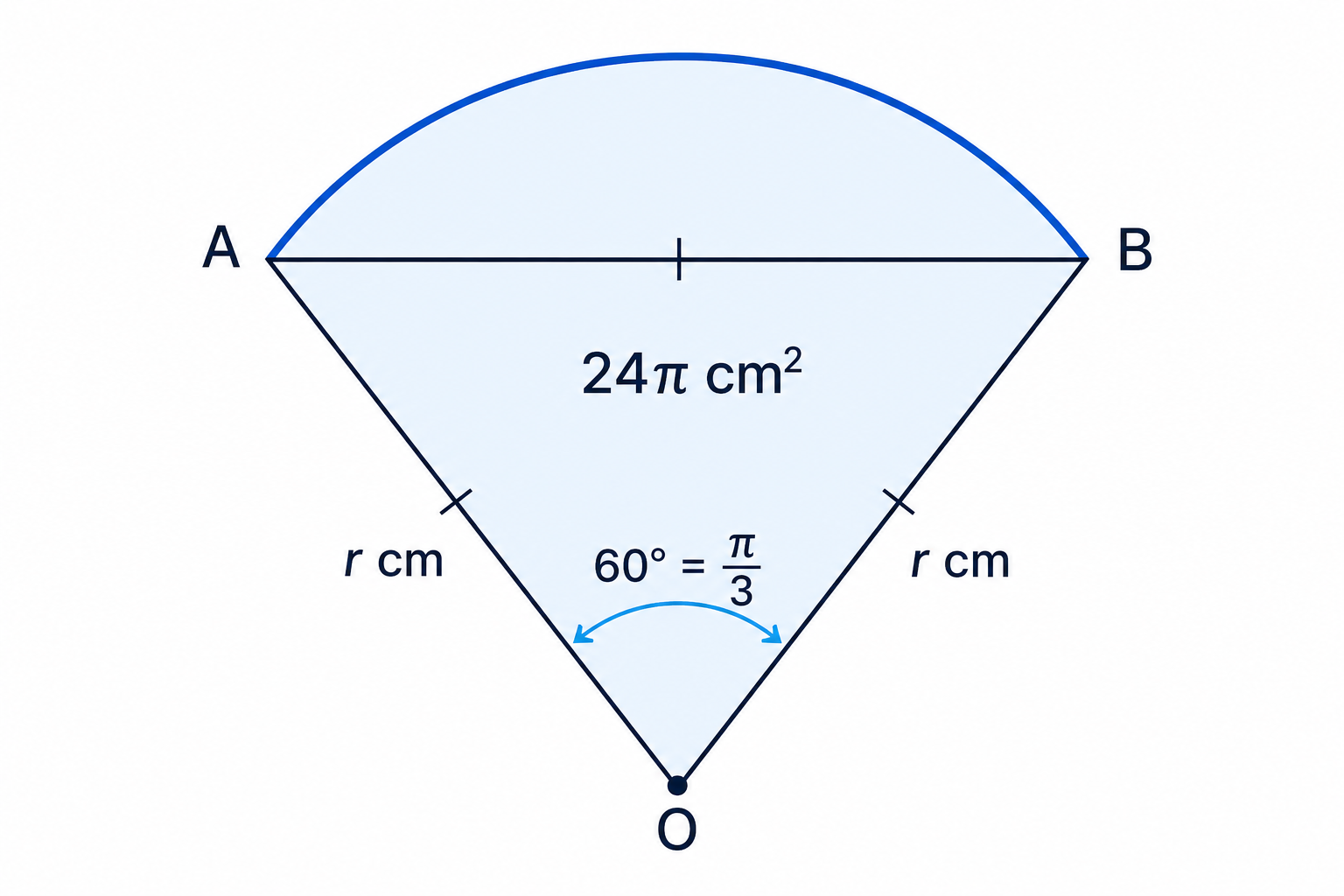
- A sector has centre OOO, and triangle AOBAOBAOB is equilateral. Therefore the central angle is 60°, so:
$$
\theta=\frac{\pi}{3}
$$
2. If the sector area is 24π24\pi24π cm², use A=12r2θA=\frac12r^2\thetaA=21r2θ:
$$
24\pi=\frac12r^2\cdot\frac{\pi}{3}
$$
3. Solve for rrr:
$$
24\pi=\frac{\pi r^2}{6}\Rightarrow r^2=144\Rightarrow r=12
$$
4. Find the arc length:
$$
s=r\theta=12\cdot\frac{\pi}{3}=4\pi
$$
5. Add two radii and the arc to get the perimeter:
$$
12+12+4\pi=24+4\pi
$$
3. Chords and circular segments
Definition
Chord and minor segment
- A chord is a straight line joining two points on the circumference of a circle.
- A minor segment is the smaller region between a chord and the arc it cuts off.
For segment problems, split the diagram into:
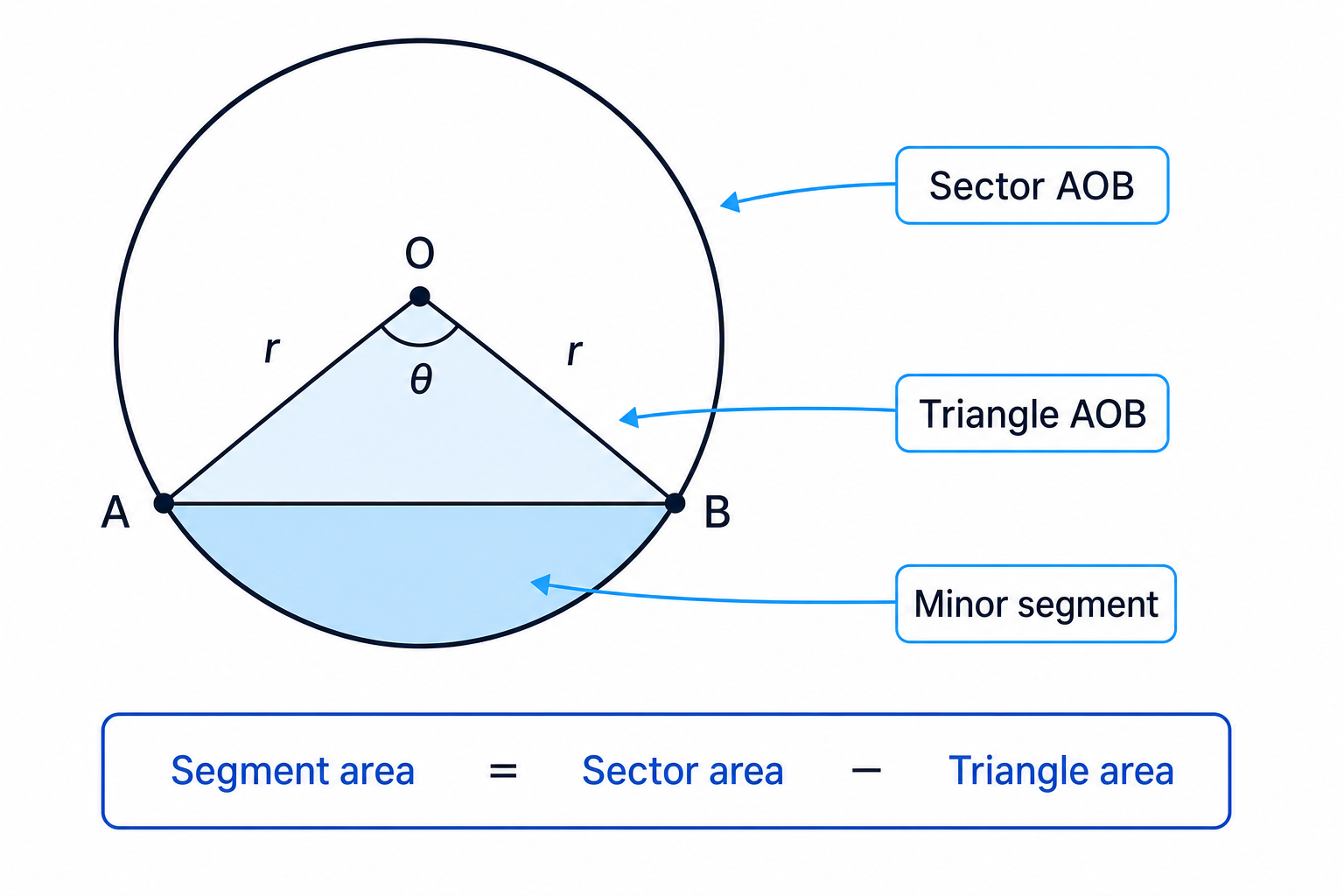
- a sector
- an isosceles triangle formed by the two radii and the chord
The area of the minor segment is:
sector area−triangle area\text{sector area}-\text{triangle area}sector area−triangle areaIf the central angle is θ\thetaθ, then the triangle area is:
12r2sinθ\frac12r^2\sin\theta21r2sinθSo the minor segment area is:
12r2(θ−sinθ)\frac12r^2(\theta-\sin\theta)21r2(θ−sinθ)Example
Finding an angle from a chord, then a segment area
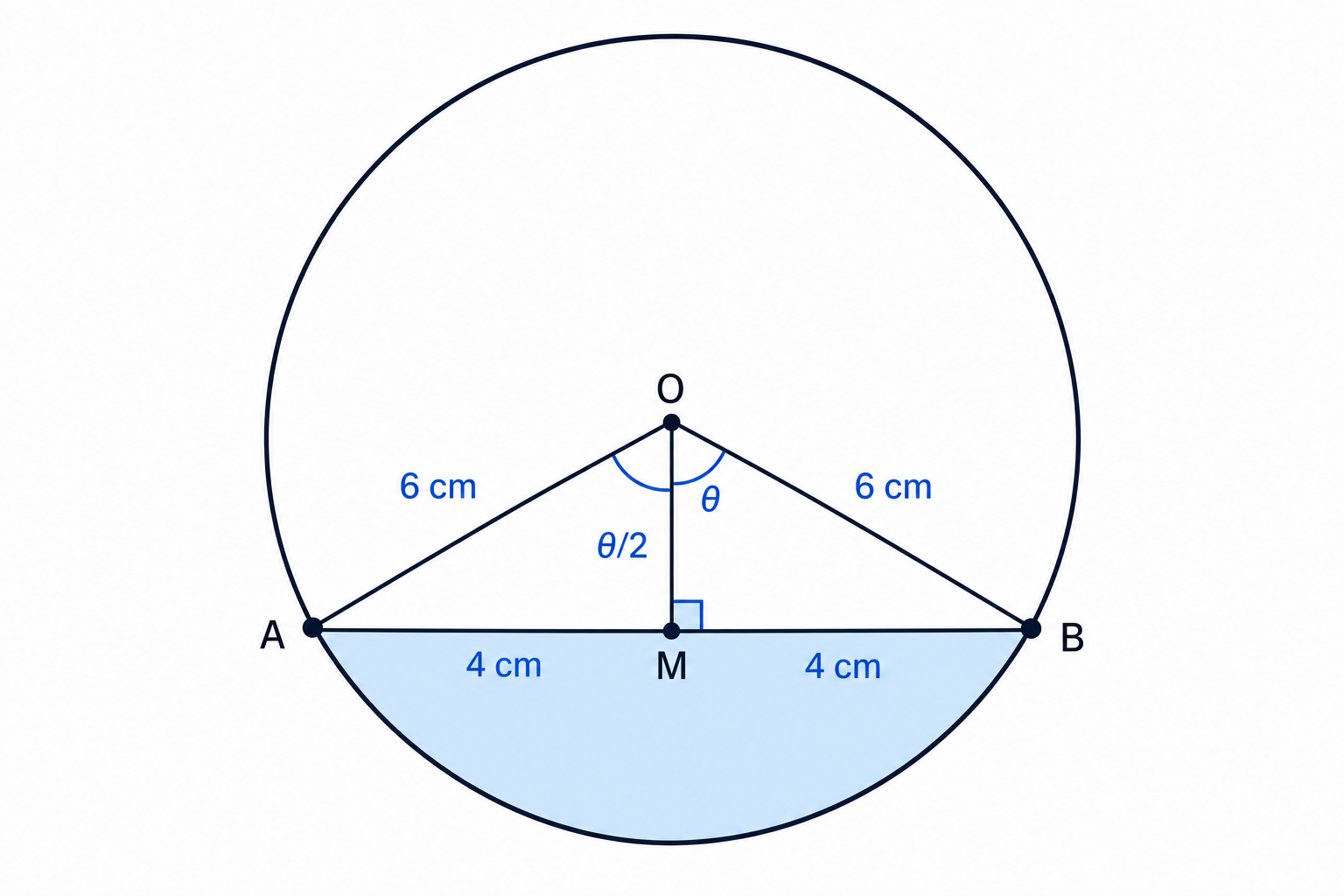
- A circle has radius 6 cm and chord length 8 cm. Split the isosceles triangle in half. Half the chord is 4 cm, so:
$$
\sin\left(\frac{\theta}{2}\right)=\frac{4}{6}=\frac23
$$
2. Find the central angle:
$$
\theta=2\arcsin\left(\frac23\right)=1.459\text{ to 3 d.p.}
$$
3. Find the sector area using the unrounded angle:
$$
A_{\text{sector}}=\frac12(6)^2\theta=26.3
$$
4. Find the minor segment area using Asegment=12r2(θ−sinθ)A_{\text{segment}}=\frac12r^2(\theta-\sin\theta)Asegment=21r2(θ−sinθ):
$$
A_{\text{segment}}=\frac12(6)^2(\theta-\sin\theta)=8.38
$$
5. The shaded minor segment area is about 8.38 cm².
Tip
Coordinate geometry link
If a circle is given by an equation, complete the square first to find its centre and radius. Then use distances, angles, and sector formulae.
4. Small angle approximations
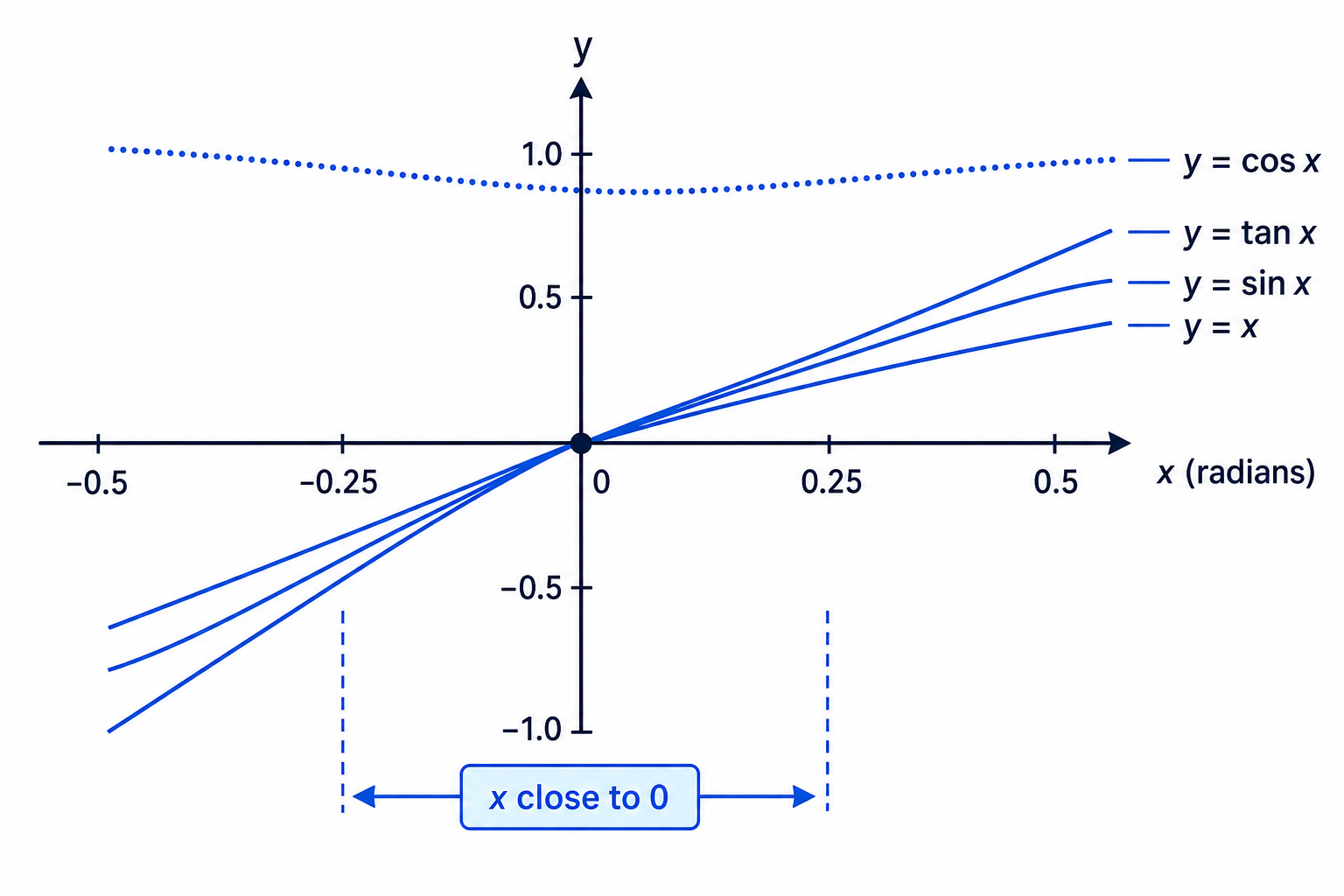
For very small angles, trig functions can be approximated by simpler expressions.
Definition
Small angle approximations
For an angle xxx close to 0, measured in radians:
sinx≈x,tanx≈x,cosx≈1−x22\sin x\approx x,\qquad \tan x\approx x,\qquad \cos x\approx 1-\frac{x^2}{2}sinx≈x,tanx≈x,cosx≈1−2x2These are especially useful when you are asked to “show that” a complicated expression can be approximated by a simpler algebraic expression.
Common Mistake
Radians only
Small angle approximations only work when the angle is measured in radians. For example, convert 3° to π60\frac{\pi}{60}60π radians before using them.
Example
Approximating a trig fraction and finding percentage error
-
Use cosθ≈1−θ22\cos\theta\approx1-\frac{\theta^2}{2}cosθ≈1−2θ2 and sinθ≈θ\sin\theta\approx\thetasinθ≈θ:
cosθsinθ≈1−θ22θ\frac{\cos\theta}{\sin\theta}\approx\frac{1-\frac{\theta^2}{2}}{\theta}sinθcosθ≈θ1−2θ2 -
Simplify the expression:
1−θ22θ=2−θ22θ\frac{1-\frac{\theta^2}{2}}{\theta}=\frac{2-\theta^2}{2\theta}θ1−2θ2=2θ2−θ2 -
For θ=π24\theta=\frac{\pi}{24}θ=24π, the approximation is:
2−(π24)22(π24)=7.57399\frac{2-\left(\frac{\pi}{24}\right)^2}{2\left(\frac{\pi}{24}\right)}=7.573992(24π)2−(24π)2=7.57399 -
Using a calculator, the true value is about 7.59575, so the percentage error is:
∣7.57399−7.59575∣7.59575×100=0.287%\frac{\left|7.57399-7.59575\right|}{7.59575}\times100=0.287\%7.59575∣7.57399−7.59575∣×100=0.287%
5. Multiplying and solving with approximations
When you substitute small angle approximations, keep your algebra tidy. Expand brackets carefully, especially if powers like x2x^2x2 or x3x^3x3 appear.
Example
Approximating a product
-
For small xxx, approximate each factor:
tan(3x)≈3x,cos(2x)≈1−(2x)22=1−2x2\tan(3x)\approx3x,\qquad \cos(2x)\approx1-\frac{(2x)^2}{2}=1-2x^2tan(3x)≈3x,cos(2x)≈1−2(2x)2=1−2x2 -
Multiply the approximations:
tan(3x)cos(2x)≈3x(1−2x2)=3x−6x3\tan(3x)\cos(2x)\approx3x(1-2x^2)=3x-6x^3tan(3x)cos(2x)≈3x(1−2x2)=3x−6x3 -
To approximate tan(0.3)cos(0.2)\tan(0.3)\cos(0.2)tan(0.3)cos(0.2), notice that 3x=0.33x=0.33x=0.3, so x=0.1x=0.1x=0.1:
3(0.1)−6(0.1)3=0.2943(0.1)-6(0.1)^3=0.2943(0.1)−6(0.1)3=0.294
Example
Solving an approximate equation
-
Approximate the left-hand side; the θ2\theta^2θ2 terms cancel:
2cosθ+(sinθ+1)2≈2(1−θ22)+(θ+1)2=2−θ2+θ2+2θ+1=3+2θ\begin{aligned} 2\cos\theta+(\sin\theta+1)^2 &\approx 2\left(1-\frac{\theta^2}{2}\right)+(\theta+1)^2\\ &=2-\theta^2+\theta^2+2\theta+1\\ &=3+2\theta \end{aligned}2cosθ+(sinθ+1)2≈2(1−2θ2)+(θ+1)2=2−θ2+θ2+2θ+1=3+2θ -
Approximate the right-hand side:
20tanθ≈20θ20\tan\theta\approx20\theta20tanθ≈20θ -
Solve the resulting linear equation:
3+2θ=20θ⇒18θ=3⇒θ=16=0.1673+2\theta=20\theta\Rightarrow 18\theta=3\Rightarrow \theta=\frac16=0.1673+2θ=20θ⇒18θ=3⇒θ=61=0.167
Key Idea
When it becomes a straight line
If a small angle approximation leaves only a constant term and an xxx term, the graph is approximately a straight line of the form y=mx+cy=mx+cy=mx+c.
Exam technique
In the exam
- Check whether the angle is in degrees or radians before using any formula.
- For sectors and segments, label the radius, angle, arc, chord, and triangle clearly.
- In small angle questions, substitute the approximations first, then simplify algebraically.
- For percentage error, use ∣approximation−true value∣∣true value∣×100\frac{|\text{approximation}-\text{true value}|}{|\text{true value}|}\times100∣true value∣∣approximation−true value∣×100.
Self review
Check yourself
- Why must θ\thetaθ be in radians when using s=rθs=r\thetas=rθ?
- How do you find the area of a minor segment from a sector and a triangle?
- Which small angle approximation would you use for cos(2x)\cos(2x)cos(2x)?

Recap questions
Test yourself with 5 quick questions on this guide. Answer them all correctly to complete it.
You've reached the end
Test yourself on this topic, or move on to the next guide.
How was this guide?