Numerical Methods
123456789101112131415161718192021222324252627282930313233343536373839404142434445464748495051525354555657585960616263646566676869707172737475767778798081828384858687888990919293949596979899100101102103104105106107108109110111112113114115116117118119120121122123124125126127128129130131132133134135136137138139140141142143144145146147148149150151152153154155156157158159160161162163164165166167168169170171172173174175176177178179180181182183184185186187188189190191192193194195196197198199200201202203204205206207208209210211212213214215216217218219220221222223
Question 164
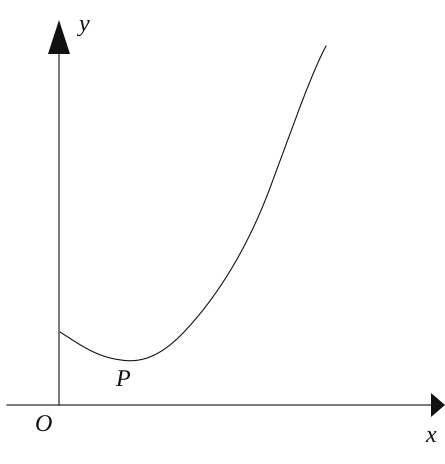
The diagram shows a sketch of the curve C C\,C with equation y=2x32−kx+ex+4\displaystyle y = 2x^{\frac{3}{2}} - k\sqrt{x} + e^x + 4y=2x23−kx+ex+4, where 4≤k≤54 \leq k \leq 54≤k≤5
a.[3]
Show that dydx=3x+ex−k2x\displaystyle \frac{dy}{dx} = 3\sqrt{x} + e^x - \frac{k}{2\sqrt{x}}dxdy=3x+ex−2xk
b.[2]
The point P P\,P is the minimum turning point on CCC. Show that the x x\,x coordinate of P P\,P is a solution of
x=k−2xex6 x = \frac{k - 2\sqrt{x}e^x}{6} x=6k−2xexc.[4]
Use the iteration formula xn+1=k−2xnexn6\displaystyle x_{n+1} = \frac{k - 2\sqrt{x_n}e^{x_n}}{6}xn+1=6k−2xnexn with x1=0.5x_1 = 0.5x1=0.5 to find (i) the value of x2 x_2\,x2 in terms of kkk, (ii) when k=5k = 5k=5, the x x\,x coordinate of P P\,P to 5 decimal places.
Numerical Methods Questions
329 exam-style questions on Edexcel A Level Maths Numerical Methods, covering 10.1 Locating Roots, 10.2 Iteration, 10.3 The Newton-Raphson Method, and 10.4 Applications to Modelling. Each one has a worked solution and a mark scheme showing where the marks go.