Revision notes for Edexcel A Level Maths Forces and Friction. Open each subtopic for explanations, worked examples, and summaries of Resolving Forces, Inclined Planes, and Friction. Written against the Edexcel A Level Maths (9MA0) specification, so the content matches what's examinable rather than general Maths background.
Forces and Friction
What you'll learn
- How to draw and use a force diagram for a particle in equilibrium.
- How to resolve forces horizontally/vertically or parallel/perpendicular to a plane.
- How friction works, including limiting friction and the coefficient of friction.
- How to decide whether an object accelerates, stays still, or is about to slip.
The core idea: forces and modelling
A force is a push or pull, measured in newtons, N. In this topic, you usually model objects as particles, meaning all forces act through one point and you do not worry about rotation.
Definition
Particle model
A particle is a model of an object where its size and shape are ignored. This lets you draw all forces acting at a single point.
Common forces you will meet:
- Weight: the gravitational force acting vertically downwards. For mass mmm, weight is mgmgmg, where g=9.8g = 9.8g=9.8.
- Tension: the pulling force in a light string, acting along the string away from the particle.
- Normal reaction: the contact force from a surface, acting perpendicular to the surface.
- Friction: a contact force that opposes actual or possible sliding.
Key Idea
Start with a force diagram
Almost every question in this topic becomes easier once you draw all forces and choose sensible directions to resolve them.
Equilibrium and resolving forces
An object is in equilibrium when its acceleration is zero. So the resultant force is zero in every direction.
Definition
Equilibrium
A particle is in equilibrium if the resultant force on it is zero. At A-Level, this usually means resolving forces in two perpendicular directions and setting both totals equal.
When a force acts at an angle, split it into components. If a force FFF makes angle θ\thetaθ with the horizontal:
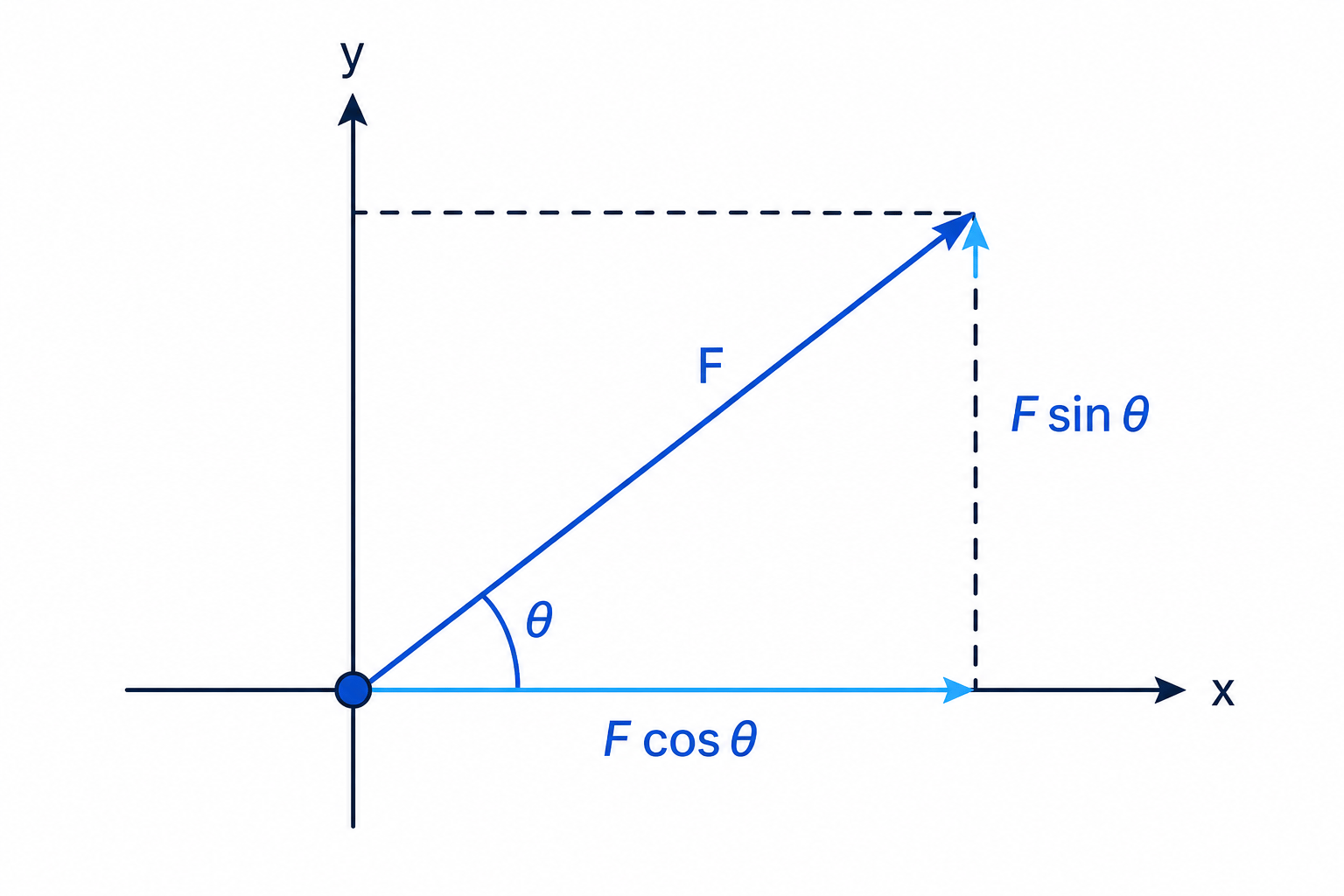
- horizontal component: FcosθF\cos\thetaFcosθ
- vertical component: FsinθF\sin\thetaFsinθ
If the angle is measured from the vertical, swap the roles.
Common Mistake
Using the wrong component
If the angle is with the vertical, the vertical component is usually the cosine part, not the sine part. Sketch a right-angled triangle if unsure.
Example
A particle held by a sloping string
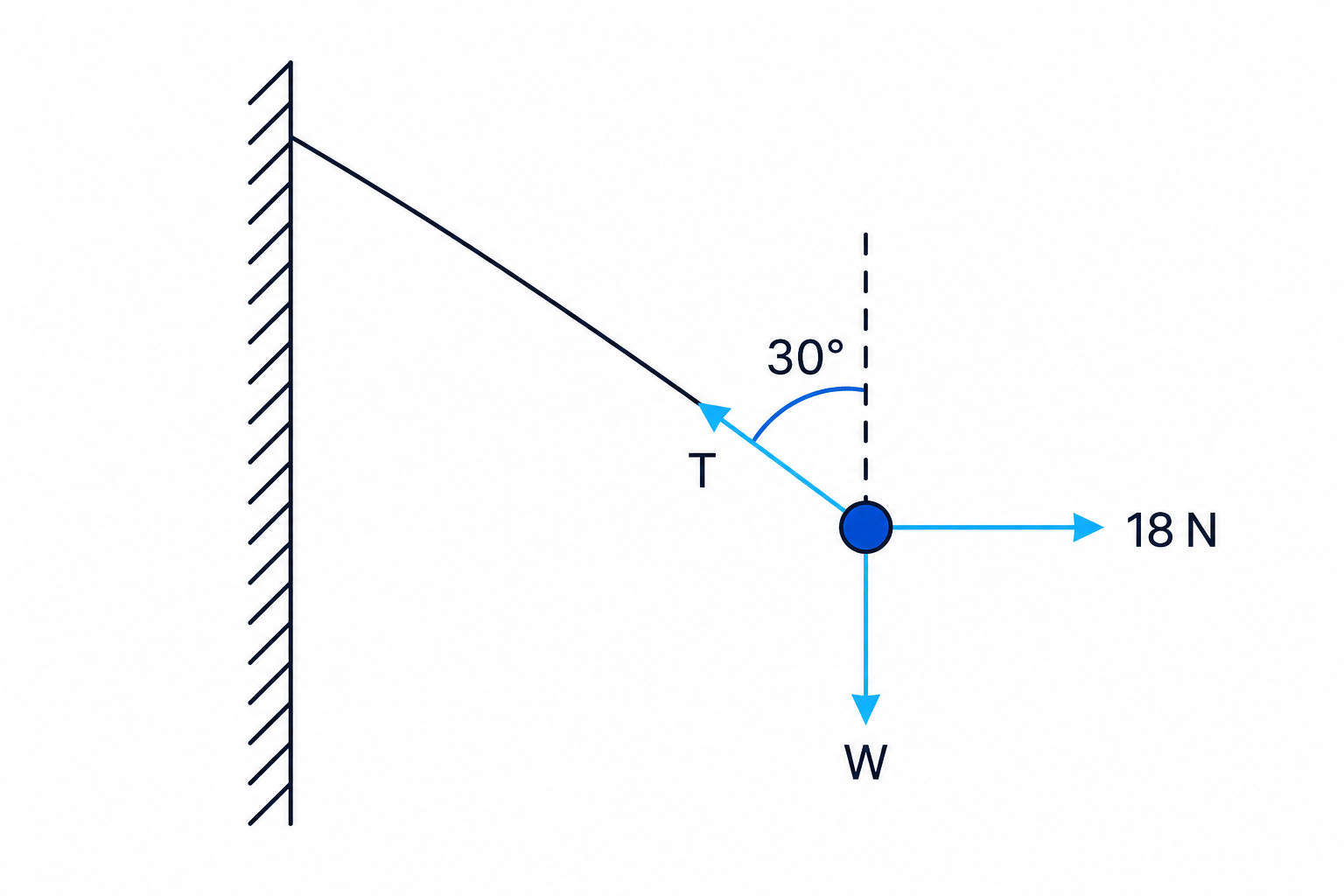
A particle is attached to a wall by a light string. A horizontal force of 18 N pulls it away from the wall. The string is taut and makes an angle of 30∘30^\circ30∘ with the vertical. Find the tension and the weight of the particle.
-
Draw the forces on the particle: tension TTT along the string, weight WWW vertically downwards, and the 18 N force horizontally away from the wall.
-
Resolve horizontally. The horizontal component of tension balances the 18 N force:
Tsin30∘=18T\sin 30^\circ = 18Tsin30∘=18 -
Solve for the tension:
T=18sin30∘=36T = \frac{18}{\sin 30^\circ} = 36T=sin30∘18=36 -
Resolve vertically. The vertical component of tension balances the weight:
W=Tcos30∘W = T\cos 30^\circW=Tcos30∘ -
Substitute T=36T = 36T=36:
W=36cos30∘≈31.2W = 36\cos 30^\circ \approx 31.2W=36cos30∘≈31.2 -
The tension is 36 N and the weight is approximately 31.2 N.
Two strings supporting a particle
When two strings support a mass, each string has its own tension. You normally get two simultaneous equations by resolving horizontally and vertically.
If a particle of mass mmm is at rest, its weight is mgmgmg acting downwards.
Example
Two angled strings in equilibrium
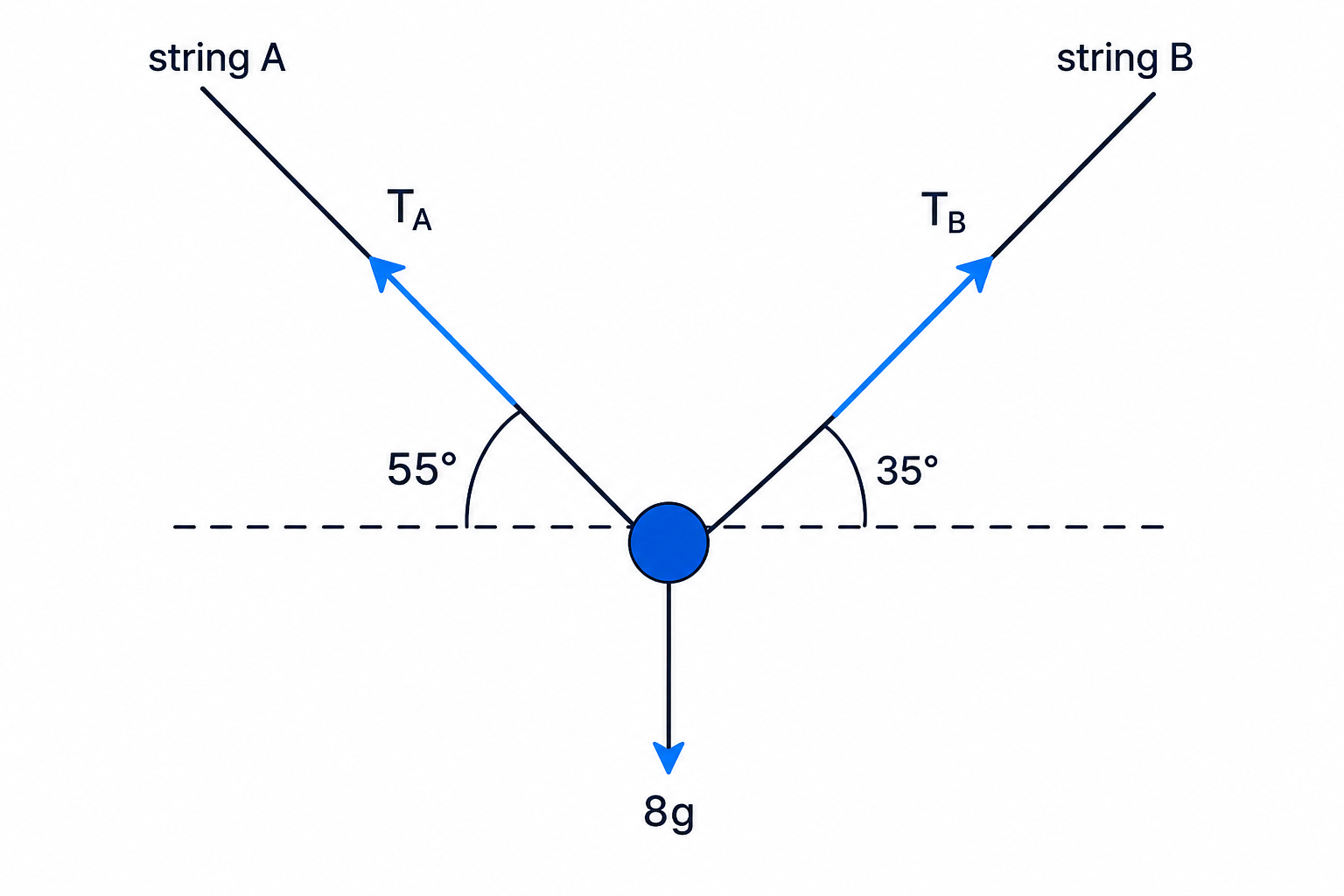
A particle of mass 8 kg is held by two light strings. String A makes an angle of 55∘55^\circ55∘ to the horizontal on the left, and string B makes an angle of 35∘35^\circ35∘ to the horizontal on the right. Find the two tensions.
-
Let the tension in string A be TAT_ATA and the tension in string B be TBT_BTB.
-
Resolve horizontally. The horizontal components balance:
TAcos55∘=TBcos35∘T_A\cos 55^\circ = T_B\cos 35^\circTAcos55∘=TBcos35∘ -
Resolve vertically. The upward components balance the weight:
TAsin55∘+TBsin35∘=8gT_A\sin 55^\circ + T_B\sin 35^\circ = 8gTAsin55∘+TBsin35∘=8g -
From the horizontal equation, write TBT_BTB in terms of TAT_ATA:
TB=TAcos55∘cos35∘T_B = \frac{T_A\cos 55^\circ}{\cos 35^\circ}TB=cos35∘TAcos55∘ -
Substitute this into the vertical equation:
TAsin55∘+TAcos55∘cos35∘sin35∘=78.4T_A\sin 55^\circ + \frac{T_A\cos 55^\circ}{\cos 35^\circ}\sin 35^\circ = 78.4TAsin55∘+cos35∘TAcos55∘sin35∘=78.4 -
Solve:
TA≈63.9T_A \approx 63.9TA≈63.9 -
Use the horizontal equation to find TBT_BTB:
TB=63.9cos55∘cos35∘≈44.7T_B = \frac{63.9\cos 55^\circ}{\cos 35^\circ} \approx 44.7TB=cos35∘63.9cos55∘≈44.7 -
So the tensions are approximately 63.9 N and 44.7 N.
Friction and the coefficient of friction
Friction acts parallel to the surface and opposes motion or the tendency to move.
Definition
Coefficient of friction
The coefficient of friction, usually μ\muμ, measures how rough two surfaces are. The maximum possible friction is μR\mu RμR, where RRR is the normal reaction.
If an object is just about to slip, it is in limiting equilibrium and the friction has its maximum value:
Ffriction=μRF_{\text{friction}} = \mu RFfriction=μRIf the object is not on the point of slipping, then friction may be less than μR\mu RμR.
Common Mistake
Only use at the limit
You may only set friction equal to μR\mu RμR when the object is moving, or is on the point of moving. If it is just resting normally, friction adjusts as needed up to its maximum.
Example
Block pulled along a rough horizontal floor
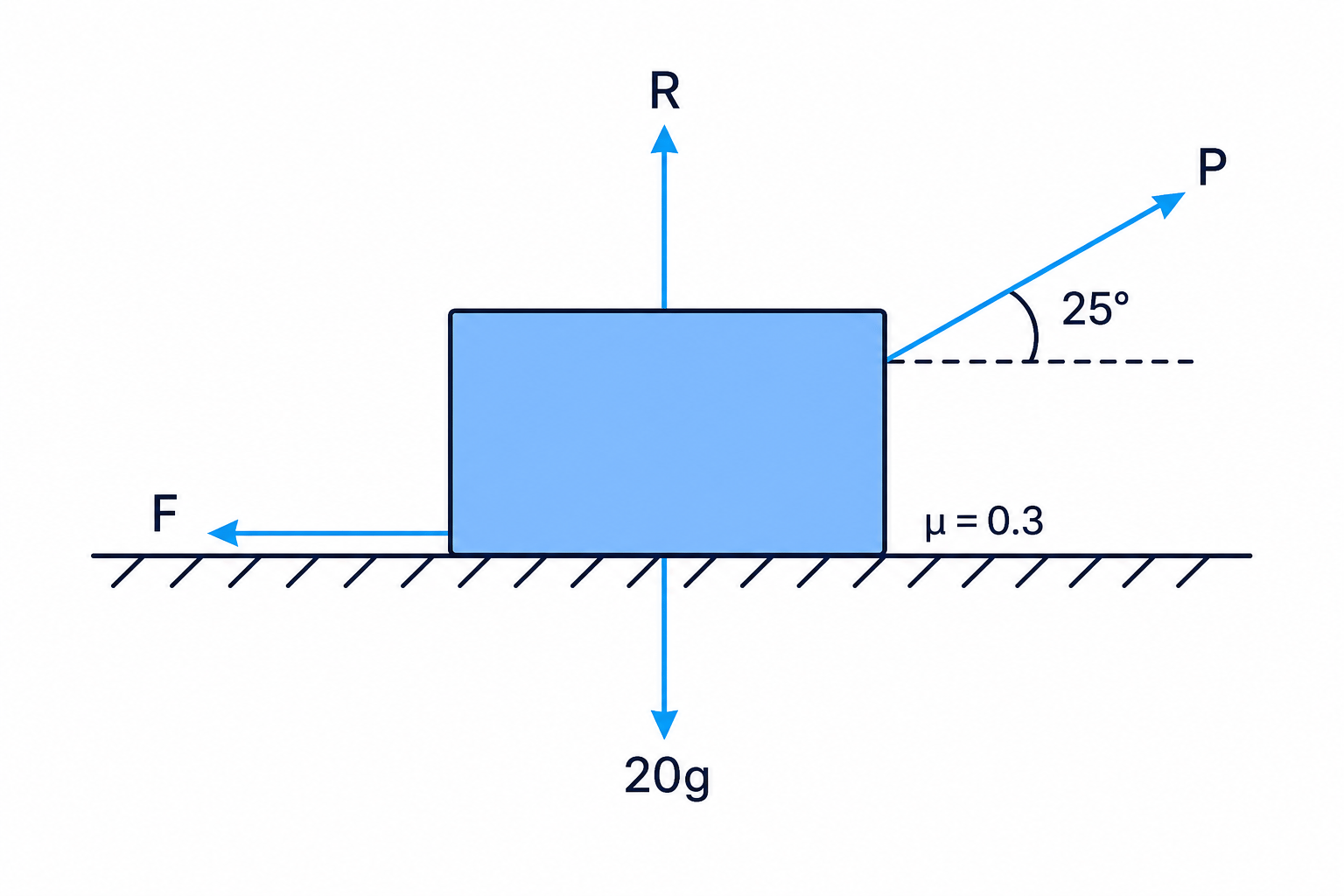
A 20 kg block rests on a rough horizontal floor. The coefficient of friction is 0.3. A force PPP pulls the block at 25∘25^\circ25∘ above the horizontal. The block is on the point of sliding. Find PPP.
-
Draw the forces: weight 20g20g20g downwards, normal reaction RRR upwards, pull PPP at 25∘25^\circ25∘, and friction acting backwards.
-
Since the block is on the point of sliding, friction is limiting:
F=μR=0.3RF = \mu R = 0.3RF=μR=0.3R -
Resolve vertically. The upward forces balance the downward forces:
R+Psin25∘=20gR + P\sin 25^\circ = 20gR+Psin25∘=20g -
Rearrange for RRR:
R=196−Psin25∘R = 196 - P\sin 25^\circR=196−Psin25∘ -
Resolve horizontally. The pulling component balances friction:
Pcos25∘=0.3RP\cos 25^\circ = 0.3RPcos25∘=0.3R -
Substitute for RRR:
Pcos25∘=0.3(196−Psin25∘)P\cos 25^\circ = 0.3(196 - P\sin 25^\circ)Pcos25∘=0.3(196−Psin25∘) -
Solve:
P(cos25∘+0.3sin25∘)=58.8P(\cos 25^\circ + 0.3\sin 25^\circ) = 58.8P(cos25∘+0.3sin25∘)=58.8 -
Hence:
P≈56.9P \approx 56.9P≈56.9 -
The required pulling force is approximately 56.9 N.
Tip
Pulling versus pushing
A pull angled upwards reduces the normal reaction, so friction decreases. A push angled downwards increases the normal reaction, so friction increases.
Inclined planes
For a block on a slope, choose axes:
- parallel to the plane
- perpendicular to the plane
If the plane is inclined at angle θ\thetaθ to the horizontal, the weight mgmgmg has components:
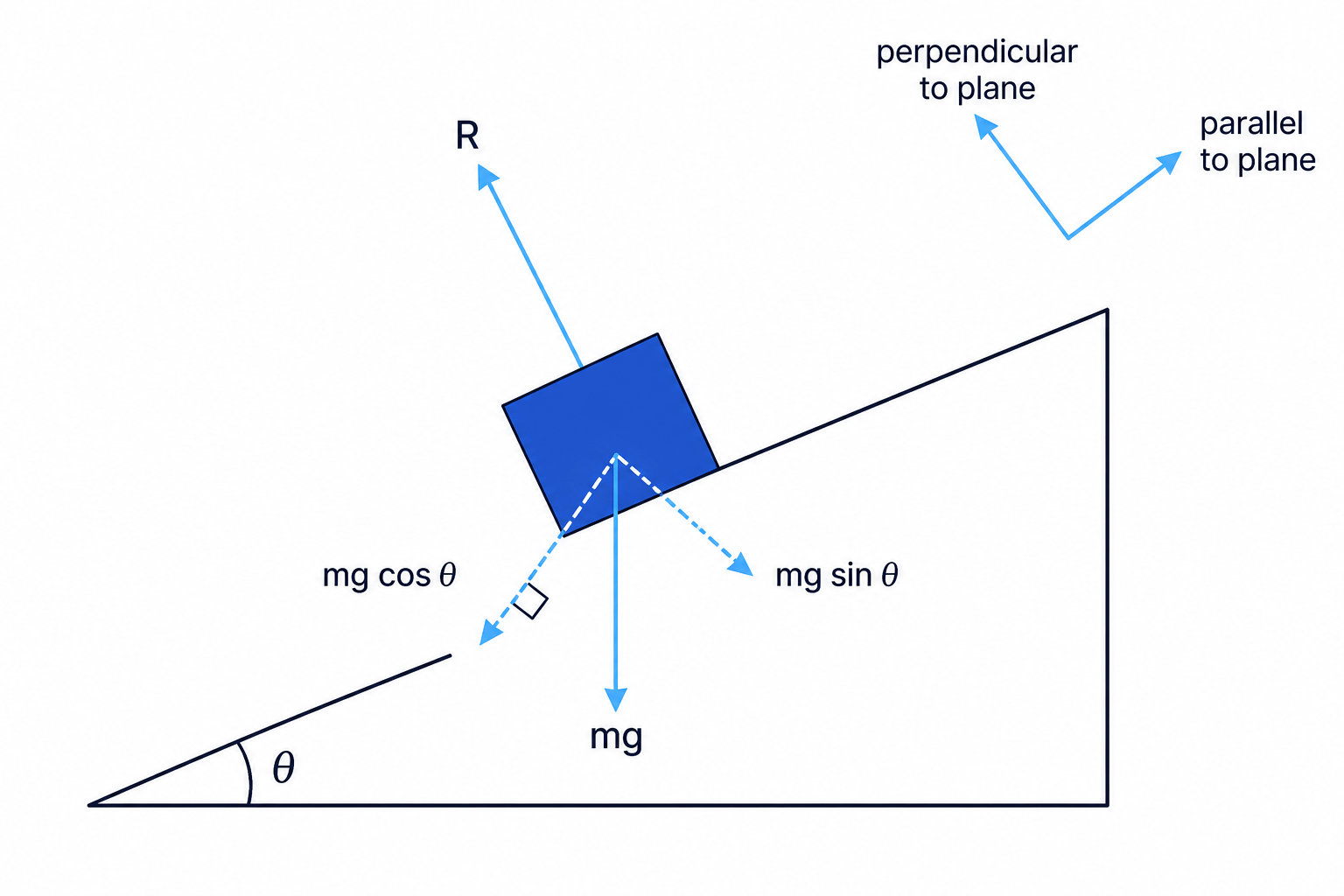
- down the plane: mgsinθmg\sin\thetamgsinθ
- into the plane: mgcosθmg\cos\thetamgcosθ
Key Idea
Resolve along the slope
On an inclined plane, do not resolve horizontally and vertically unless you have a special reason. Parallel and perpendicular to the plane are usually much cleaner.
Example
Finding the coefficient of friction on a slope
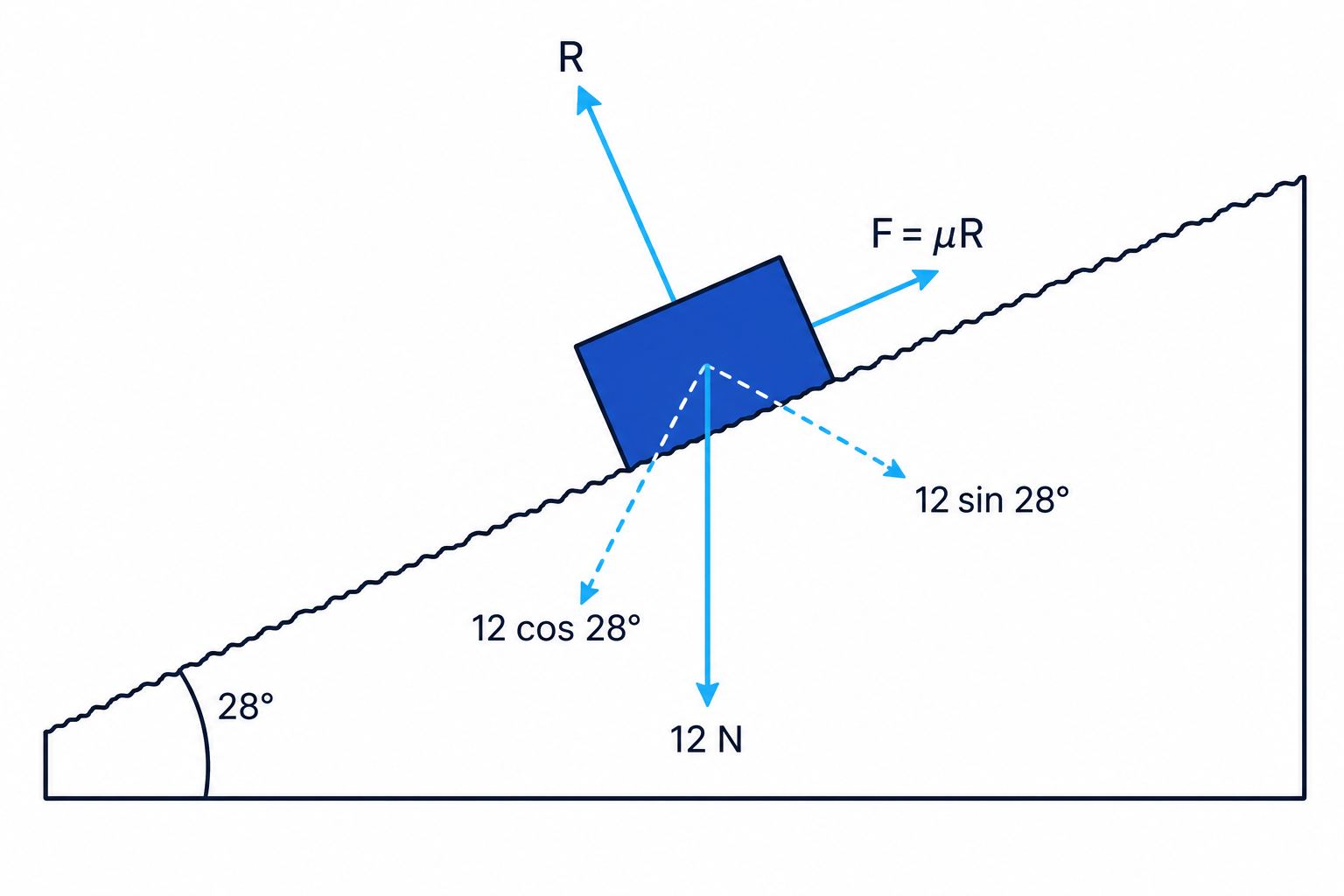
A block of weight 12 N rests on a rough plane inclined at 28∘28^\circ28∘ to the horizontal. It is on the point of sliding down the plane. Find μ\muμ.
-
The component of weight down the plane is 12sin28∘12\sin 28^\circ12sin28∘.
-
The normal reaction is found perpendicular to the plane:
R=12cos28∘R = 12\cos 28^\circR=12cos28∘ -
Since the block is about to slide down, friction acts up the plane and is limiting:
F=μRF = \mu RF=μR -
Resolve parallel to the plane. Friction balances the down-slope component of weight:
μR=12sin28∘\mu R = 12\sin 28^\circμR=12sin28∘ -
Substitute R=12cos28∘R = 12\cos 28^\circR=12cos28∘:
μ(12cos28∘)=12sin28∘\mu(12\cos 28^\circ) = 12\sin 28^\circμ(12cos28∘)=12sin28∘ -
Cancel 12 and solve:
μ=tan28∘≈0.532\mu = \tan 28^\circ \approx 0.532μ=tan28∘≈0.532 -
The coefficient of friction is approximately 0.532.
Motion on a rough inclined plane
If the block is moving, use Newton’s second law:
Fresultant=maF_{\text{resultant}} = maFresultant=maThe friction force still acts against the motion. If the block slides down the plane, friction acts up the plane.
Example
Acceleration down a rough slope
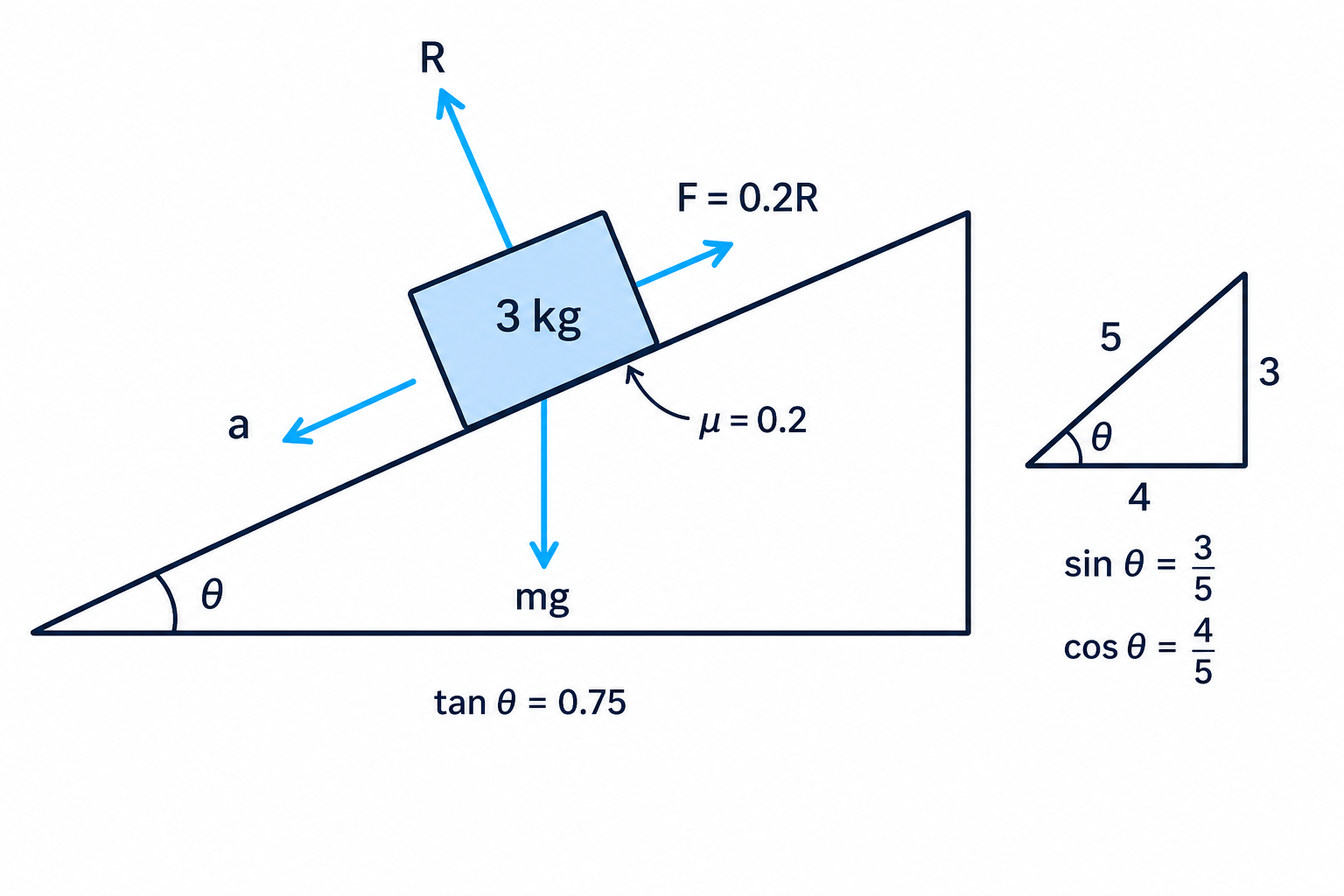
A 3 kg block is released from rest on a rough plane. The plane is inclined at angle θ\thetaθ where tanθ=0.75\tan\theta = 0.75tanθ=0.75. The coefficient of friction is 0.2. Find the acceleration.
-
Use tanθ=0.75=34\tan\theta = 0.75 = \frac{3}{4}tanθ=0.75=43. This suggests a 3-4-5 triangle, so:
sinθ=35,cosθ=45\sin\theta = \frac{3}{5}, \qquad \cos\theta = \frac{4}{5}sinθ=53,cosθ=54 -
Resolve perpendicular to the plane:
R=mgcosθR = mg\cos\thetaR=mgcosθ -
Friction acts up the plane because the block moves down the plane:
F=μR=0.2mgcosθF = \mu R = 0.2mg\cos\thetaF=μR=0.2mgcosθ -
Apply Newton’s second law down the plane:
mgsinθ−0.2mgcosθ=mamg\sin\theta - 0.2mg\cos\theta = mamgsinθ−0.2mgcosθ=ma -
Cancel mmm:
a=g(sinθ−0.2cosθ)a = g(\sin\theta - 0.2\cos\theta)a=g(sinθ−0.2cosθ) -
Substitute the exact trig values:
a=9.8(35−0.2×45)a = 9.8\left(\frac{3}{5} - 0.2 \times \frac{4}{5}\right)a=9.8(53−0.2×54) -
Calculate:
a=4.312a = 4.312a=4.312 -
The acceleration is approximately 4.31 m s−2 down the plane.
Common Mistake
Keeping the mass unnecessarily
In many sliding-block problems, the mass cancels. If two blocks have the same μ\muμ on the same slope, their accelerations are the same, even if their masses differ.
Deciding whether the block moves
Sometimes a force is removed, and you must decide whether the object starts moving. Compare the force trying to make it move with the maximum possible friction.
For a block on a slope with no applied force:
- force down the plane is mgsinθmg\sin\thetamgsinθ
- maximum friction is μmgcosθ\mu mg\cos\thetaμmgcosθ
If mgsinθ>μmgcosθmg\sin\theta > \mu mg\cos\thetamgsinθ>μmgcosθ, it slides down.
If mgsinθ≤μmgcosθmg\sin\theta \le \mu mg\cos\thetamgsinθ≤μmgcosθ, it stays at rest.
Example
After an applied force is removed
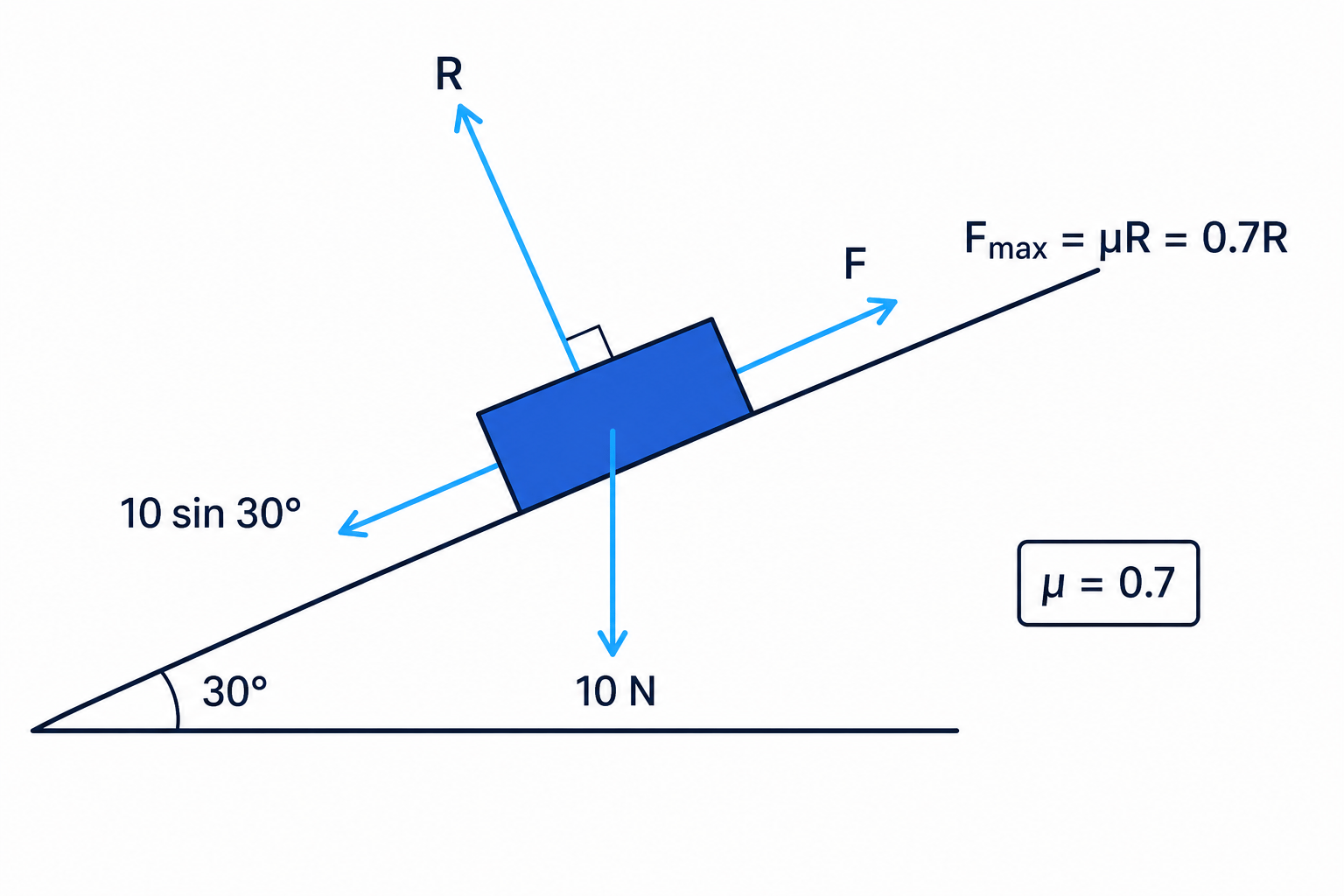
A brick of weight 10 N is on a rough plane at 30∘30^\circ30∘. The coefficient of friction is 0.7. A force that had been holding it is removed. Decide whether the brick moves.
-
The component of weight down the plane is:
10sin30∘=510\sin 30^\circ = 510sin30∘=5 -
The normal reaction is:
R=10cos30∘R = 10\cos 30^\circR=10cos30∘ -
The maximum friction available is:
μR=0.7×10cos30∘≈6.06\mu R = 0.7 \times 10\cos 30^\circ \approx 6.06μR=0.7×10cos30∘≈6.06 -
Compare the two forces: the down-slope component is 5 N, while the maximum friction is about 6.06 N.
-
Since friction can be large enough to prevent sliding, the brick remains at rest.
Exam technique
In the exam
-
Draw a force diagram first, including directions for friction and the normal reaction.
-
Choose axes that match the situation: horizontal/vertical for hanging particles, parallel/perpendicular for inclined planes.
-
Use F=μRF=\mu RF=μR only when the object is moving or in limiting equilibrium.
-
If asked to “determine whether it moves”, compare the driving force with the maximum possible friction.
Self review
Check yourself
-
If a force pulls a block upwards at an angle, what happens to the normal reaction?
-
On a slope, what are the two components of weight parallel and perpendicular to the plane?
-
When is it valid to write friction as exactly μR\mu RμR?

Recap questions
Test yourself with 5 quick questions on this guide. Answer them all correctly to complete it.
You've reached the end
Test yourself on this topic, or move on to the next guide.
How was this guide?