Revision notes for Edexcel A Level Maths Moments. Open each subtopic for explanations, worked examples, and summaries of Moments, Resultant Moments, Equilibrium, Centres of Mass, and Tilting. Written against the Edexcel A Level Maths (9MA0) specification, so the content matches what's examinable rather than general Maths background.
Moments
What you'll learn
- How to calculate the turning effect of a force.
- How to use moments to find support reactions.
- What changes when a rod is just about to tilt.
- How to locate the centre of mass of a non-uniform rod.
Prerequisites: forces on rods
Before moments, you need to be comfortable drawing the forces acting on a rod or seesaw. Most questions in this topic are really about drawing a good force diagram, then writing two equations.
Definition
Forces you will meet
- Weight is the downward force due to gravity. For a body of mass mmm, its weight is W=mgW=mgW=mg, where ggg is usually 9.8.
- A normal reaction is the force from a support. For a horizontal rod on supports, reactions usually act vertically upwards.
- Tension is the pulling force in a string or cable.
- A light inextensible string has negligible mass and does not stretch, so it simply provides a tension force along the string.
Definition
Centre of mass
- The centre of mass is the point where the weight of an object may be treated as acting.
- A uniform rod has its mass evenly spread out, so its centre of mass is at its midpoint.
- A non-uniform rod does not have its mass evenly spread out, so its centre of mass may be anywhere along the rod.
Example
Forces on a simple suspended rod
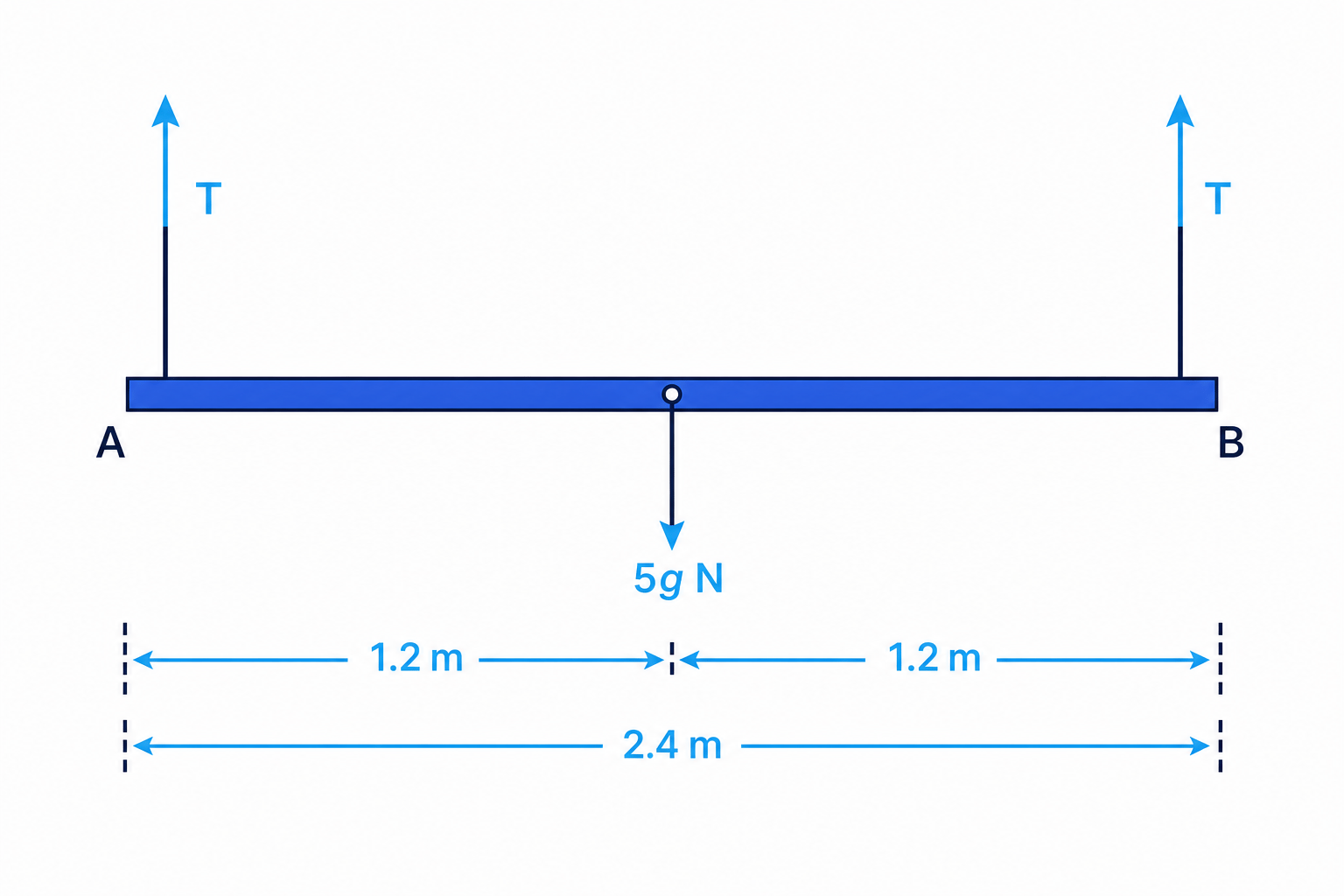
A uniform rod of length 2.4 m and mass 5 kg is held horizontally by two identical vertical strings, one at each end. Find the tension in each string.
-
Since the rod is uniform, its weight acts at the midpoint of the rod.
-
The rod is symmetrical and the strings are identical, so the two tensions are equal. Call each tension TTT.
-
Use vertical equilibrium: total upward force equals total downward force.
2T=5g2T = 5g2T=5g -
Solve for TTT.
T=5g2T = \frac{5g}{2}T=25g -
Using g=9.8g=9.8g=9.8, each string has tension 24.5 N.
Common Mistake
Mass is not weight
A 30 kg child does not exert a force of 30 N. Their weight is 30g30g30g N. In many moment equations the ggg cancels, but you should still write weights as forces first.
The moment of a force
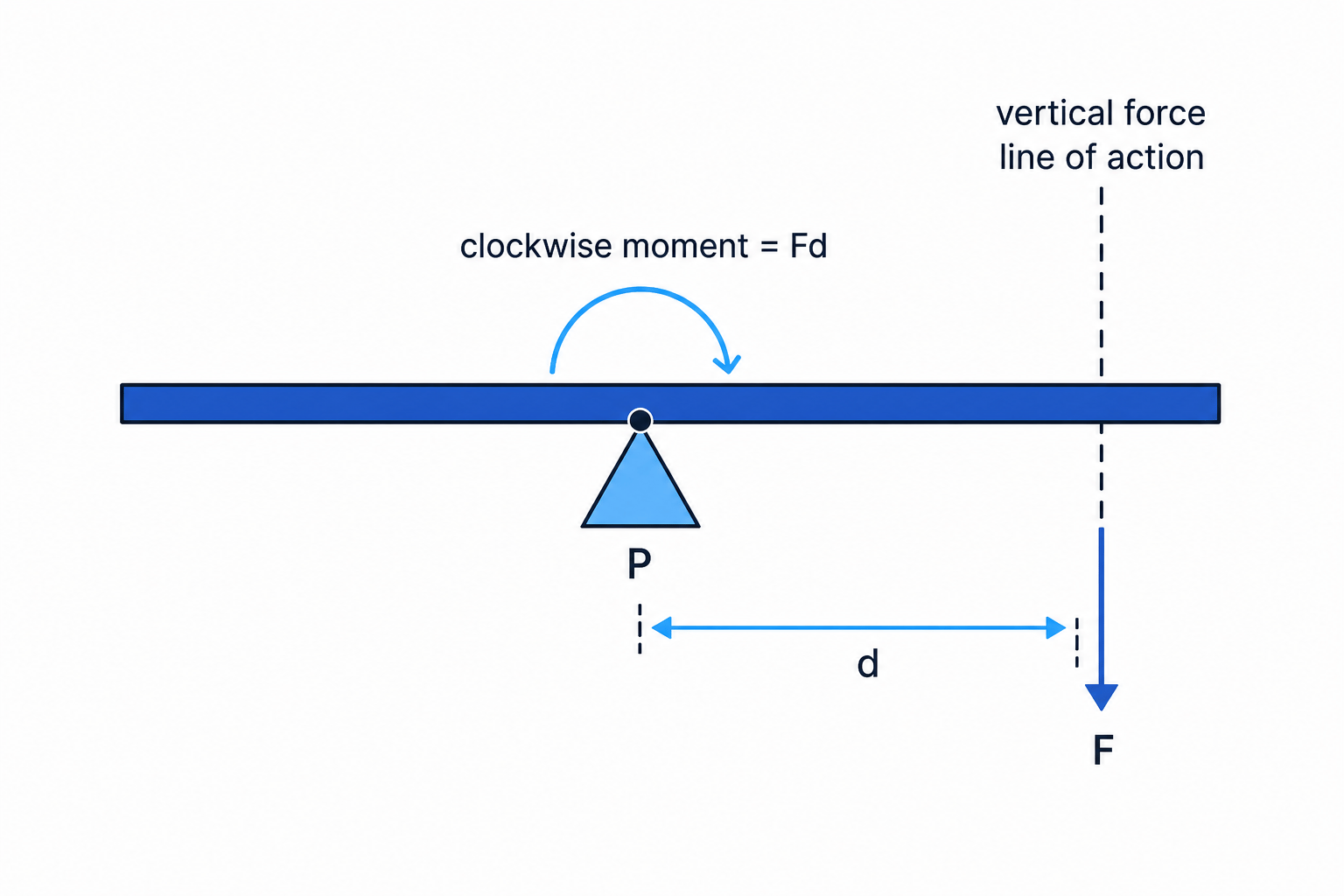
A force can make an object turn. For example, pushing down on one side of a seesaw creates a turning effect about the pivot.
Definition
Moment of a force
The moment of a force about a point is the force multiplied by the perpendicular distance from the point to the force’s line of action.
For horizontal rods with vertical forces, the perpendicular distance is usually just the horizontal distance along the rod.
The unit of moment is N m.
Key Idea
Moment formula
For a vertical force on a horizontal rod, use: moment = force times distance from the pivot.
You also need a direction: a moment is either clockwise or anticlockwise about the chosen point.
Example
Balancing a seesaw
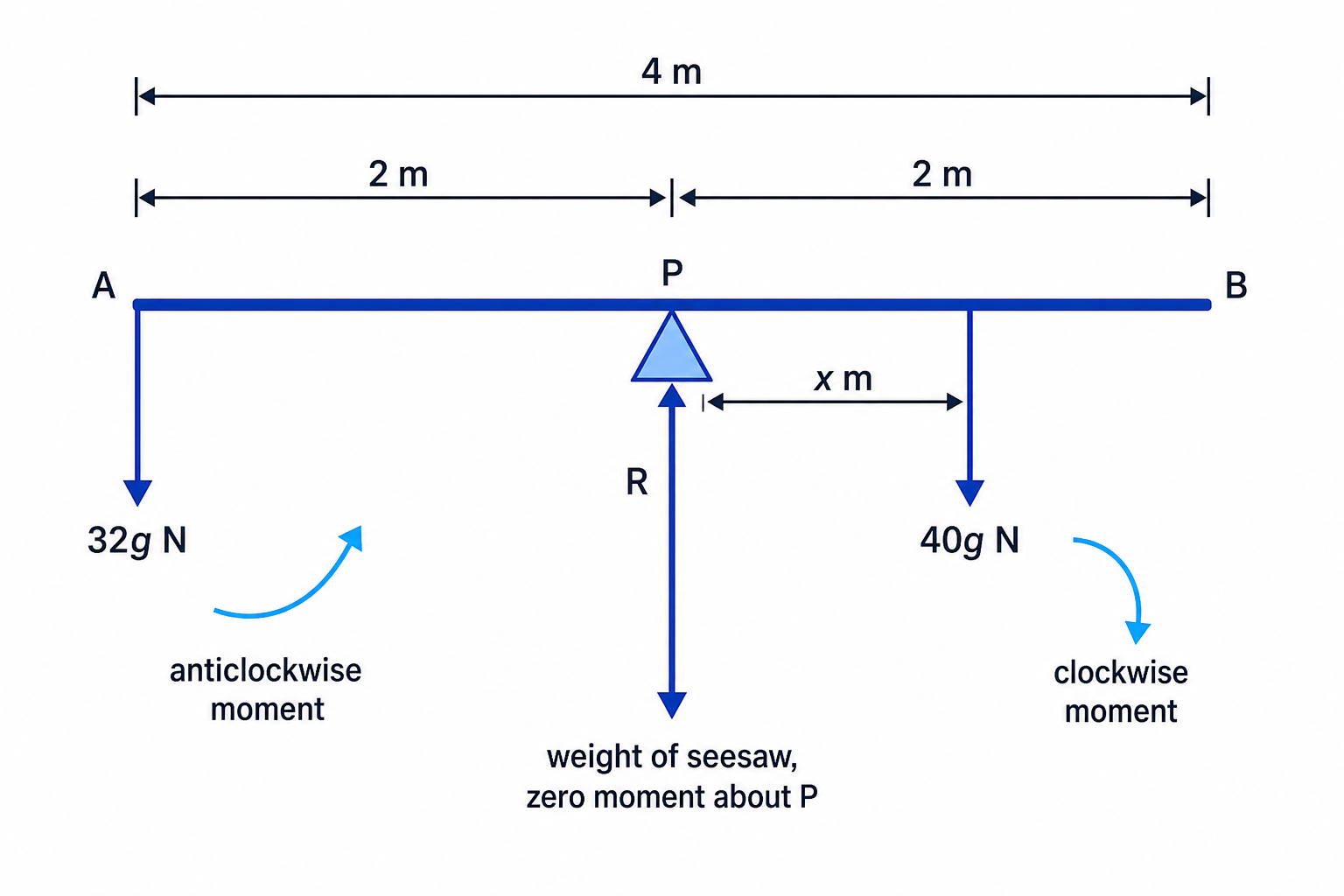
A uniform seesaw of length 4 m is supported at its centre. A child of mass 32 kg sits at the left end. A child of mass 40 kg sits on the right, at distance xxx m from the centre. The seesaw is horizontal and in equilibrium. Find xxx.
-
The pivot is at the centre, so the left end is 2 m from the pivot.
-
The seesaw is uniform, so its own weight acts at the centre. Its line of action passes through the pivot, so it has zero moment about the pivot.
-
The 32 kg child produces an anticlockwise moment:
32g×232g \times 232g×2 -
The 40 kg child produces a clockwise moment:
40g×x40g \times x40g×x -
For equilibrium, clockwise moment equals anticlockwise moment.
40gx=32g×240g x = 32g \times 240gx=32g×2 -
Cancel ggg and solve.
x=6440=1.6x = \frac{64}{40} = 1.6x=4064=1.6 -
The child should sit 1.6 m from the centre.
Common Mistake
Using the wrong distance
Moments use distance from the pivot, not necessarily distance from the end of the rod. Always mark your pivot first, then measure from there.
Equilibrium of a rod
Definition
Equilibrium
A body is in equilibrium when it is not accelerating and not rotating. For a horizontal rod with vertical forces, you usually use two facts: total upward force equals total downward force, and total clockwise moment equals total anticlockwise moment.
In exam-style rod problems, you often need to find unknown reactions at supports. The best method is usually:
- draw all forces;
- take moments about one support to eliminate its reaction;
- use vertical equilibrium to find the other reaction.
Tip
Choosing where to take moments
Take moments about a point where an unknown force acts. That unknown force then has zero moment because its distance from the point is zero.
Example
Finding reactions at two supports
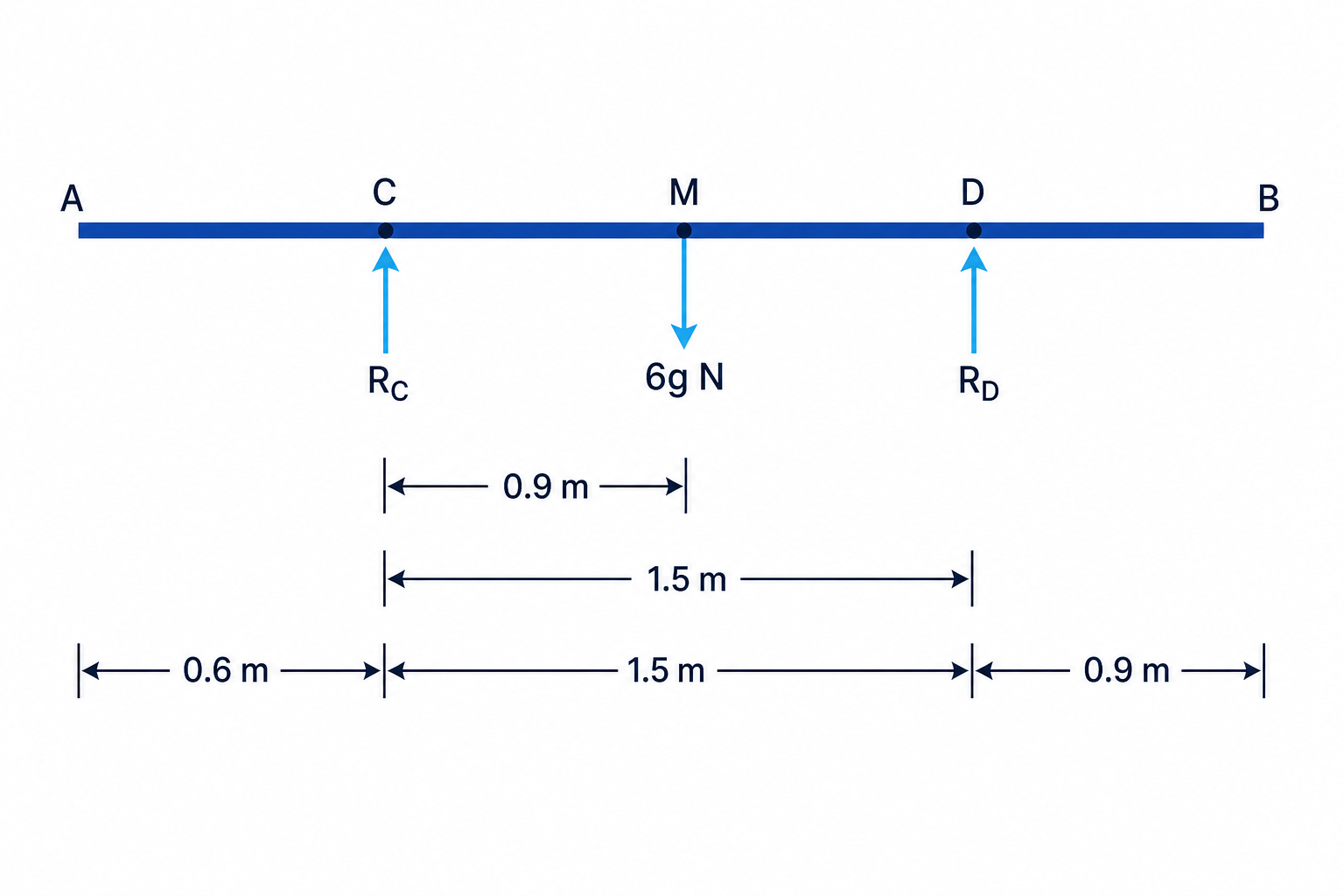
A uniform rod ABABAB has length 3 m and mass 6 kg. It rests horizontally on two supports at CCC and DDD, where AC=0.6AC=0.6AC=0.6 m and AD=2.1AD=2.1AD=2.1 m. Find the reactions at the two supports.
-
Let the reactions at CCC and DDD be RCR_CRC and RDR_DRD.
-
The rod is uniform, so its weight 6g6g6g acts at the midpoint, 1.5 m from AAA.
-
Work out the distances from CCC: the distance from CCC to DDD is 1.5 m, and the distance from CCC to the centre of mass is 0.9 m.
-
Take moments about CCC. The reaction at CCC has no moment.
RD×1.5=6g×0.9R_D \times 1.5 = 6g \times 0.9RD×1.5=6g×0.9 -
Solve for RDR_DRD.
RD=6g×0.91.5=3.6gR_D = \frac{6g \times 0.9}{1.5} = 3.6gRD=1.56g×0.9=3.6g -
So the reaction at DDD is 35.3 N, using g=9.8g=9.8g=9.8.
-
Now use vertical equilibrium.
RC+RD=6gR_C + R_D = 6gRC+RD=6g -
Substitute RD=3.6gR_D=3.6gRD=3.6g.
RC=6g−3.6g=2.4gR_C = 6g - 3.6g = 2.4gRC=6g−3.6g=2.4g -
So the reaction at CCC is 23.5 N.
Rods on the point of tilting
Sometimes a load is added and the rod is just about to lift off one support.
Definition
Point of tilting
A rod is on the point of tilting about a support when it is just about to rotate around that support. The reaction at the other support is zero because contact is just lost.
This is a very common moments idea: once the rod is tipping about a support, that support becomes the pivot.
Example
A block causing a rod to tilt
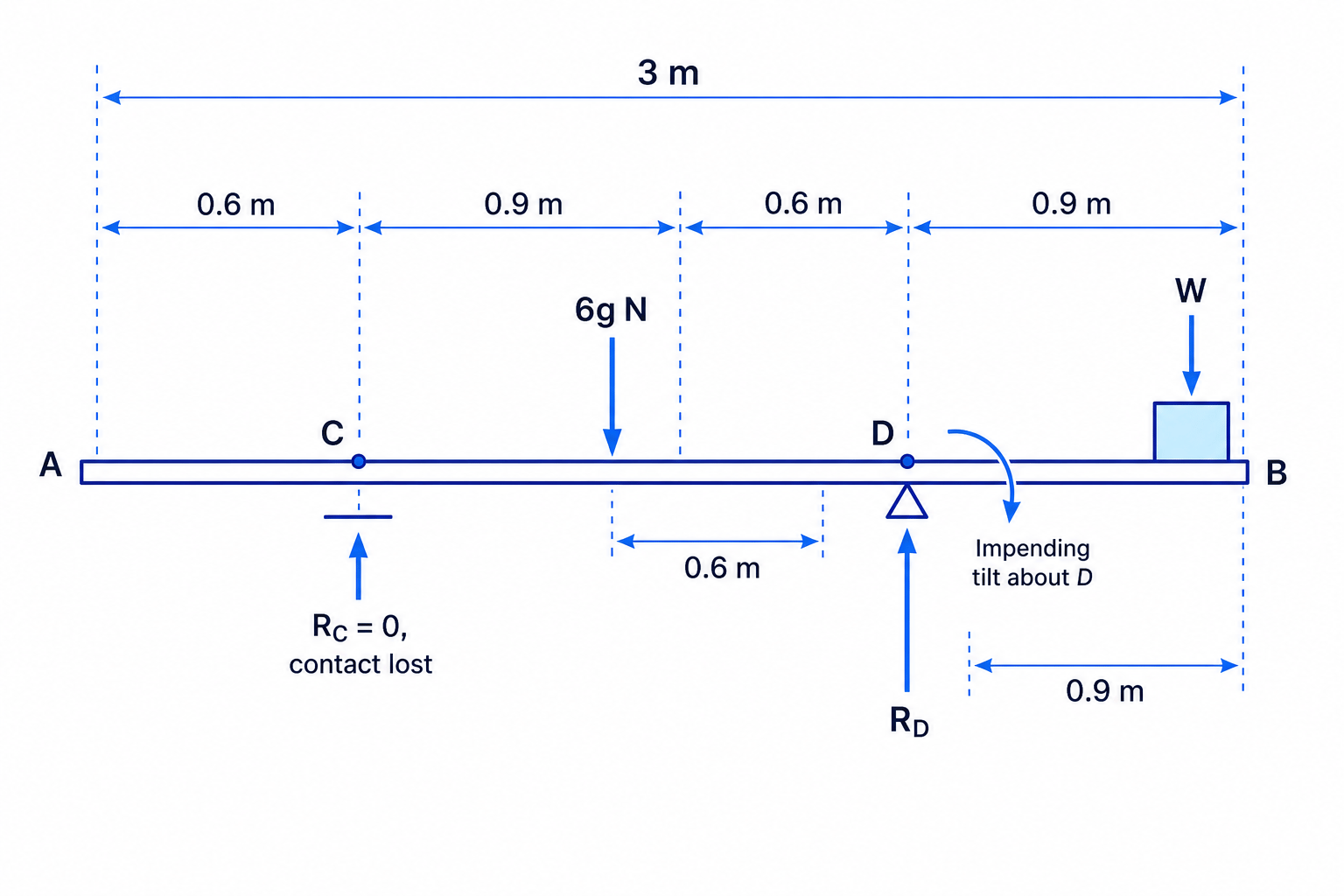
The same uniform 3 m rod of mass 6 kg rests on supports at CCC and DDD, where AC=0.6AC=0.6AC=0.6 m and AD=2.1AD=2.1AD=2.1 m. A block is placed at BBB. The rod is on the point of tilting about DDD. Find the weight of the block and the reaction at DDD.
-
Since the rod is about to tilt about DDD, the reaction at CCC is zero.
-
Let the weight of the block be WWW. The block is at BBB, which is 0.9 m to the right of DDD.
-
The rod’s weight 6g6g6g acts at its midpoint, 1.5 m from AAA. This is 0.6 m to the left of DDD.
-
Take moments about DDD.
W×0.9=6g×0.6W \times 0.9 = 6g \times 0.6W×0.9=6g×0.6 -
Solve for WWW.
W=6g×0.60.9=4gW = \frac{6g \times 0.6}{0.9} = 4gW=0.96g×0.6=4g -
So the block has weight 39.2 N.
-
Use vertical equilibrium. The only upward reaction is now at DDD.
RD=6g+4g=10gR_D = 6g + 4g = 10gRD=6g+4g=10g -
Therefore the reaction at DDD is 98 N.
Common Mistake
Reactions cannot pull
A support can push up, but it cannot pull the rod down. If a calculated reaction becomes negative, that means the rod would have lifted off that support.
Non-uniform rods and unknown centres of mass
For a non-uniform rod, you usually let the centre of mass be xxx m from one end, often from AAA. Then take moments to find xxx.
Key Idea
Non-uniform rod strategy
If the centre of mass is unknown, replace the rod’s weight by a single downward force acting at distance xxx from a chosen end.
Example
Using tensions to find a centre of mass
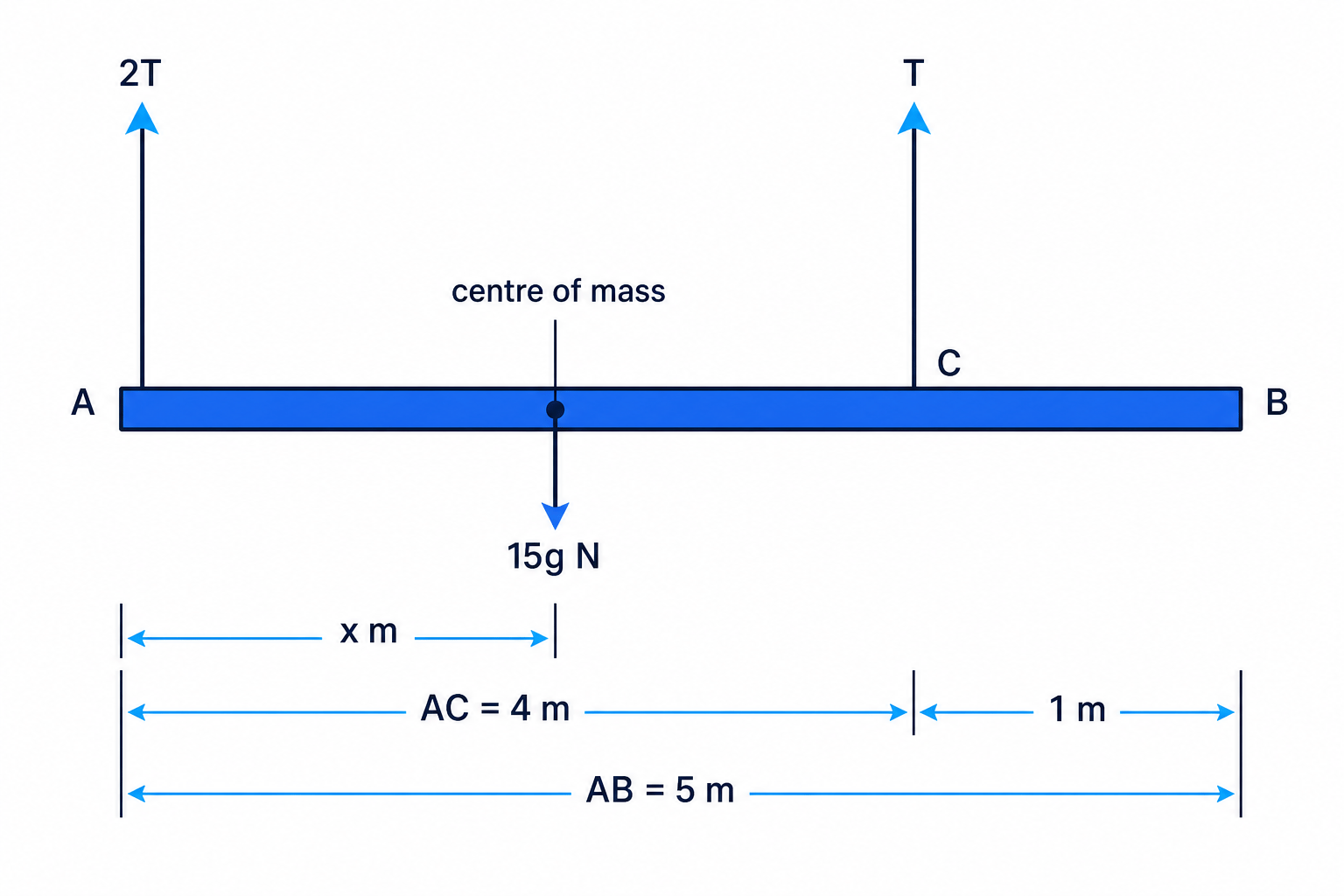
A non-uniform rod ABABAB has length 5 m and mass 15 kg. It is held horizontally by vertical strings at AAA and at a point CCC, where AC=4AC=4AC=4 m. The tension at AAA is twice the tension at CCC. Find the tension at CCC and the distance of the rod’s centre of mass from AAA.
-
Let the tension at CCC be TTT. Then the tension at AAA is 2T2T2T.
-
Use vertical equilibrium.
2T+T=15g2T + T = 15g2T+T=15g -
Solve for TTT.
T=5gT = 5gT=5g -
So the tension at CCC is 49 N.
-
Let the centre of mass be xxx m from AAA.
-
Take moments about AAA. The tension at AAA has zero moment.
T×4=15g×xT \times 4 = 15g \times xT×4=15g×x -
Substitute T=5gT=5gT=5g.
5g×4=15gx5g \times 4 = 15g x5g×4=15gx -
Cancel ggg and solve.
x=2015=43x = \frac{20}{15} = \frac{4}{3}x=1520=34 -
The centre of mass is 43\frac{4}{3}34 m from AAA.
Adding a separate mass to a rod
A block or particle placed on a rod is treated as an extra downward weight at its position. Keep it separate from the rod’s own weight.
Example
Non-uniform rod with a block
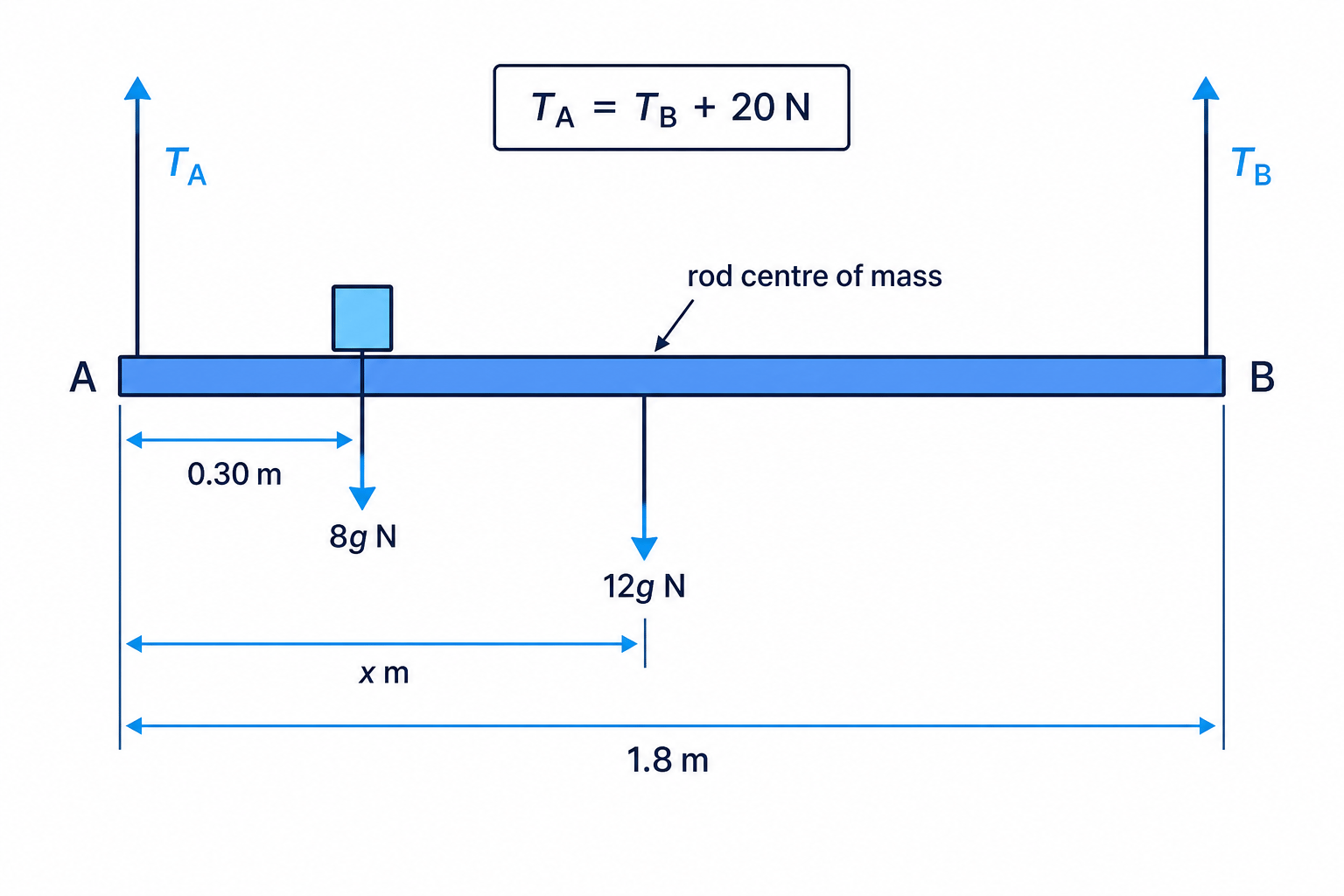
A non-uniform rod ABABAB is 180 cm long and has mass 12 kg. An 8 kg block is placed at a point 30 cm from AAA. The rod is held horizontally by vertical strings at AAA and BBB. The tension at AAA is 20 N greater than the tension at BBB. Find the distance of the rod’s centre of mass from AAA, to the nearest cm.
-
Convert the distances to metres: the rod is 1.8 m long, and the block is 0.30 m from AAA.
-
Let the tensions be TAT_ATA and TBT_BTB, where TA=TB+20T_A=T_B+20TA=TB+20.
-
Use vertical equilibrium.
TA+TB=20gT_A + T_B = 20gTA+TB=20g -
Substitute g=9.8g=9.8g=9.8 and TA=TB+20T_A=T_B+20TA=TB+20.
TB+20+TB=1962TB=176TB=88\begin{aligned} T_B + 20 + T_B &= 196 \\ 2T_B &= 176 \\ T_B &= 88 \end{aligned}TB+20+TB2TBTB=196=176=88 -
Let the rod’s centre of mass be xxx m from AAA.
-
Take moments about AAA. The tension at AAA has zero moment.
88×1.8=12g×x+8g×0.3088 \times 1.8 = 12g \times x + 8g \times 0.3088×1.8=12g×x+8g×0.30 -
Substitute g=9.8g=9.8g=9.8.
158.4=117.6x+23.52158.4 = 117.6x + 23.52158.4=117.6x+23.52 -
Solve for xxx.
x=158.4−23.52117.6≈1.148x = \frac{158.4 - 23.52}{117.6} \approx 1.148x=117.6158.4−23.52≈1.148 -
The centre of mass is about 1.15 m from AAA, so the answer is 115 cm to the nearest cm.
Common Mistake
Mixing cm and m
You may use cm or m in a moments equation, but do not mix them. If one distance is in metres, convert all distances to metres first.
Exam technique
In the exam
- Draw a clear force diagram before writing equations, including weights, reactions, tensions, and distances.
- Choose a pivot that eliminates an unknown force, usually a support or string attachment point.
- If the rod is on the point of tilting, immediately set the reaction at the lifted support to zero.
Self review
Check yourself
- Why does a uniform rod’s own weight sometimes create no moment about a pivot?
- What does a negative reaction tell you physically?
- When finding a centre of mass, why is it helpful to take moments about one end of the rod?

Recap questions
Test yourself with 5 quick questions on this guide. Answer them all correctly to complete it.
You've reached the end
Test yourself on this topic, or move on to the next guide.
How was this guide?