Question 17
In this question use g=9.8g = 9.8g=9.8 m s−2^{-2}−2.
A uniform rod AB AB\,AB of mass 10 kg and length 6 m rests in equilibrium with the end A A\,A on rough horizontal ground. The rod rests on a smooth peg at the point CCC, where AC=4AC = 4AC=4 m.
The angle between AB AB\,AB and the ground is θ\thetaθ, where tanθ=0.4\tan\theta = 0.4tanθ=0.4. The rod is on the point of slipping.
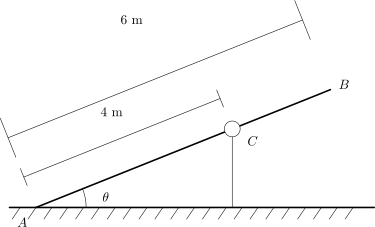
Find the coefficient of friction between the rod and the ground.
2.3 Forces and Newton's laws Questions
136 exam-style questions on CCEA A Level Maths 2.3 Forces and Newton's laws, covering 2.3.1 Forces and Newton's laws, 2.3.2 Forces and Newton's laws, 2.3.3 Forces and Newton's laws, 2.3.4 Forces and Newton's laws, 2.3.5 Forces and Newton's laws, 2.3.6 Forces and Newton's laws, 2.3.7 Forces and Newton's laws, 2.3.8 Forces and Newton's laws, 2.3.9 Forces and Newton's laws, 2.3.10 Forces and Newton's laws, 2.3.11 Forces and Newton's laws, 2.3.12 Forces and Newton's laws, and 2.3 Forces and Newton's laws. Each one has a worked solution and a mark scheme showing where the marks go.