

What you'll learn
- Use i\mathbf{i}i and j\mathbf{j}j components to describe motion in a plane.
- Connect position, velocity and acceleration using vector equations.
- Handle directions, bearings, minimum speed and relative motion.
- Differentiate and integrate vector functions of time.
1. Vectors, speed and constant velocity
In Further Kinematics, you usually model motion in two perpendicular directions. The unit vector i\mathbf{i}i is often due east, and j\mathbf{j}j is often due north.
A vector such as 3i−4j3\mathbf{i}-4\mathbf{j}3i−4j means 3 units in the i\mathbf{i}i direction and 4 units in the negative j\mathbf{j}j direction.
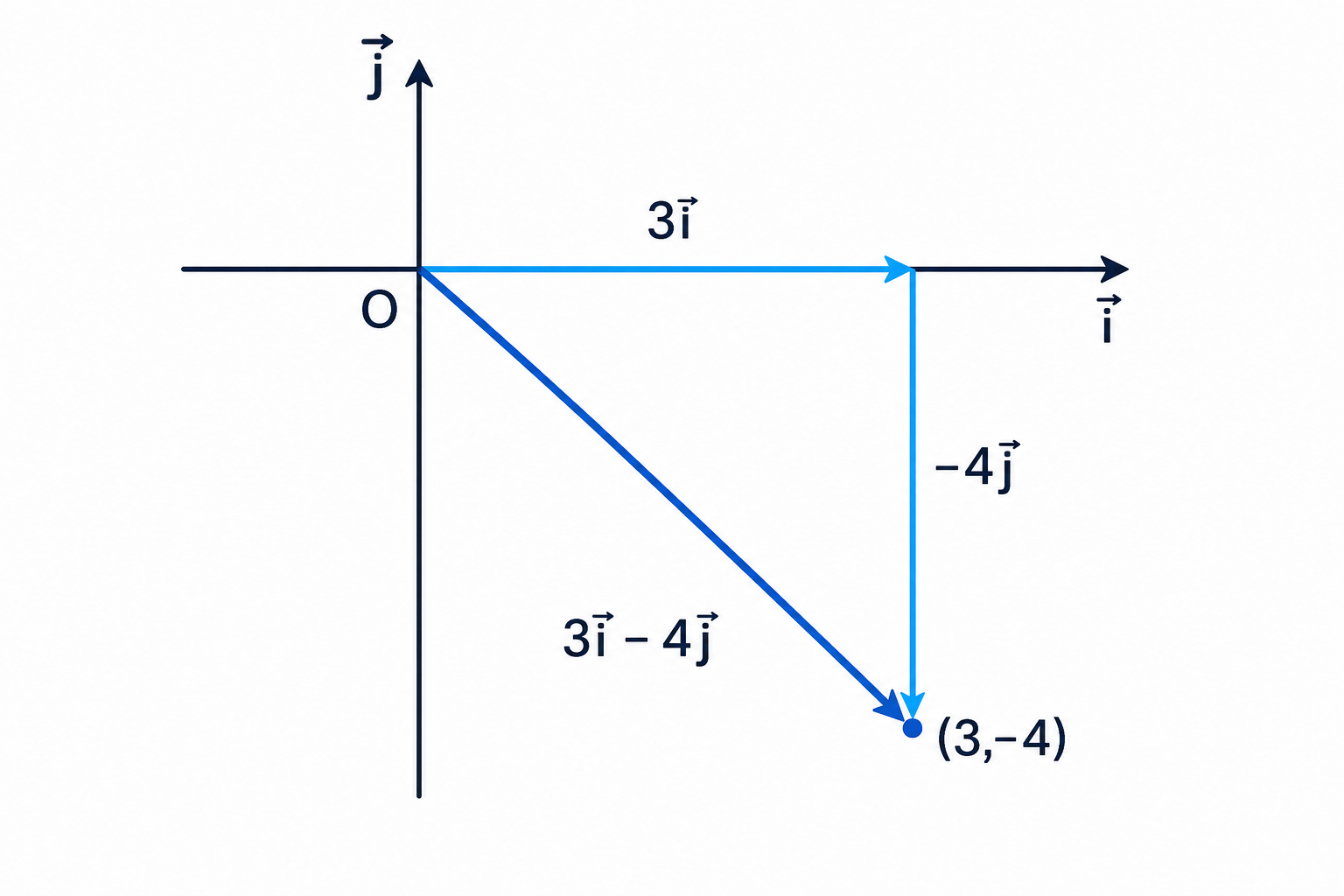
Position vector and displacement
-
A position vector gives the position of a particle relative to a fixed origin OOO.
-
A displacement is the change in position, so displacement=final position−initial position\text{displacement}=\text{final position}-\text{initial position}displacement=final position−initial position.
-
The speed is the magnitude of the velocity vector.
For constant velocity,
r=r0+vt\mathbf{r}=\mathbf{r}_0+\mathbf{v}tr=r0+vtwhere r0\mathbf{r}_0r0 is the initial position vector, v\mathbf{v}v is the constant velocity, and ttt is the time.
Work component by component
Treat the i\mathbf{i}i and j\mathbf{j}j parts like two separate one-dimensional problems, then combine them at the end for speed, distance or direction.
Finding velocity, speed, bearing and position
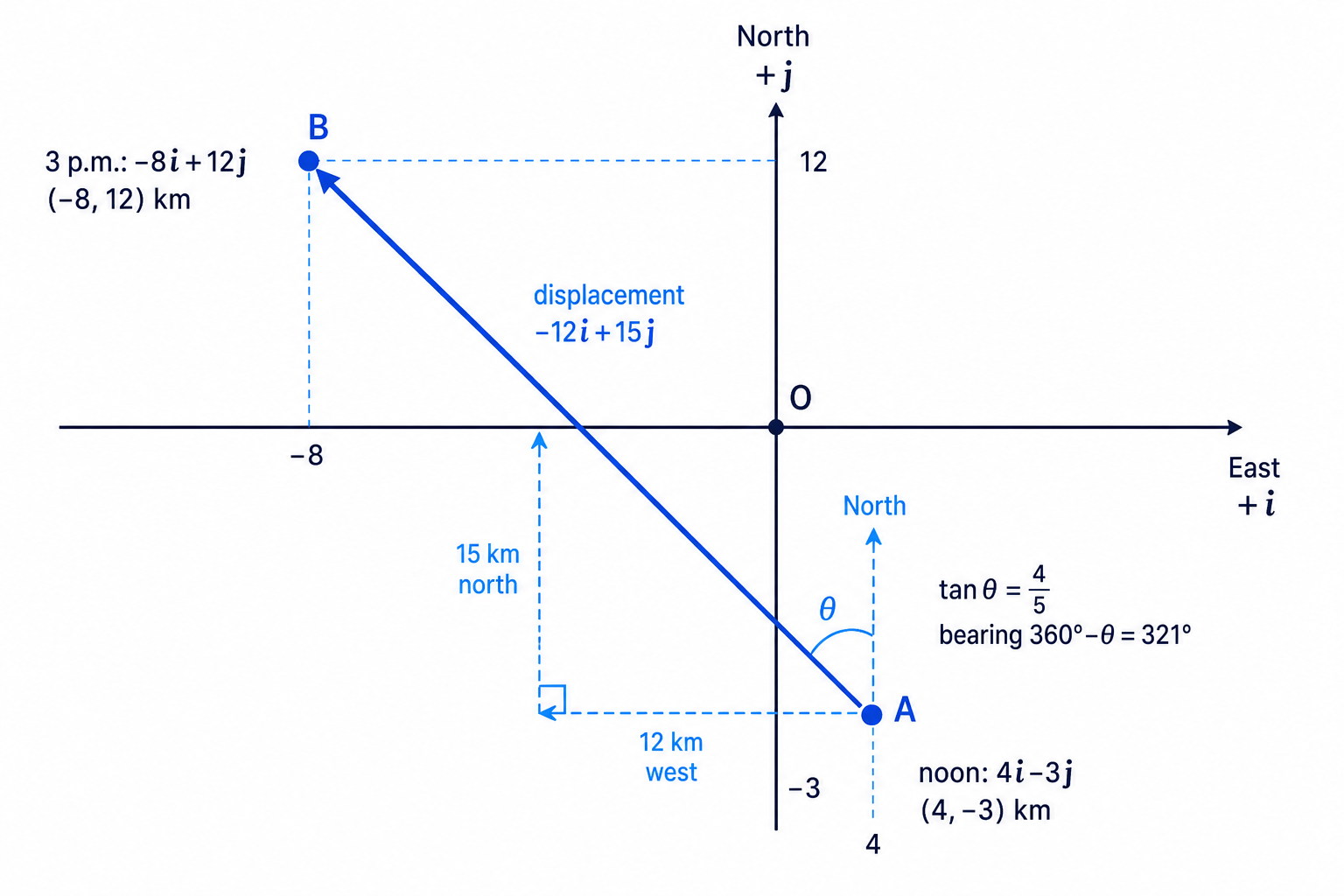
A boat is at position 4i−3j4\mathbf{i}-3\mathbf{j}4i−3j km at noon. At 3 p.m. it is at position −8i+12j-8\mathbf{i}+12\mathbf{j}−8i+12j km. Find its velocity, speed, bearing, and position vector ttt hours after noon.
-
Find the displacement over the 3 hours:
(−8i+12j)−(4i−3j)=−12i+15j(-8\mathbf{i}+12\mathbf{j})-(4\mathbf{i}-3\mathbf{j}) = -12\mathbf{i}+15\mathbf{j}(−8i+12j)−(4i−3j)=−12i+15j -
Divide by the time to get the velocity:
v=−12i+15j3=−4i+5j\mathbf{v} = \frac{-12\mathbf{i}+15\mathbf{j}}{3} = -4\mathbf{i}+5\mathbf{j}v=3−12i+15j=−4i+5j -
The speed is the magnitude of the velocity:
∣v∣=(−4)2+52=41|\mathbf{v}|=\sqrt{(-4)^2+5^2}=\sqrt{41}∣v∣=(−4)2+52=41 -
For the bearing, the boat moves west and north. The angle west of north is:
θ=tan−1(45)≈38.7∘\theta=\tan^{-1}\left(\frac{4}{5}\right)\approx 38.7^\circθ=tan−1(54)≈38.7∘ -
Bearings are measured clockwise from north, so the bearing is approximately 321°.
-
Write the position vector after ttt hours:
r=(4i−3j)+t(−4i+5j)=(4−4t)i+(−3+5t)j\mathbf{r}=(4\mathbf{i}-3\mathbf{j})+t(-4\mathbf{i}+5\mathbf{j}) = (4-4t)\mathbf{i}+(-3+5t)\mathbf{j}r=(4i−3j)+t(−4i+5j)=(4−4t)i+(−3+5t)j
Bearings
Always sketch the quadrant first. A vector with negative i\mathbf{i}i and positive j\mathbf{j}j components points north-west, so its bearing is close to 360°, not close to 0°.
2. Constant acceleration in vector form
Acceleration is the rate of change of velocity. With constant acceleration, the familiar SUVAT equations work as vector equations:
v=u+at\mathbf{v}=\mathbf{u}+\mathbf{a}tv=u+at r=r0+ut+12at2\mathbf{r}=\mathbf{r}_0+\mathbf{u}t+\frac{1}{2}\mathbf{a}t^2r=r0+ut+21at2Here u\mathbf{u}u is the initial velocity, v\mathbf{v}v is the velocity at time ttt, and a\mathbf{a}a is the acceleration.
If you are told a particle moves “in the direction” of a vector, that vector gives the ratio of the components, not necessarily the velocity itself.
Using a direction vector and constant acceleration
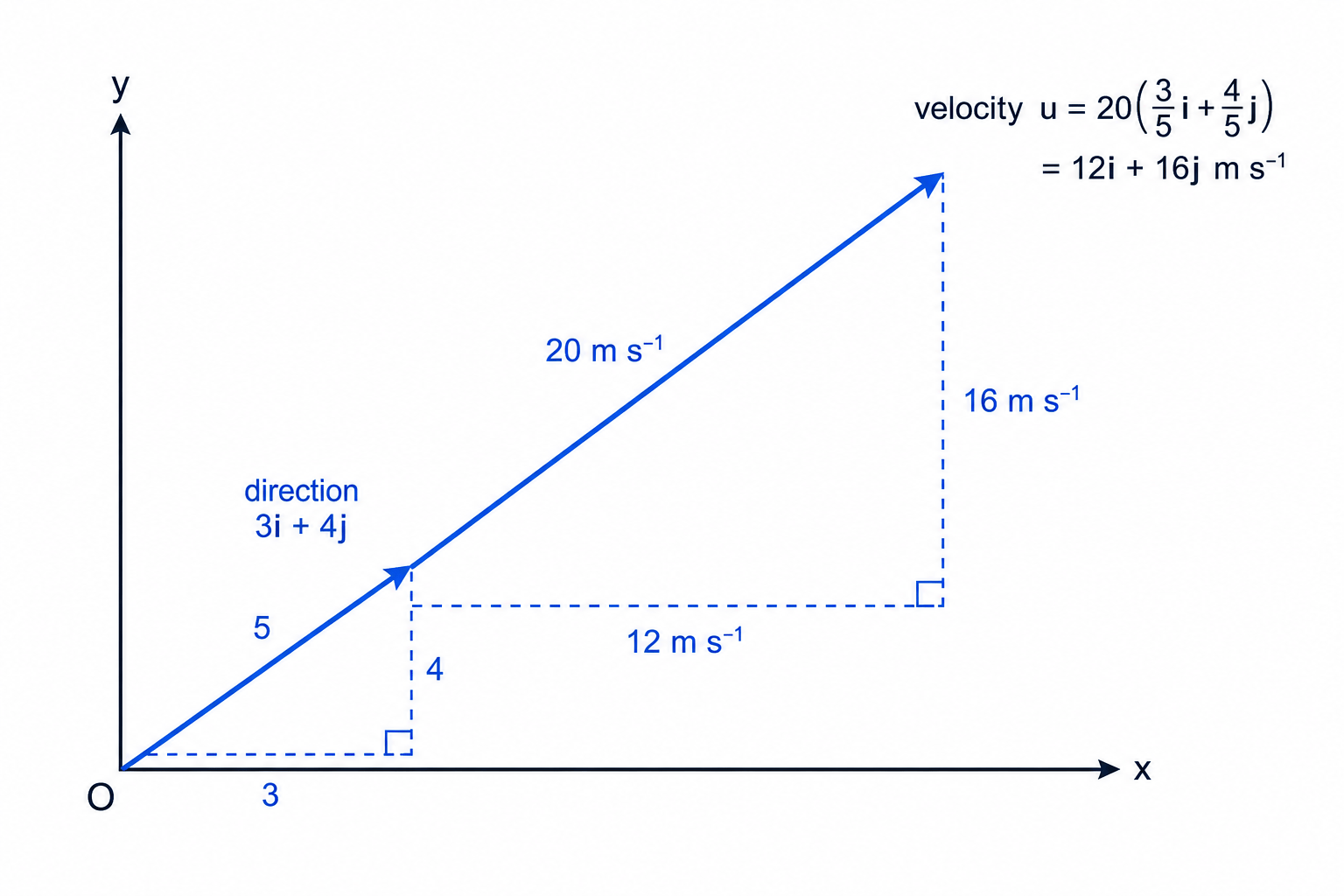
A particle starts at the origin. Initially it moves in the direction 3i+4j3\mathbf{i}+4\mathbf{j}3i+4j with speed 20 m s^-1. Five seconds later its velocity is −5i+18j-5\mathbf{i}+18\mathbf{j}−5i+18j m s^-1. Find its acceleration and its position after 5 seconds.
-
Convert the initial direction into a unit vector, then multiply by the speed:
u=20(35i+45j)=12i+16j\mathbf{u} = 20\left(\frac{3}{5}\mathbf{i}+\frac{4}{5}\mathbf{j}\right) = 12\mathbf{i}+16\mathbf{j}u=20(53i+54j)=12i+16j -
Use v=u+at\mathbf{v}=\mathbf{u}+\mathbf{a}tv=u+at, rearranged to find a\mathbf{a}a:
a=(−5i+18j)−(12i+16j)5=−175i+25j\mathbf{a} = \frac{(-5\mathbf{i}+18\mathbf{j})-(12\mathbf{i}+16\mathbf{j})}{5} = -\frac{17}{5}\mathbf{i}+\frac{2}{5}\mathbf{j}a=5(−5i+18j)−(12i+16j)=−517i+52j -
Use the position formula with r0=0\mathbf{r}_0=\mathbf{0}r0=0 and t=5t=5t=5:
r=(12i+16j)(5)+12(−175i+25j)(25)=352i+85j\mathbf{r} = (12\mathbf{i}+16\mathbf{j})(5) + \frac{1}{2}\left(-\frac{17}{5}\mathbf{i}+\frac{2}{5}\mathbf{j}\right)(25) = \frac{35}{2}\mathbf{i}+85\mathbf{j}r=(12i+16j)(5)+21(−517i+52j)(25)=235i+85j -
So after 5 seconds, the position vector is 352i+85j\frac{35}{2}\mathbf{i}+85\mathbf{j}235i+85j m.
Direction is not velocity
Do not use a direction vector as a velocity until you have scaled it to the correct speed.
3. Direction tests and minimum speed
A velocity is parallel to another vector if it is a scalar multiple of it. For example, moving in the direction i+2j\mathbf{i}+2\mathbf{j}i+2j means the j\mathbf{j}j component is twice the i\mathbf{i}i component, with the same overall direction.
A vector is perpendicular to i\mathbf{i}i if its i\mathbf{i}i component is zero.
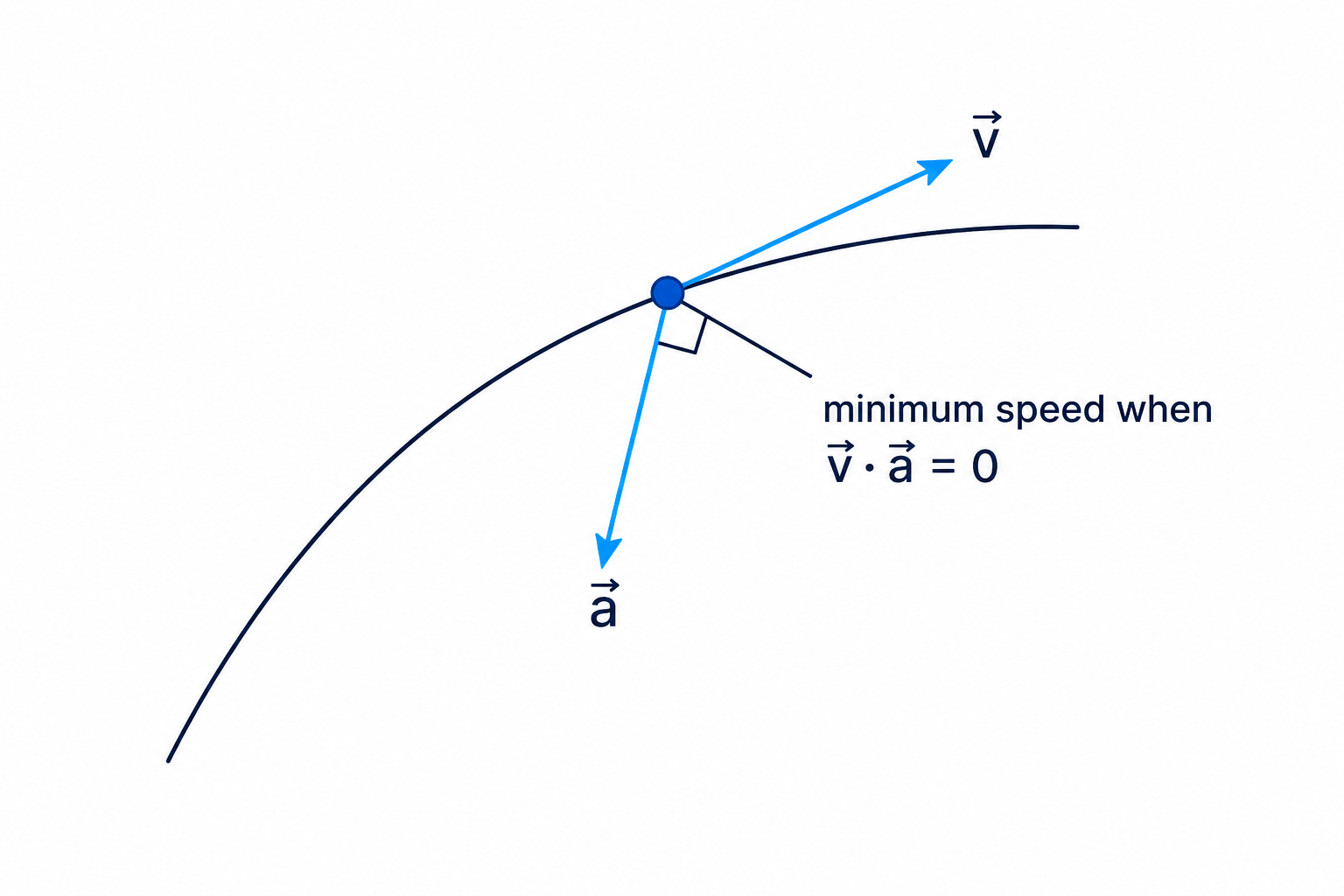
For minimum speed, avoid square roots. Minimise the square of the speed instead.
Direction and minimum speed
A particle has velocity
v=(4t−8)i+(3t+1)j\mathbf{v}=(4t-8)\mathbf{i}+(3t+1)\mathbf{j}v=(4t−8)i+(3t+1)jwhere t≥0t\ge 0t≥0. Find when it moves in the direction i+2j\mathbf{i}+2\mathbf{j}i+2j, and when its speed is minimum.
-
Moving in the direction i+2j\mathbf{i}+2\mathbf{j}i+2j means the j\mathbf{j}j component is twice the i\mathbf{i}i component:
3t+1=2(4t−8)3t+1=2(4t-8)3t+1=2(4t−8) -
Solve for ttt:
3t+1=8t−16⇒t=1753t+1=8t-16 \Rightarrow t=\frac{17}{5}3t+1=8t−16⇒t=517 -
At t=175t=\frac{17}{5}t=517, the i\mathbf{i}i component is positive, so the particle is moving in the required direction.
-
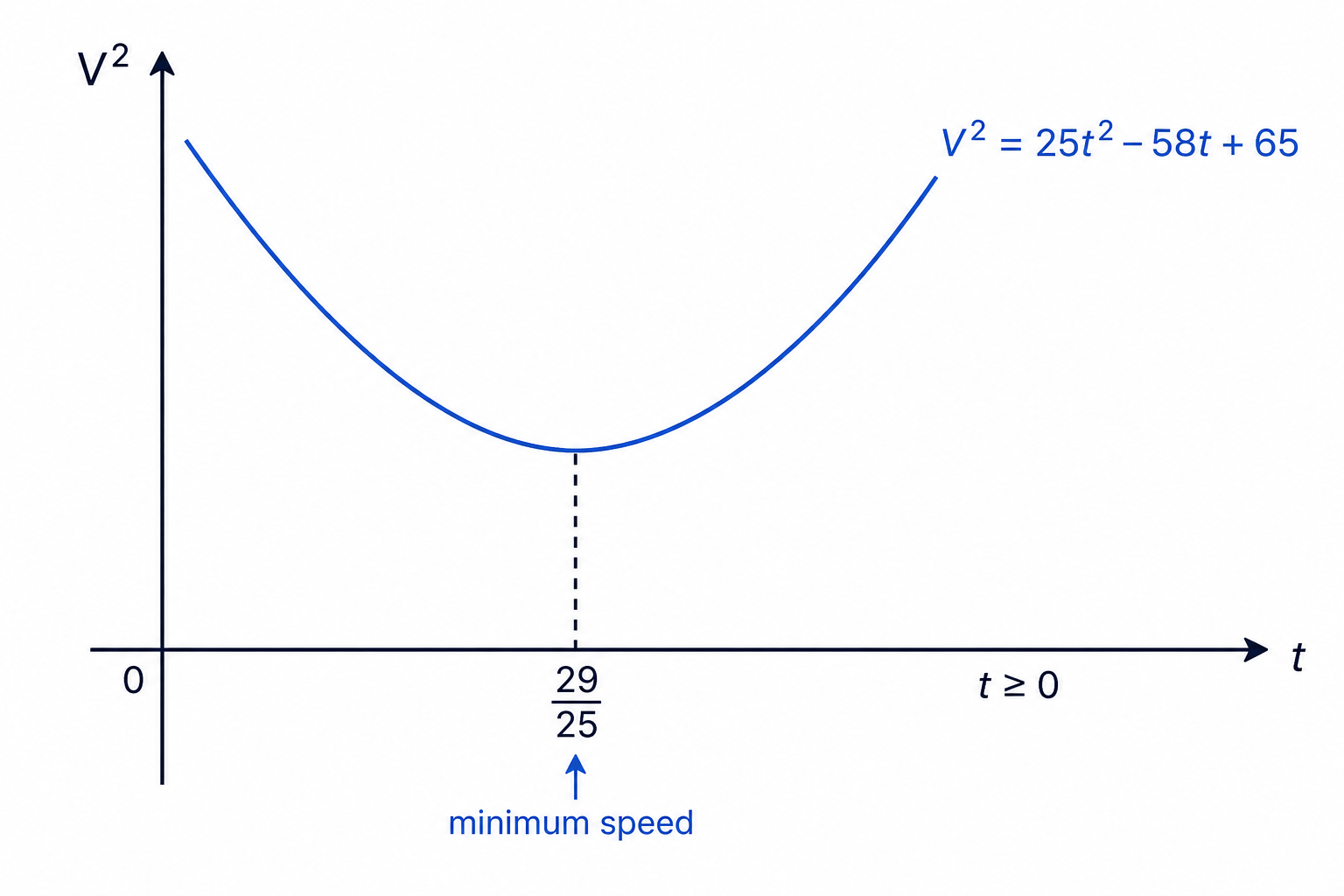
Let VVV be the speed. Minimise V2V^2V2:
V2=(4t−8)2+(3t+1)2=25t2−58t+65V^2=(4t-8)^2+(3t+1)^2=25t^2-58t+65V2=(4t−8)2+(3t+1)2=25t2−58t+65 -
Differentiate and set equal to zero:
ddt(V2)=50t−58=0⇒t=2925\frac{d}{dt}(V^2)=50t-58=0 \Rightarrow t=\frac{29}{25}dtd(V2)=50t−58=0⇒t=2529 -
Since V2V^2V2 is a positive quadratic, the speed is minimum when t=2925t=\frac{29}{25}t=2529.
Minimum speed shortcut
For constant acceleration, minimum speed occurs when the velocity is perpendicular to the acceleration, provided that time lies in the allowed interval.
4. Relative motion and collisions
Relative motion describes one object as seen from another object.
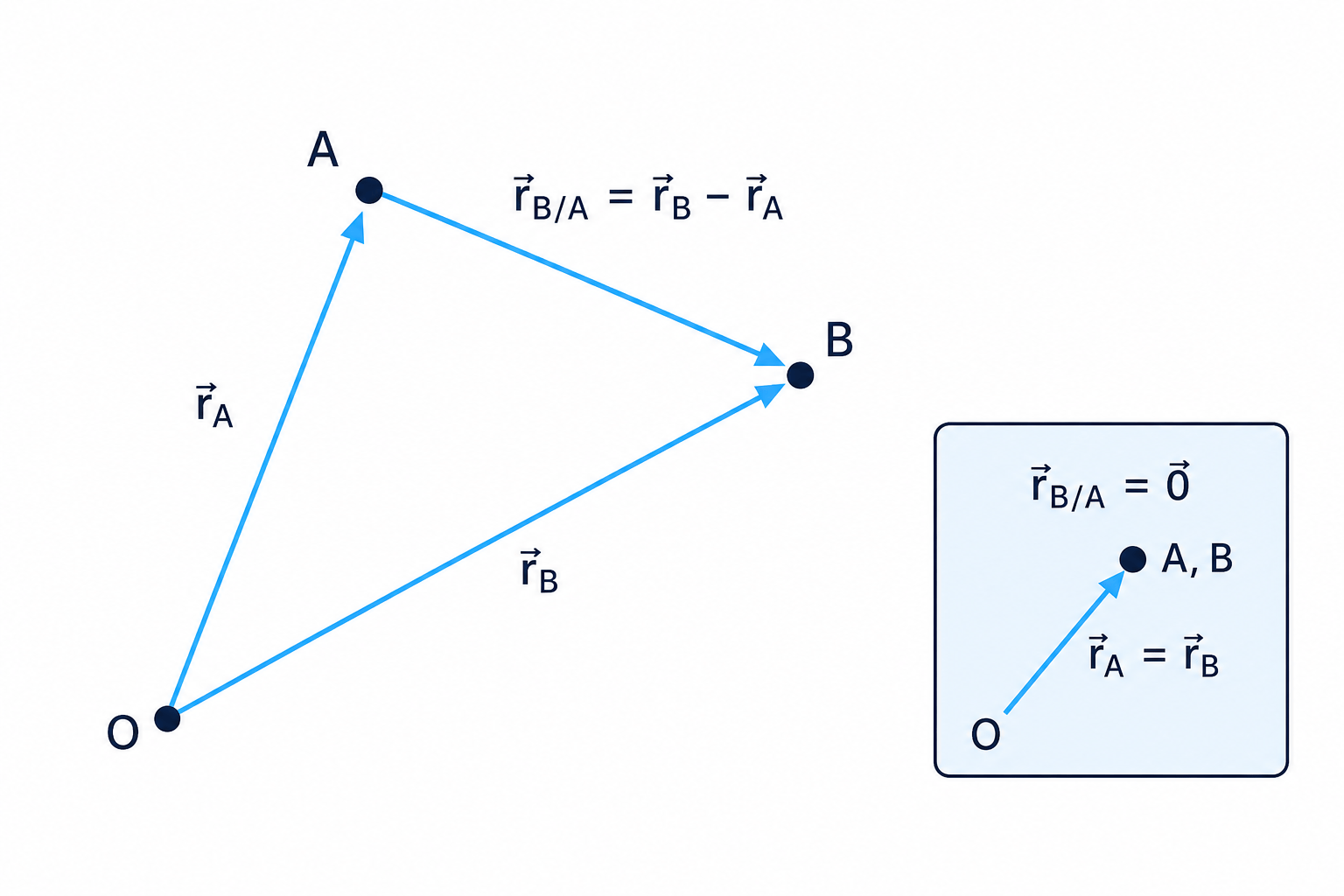
Relative position
The position of BBB relative to AAA is rB/A=rB−rA\mathbf{r}_{B/A}=\mathbf{r}_B-\mathbf{r}_ArB/A=rB−rA. If rB/A=0\mathbf{r}_{B/A}=\mathbf{0}rB/A=0, the two objects are at the same point.
Checking whether two boats collide
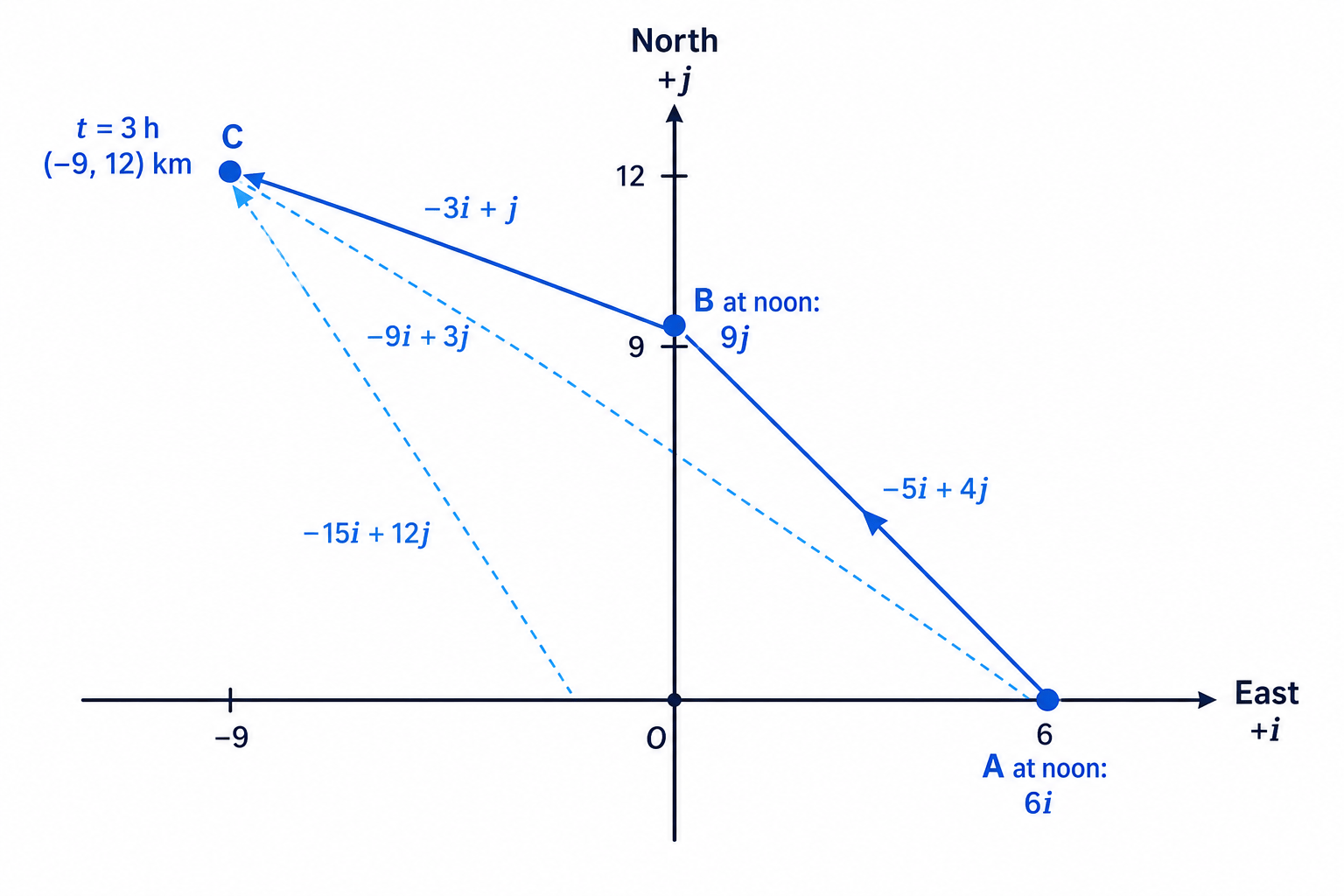
At noon, boat AAA is at 6i6\mathbf{i}6i km and moves with velocity −5i+4j-5\mathbf{i}+4\mathbf{j}−5i+4j km h^-1. Boat BBB is at 9j9\mathbf{j}9j km and moves with velocity −3i+j-3\mathbf{i}+\mathbf{j}−3i+j km h^-1. Find the relative position of BBB from AAA, and decide whether they collide.
-
Write position vectors after ttt hours:
rA=(6−5t)i+4tj,rB=−3ti+(9+t)j\mathbf{r}_A=(6-5t)\mathbf{i}+4t\mathbf{j}, \qquad \mathbf{r}_B=-3t\mathbf{i}+(9+t)\mathbf{j}rA=(6−5t)i+4tj,rB=−3ti+(9+t)j -
Subtract to find the relative position:
rB/A=rB−rA=(2t−6)i+(9−3t)j\mathbf{r}_{B/A} = \mathbf{r}_B-\mathbf{r}_A = (2t-6)\mathbf{i}+(9-3t)\mathbf{j}rB/A=rB−rA=(2t−6)i+(9−3t)j -
For a collision, both components must be zero:
2t−6=0⇒t=3,9−3t=0⇒t=32t-6=0\Rightarrow t=3, \qquad 9-3t=0\Rightarrow t=32t−6=0⇒t=3,9−3t=0⇒t=3 -
Both components give the same time, so the boats collide 3 hours after noon.
-
The collision position can be found using either boat’s position vector:
rA(3)=−9i+12j\mathbf{r}_A(3)=-9\mathbf{i}+12\mathbf{j}rA(3)=−9i+12j
Only checking one component
A collision needs the same i\mathbf{i}i coordinate and the same j\mathbf{j}j coordinate at the same time.
5. Variable kinematics with calculus
When position, velocity or acceleration depends on ttt, use calculus component by component.
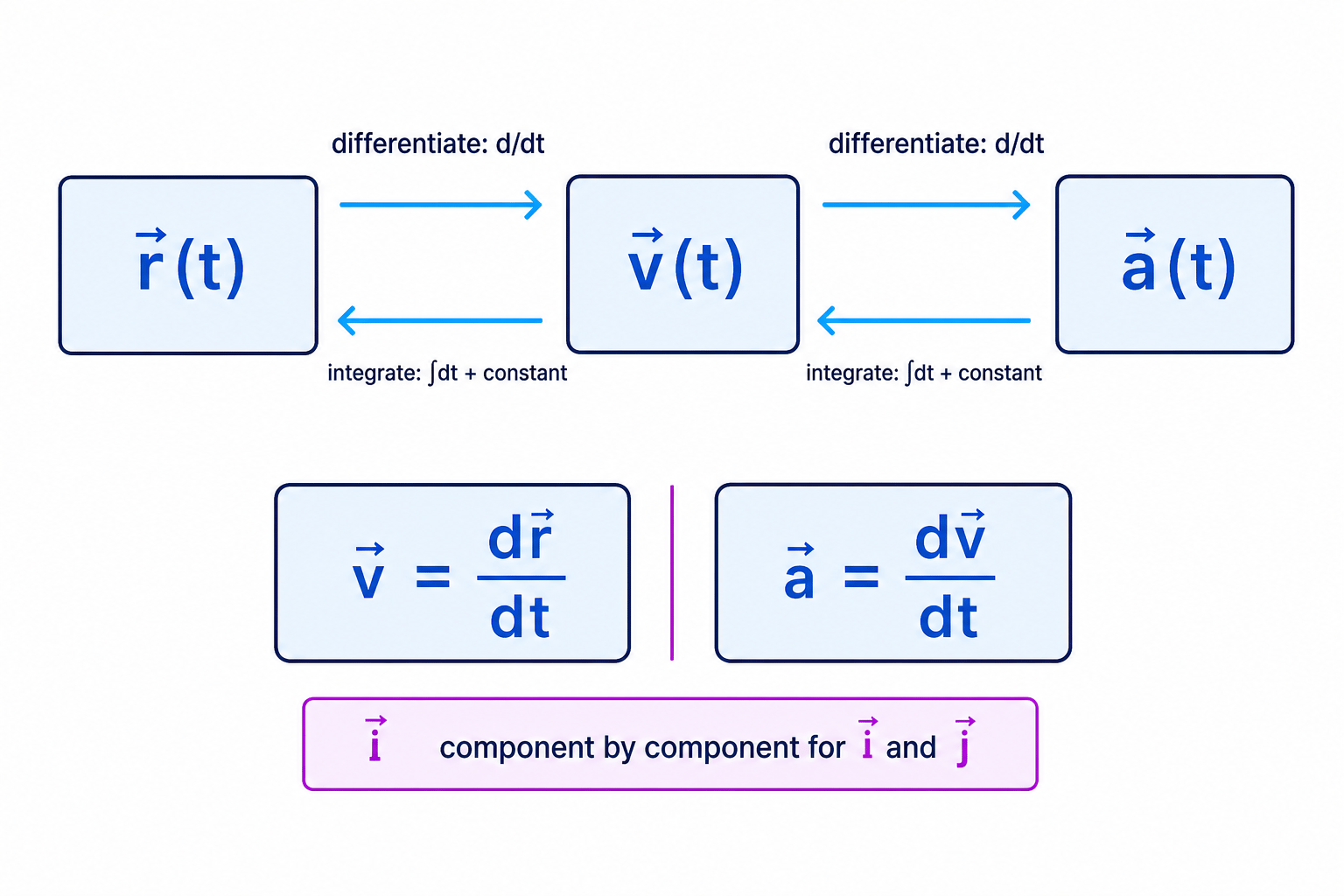
Going backwards, integrate. Remember that integrating introduces constants, which you find using given conditions.
Differentiating and integrating vector functions
Particle PPP has position vector
rP=(2t2+3t−1)i+(t2+9t+4)j\mathbf{r}_P=(2t^2+3t-1)\mathbf{i}+(t^2+9t+4)\mathbf{j}rP=(2t2+3t−1)i+(t2+9t+4)jParticle QQQ has acceleration aQ=(6t−2)i+4tj\mathbf{a}_Q=(6t-2)\mathbf{i}+4t\mathbf{j}aQ=(6t−2)i+4tj. When t=2t=2t=2, its velocity is 8i+10j8\mathbf{i}+10\mathbf{j}8i+10j, and initially its position vector is i−3j\mathbf{i}-3\mathbf{j}i−3j. Find vP\mathbf{v}_PvP, aP\mathbf{a}_PaP, and the position vector of QQQ.
-
Differentiate rP\mathbf{r}_PrP to find velocity:
vP=(4t+3)i+(2t+9)j\mathbf{v}_P=(4t+3)\mathbf{i}+(2t+9)\mathbf{j}vP=(4t+3)i+(2t+9)j -
Differentiate again to find acceleration:
aP=4i+2j\mathbf{a}_P=4\mathbf{i}+2\mathbf{j}aP=4i+2j -
Integrate aQ\mathbf{a}_QaQ to find vQ\mathbf{v}_QvQ:
vQ=(3t2−2t+C)i+(2t2+D)j\mathbf{v}_Q=(3t^2-2t+C)\mathbf{i}+(2t^2+D)\mathbf{j}vQ=(3t2−2t+C)i+(2t2+D)j -
Use the velocity condition at t=2t=2t=2:
8+C=8,8+D=10⇒C=0,D=28+C=8,\qquad 8+D=10 \Rightarrow C=0,\quad D=28+C=8,8+D=10⇒C=0,D=2 -
Integrate again and use the initial position:
rQ=(t3−t2+1)i+(23t3+2t−3)j\mathbf{r}_Q=(t^3-t^2+1)\mathbf{i}+\left(\frac{2}{3}t^3+2t-3\right)\mathbf{j}rQ=(t3−t2+1)i+(32t3+2t−3)j
Distance between two positions
If you are given v(t)\mathbf{v}(t)v(t) and asked for the distance between two points, integrate velocity to get displacement first, then take the magnitude of that displacement.
In the exam
-
Write down whether you are using position, velocity or acceleration before substituting numbers.
-
Keep units of time consistent, especially when questions use clock times such as noon, 1430 or 6 a.m.
-
For collisions, solve both components and check that they give the same value of ttt.
-
For directions and bearings, sketch the vector so your angle is in the correct quadrant.
Check yourself
-
Can you convert “speed 15 in the direction 4i+3j4\mathbf{i}+3\mathbf{j}4i+3j” into a velocity vector?
-
If rB/A=(3t−6)i+(12−6t)j\mathbf{r}_{B/A}=(3t-6)\mathbf{i}+(12-6t)\mathbf{j}rB/A=(3t−6)i+(12−6t)j, how would you test for a collision?
-
When should you differentiate, and when should you integrate, in a vector kinematics question?
