

What you'll learn
- How mass, weight and gravitational acceleration are connected.
- Why the value of gravitational acceleration depends on location.
- How to model vertical motion using constant-acceleration equations.
- How to handle objects that are dropped, projected upwards or moving downwards.
Mass, weight and gravity
Mass
Mass measures the amount of matter in an object. Its SI unit is the kilogram, kg.
An object's mass does not change simply because it moves to a different location. For example, an astronaut has the same mass on Earth and on the Moon.
Weight
Weight is the gravitational force acting on an object. As it is a force, its SI unit is the newton, N.
Weight
For an object of mass mmm, its weight WWW is
W=mg,W=mg,W=mg,where ggg is the magnitude of the gravitational acceleration at that location.
Weight acts vertically downwards, towards the centre of the Earth or other astronomical body.
Mass is not weight
Mass is measured in kilograms, while weight is measured in newtons. A statement such as “the weight is 5 kg” confuses two different quantities.
Calculating weight
A suitcase has mass 18 kg. Calculate its weight where g=9.8 m s−2g=9.8\text{ m s}^{-2}g=9.8 m s−2.
-
Use the relationship W=mgW=mgW=mg.
-
Substitute the mass and gravitational acceleration:
W=18×9.8.W=18\times 9.8.W=18×9.8. -
Therefore, the suitcase has weight 176.4 N176.4\text{ N}176.4 N, acting vertically downwards.
Gravitational acceleration
An object falling under gravity accelerates because its weight produces a resultant downward force.
Gravitational acceleration
The symbol ggg represents the magnitude of the acceleration due to gravity. Near the Earth's surface, its usual A-Level value is
g=9.8 m s−2.g=9.8\text{ m s}^{-2}.g=9.8 m s−2.This means that, when air resistance is ignored, the object's downward velocity increases by approximately 9.8 m s⁻¹ every second.
Questions may specify different levels of accuracy, such as 9.81 m s⁻² or 10 m s⁻². Use the value given in the question. If none is given, use 9.8 m s⁻².
Although ggg is often treated as constant in mechanics models, it is not a universal constant. Its value depends on location, including altitude and the astronomical body involved. You are not required to use the inverse square law for gravitation in this topic.
The standard model
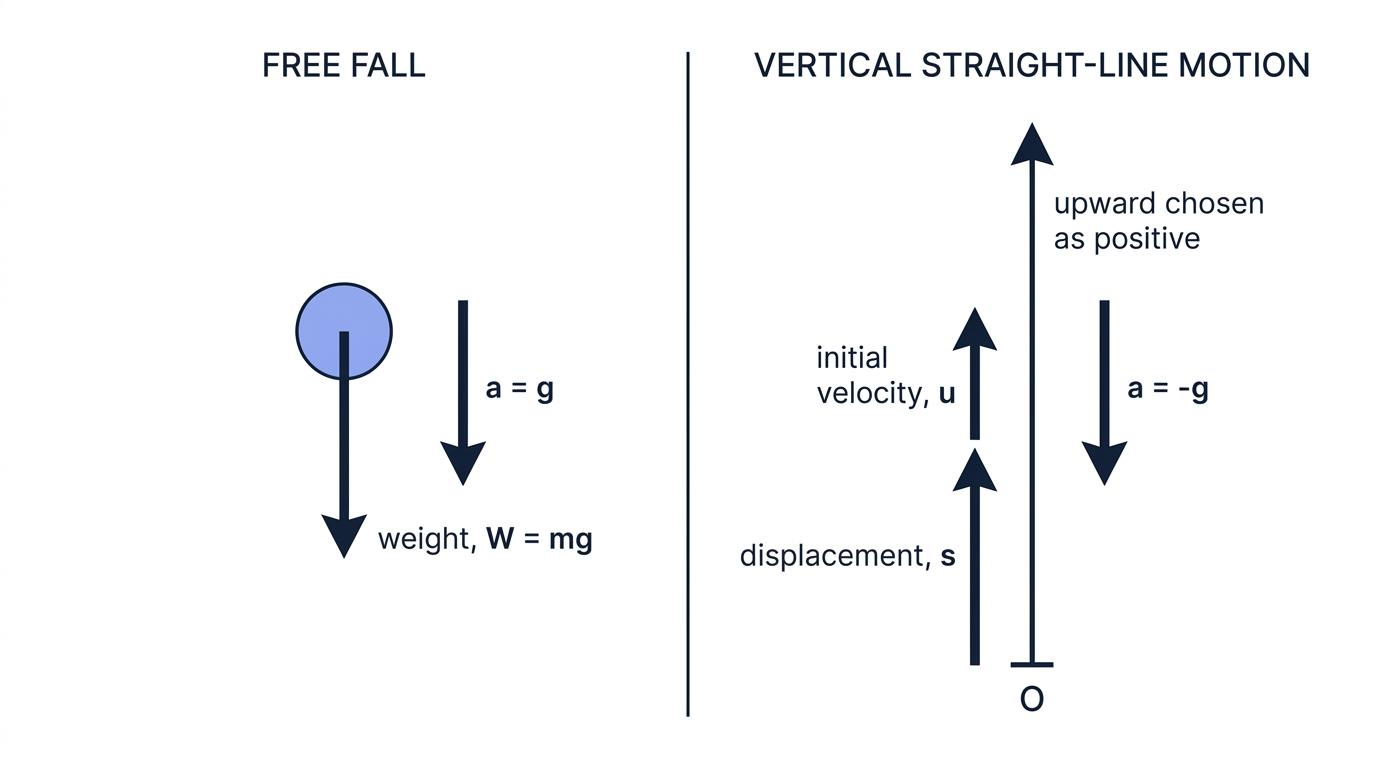
Near the Earth's surface, an object moving under gravity alone is modelled as having constant acceleration of magnitude ggg, directed vertically downwards.
Free fall and modelling assumptions
An object is in free fall when gravity is the only force acting on it. In the standard model, air resistance is ignored.
This has an important consequence: all freely falling objects at the same location have the same acceleration, regardless of their mass.
Using Newton's second law confirms this. For an object of mass mmm falling freely, its weight is the resultant force:
F=ma,mg=ma,a=g.\begin{aligned} F&=ma,\\ mg&=ma,\\ a&=g. \end{aligned}Fmga=ma,=ma,=g.The mass cancels, so a heavier object does not have a greater free-fall acceleration.
When the constant-acceleration model is unsuitable
If air resistance is significant, gravity is not the only force acting. The object's acceleration is then not necessarily constant or equal to ggg, so the usual constant-acceleration equations may not apply over the whole motion.
Choosing a positive direction
Velocity, displacement and acceleration are vector quantities, so their signs depend on the direction chosen as positive.
You may choose either upwards or downwards as positive. State your choice clearly and use it consistently.
Upwards as positive
If upwards is positive, then gravitational acceleration is negative:
a=−g=−9.8 m s−2.a=-g=-9.8\text{ m s}^{-2}.a=−g=−9.8 m s−2.An upward velocity is positive, while a downward velocity is negative.
Downwards as positive
If downwards is positive, then
a=g=9.8 m s−2.a=g=9.8\text{ m s}^{-2}.a=g=9.8 m s−2.A downward displacement and velocity are then positive.
Choose the convenient direction
For an object projected upwards, choosing upwards as positive often makes the initial velocity positive. For an object dropped down a shaft, choosing downwards as positive usually keeps the main quantities positive.
Using positive g automatically
The value 9.8 is the magnitude of gravitational acceleration. The signed acceleration is +9.8 m s−2+9.8\text{ m s}^{-2}+9.8 m s−2 or −9.8 m s−2-9.8\text{ m s}^{-2}−9.8 m s−2 according to your chosen positive direction.
Constant-acceleration equations
When an object moves in a straight vertical line under gravity alone, its acceleration is constant. You can therefore use the SUVAT equations:
v=u+at,s=ut+12at2,v2=u2+2as,s=12(u+v)t,s=vt−12at2.\begin{aligned} v&=u+at,\\ s&=ut+\frac{1}{2}at^2,\\ v^2&=u^2+2as,\\ s&=\frac{1}{2}(u+v)t,\\ s&=vt-\frac{1}{2}at^2. \end{aligned}vsv2ss=u+at,=ut+21at2,=u2+2as,=21(u+v)t,=vt−21at2.Here:
- sss is displacement from the chosen starting point, in m;
- uuu is initial velocity, in m s⁻¹;
- vvv is final velocity, in m s⁻¹;
- aaa is constant acceleration, in m s⁻²;
- ttt is elapsed time, in s.
Displacement is the signed change in position. It is not necessarily the same as total distance travelled.
An object dropped from rest
“Dropped” or “released from rest” means that the initial velocity is zero, so u=0u=0u=0.
Dropping an object from a tower
A stone is dropped from rest from a tower and falls 30 m. Ignore air resistance. Find its speed immediately before it reaches the ground.
-
Choose downwards as positive. Then u=0u=0u=0, s=30 ms=30\text{ m}s=30 m and a=9.8 m s−2a=9.8\text{ m s}^{-2}a=9.8 m s−2. Time is not required, so use v2=u2+2asv^2=u^2+2asv2=u2+2as.
-
Substitute the known quantities:
v2=02+2×9.8×30=588.v^2=0^2+2\times 9.8\times 30=588.v2=02+2×9.8×30=588. -
Since the question asks for speed, take the positive square root:
v=588=143 m s−1.v=\sqrt{588}=14\sqrt{3}\text{ m s}^{-1}.v=588=143 m s−1.
When an equation gives v=±⋯v=\pm\sqrt{\cdots}v=±⋯, select the sign that matches the actual direction of motion. If the question asks for speed, give the non-negative magnitude.
An object projected vertically upwards
When an object is projected upwards, gravity slows it down as it rises. At its greatest height, its instantaneous velocity is zero.
At maximum height
At the highest point, v=0v=0v=0, but the acceleration is still directed downwards and has magnitude ggg. The object has not lost its acceleration.
Finding maximum height and time
A ball is projected vertically upwards at 14 m s⁻¹. Find the time taken to reach its greatest height and the height gained.
-
Choose upwards as positive, giving u=14 m s−1u=14\text{ m s}^{-1}u=14 m s−1, a=−9.8 m s−2a=-9.8\text{ m s}^{-2}a=−9.8 m s−2 and v=0v=0v=0 at maximum height. From v=u+atv=u+atv=u+at:
0=14−9.8t,0=14-9.8t,0=14−9.8t,so t=107 st=\frac{10}{7}\text{ s}t=710 s.
-
To find the height gained without introducing another unknown, use v2=u2+2asv^2=u^2+2asv2=u2+2as:
02=142+2(−9.8)s.0^2=14^2+2(-9.8)s.02=142+2(−9.8)s. -
Solving gives
s=19619.6=10 m.s=\frac{196}{19.6}=10\text{ m}.s=19.6196=10 m.
Zero velocity does not mean zero acceleration
At the highest point, the ball is momentarily stationary, but gravity continues to act. Its acceleration remains −9.8 m s−2-9.8\text{ m s}^{-2}−9.8 m s−2 when upwards is positive.
Returning to the starting height
If an object returns to the same height from which it was projected, its overall displacement is zero.
In the model with constant gravity and no air resistance:
- the time rising equals the time falling back to the starting height;
- the speed on return equals the initial speed;
- the return velocity has the opposite sign to the initial velocity.
Returning to the point of projection
A particle is projected vertically upwards at 19.6 m s⁻¹. Find when it returns to its starting point and its velocity then.
-
Choose upwards as positive. At the return point, s=0s=0s=0, while u=19.6 m s−1u=19.6\text{ m s}^{-1}u=19.6 m s−1 and a=−9.8 m s−2a=-9.8\text{ m s}^{-2}a=−9.8 m s−2. Use s=ut+12at2s=ut+\frac12at^2s=ut+21at2:
0=19.6t−4.9t2.0=19.6t-4.9t^2.0=19.6t−4.9t2. -
Factorise:
0=4.9t(4−t),0=4.9t(4-t),0=4.9t(4−t),giving t=0t=0t=0 or t=4 st=4\text{ s}t=4 s. The value t=0t=0t=0 describes the launch, so the particle returns after 4 s.
-
Find the return velocity using v=u+atv=u+atv=u+at:
v=19.6−9.8(4)=−19.6 m s−1.v=19.6-9.8(4)=-19.6\text{ m s}^{-1}.v=19.6−9.8(4)=−19.6 m s−1.The negative sign means the particle is moving downwards.
Interpreting multiple solutions
A quadratic equation for time can produce two valid positive answers. This usually means that the object passes the same height once while rising and once while falling.
Do not reject a second time automatically. Interpret each solution using the physical motion.
Check the meaning of your answer
A negative velocity may be completely correct: it indicates motion opposite to your chosen positive direction. By contrast, a negative value of time is usually outside the modelled interval and should normally be rejected.
In the exam
- Draw a simple vertical diagram, choose a positive direction and assign signs to uuu, vvv, aaa and sss consistently.
- Translate phrases carefully: “dropped” means u=0u=0u=0, “greatest height” means v=0v=0v=0, and “returns to its starting point” means s=0s=0s=0.
- Select the SUVAT equation containing the quantities you know and the one you need, substitute with units, and interpret signs or multiple solutions in context.
- Use the stated value of ggg and avoid rounding until the final answer.
Check yourself
- What is the difference between an object's mass and its weight?
- If upwards is positive, what signs should displacement, velocity and acceleration have while an object is falling?
- A ball is projected upwards and later passes the launch point again. What are its displacement and direction of velocity at that instant?
