

What you'll learn
- How to add vectors using column-vector notation.
- How to add vectors diagrammatically using the triangle and parallelogram rules.
- How multiplying a vector by a scalar changes its length and direction.
- How to subtract vectors and simplify vector expressions.
Before you begin
A vector is a quantity with both magnitude and direction. The magnitude is the size or length of the vector.
For example,
a=(3−2)\mathbf{a}=\begin{pmatrix}3\\-2\end{pmatrix}a=(3−2)describes a movement of 3 units in the positive horizontal direction and 2 units in the negative vertical direction.
A vector is often shown in bold, such as a\mathbf{a}a, or as an arrow, such as AB→\overrightarrow{AB}AB.
Equal vectors
Two vectors are equal if they have the same magnitude and the same direction. They do not need to begin at the same point.
The vector AB→\overrightarrow{AB}AB describes the displacement from point AAA to point BBB. Reversing the order reverses the direction:
BA→=−AB→.\overrightarrow{BA}=-\overrightarrow{AB}.BA=−AB.Adding vectors algebraically
To add two vectors in column-vector form, add their corresponding components.
If
a=(a1a2)andb=(b1b2),\mathbf{a}=\begin{pmatrix}a_1\\a_2\end{pmatrix} \quad\text{and}\quad \mathbf{b}=\begin{pmatrix}b_1\\b_2\end{pmatrix},a=(a1a2)andb=(b1b2),then
a+b=(a1+b1a2+b2).\mathbf{a}+\mathbf{b} = \begin{pmatrix} a_1+b_1\\ a_2+b_2 \end{pmatrix}.a+b=(a1+b1a2+b2).The same principle applies in three dimensions: add the first components, then the second components, then the third components.
Add matching components
Vector arithmetic is carried out component by component. Horizontal components combine with horizontal components, and vertical components combine with vertical components.
Adding two vectors
Let
a=(4−3),b=(−15).\mathbf{a}=\begin{pmatrix}4\\-3\end{pmatrix}, \qquad \mathbf{b}=\begin{pmatrix}-1\\5\end{pmatrix}.a=(4−3),b=(−15).Find a+b\mathbf{a}+\mathbf{b}a+b.
-
Add the horizontal components: 4+(−1)=34+(-1)=34+(−1)=3.
-
Add the vertical components: −3+5=2-3+5=2−3+5=2.
-
Therefore,
a+b=(4+(−1)−3+5)=(32).\mathbf{a}+\mathbf{b} = \begin{pmatrix} 4+(-1)\\ -3+5 \end{pmatrix} = \begin{pmatrix}3\\2\end{pmatrix}.a+b=(4+(−1)−3+5)=(32).
Ignoring negative components
A negative component must keep its sign during the calculation. For example, adding −1-1−1 means subtracting 1; it does not become positive automatically.
Adding vectors diagrammatically
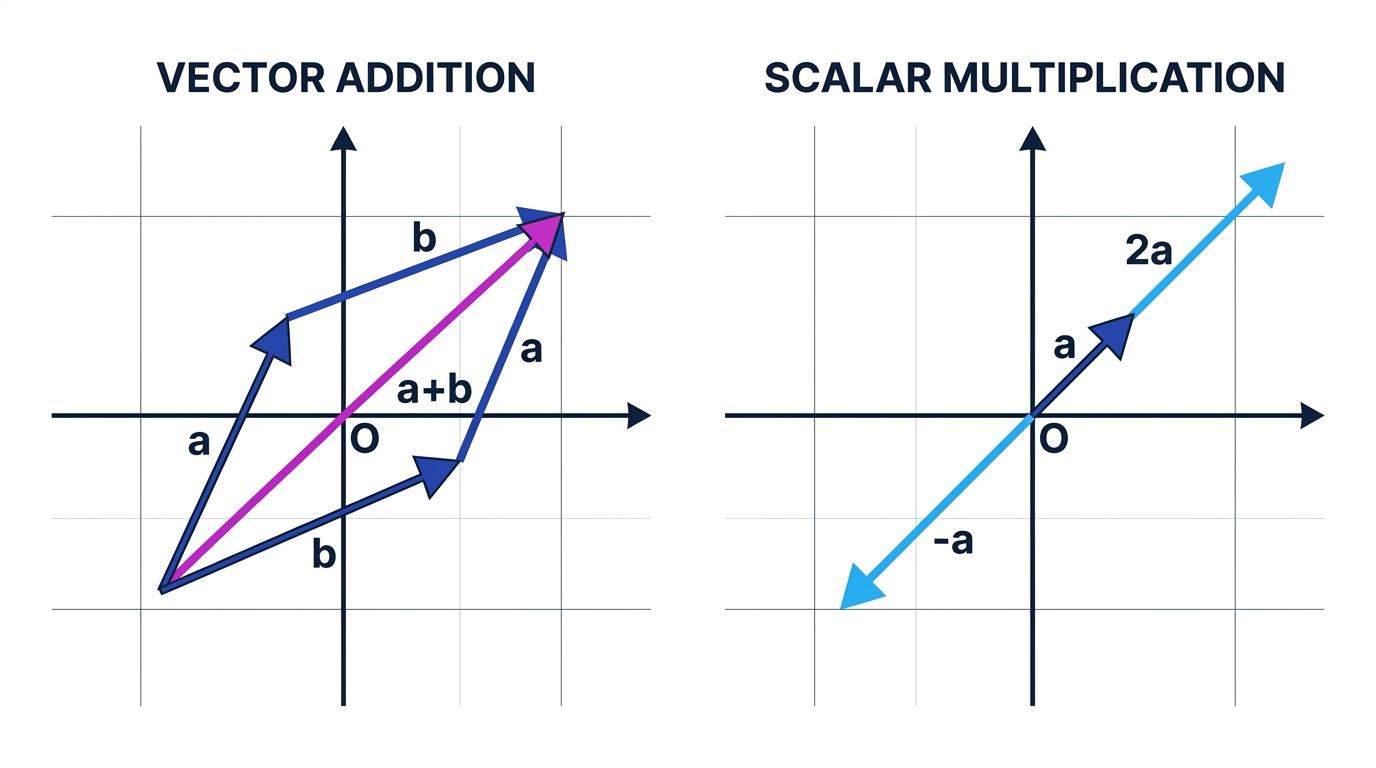
Geometrically, vector addition represents performing one displacement and then another.
The triangle rule
To add a\mathbf{a}a and b\mathbf{b}b:
- Draw a\mathbf{a}a.
- Place the tail of b\mathbf{b}b at the head of a\mathbf{a}a without changing the length or direction of b\mathbf{b}b.
- Draw the resultant vector from the tail of a\mathbf{a}a to the head of b\mathbf{b}b.
This resultant is a+b\mathbf{a}+\mathbf{b}a+b.
The parallelogram rule
Alternatively, draw a\mathbf{a}a and b\mathbf{b}b from the same starting point. Complete a parallelogram using copies of the two vectors. The diagonal from the starting point is a+b\mathbf{a}+\mathbf{b}a+b.
Combining two displacements
A particle moves through displacement
p=(21)\mathbf{p}=\begin{pmatrix}2\\1\end{pmatrix}p=(21)followed by displacement
q=(3−4).\mathbf{q}=\begin{pmatrix}3\\-4\end{pmatrix}.q=(3−4).Find its overall displacement.
-
The phrase “followed by” tells you to add the displacement vectors: p+q\mathbf{p}+\mathbf{q}p+q.
-
Combine the corresponding components:
p+q=(2+31+(−4)).\mathbf{p}+\mathbf{q} = \begin{pmatrix} 2+3\\ 1+(-4) \end{pmatrix}.p+q=(2+31+(−4)). -
The overall displacement is
(5−3).\begin{pmatrix}5\\-3\end{pmatrix}.(5−3).Geometrically, this is the vector from the particle's original position to its final position.
Vector addition is commutative, meaning that the order does not affect the result:
a+b=b+a.\mathbf{a}+\mathbf{b}=\mathbf{b}+\mathbf{a}.a+b=b+a.It is also associative, so brackets may be regrouped:
(a+b)+c=a+(b+c).(\mathbf{a}+\mathbf{b})+\mathbf{c} = \mathbf{a}+(\mathbf{b}+\mathbf{c}).(a+b)+c=a+(b+c).The intermediate routes may look different, but the starting and finishing points, and therefore the resultant vector, are the same.
The zero vector
The zero vector, written 0\mathbf{0}0, has magnitude zero. In two dimensions,
0=(00).\mathbf{0}=\begin{pmatrix}0\\0\end{pmatrix}.0=(00).Adding it has no effect:
a+0=a.\mathbf{a}+\mathbf{0}=\mathbf{a}.a+0=a.Geometrically, the zero vector represents no displacement.
Multiplication by scalars
A scalar is an ordinary numerical quantity with magnitude but no direction. Multiplying a vector by a scalar changes its magnitude and may change its direction.
If
a=(a1a2),\mathbf{a}=\begin{pmatrix}a_1\\a_2\end{pmatrix},a=(a1a2),then
ka=(ka1ka2),k\mathbf{a} = \begin{pmatrix} ka_1\\ ka_2 \end{pmatrix},ka=(ka1ka2),where kkk is a scalar.
The geometrical interpretation depends on the value of kkk:
- If k>1k>1k>1, the vector points in the same direction and becomes longer.
- If 0<k<10<k<10<k<1, it points in the same direction and becomes shorter.
- If k<0k<0k<0, its direction is reversed as well as its length being scaled.
- If k=0k=0k=0, the result is the zero vector.
In particular, −a-\mathbf{a}−a has the same magnitude as a\mathbf{a}a but points in the opposite direction.
Effect of a scalar
Multiplying by kkk multiplies the vector's length by ∣k∣|k|∣k∣. A negative value of kkk also reverses its direction.
Scaling and reversing a vector
Given
a=(−23),\mathbf{a}=\begin{pmatrix}-2\\3\end{pmatrix},a=(−23),find −3a-3\mathbf{a}−3a and interpret it geometrically.
-
Multiply each component by the scalar:
−3a=−3(−23)=((−3)(−2)(−3)(3)).-3\mathbf{a} = -3\begin{pmatrix}-2\\3\end{pmatrix} = \begin{pmatrix} (-3)(-2)\\ (-3)(3) \end{pmatrix}.−3a=−3(−23)=((−3)(−2)(−3)(3)). -
This gives
−3a=(6−9).-3\mathbf{a}=\begin{pmatrix}6\\-9\end{pmatrix}.−3a=(6−9). -
The magnitude is three times the magnitude of a\mathbf{a}a, while the negative scalar means that the direction is opposite to a\mathbf{a}a.
Spotting parallel vectors
If b=ka\mathbf{b}=k\mathbf{a}b=ka for some non-zero scalar kkk, then the vectors are parallel. They point in the same direction when k>0k>0k>0 and in opposite directions when k<0k<0k<0.
Subtracting vectors
Subtracting a vector means adding its negative:
a−b=a+(−b).\mathbf{a}-\mathbf{b} = \mathbf{a}+(-\mathbf{b}).a−b=a+(−b).In column-vector form, you can subtract corresponding components directly:
(a1a2)−(b1b2)=(a1−b1a2−b2).\begin{pmatrix}a_1\\a_2\end{pmatrix} - \begin{pmatrix}b_1\\b_2\end{pmatrix} = \begin{pmatrix} a_1-b_1\\ a_2-b_2 \end{pmatrix}.(a1a2)−(b1b2)=(a1−b1a2−b2).Geometrically, if a\mathbf{a}a and b\mathbf{b}b begin at the same point, then a−b\mathbf{a}-\mathbf{b}a−b is the vector from the head of b\mathbf{b}b to the head of a\mathbf{a}a.
Finding the vector between two points
The position vectors of points AAA and BBB are
OA→=(2−1),OB→=(73).\overrightarrow{OA}=\begin{pmatrix}2\\-1\end{pmatrix}, \qquad \overrightarrow{OB}=\begin{pmatrix}7\\3\end{pmatrix}.OA=(2−1),OB=(73).Find AB→\overrightarrow{AB}AB.
-
Travelling from AAA to BBB can be written as travelling from AAA back to OOO, then from OOO to BBB:
AB→=AO→+OB→.\overrightarrow{AB} = \overrightarrow{AO}+\overrightarrow{OB}.AB=AO+OB. -
Since AO→=−OA→\overrightarrow{AO}=-\overrightarrow{OA}AO=−OA,
AB→=OB→−OA→.\overrightarrow{AB} = \overrightarrow{OB}-\overrightarrow{OA}.AB=OB−OA. -
Substitute and subtract corresponding components:
AB→=(73)−(2−1)=(54).\overrightarrow{AB} = \begin{pmatrix}7\\3\end{pmatrix} - \begin{pmatrix}2\\-1\end{pmatrix} = \begin{pmatrix}5\\4\end{pmatrix}.AB=(73)−(2−1)=(54).
Reversing the subtraction
To find AB→\overrightarrow{AB}AB from position vectors, use OB→−OA→\overrightarrow{OB}-\overrightarrow{OA}OB−OA. The destination comes first and the starting point comes second.
Simplifying vector expressions
Scalar multiplication distributes over vector addition:
k(a+b)=ka+kb.k(\mathbf{a}+\mathbf{b}) = k\mathbf{a}+k\mathbf{b}.k(a+b)=ka+kb.You can therefore simplify vector expressions using familiar algebraic rules, while keeping bold vector symbols.
Simplifying a vector expression
Simplify
3(a−2b)−(a+b).3(\mathbf{a}-2\mathbf{b})-(\mathbf{a}+\mathbf{b}).3(a−2b)−(a+b).-
Expand both brackets:
3a−6b−a−b.3\mathbf{a}-6\mathbf{b}-\mathbf{a}-\mathbf{b}.3a−6b−a−b. -
Collect the multiples of each vector separately:
(3−1)a+(−6−1)b.(3-1)\mathbf{a}+(-6-1)\mathbf{b}.(3−1)a+(−6−1)b. -
The simplified expression is
2a−7b.2\mathbf{a}-7\mathbf{b}.2a−7b.
In the exam
- Keep vector notation throughout and align column-vector components carefully.
- For AB→\overrightarrow{AB}AB, use “position of BBB minus position of AAA”.
- Check the geometry: a positive scalar keeps the direction, a negative scalar reverses it, and a sum should represent the complete head-to-tail journey.
- Give exact component values unless the question specifically requests decimals.
Check yourself
- How would you calculate a−2b\mathbf{a}-2\mathbf{b}a−2b from two column vectors?
- What does the equation b=−4a\mathbf{b}=-4\mathbf{a}b=−4a tell you about the lengths and directions of the vectors?
- If OP→\overrightarrow{OP}OP and OQ→\overrightarrow{OQ}OQ are known, how would you find PQ→\overrightarrow{PQ}PQ?
