

What you'll learn
- How to generate a sequence from an nth-term formula or a recurrence relation.
- How to decide whether a sequence is increasing or decreasing.
- How to recognise and describe periodic sequences.
- How to justify a sequence's type using algebra rather than checking only a few terms.
Sequences and their notation
A sequence is an ordered list of numbers called terms. The position of each term matters.
For example, the sequence
3, 7, 11, 15,…3,\ 7,\ 11,\ 15,\ldots3, 7, 11, 15,…has first term 3, second term 7 and so on.
Term notation
The symbol xnx_nxn means the term in position nnn. Thus, x1x_1x1 is the first term, x2x_2x2 is the second term and x10x_{10}x10 is the tenth term.
The letter used does not matter: you may also see unu_nun, ana_nan or another letter.
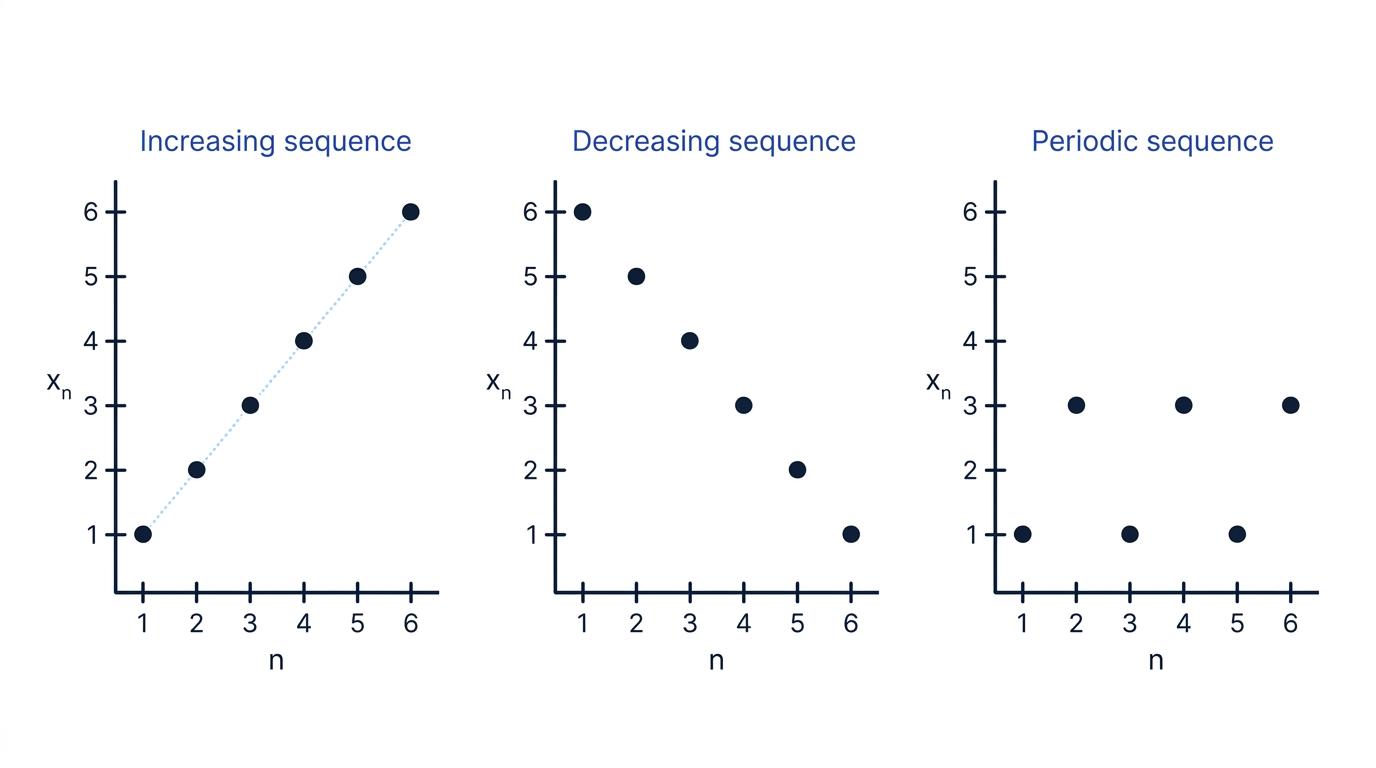
A sequence is made of separate terms, usually corresponding to positive integer values of nnn. If its terms are plotted, the points should not be treated as a continuous curve.
Sequences defined by an nth term
An nth-term formula gives each term directly in terms of its position nnn. To find a particular term, substitute its position into the formula.
For example, if
xn=3n2−2,x_n=3n^2-2,xn=3n2−2,then any term can be calculated without finding the terms before it.
Generating terms from an nth-term formula
The sequence is defined by xn=3n2−2x_n=3n^2-2xn=3n2−2. Find its first three terms and its tenth term.
-
Substitute n=1n=1n=1, n=2n=2n=2 and n=3n=3n=3:
x1=3(1)2−2=1,x2=3(2)2−2=10,x3=3(3)2−2=25.\begin{aligned} x_1&=3(1)^2-2=1,\\ x_2&=3(2)^2-2=10,\\ x_3&=3(3)^2-2=25. \end{aligned}x1x2x3=3(1)2−2=1,=3(2)2−2=10,=3(3)2−2=25. -
Therefore, the sequence begins
1, 10, 25,…1,\ 10,\ 25,\ldots1, 10, 25,… -
Substitute n=10n=10n=10 directly to find the tenth term:
x10=3(10)2−2=298.x_{10}=3(10)^2-2=298.x10=3(10)2−2=298.
Sequences defined recursively
A recurrence relation defines each new term using one or more earlier terms.
A simple recurrence has the form
xn+1=f(xn),x_{n+1}=f(x_n),xn+1=f(xn),where fff is a function. This means that the next term is found by applying the rule fff to the current term.
A starting value is essential
A recurrence relation does not usually define a unique sequence by itself. You also need an initial value, such as x1=4x_1=4x1=4, to start the process.
Generating terms recursively
A sequence is defined by
x1=4,xn+1=3xn−2.x_1=4,\qquad x_{n+1}=3x_n-2.x1=4,xn+1=3xn−2.Find the next three terms.
-
Apply the recurrence to x1=4x_1=4x1=4:
x2=3x1−2=3(4)−2=10.x_2=3x_1-2=3(4)-2=10.x2=3x1−2=3(4)−2=10. -
Use the newly calculated value to find the next term:
x3=3x2−2=3(10)−2=28.x_3=3x_2-2=3(10)-2=28.x3=3x2−2=3(10)−2=28. -
Repeat the process once more:
x4=3x3−2=3(28)−2=82.x_4=3x_3-2=3(28)-2=82.x4=3x3−2=3(28)−2=82.The sequence begins 4, 10, 28, 82,…4,\ 10,\ 28,\ 82,\ldots4, 10, 28, 82,…
Substituting the term number
In xn+1=3xn−2x_{n+1}=3x_n-2xn+1=3xn−2, the input is the previous term value, not the term number. To find x4x_4x4, use x3x_3x3, not n=3n=3n=3.
Increasing sequences
An increasing sequence has terms that get larger as nnn increases.
Strictly increasing sequence
A sequence is strictly increasing if
xn+1>xnx_{n+1}>x_nxn+1>xnfor every permitted value of nnn.
A sequence is non-decreasing if xn+1≥xnx_{n+1}\ge x_nxn+1≥xn. This allows consecutive terms to be equal. Questions sometimes use “increasing” for this weaker meaning, so read the wording carefully.
Checking several terms can suggest that a sequence is increasing, but it does not prove that every later term continues to increase.
For a sequence defined by an nth term, examine the difference
xn+1−xn.x_{n+1}-x_n.xn+1−xn.- If this difference is positive for every permitted nnn, the sequence is strictly increasing.
- If it is non-negative, the sequence is non-decreasing.
Decreasing sequences
A decreasing sequence has terms that get smaller as nnn increases.
Strictly decreasing sequence
A sequence is strictly decreasing if
xn+1<xnx_{n+1}<x_nxn+1<xnfor every permitted value of nnn.
Similarly, a sequence is non-increasing if xn+1≤xnx_{n+1}\le x_nxn+1≤xn, allowing equal consecutive terms.
The same difference test works:
- xn+1−xn<0x_{n+1}-x_n<0xn+1−xn<0 proves that the sequence is strictly decreasing.
- xn+1−xn≤0x_{n+1}-x_n\le 0xn+1−xn≤0 proves that it is non-increasing.
Classifying a sequence using differences
Determine whether the sequence xn=n2−4nx_n=n^2-4nxn=n2−4n is increasing or decreasing for n≥1n\ge1n≥1.
-
Form the next term by replacing nnn with n+1n+1n+1:
xn+1=(n+1)2−4(n+1)=n2−2n−3.x_{n+1}=(n+1)^2-4(n+1)=n^2-2n-3.xn+1=(n+1)2−4(n+1)=n2−2n−3. -
Subtract the current term:
xn+1−xn=(n2−2n−3)−(n2−4n)=2n−3.\begin{aligned} x_{n+1}-x_n &=(n^2-2n-3)-(n^2-4n)\\ &=2n-3. \end{aligned}xn+1−xn=(n2−2n−3)−(n2−4n)=2n−3. -
Test the sign over the required domain. At n=1n=1n=1, the difference is negative, but for n≥2n\ge2n≥2 it is positive. Therefore, the sequence decreases from x1x_1x1 to x2x_2x2, then increases from that point onwards. It is neither increasing nor decreasing over the whole domain n≥1n\ge1n≥1.
Use the sign, not the size of the terms
An increasing sequence can contain negative terms, and a decreasing sequence can contain positive terms. Compare consecutive terms rather than asking whether the terms themselves are positive or negative.
For a recurrence relation, it may be possible to rearrange the rule to identify the sign of xn+1−xnx_{n+1}-x_nxn+1−xn directly. However, take care: the sign may depend on the current value xnx_nxn.
Periodic sequences
A periodic sequence repeats after a fixed number of terms.
Period
A sequence has period ppp if ppp is a positive integer such that
xn+p=xnx_{n+p}=x_nxn+p=xnfor every permitted value of nnn. The smallest possible positive value of ppp is called the fundamental period.
For example, the sequence
2, 5, 2, 5, 2, 5,…2,\ 5,\ 2,\ 5,\ 2,\ 5,\ldots2, 5, 2, 5, 2, 5,…has fundamental period 2.
A constant sequence has period 1 because every term is the same.
Identifying a periodic recurrence
A sequence is defined by
x1=3,xn+1=1−xn.x_1=3,\qquad x_{n+1}=1-x_n.x1=3,xn+1=1−xn.Show that it is periodic and state its fundamental period.
-
Generate the next terms:
x2=1−3=−2,x3=1−(−2)=3,x4=1−3=−2.\begin{aligned} x_2&=1-3=-2,\\ x_3&=1-(-2)=3,\\ x_4&=1-3=-2. \end{aligned}x2x3x4=1−3=−2,=1−(−2)=3,=1−3=−2.This suggests the repeating pattern 3, −2, 3, −2,…3,\ -2,\ 3,\ -2,\ldots3, −2, 3, −2,…
-
Apply the recurrence twice to justify the repetition:
xn+2=1−xn+1=1−(1−xn)=xn.x_{n+2}=1-x_{n+1}=1-(1-x_n)=x_n.xn+2=1−xn+1=1−(1−xn)=xn.Therefore, every term repeats two places later.
-
Since the sequence is not constant, its period cannot be 1. Its fundamental period is therefore 2.
A sequence may also be periodic when defined by an nth term. For instance,
xn=cos(nπ2)x_n=\cos\left(\frac{n\pi}{2}\right)xn=cos(2nπ)generates 0, −1, 0, 1,…0,\ -1,\ 0,\ 1,\ldots0, −1, 0, 1,… and satisfies xn+4=xnx_{n+4}=x_nxn+4=xn, so its fundamental period is 4.
Assuming an observed pattern is proof
Writing down a few repeated terms provides evidence of periodicity, but an algebraic argument such as xn+p=xnx_{n+p}=x_nxn+p=xn proves that the pattern continues indefinitely.
Sequences that do not fit one type
Not every sequence is increasing, decreasing or periodic.
For example, xn=(−1)nnx_n=(-1)^n nxn=(−1)nn generates
−1, 2, −3, 4, −5,…-1,\ 2,\ -3,\ 4,\ -5,\ldots−1, 2, −3, 4, −5,…The terms alternate in sign while their magnitudes grow. The sequence is neither increasing nor decreasing, and it does not repeat, so it is not periodic.
In the exam
- Identify whether you have an nth-term formula or a recurrence relation; for a recurrence, locate the starting value.
- To test increasing or decreasing behaviour, calculate and simplify xn+1−xnx_{n+1}-x_nxn+1−xn, then justify its sign over the stated values of nnn.
- To prove periodicity, show that xn+p=xnx_{n+p}=x_nxn+p=xn for every relevant nnn, and check whether a smaller positive period is possible.
- Pay attention to the starting index and to whether the question requires strict or non-strict inequalities.
Check yourself
- How would you prove that xn=2n2+3x_n=2n^2+3xn=2n2+3 is strictly increasing for n≥1n\ge1n≥1?
- Generate the first five terms of x1=2x_1=2x1=2, xn+1=4−xnx_{n+1}=4-x_nxn+1=4−xn, and identify the fundamental period.
- Can a sequence be non-decreasing and non-increasing at the same time? What would such a sequence look like?
