

What you'll learn
- How to resolve vectors into perpendicular components using sine and cosine.
- How to model motion in two dimensions, including projectiles.
- How to use trigonometry with forces and equilibrium.
- How to interpret solutions correctly in a real context.
Prerequisites: right-angled trigonometry
For an angle θ\thetaθ in a right-angled triangle,
sinθ=oppositehypotenuse,cosθ=adjacenthypotenuse,tanθ=oppositeadjacent.\sin\theta=\frac{\text{opposite}}{\text{hypotenuse}},\qquad \cos\theta=\frac{\text{adjacent}}{\text{hypotenuse}},\qquad \tan\theta=\frac{\text{opposite}}{\text{adjacent}}.sinθ=hypotenuseopposite,cosθ=hypotenuseadjacent,tanθ=adjacentopposite.You will also need Pythagoras' theorem and inverse trigonometric functions. For example, if
tanθ=34,\tan\theta=\frac{3}{4},tanθ=43,then θ=tan−1(34)\theta=\tan^{-1}\left(\frac{3}{4}\right)θ=tan−1(43).
In mechanics, angles are usually measured from the horizontal or vertical. Always identify which direction the angle is measured from before choosing sine or cosine.
Choosing sine or cosine
The component next to the given angle uses cosine; the component opposite the angle uses sine.
Vectors and components
A vector is a quantity with both magnitude and direction. Velocity, acceleration and force are vectors.
A component is the part of a vector acting in a chosen direction. In two-dimensional problems, the most useful directions are usually horizontal and vertical.
Resolving a vector
Resolving a vector means replacing it with two or more components whose combined effect is the same as the original vector.
If a vector of magnitude FFF acts at an angle θ\thetaθ above the horizontal, its components are
horizontal component=Fcosθ,vertical component=Fsinθ.\begin{aligned} \text{horizontal component} &= F\cos\theta,\\ \text{vertical component} &= F\sin\theta. \end{aligned}horizontal componentvertical component=Fcosθ,=Fsinθ.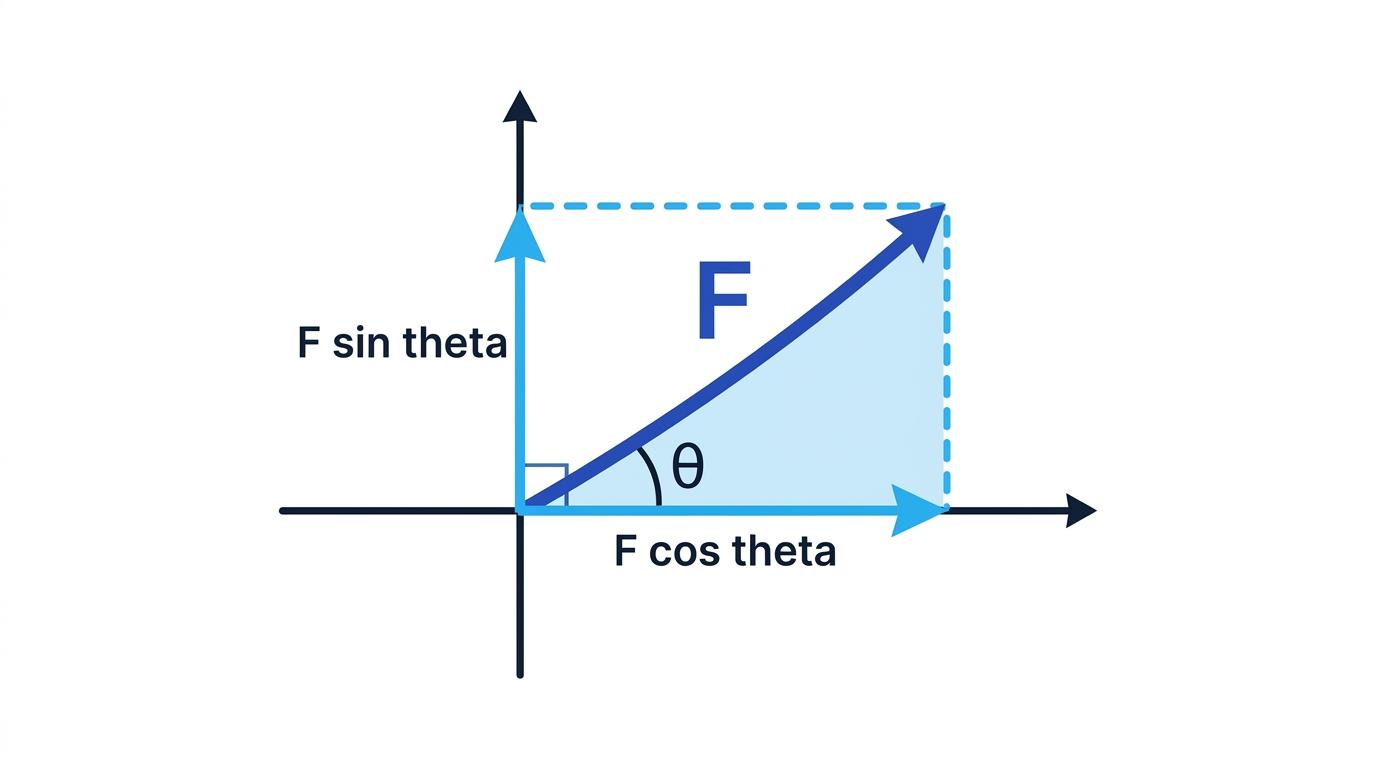
Directions must be represented by signs. If right and up are positive, a component to the left or down is negative.
Finding a resultant velocity
A boat travels east at 8 m s⁻¹ while a current carries it north at 6 m s⁻¹. Find the magnitude and direction of its resultant velocity.
-
The east and north velocities are perpendicular components, so the magnitude vvv is found using Pythagoras:
v=82+62=10 m s−1.v=\sqrt{8^2+6^2}=10\text{ m s}^{-1}.v=82+62=10 m s−1. -
If θ\thetaθ is the angle north of east, the northward component is opposite θ\thetaθ and the eastward component is adjacent:
tanθ=68.\tan\theta=\frac{6}{8}.tanθ=86. -
Therefore,
θ=tan−1(68)≈36.9∘.\theta=\tan^{-1}\left(\frac{6}{8}\right)\approx36.9^\circ.θ=tan−1(86)≈36.9∘.The resultant velocity is 10 m s⁻¹ at approximately 36.9∘36.9^\circ36.9∘ north of east.
Giving an incomplete direction
An angle such as 36.9∘36.9^\circ36.9∘ is not a complete direction by itself. State the reference direction, for example “36.9∘36.9^\circ36.9∘ north of east”.
Kinematics in two dimensions
Kinematics is the study of motion without considering the forces causing it.
For constant acceleration in one dimension, the SUVAT equations include
v=u+at,s=ut+12at2,v2=u2+2as.v=u+at,\qquad s=ut+\frac12at^2,\qquad v^2=u^2+2as.v=u+at,s=ut+21at2,v2=u2+2as.In two dimensions, resolve the motion and apply SUVAT separately in each direction. The same time ttt applies to both directions.
Projectile motion
A projectile is an object that moves under gravity alone after it has been launched. The standard model assumes no air resistance and uses g=9.8 m s−2g=9.8\text{ m s}^{-2}g=9.8 m s−2 unless told otherwise.
For a projectile launched with speed uuu at angle θ\thetaθ above the horizontal,
ux=ucosθ,uy=usinθ.u_x=u\cos\theta,\qquad u_y=u\sin\theta.ux=ucosθ,uy=usinθ.Horizontally, the acceleration is zero. Vertically, taking upwards as positive, the acceleration is −g-g−g.
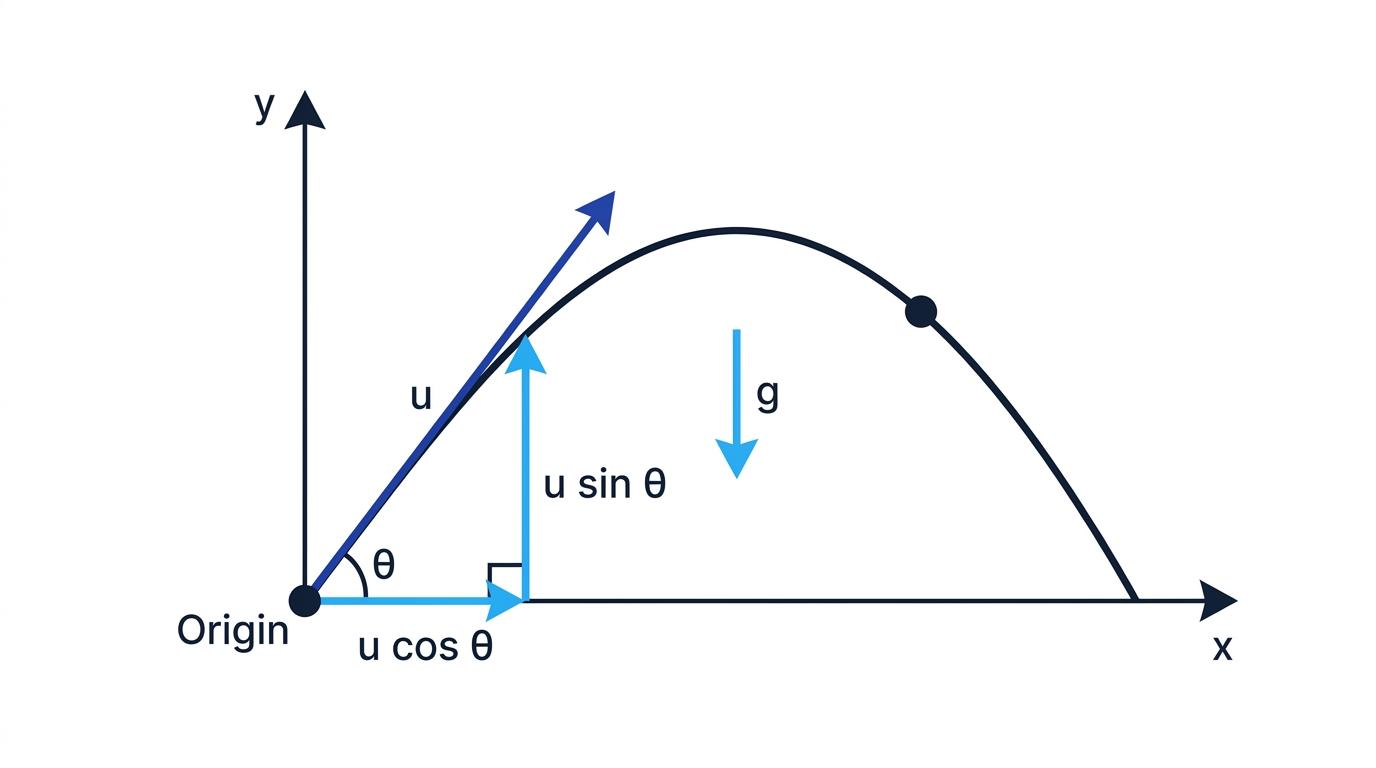
Two linked motions
A projectile has constant horizontal velocity and accelerated vertical motion. The two motions are linked by their common time.
Finding the flight time and range
A particle is projected from horizontal ground at 20 m s⁻¹ at an angle of 30∘30^\circ30∘ above the horizontal. Find its time of flight and horizontal range.
-
Resolve the initial velocity:
ux=20cos30∘=103 m s−1,uy=20sin30∘=10 m s−1.\begin{aligned} u_x&=20\cos30^\circ=10\sqrt3\text{ m s}^{-1},\\ u_y&=20\sin30^\circ=10\text{ m s}^{-1}. \end{aligned}uxuy=20cos30∘=103 m s−1,=20sin30∘=10 m s−1. -
At the end of the flight, the particle has returned to its original vertical level, so the vertical displacement is zero. Using s=ut+12at2s=ut+\frac12at^2s=ut+21at2 vertically:
0=10t−12(9.8)t2.0=10t-\frac12(9.8)t^2.0=10t−21(9.8)t2. -
Factorising gives
t(10−4.9t)=0.t(10-4.9t)=0.t(10−4.9t)=0.The solution t=0t=0t=0 represents the launch, so the later time is
t=104.9≈2.04 s.t=\frac{10}{4.9}\approx2.04\text{ s}.t=4.910≈2.04 s. -
Horizontal acceleration is zero, so the range RRR is
R=uxt=103(104.9)≈35.3 m.R=u_xt=10\sqrt3\left(\frac{10}{4.9}\right)\approx35.3\text{ m}.R=uxt=103(4.910)≈35.3 m.
Discarding the wrong time
When a displacement equation gives t=0t=0t=0 and a positive time, t=0t=0t=0 is usually the initial launch. Use the positive later time for the flight time.
Maximum height
At the highest point of a projectile's path, its vertical velocity is zero. Its horizontal velocity is not zero.
You can find the time to maximum height using v=u+atv=u+atv=u+at, or find the height directly using v2=u2+2asv^2=u^2+2asv2=u2+2as, applied vertically.
Finding maximum height
For the previous projectile, the initial vertical velocity is 10 m s⁻¹. Find its maximum height.
-
At maximum height, set the vertical velocity to zero and use vertical acceleration a=−9.8a=-9.8a=−9.8 m s⁻²:
02=102+2(−9.8)h.0^2=10^2+2(-9.8)h.02=102+2(−9.8)h. -
Rearranging gives
h=10019.6≈5.10 m.h=\frac{100}{19.6}\approx5.10\text{ m}.h=19.6100≈5.10 m.
Forces at angles
A force is a push or pull measured in newtons, N. Forces are vectors, so an angled force should usually be resolved before applying Newton's laws.
Common forces include:
- Weight, which acts vertically downwards and has magnitude mgmgmg.
- Normal reaction, which acts perpendicular to a surface.
- Friction, which acts parallel to a surface and opposes motion or impending motion.
- Tension, which acts along a taut string or cable.
Equilibrium
An object is in equilibrium when its resultant force is zero. Therefore, the total force in every chosen direction is zero.
Equilibrium equations
For equilibrium in a horizontal-vertical coordinate system,
∑Fx=0and∑Fy=0.\sum F_x=0 \qquad\text{and}\qquad \sum F_y=0.∑Fx=0and∑Fy=0.Balancing an angled force
A sign of weight 120 N is held in equilibrium by a cable making an angle of 40∘40^\circ40∘ above the horizontal and a horizontal force. Find the cable tension TTT and the horizontal force PPP.
-
Resolve the cable tension. Its vertical component is Tsin40∘T\sin40^\circTsin40∘ and its horizontal component is Tcos40∘T\cos40^\circTcos40∘.
-
Vertical equilibrium requires the upward component to balance the weight:
Tsin40∘=120.T\sin40^\circ=120.Tsin40∘=120.Hence
T=120sin40∘≈187 N.T=\frac{120}{\sin40^\circ}\approx187\text{ N}.T=sin40∘120≈187 N. -
Horizontal equilibrium requires PPP to balance the cable's horizontal component:
P=Tcos40∘≈187cos40∘≈143 N.P=T\cos40^\circ\approx187\cos40^\circ\approx143\text{ N}.P=Tcos40∘≈187cos40∘≈143 N.
Choose helpful axes
On an inclined plane, resolving parallel and perpendicular to the plane is often easier than resolving horizontally and vertically.
Modelling and interpreting answers
A mathematical model is a simplified representation of a real situation. Typical assumptions include particles having no size, strings being light and inextensible, and air resistance being negligible.
Your calculated answer is only valid within those assumptions. You should also check that it is physically meaningful:
- Time, speed, distance and force magnitudes should not be negative.
- A value of sinθ\sin\thetasinθ or cosθ\cos\thetacosθ must lie between -1 and 1.
- An angle must match the geometry and stated interval.
- Units should be carried through and included in the final answer.
Accepting every calculator solution
A trigonometric equation may have several mathematical solutions, but the context may allow only one. Reject angles or times that do not fit the diagram, interval or physical situation.
In the exam
- Draw a clear diagram, mark the angle and choose positive directions.
- Resolve every relevant vector before writing kinematics or force equations.
- Keep horizontal and vertical equations separate, linking them only through common quantities such as time.
- Use the context to reject impossible solutions, then give appropriate units and accuracy.
Check yourself
- A force of magnitude FFF acts at 25∘25^\circ25∘ to the vertical. What are its horizontal and vertical components?
- Why is the vertical velocity, but not the total velocity, zero at the highest point of a projectile's path?
- How would you form two equilibrium equations for an object held by two angled cables?
