

What you'll learn
- What makes a trigonometric identity different from an equation.
- How tanθ\tan\thetatanθ, secθ\sec\thetasecθ, cosecθ\operatorname{cosec}\thetacosecθ and cotθ\cot\thetacotθ are connected to sine and cosine.
- How to derive and use the three Pythagorean identities.
- How to simplify expressions and prove identities systematically.
Prerequisites: the trigonometric ratios
You should already know the three basic trigonometric ratios:
sinθ=oppositehypotenuse,cosθ=adjacenthypotenuse,tanθ=oppositeadjacent.\sin\theta=\frac{\text{opposite}}{\text{hypotenuse}}, \qquad \cos\theta=\frac{\text{adjacent}}{\text{hypotenuse}}, \qquad \tan\theta=\frac{\text{opposite}}{\text{adjacent}}.sinθ=hypotenuseopposite,cosθ=hypotenuseadjacent,tanθ=adjacentopposite.At A-level, you also use three reciprocal trigonometric functions. A reciprocal is obtained by dividing 1 by a quantity.
Reciprocal trigonometric functions
For example, sec2θ\sec^2\thetasec2θ means (secθ)2(\sec\theta)^2(secθ)2. It does not mean sec(θ2)\sec(\theta^2)sec(θ2).
Reciprocal is not inverse
The reciprocal secθ=1cosθ\sec\theta=\frac{1}{\cos\theta}secθ=cosθ1 is different from the inverse function cos−1θ\cos^{-1}\thetacos−1θ, which is used to find an angle.
What is an identity?
A trigonometric identity is a statement that is true for every value of the angle for which both sides are defined.
The symbol ≡\equiv≡ means “is identically equal to”. For example,
sin2θ+cos2θ≡1.\sin^2\theta+\cos^2\theta\equiv 1.sin2θ+cos2θ≡1.This is different from an equation such as sinθ=12\sin\theta=\frac12sinθ=21, which is true only for particular values of θ\thetaθ.
Identities versus equations
An equation is solved to find particular values. An identity is rearranged, applied or proved because it is true throughout its domain.
The tangent identity
The first identity connects tangent to sine and cosine:
tanθ≡sinθcosθ.\tan\theta\equiv\frac{\sin\theta}{\cos\theta}.tanθ≡cosθsinθ.It follows directly from the right-angled triangle definitions:
sinθcosθ=oppositehypotenuseadjacenthypotenuse=oppositeadjacent=tanθ.\frac{\sin\theta}{\cos\theta} = \frac{\frac{\text{opposite}}{\text{hypotenuse}}} {\frac{\text{adjacent}}{\text{hypotenuse}}} = \frac{\text{opposite}}{\text{adjacent}} = \tan\theta.cosθsinθ=hypotenuseadjacenthypotenuseopposite=adjacentopposite=tanθ.When tangent is undefined
The fraction sinθcosθ\frac{\sin\theta}{\cos\theta}cosθsinθ is undefined when cosθ=0\cos\theta=0cosθ=0. Therefore, tangent is also undefined at these angles.
Simplifying an expression containing tangent
Simplify
sinθtanθ.\frac{\sin\theta}{\tan\theta}.tanθsinθ.-
Replace tangent using tanθ=sinθcosθ\tan\theta=\frac{\sin\theta}{\cos\theta}tanθ=cosθsinθ:
sinθtanθ=sinθsinθcosθ.\frac{\sin\theta}{\tan\theta} = \frac{\sin\theta}{\frac{\sin\theta}{\cos\theta}}.tanθsinθ=cosθsinθsinθ. -
Dividing by a fraction means multiplying by its reciprocal:
sinθ⋅cosθsinθ.\sin\theta\cdot\frac{\cos\theta}{\sin\theta}.sinθ⋅sinθcosθ. -
Cancel the common factor sinθ\sin\thetasinθ to obtain
sinθtanθ=cosθ.\frac{\sin\theta}{\tan\theta}=\cos\theta.tanθsinθ=cosθ.
The first Pythagorean identity
On the unit circle, the point at angle θ\thetaθ has coordinates (cosθ,sinθ)(\cos\theta,\sin\theta)(cosθ,sinθ). Because the circle has radius 1, Pythagoras’ theorem gives
(cosθ)2+(sinθ)2=12.(\cos\theta)^2+(\sin\theta)^2=1^2.(cosθ)2+(sinθ)2=12.Therefore,
sin2θ+cos2θ≡1.\sin^2\theta+\cos^2\theta\equiv 1.sin2θ+cos2θ≡1.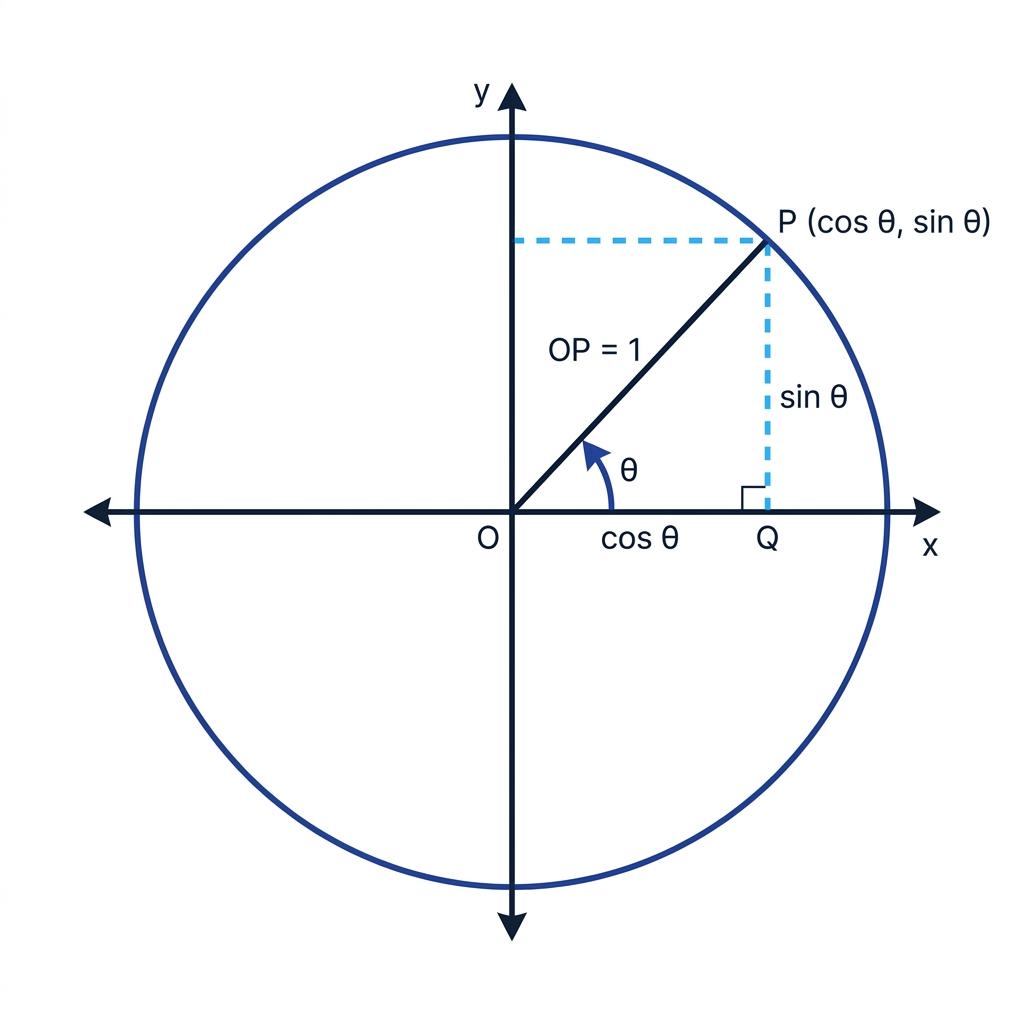
This identity can be rearranged in either direction:
sin2θ≡1−cos2θ,cos2θ≡1−sin2θ.\sin^2\theta\equiv 1-\cos^2\theta, \qquad \cos^2\theta\equiv 1-\sin^2\theta.sin2θ≡1−cos2θ,cos2θ≡1−sin2θ.Rewriting in terms of cosine
Simplify
3sin2θ+3cos2θ−2cos2θ.3\sin^2\theta+3\cos^2\theta-2\cos^2\theta.3sin2θ+3cos2θ−2cos2θ.-
Group the first two terms because they contain the complete Pythagorean identity:
3(sin2θ+cos2θ)−2cos2θ.3(\sin^2\theta+\cos^2\theta)-2\cos^2\theta.3(sin2θ+cos2θ)−2cos2θ. -
Substitute sin2θ+cos2θ=1\sin^2\theta+\cos^2\theta=1sin2θ+cos2θ=1:
3(1)−2cos2θ.3(1)-2\cos^2\theta.3(1)−2cos2θ. -
The simplified expression is
3−2cos2θ.3-2\cos^2\theta.3−2cos2θ.
Deriving the secant identity
Begin with
sin2θ+cos2θ≡1.\sin^2\theta+\cos^2\theta\equiv 1.sin2θ+cos2θ≡1.Divide every term by cos2θ\cos^2\thetacos2θ:
sin2θcos2θ+cos2θcos2θ≡1cos2θ.\frac{\sin^2\theta}{\cos^2\theta} + \frac{\cos^2\theta}{\cos^2\theta} \equiv \frac{1}{\cos^2\theta}.cos2θsin2θ+cos2θcos2θ≡cos2θ1.Using tanθ=sinθcosθ\tan\theta=\frac{\sin\theta}{\cos\theta}tanθ=cosθsinθ and secθ=1cosθ\sec\theta=\frac{1}{\cos\theta}secθ=cosθ1 gives
tan2θ+1≡sec2θ.\tan^2\theta+1\equiv\sec^2\theta.tan2θ+1≡sec2θ.It is usually written as
sec2θ≡1+tan2θ.\sec^2\theta\equiv 1+\tan^2\theta.sec2θ≡1+tan2θ.Choosing the secant identity
Use sec2θ≡1+tan2θ\sec^2\theta\equiv 1+\tan^2\thetasec2θ≡1+tan2θ when an expression involves only secant and tangent, or when you want to change one of these functions into the other.
Simplifying with secant and tangent
Simplify
sec2θ−1tanθ.\frac{\sec^2\theta-1}{\tan\theta}.tanθsec2θ−1.-
Rearrange sec2θ=1+tan2θ\sec^2\theta=1+\tan^2\thetasec2θ=1+tan2θ to obtain
sec2θ−1=tan2θ.\sec^2\theta-1=\tan^2\theta.sec2θ−1=tan2θ. -
Substitute this into the numerator:
sec2θ−1tanθ=tan2θtanθ.\frac{\sec^2\theta-1}{\tan\theta} = \frac{\tan^2\theta}{\tan\theta}.tanθsec2θ−1=tanθtan2θ. -
Cancel one factor of tanθ\tan\thetatanθ:
sec2θ−1tanθ=tanθ.\frac{\sec^2\theta-1}{\tan\theta}=\tan\theta.tanθsec2θ−1=tanθ.
Deriving the cosecant identity
Again begin with
sin2θ+cos2θ≡1.\sin^2\theta+\cos^2\theta\equiv 1.sin2θ+cos2θ≡1.This time, divide every term by sin2θ\sin^2\thetasin2θ:
sin2θsin2θ+cos2θsin2θ≡1sin2θ.\frac{\sin^2\theta}{\sin^2\theta} + \frac{\cos^2\theta}{\sin^2\theta} \equiv \frac{1}{\sin^2\theta}.sin2θsin2θ+sin2θcos2θ≡sin2θ1.Since cotθ=cosθsinθ\cot\theta=\frac{\cos\theta}{\sin\theta}cotθ=sinθcosθ and cosecθ=1sinθ\operatorname{cosec}\theta=\frac{1}{\sin\theta}cosecθ=sinθ1, this becomes
1+cot2θ≡cosec2θ.1+\cot^2\theta\equiv\operatorname{cosec}^2\theta.1+cot2θ≡cosec2θ.Hence,
cosec2θ≡1+cot2θ.\operatorname{cosec}^2\theta\equiv 1+\cot^2\theta.cosec2θ≡1+cot2θ.Remembering the pairings
Secant pairs with tangent, while cosecant pairs with cotangent:
sec2θ≡1+tan2θ,cosec2θ≡1+cot2θ.\sec^2\theta\equiv 1+\tan^2\theta, \qquad \operatorname{cosec}^2\theta\equiv 1+\cot^2\theta.sec2θ≡1+tan2θ,cosec2θ≡1+cot2θ.Finding a cosecant value
Given that cotθ=2\cot\theta=2cotθ=2 and cosecθ>0\operatorname{cosec}\theta>0cosecθ>0, find cosecθ\operatorname{cosec}\thetacosecθ.
-
Apply the appropriate identity:
cosec2θ=1+cot2θ.\operatorname{cosec}^2\theta=1+\cot^2\theta.cosec2θ=1+cot2θ. -
Substitute cotθ=2\cot\theta=2cotθ=2:
cosec2θ=1+22=5.\operatorname{cosec}^2\theta=1+2^2=5.cosec2θ=1+22=5. -
Taking square roots gives cosecθ=±5\operatorname{cosec}\theta=\pm\sqrt5cosecθ=±5. The given sign condition selects
cosecθ=5.\operatorname{cosec}\theta=\sqrt5.cosecθ=5.
Forgetting both square roots
From cosec2θ=5\operatorname{cosec}^2\theta=5cosec2θ=5, you initially obtain cosecθ=±5\operatorname{cosec}\theta=\pm\sqrt5cosecθ=±5. Use information about the angle or the required sign to choose the correct value.
Proving trigonometric identities
To prove an identity, usually start with the more complicated side and transform it until it matches the other side. Avoid changing both sides at once, as this can hide gaps in your reasoning.
Converting tangent, cotangent, secant and cosecant into sine and cosine often makes the route clearer.
Proving an identity using sine and cosine
Prove that
1−cos2θsinθ≡sinθ.\frac{1-\cos^2\theta}{\sin\theta}\equiv\sin\theta.sinθ1−cos2θ≡sinθ.-
Use the rearranged Pythagorean identity 1−cos2θ=sin2θ1-\cos^2\theta=\sin^2\theta1−cos2θ=sin2θ:
1−cos2θsinθ=sin2θsinθ.\frac{1-\cos^2\theta}{\sin\theta} = \frac{\sin^2\theta}{\sin\theta}.sinθ1−cos2θ=sinθsin2θ. -
Write sin2θ\sin^2\thetasin2θ as a product:
sinθsinθsinθ.\frac{\sin\theta\sin\theta}{\sin\theta}.sinθsinθsinθ. -
Cancel the common factor, wherever the original expression is defined:
1−cos2θsinθ=sinθ,\frac{1-\cos^2\theta}{\sin\theta} = \sin\theta,sinθ1−cos2θ=sinθ,which is the required right-hand side.
Treating sums as factors
You cannot cancel terms across addition. For example, nothing cancels directly in 1+sinθsinθ\frac{1+\sin\theta}{\sin\theta}sinθ1+sinθ. Cancellation is allowed only between common factors.
In the exam
- Identify which functions appear: sine and cosine suggest sin2θ+cos2θ=1\sin^2\theta+\cos^2\theta=1sin2θ+cos2θ=1, while secant and tangent suggest sec2θ=1+tan2θ\sec^2\theta=1+\tan^2\thetasec2θ=1+tan2θ.
- In a proof, start with the more complicated side and show each substitution or factorisation clearly.
- Convert everything to sine and cosine if the route is unclear, and check that you have not divided by a quantity that could be zero.
Check yourself
- Can you derive sec2θ≡1+tan2θ\sec^2\theta\equiv1+\tan^2\thetasec2θ≡1+tan2θ from the first Pythagorean identity?
- How would you simplify cosec2θ−cot2θ\operatorname{cosec}^2\theta-\cot^2\thetacosec2θ−cot2θ?
- Why is tanθ≡sinθcosθ\tan\theta\equiv\frac{\sin\theta}{\cos\theta}tanθ≡cosθsinθ not defined when cosθ=0\cos\theta=0cosθ=0?
