

What you'll learn
- How to solve equations involving sinx\sin xsinx, cosx\cos xcosx and tanx\tan xtanx in a given interval.
- How symmetry and periodicity produce additional solutions.
- How to solve equations that are quadratic in a trigonometric function.
- How to handle multiples of the unknown angle, such as sin2x\sin 2xsin2x or cos3x\cos 3xcos3x.
Before you begin
You should be comfortable with exact trigonometric values, rearranging equations and solving quadratic equations.
Always check whether the question is working in degrees or radians. An interval containing π\piπ uses radians, while an interval containing a degree symbol uses degrees. Make sure your calculator is in the correct mode.
Periodicity and symmetry
Periodicity
A trigonometric function is periodic if its values repeat after a fixed interval. This repeating interval is called the period.
Periods of the trigonometric functions
- The functions sinx\sin xsinx and cosx\cos xcosx have period 2π2\pi2π radians, or 360°.
- The function tanx\tan xtanx has period π\piπ radians, or 180°.
Therefore,
sin(x+2π)=sinx,cos(x+2π)=cosx,tan(x+π)=tanx.\begin{aligned} \sin(x+2\pi)&=\sin x,\\ \cos(x+2\pi)&=\cos x,\\ \tan(x+\pi)&=\tan x. \end{aligned}sin(x+2π)cos(x+2π)tan(x+π)=sinx,=cosx,=tanx.Periodicity means that a trigonometric equation will usually have infinitely many solutions overall. A stated interval tells you which of these solutions to include.
Symmetry
Your calculator gives one principal value, meaning its standard inverse-trigonometric answer. This is not necessarily the only solution in the interval.
For an angle α\alphaα:
sinx=sinα⇒x=α or x=π−α,cosx=cosα⇒x=α or x=2π−α,tanx=tanα⇒x=α or x=α+π,\begin{aligned} \sin x=\sin\alpha &\Rightarrow x=\alpha \text{ or } x=\pi-\alpha,\\ \cos x=\cos\alpha &\Rightarrow x=\alpha \text{ or } x=2\pi-\alpha,\\ \tan x=\tan\alpha &\Rightarrow x=\alpha \text{ or } x=\alpha+\pi, \end{aligned}sinx=sinαcosx=cosαtanx=tanα⇒x=α or x=π−α,⇒x=α or x=2π−α,⇒x=α or x=α+π,when searching through one full turn from 000 to 2π2\pi2π.
One calculator answer is not enough
Use the first answer to find a reference angle, then use the signs, symmetry and period of the function to locate every solution in the required interval.
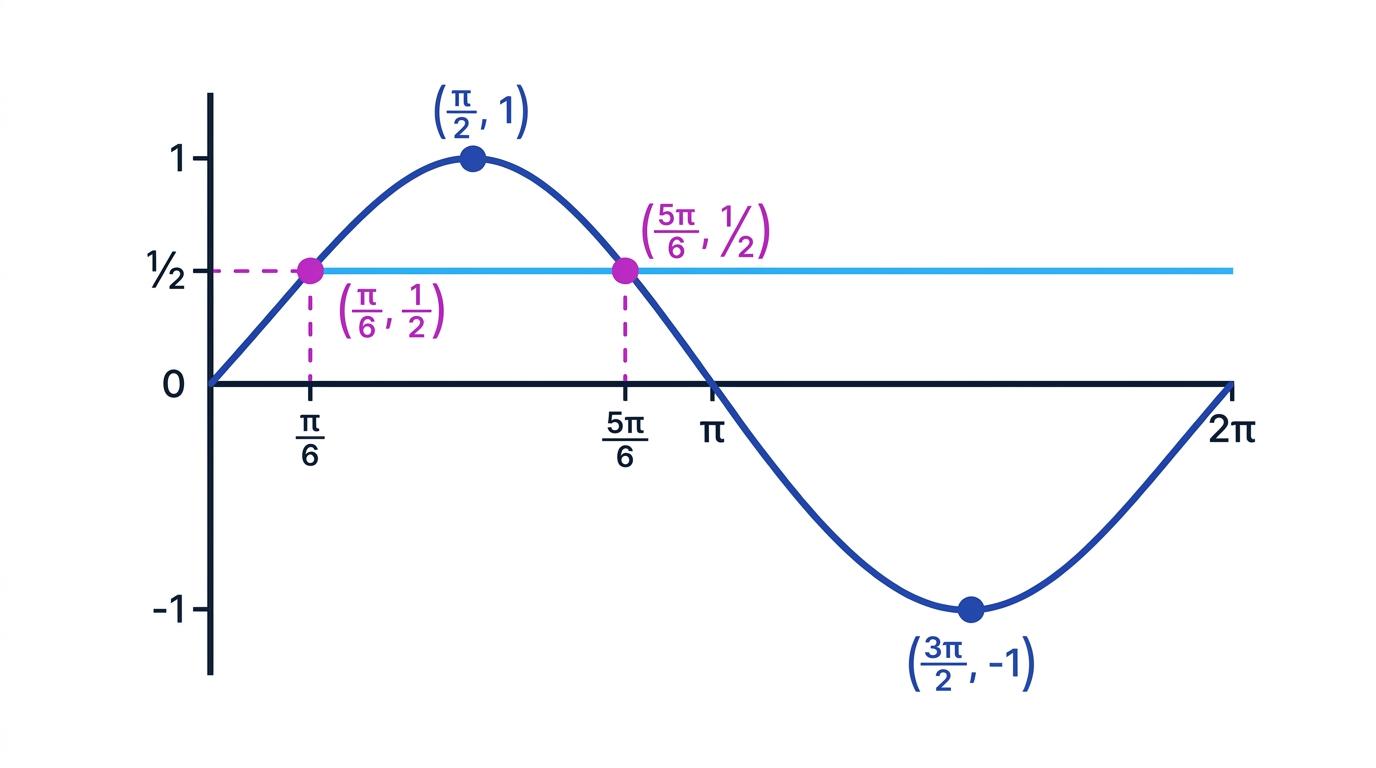
The graph below shows why sinx=12\sin x=\frac12sinx=21 has two solutions between 000 and 2π2\pi2π: the sine curve meets the horizontal line twice.
Solving simple trigonometric equations
A simple trigonometric equation can be rearranged into one of the forms
sinx=a,cosx=a,tanx=a.\sin x=a,\qquad \cos x=a,\qquad \tan x=a.sinx=a,cosx=a,tanx=a.A reliable method is:
- Rearrange to isolate the trigonometric function.
- Find one angle using the appropriate inverse function.
- Use symmetry and periodicity to find the other angles.
- Keep only the solutions in the stated interval.
Solving a sine equation
Solve 2sinx−1=02\sin x-1=02sinx−1=0 for 0≤x<2π0\le x<2\pi0≤x<2π.
-
Isolate the sine term:
2sinx−1=0⇒sinx=12.2\sin x-1=0 \Rightarrow \sin x=\frac12.2sinx−1=0⇒sinx=21. -
Find the first solution using the exact value sinπ6=12\sin\frac{\pi}{6}=\frac12sin6π=21, so the reference angle is π6\frac{\pi}{6}6π.
-
Sine is positive in the first and second quadrants. The second solution is
π−π6=5π6.\pi-\frac{\pi}{6}=\frac{5\pi}{6}.π−6π=65π. -
Both angles lie in the interval, so
x=π6, 5π6.x=\frac{\pi}{6},\ \frac{5\pi}{6}.x=6π, 65π.
Missing the second solution
Writing only x=sin−1(12)x=\sin^{-1}\left(\frac12\right)x=sin−1(21) misses the second intersection of the sine graph with the line y=12y=\frac12y=21.
Negative trigonometric values
The sign tells you which quadrants contain solutions:
- Sine is positive in quadrants 1 and 2.
- Cosine is positive in quadrants 1 and 4.
- Tangent is positive in quadrants 1 and 3.
For a negative value, use the remaining two quadrants.
Use a positive reference angle
When the trigonometric value is negative, find the acute reference angle from its positive magnitude. Then place that angle in the quadrants where the required function is negative.
Solving a negative cosine equation
Solve cosx=−32\cos x=-\frac{\sqrt3}{2}cosx=−23 for 0≤x<2π0\le x<2\pi0≤x<2π.
-
The reference angle is π6\frac{\pi}{6}6π because cosπ6=32\cos\frac{\pi}{6}=\frac{\sqrt3}{2}cos6π=23.
-
Cosine is negative in quadrants 2 and 3, giving
x=π−π6orx=π+π6.x=\pi-\frac{\pi}{6} \quad\text{or}\quad x=\pi+\frac{\pi}{6}.x=π−6πorx=π+6π. -
Therefore,
x=5π6, 7π6.x=\frac{5\pi}{6},\ \frac{7\pi}{6}.x=65π, 67π.
Checking whether solutions are possible
For every real angle,
−1≤sinx≤1and−1≤cosx≤1.-1\le\sin x\le1 \qquad\text{and}\qquad -1\le\cos x\le1.−1≤sinx≤1and−1≤cosx≤1.Therefore, equations such as sinx=1.4\sin x=1.4sinx=1.4 and cosx=−2\cos x=-2cosx=−2 have no real solutions.
Tangent is not restricted to this range, so tanx=a\tan x=atanx=a can have solutions for any real value of aaa.
Reject impossible roots
When algebra produces a value outside the interval from negative one to one for sinx\sin xsinx or cosx\cos xcosx, reject that value before trying to find an angle.
Quadratic trigonometric equations
A quadratic trigonometric equation is quadratic in one trigonometric expression. For example,
2sin2x−sinx−1=0.2\sin^2x-\sin x-1=0.2sin2x−sinx−1=0.Treat the trigonometric function temporarily as one algebraic variable. You can factorise or use the quadratic formula, then solve the resulting simple trigonometric equations.
Solving a quadratic equation in sine
Solve 2sin2x−sinx−1=02\sin^2x-\sin x-1=02sin2x−sinx−1=0 for 0≤x<2π0\le x<2\pi0≤x<2π.
-
Let u=sinxu=\sin xu=sinx. The equation becomes
2u2−u−1=0.2u^2-u-1=0.2u2−u−1=0. -
Factorise:
(2u+1)(u−1)=0,(2u+1)(u-1)=0,(2u+1)(u−1)=0,so
u=−12oru=1.u=-\frac12 \quad\text{or}\quad u=1.u=−21oru=1. -
Substitute back:
sinx=−12orsinx=1.\sin x=-\frac12 \quad\text{or}\quad \sin x=1.sinx=−21orsinx=1. -
Sine equals −12-\frac12−21 in quadrants 3 and 4, giving x=7π6x=\frac{7\pi}{6}x=67π and x=11π6x=\frac{11\pi}{6}x=611π. Sine equals 1 at x=π2x=\frac{\pi}{2}x=2π.
-
Therefore,
x=π2, 7π6, 11π6.x=\frac{\pi}{2},\ \frac{7\pi}{6},\ \frac{11\pi}{6}.x=2π, 67π, 611π.
Losing one branch
After factorising, solve every resulting equation. It is easy to solve one factor and accidentally ignore the other.
The same technique applies to quadratics in cosine or tangent. Remember that possible cosine roots must also lie between negative one and one.
Equations involving multiples of the angle
An equation such as sin2x=12\sin 2x=\frac12sin2x=21 involves a multiple angle because the input to sine is 2x2x2x, not xxx.
Introduce a temporary angle, such as θ=2x\theta=2xθ=2x. Most importantly, transform the interval as well.
Transform the interval
If a≤x≤ba\le x\le ba≤x≤b and θ=kx\theta=kxθ=kx for positive kkk, then search over ka≤θ≤kbka\le\theta\le kbka≤θ≤kb. This prevents you from missing solutions.
Solving an equation involving a double angle
Solve sin2x=12\sin 2x=\frac12sin2x=21 for 0≤x<2π0\le x<2\pi0≤x<2π.
-
Let θ=2x\theta=2xθ=2x. Since 0≤x<2π0\le x<2\pi0≤x<2π, the transformed interval is
0≤θ<4π.0\le\theta<4\pi.0≤θ<4π. -
Solve sinθ=12\sin\theta=\frac12sinθ=21. In the first cycle, the solutions are
θ=π6, 5π6.\theta=\frac{\pi}{6},\ \frac{5\pi}{6}.θ=6π, 65π. -
The interval extends through a second cycle, so add the sine period 2π2\pi2π:
θ=13π6, 17π6.\theta=\frac{13\pi}{6},\ \frac{17\pi}{6}.θ=613π, 617π. -
Divide every value by 2 because θ=2x\theta=2xθ=2x:
x=π12, 5π12, 13π12, 17π12.x=\frac{\pi}{12},\ \frac{5\pi}{12},\ \frac{13\pi}{12},\ \frac{17\pi}{12}.x=12π, 125π, 1213π, 1217π.
Using the original interval
If you solve sin2x=12\sin 2x=\frac12sin2x=21 only over 0≤2x<2π0\le2x<2\pi0≤2x<2π, you search through only half of the required range and miss valid solutions.
Combining quadratics and multiple angles
Some questions combine both techniques. First solve the quadratic in the complete trigonometric expression, then solve each resulting multiple-angle equation over a transformed interval.
Combining a quadratic with a multiple angle
Solve 2cos22x−cos2x−1=02\cos^2 2x-\cos 2x-1=02cos22x−cos2x−1=0 for 0≤x<π0\le x<\pi0≤x<π.
-
Let u=cos2xu=\cos 2xu=cos2x and factorise:
2u2−u−1=(2u+1)(u−1)=0.2u^2-u-1=(2u+1)(u-1)=0.2u2−u−1=(2u+1)(u−1)=0.Hence cos2x=−12\cos 2x=-\frac12cos2x=−21 or cos2x=1\cos 2x=1cos2x=1.
-
Let θ=2x\theta=2xθ=2x. The interval becomes 0≤θ<2π0\le\theta<2\pi0≤θ<2π.
-
Within this interval,
cosθ=−12⇒θ=2π3, 4π3,\cos\theta=-\frac12 \Rightarrow \theta=\frac{2\pi}{3},\ \frac{4\pi}{3},cosθ=−21⇒θ=32π, 34π,and
cosθ=1⇒θ=0.\cos\theta=1 \Rightarrow \theta=0.cosθ=1⇒θ=0. -
Divide each value by 2:
x=0, π3, 2π3.x=0,\ \frac{\pi}{3},\ \frac{2\pi}{3}.x=0, 3π, 32π.
In the exam
- Isolate the trigonometric function, or factorise first if the equation is quadratic.
- Write down every algebraic branch and reject impossible sine or cosine values.
- For sinkx\sin kxsinkx, coskx\cos kxcoskx or tankx\tan kxtankx, transform the interval before finding solutions.
- Use symmetry and periodicity to find every angle, then check each endpoint carefully.
- Give exact answers involving π\piπ, fractions or surds unless the question requests decimals.
Check yourself
- Can you solve tanx=−1\tan x=-1tanx=−1 for 0≤x<2π0\le x<2\pi0≤x<2π?
- How would you solve 2cos2x+cosx−1=02\cos^2x+\cos x-1=02cos2x+cosx−1=0 over one full turn?
- What interval should you use for θ=3x\theta=3xθ=3x if −π≤x≤π-\pi\le x\le\pi−π≤x≤π?
