

What you'll learn
- How to recognise an exponential equation.
- How to solve by rewriting both sides with the same base.
- How logarithms solve equations of the form ax=ba^x=bax=b.
- How to decide whether a solution exists and present suitable exact or decimal answers.
Prerequisites: powers and indices
An index (plural indices), also called an exponent or power, tells you how many times a base is used as a factor. In 252^525, the base is 2 and the index is 5.
You should remember these index laws:
am×an=am+naman=am−n(am)n=amna−n=1ana0=1\begin{aligned} a^m \times a^n &= a^{m+n} \\ \frac{a^m}{a^n} &= a^{m-n} \\ \left(a^m\right)^n &= a^{mn} \\ a^{-n} &= \frac{1}{a^n} \\ a^0 &= 1 \end{aligned}am×ananam(am)na−na0=am+n=am−n=amn=an1=1These laws let you rewrite expressions so that both sides of an equation have the same base.
Rewriting powers with the same base
Solve 8x=328^x=328x=32.
-
Write both 8 and 32 as powers of 2:
8=23and32=25.8=2^3 \qquad\text{and}\qquad 32=2^5.8=23and32=25. -
Substitute these forms into the equation and use the power-of-a-power rule:
(23)x=25⇒23x=25.\left(2^3\right)^x=2^5 \quad\Rightarrow\quad 2^{3x}=2^5.(23)x=25⇒23x=25. -
Equal powers with the same valid base have equal indices, so:
3x=5⇒x=53.3x=5 \quad\Rightarrow\quad x=\frac{5}{3}.3x=5⇒x=35.
Same base, same index
If ap=aqa^p=a^qap=aq, where a>0a>0a>0 and a≠1a\neq1a=1, then p=qp=qp=q. Always check whether both sides can be written as powers of the same base before using logarithms.
What is an exponential equation?
An exponential equation is an equation in which the unknown appears in an exponent. For example, 3x=173^x=173x=17 is exponential because xxx is the power.
The AQA specification requires you to solve equations of the form:
ax=b.a^x=b.ax=b.For a standard exponential function, the base must satisfy a>0a>0a>0 and a≠1a\neq1a=1.
Understanding the graph
For a>1a>1a>1, the graph of y=axy=a^xy=ax is increasing and always lies above the xxx-axis. The solution of ax=ba^x=bax=b is the xxx-coordinate where the exponential curve intersects the horizontal line y=by=by=b.
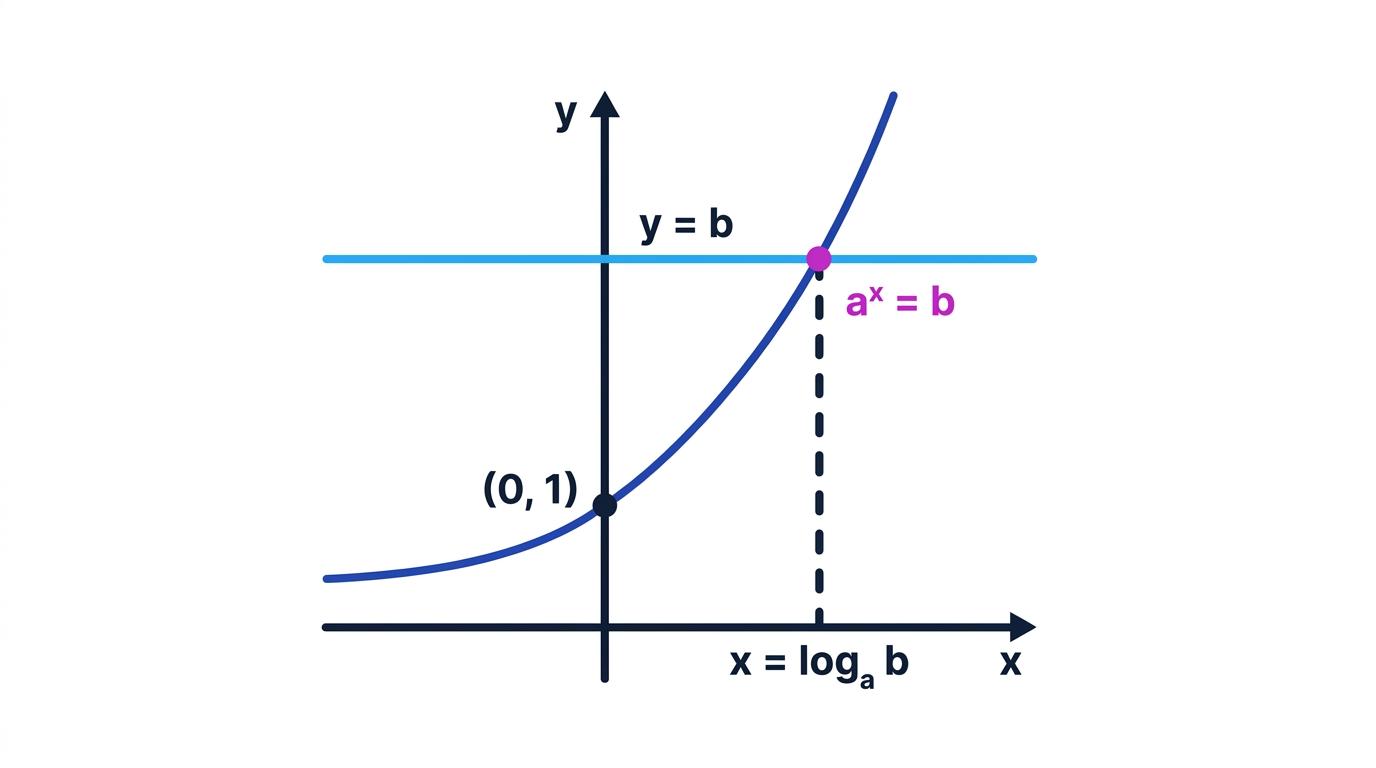
When b>0b>0b>0, there is exactly one intersection and therefore exactly one real solution.
If 0<a<10<a<10<a<1, the exponential graph is decreasing, but it still takes every positive value exactly once. There is again one real solution when b>0b>0b>0.
When no real solution exists
For a valid positive base, axa^xax is always positive. Therefore, ax=ba^x=bax=b has no real solution if b≤0b\leq0b≤0.
Solving by inspection
Sometimes you can recognise bbb as a familiar power of aaa. This is called solving by inspection because no logarithms or calculator work are needed.
Recognising a familiar power
Solve 5x=11255^x=\frac{1}{125}5x=1251.
-
Express 125 as a power of 5:
125=53.125=5^3.125=53. -
Use the negative-index law to rewrite the reciprocal:
1125=153=5−3.\frac{1}{125}=\frac{1}{5^3}=5^{-3}.1251=531=5−3. -
The equation is now 5x=5−35^x=5^{-3}5x=5−3, so the indices must be equal:
x=−3.x=-3.x=−3.
Check simple powers first
Before reaching for your calculator, look for positive, zero, fractional and negative powers. In particular, remember that a0=1a^0=1a0=1 and a−n=1/ana^{-n}=1/a^na−n=1/an.
Logarithms as inverse operations
Most numbers cannot be written as convenient powers of the base. For example, there is no obvious whole-number power of 3 equal to 17. This is where logarithms are needed.
A logarithm gives the exponent to which a base must be raised to produce a particular number.
Logarithm
For a>0a>0a>0, a≠1a\neq1a=1 and b>0b>0b>0,
ax=b⟺x=logab.a^x=b \quad\Longleftrightarrow\quad x=\log_a b.ax=b⟺x=logab.The expression logab\log_a blogab means “the power of aaa that gives bbb”.
For example, log28=3\log_2 8=3log28=3 because 23=82^3=823=8. Exponentials and logarithms are inverse functions, meaning that each reverses the effect of the other.
Using a logarithm with the required base
Solve 3x=173^x=173x=17.
-
Rewrite the exponential equation directly in logarithmic form:
x=log317.x=\log_3 17.x=log317.This is the exact answer.
-
A calculator may not have a direct log3\log_3log3 button, so use the change-of-base formula:
log317=log17log3.\log_3 17=\frac{\log 17}{\log 3}.log317=log3log17. -
Evaluate and round appropriately:
x≈2.579.x\approx2.579.x≈2.579.
The change-of-base formula
Calculators usually provide log\loglog, the logarithm to base 10, and ln\lnln, the natural logarithm to base eee.
You may use either one:
logab=logblogaorlogab=lnblna.\log_a b=\frac{\log b}{\log a} \qquad\text{or}\qquad \log_a b=\frac{\ln b}{\ln a}.logab=logalogborlogab=lnalnb.Therefore, the general solution of ax=ba^x=bax=b is:
x=logbloga.x=\frac{\log b}{\log a}.x=logalogb.The same answer results from natural logarithms:
x=lnblna.x=\frac{\ln b}{\ln a}.x=lnalnb.Why the formula works
You can derive the formula rather than simply memorising it. Starting from ax=ba^x=bax=b, take logarithms of both sides:
log(ax)=logb.\log\left(a^x\right)=\log b.log(ax)=logb.Using the logarithm law log(ax)=xloga\log(a^x)=x\log alog(ax)=xloga gives:
xloga=logb.x\log a=\log b.xloga=logb.Dividing by loga\log aloga gives:
x=logbloga.x=\frac{\log b}{\log a}.x=logalogb.Solving with natural logarithms
Solve 0.7x=120.7^x=120.7x=12, giving your answer to three significant figures.
-
Take natural logarithms of both sides:
ln(0.7x)=ln12.\ln\left(0.7^x\right)=\ln 12.ln(0.7x)=ln12. -
Bring the exponent down using ln(ax)=xlna\ln(a^x)=x\ln aln(ax)=xlna:
xln0.7=ln12.x\ln 0.7=\ln 12.xln0.7=ln12. -
Divide by ln0.7\ln 0.7ln0.7 and evaluate:
x=ln12ln0.7≈−6.97.x=\frac{\ln 12}{\ln 0.7}\approx-6.97.x=ln0.7ln12≈−6.97.The negative answer is sensible: because the base is between 0 and 1, a negative power produces a value greater than 1.
Dividing the logarithms incorrectly
From xloga=logbx\log a=\log bxloga=logb, the correct result is x=logblogax=\frac{\log b}{\log a}x=logalogb. Keep the logarithm of the right-hand side in the numerator.
Exact and decimal answers
The form logab\log_a blogab or lnblna\frac{\ln b}{\ln a}lnalnb is an exact value. A calculator value such as 2.579 is an approximation.
If a question asks for an exact answer, leave your result in logarithmic form. If it requests a given degree of accuracy, keep the exact value in your calculator and round only at the end.
Rounding too early
Do not round separate logarithms before dividing them. Enter the full calculation, such as ln(17) ÷ ln(3), and round only the final answer.
Checking your solution
Substitute your answer into the original equation. For 3x=173^x=173x=17 with x≈2.579x\approx2.579x≈2.579:
32.579≈17.3^{2.579}\approx17.32.579≈17.A small difference may appear because the value of xxx was rounded.
You can also check whether the sign is reasonable:
- If a>1a>1a>1 and b>1b>1b>1, then x>0x>0x>0.
- If a>1a>1a>1 and 0<b<10<b<10<b<1, then x<0x<0x<0.
- If 0<a<10<a<10<a<1 and b>1b>1b>1, then x<0x<0x<0.
- For any valid base, if b=1b=1b=1, then x=0x=0x=0.
In the exam
- Check whether both sides can be rewritten using the same base; this may give an exact solution quickly.
- Otherwise, take logarithms and use x=logblogax=\frac{\log b}{\log a}x=logalogb or x=lnblnax=\frac{\ln b}{\ln a}x=lnalnb.
- Keep full calculator accuracy until the final line, round as requested, and substitute back to check that the result is sensible.
Check yourself
- Can you solve 4x=184^x=\frac{1}{8}4x=81 by first rewriting both sides with base 2?
- How would you solve 7x=207^x=207x=20 and give the answer to three significant figures?
- Why does 5x=−35^x=-35x=−3 have no real solution?
