

What you'll learn
- The standard approximations for sinθ\sin\thetasinθ, cosθ\cos\thetacosθ and tanθ\tan\thetatanθ when θ\thetaθ is small.
- Why the angle must be measured in radians.
- How to approximate numerical values and simplify trigonometric expressions.
- How to solve equations that are valid for small values of θ\thetaθ.
Prerequisite: radians
An angle can be measured in degrees or radians. Radian measure is defined using a circle: an angle of θ\thetaθ radians subtends an arc whose length is θ\thetaθ times the radius.
For example, since a full turn is 2π2\pi2π radians,
180∘=π radians.180^\circ=\pi\text{ radians}.180∘=π radians.To convert degrees to radians, multiply by π180\frac{\pi}{180}180π.
Radians are essential
The standard small angle approximations work only when θ\thetaθ is measured in radians. They do not work if you substitute an angle measured in degrees.
Converting a small angle to radians
Express an angle of 5 degrees in radians.
-
Use the degree-to-radian conversion:
θ=5×π180.\theta=5\times\frac{\pi}{180}.θ=5×180π. -
Simplify the fraction:
θ=π36.\theta=\frac{\pi}{36}.θ=36π. -
As a decimal, this is approximately 0.0873 radians, which is reasonably close to zero and therefore suitable for a small angle approximation.
Leaving your calculator in degree mode
If you use a calculator to check an approximation, make sure it is in radian mode. For example, sin(0.1)\sin(0.1)sin(0.1) means the sine of 0.1 radians, not 0.1 degrees.
What is a small angle approximation?
An approximation is a value or expression that is close to the exact value but is usually simpler to work with.
A small angle approximation replaces a trigonometric function with a simpler algebraic expression when its angle is close to zero.
The standard approximations
For θ\thetaθ close to zero, measured in radians,
sinθ≈θ,\sin\theta\approx\theta,sinθ≈θ, cosθ≈1−θ22,\cos\theta\approx 1-\frac{\theta^2}{2},cosθ≈1−2θ2,and
tanθ≈θ.\tan\theta\approx\theta.tanθ≈θ.The symbol ≈\approx≈ means “is approximately equal to”.
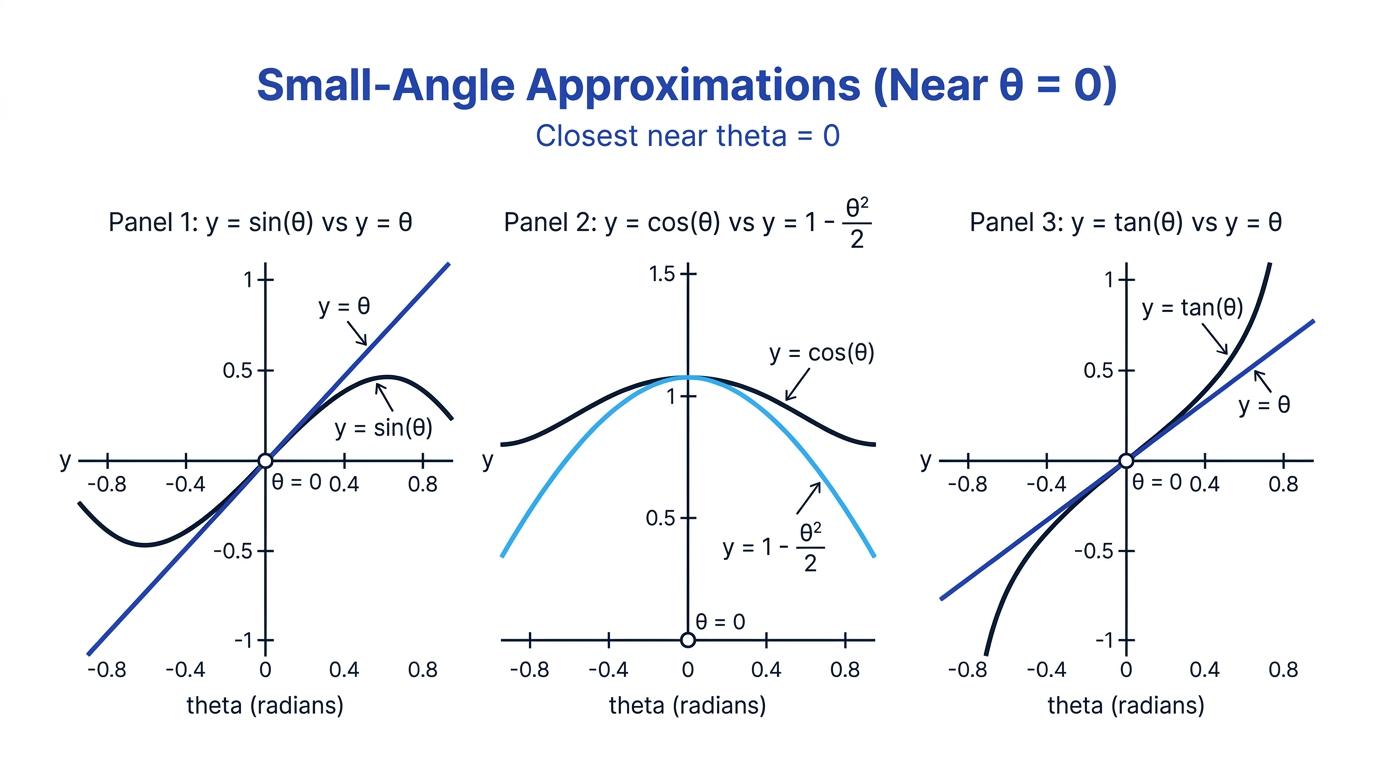
The diagram shows that each exact trigonometric curve is very close to its approximation near θ=0\theta=0θ=0. As the size of θ\thetaθ increases, the curves move farther apart and the approximations become less accurate.
Why the approximations have these forms
Near zero, the graph of y=sinθy=\sin\thetay=sinθ has almost the same gradient and position as the straight line y=θy=\thetay=θ. This gives sinθ≈θ\sin\theta\approx\thetasinθ≈θ.
Similarly, y=tanθy=\tan\thetay=tanθ is almost the same as y=θy=\thetay=θ near zero, giving tanθ≈θ\tan\theta\approx\thetatanθ≈θ.
The cosine curve is flatter near zero, so the linear approximation cosθ≈1\cos\theta\approx 1cosθ≈1 is often not accurate enough. The term −θ22-\frac{\theta^2}{2}−2θ2 accounts for the curve bending downwards.
Notice that the cosine approximation contains θ2\theta^2θ2. This also reflects the fact that cosine is an even function:
cos(−θ)=cosθ.\cos(-\theta)=\cos\theta.cos(−θ)=cosθ.Closeness to zero matters
“Small” means that the magnitude ∣θ∣|\theta|∣θ∣ is close to zero. Both small positive and small negative angles can be used.
Approximating trigonometric values
To estimate a trigonometric value, identify the appropriate standard approximation and substitute the angle.
Approximating sine, cosine and tangent
Estimate sin(0.08)\sin(0.08)sin(0.08), cos(0.08)\cos(0.08)cos(0.08) and tan(0.08)\tan(0.08)tan(0.08).
-
Apply sinθ≈θ\sin\theta\approx\thetasinθ≈θ:
sin(0.08)≈0.08.\sin(0.08)\approx 0.08.sin(0.08)≈0.08. -
Apply cosθ≈1−θ22\cos\theta\approx 1-\frac{\theta^2}{2}cosθ≈1−2θ2:
cos(0.08)≈1−0.0822=1−0.0032=0.9968.\begin{aligned} \cos(0.08) &\approx 1-\frac{0.08^2}{2}\\ &=1-0.0032\\ &=0.9968. \end{aligned}cos(0.08)≈1−20.082=1−0.0032=0.9968. -
Apply tanθ≈θ\tan\theta\approx\thetatanθ≈θ:
tan(0.08)≈0.08.\tan(0.08)\approx 0.08.tan(0.08)≈0.08.
These estimates are close to the corresponding calculator values because 0.08 radians is close to zero.
A quick sanity check
For a small positive angle, sinθ\sin\thetasinθ and tanθ\tan\thetatanθ should be close to θ\thetaθ, while cosθ\cos\thetacosθ should be positive and slightly less than 1.
Angles containing a multiple of a variable
The approximation is applied to the whole angle inside the trigonometric function.
For example, if θ\thetaθ is small, then 3θ3\theta3θ may also be small enough for
sin(3θ)≈3θ\sin(3\theta)\approx 3\thetasin(3θ)≈3θand
cos(3θ)≈1−(3θ)22.\cos(3\theta)\approx 1-\frac{(3\theta)^2}{2}.cos(3θ)≈1−2(3θ)2.Approximating an expression with multiple angles
Find a small angle approximation for
2sin(3θ)+cos(2θ).2\sin(3\theta)+\cos(2\theta).2sin(3θ)+cos(2θ).-
Replace each trigonometric function using its entire angle:
sin(3θ)≈3θ\sin(3\theta)\approx 3\thetasin(3θ)≈3θand
cos(2θ)≈1−(2θ)22.\cos(2\theta)\approx 1-\frac{(2\theta)^2}{2}.cos(2θ)≈1−2(2θ)2. -
Substitute these into the original expression:
2sin(3θ)+cos(2θ)≈2(3θ)+1−(2θ)22.2\sin(3\theta)+\cos(2\theta) \approx 2(3\theta)+1-\frac{(2\theta)^2}{2}.2sin(3θ)+cos(2θ)≈2(3θ)+1−2(2θ)2. -
Simplify:
2sin(3θ)+cos(2θ)≈6θ+1−4θ22=1+6θ−2θ2.\begin{aligned} 2\sin(3\theta)+\cos(2\theta) &\approx 6\theta+1-\frac{4\theta^2}{2}\\ &=1+6\theta-2\theta^2. \end{aligned}2sin(3θ)+cos(2θ)≈6θ+1−24θ2=1+6θ−2θ2.
Forgetting to square the whole angle
In cos(3θ)≈1−(3θ)22\cos(3\theta)\approx 1-\frac{(3\theta)^2}{2}cos(3θ)≈1−2(3θ)2, the square applies to both 3 and θ\thetaθ. Therefore, (3θ)2=9θ2(3\theta)^2=9\theta^2(3θ)2=9θ2.
Simplifying ratios and expressions
Small angle approximations turn trigonometric expressions into algebraic ones. You can then expand, cancel and simplify normally.
Simplifying a trigonometric ratio
Find an approximation for
1−cos(2θ)θ2\frac{1-\cos(2\theta)}{\theta^2}θ21−cos(2θ)when θ\thetaθ is small and non-zero.
-
Approximate the cosine term:
cos(2θ)≈1−(2θ)22=1−2θ2.\cos(2\theta)\approx 1-\frac{(2\theta)^2}{2} =1-2\theta^2.cos(2θ)≈1−2(2θ)2=1−2θ2. -
Substitute this into the numerator:
1−cos(2θ)≈1−(1−2θ2)=2θ2.1-\cos(2\theta)\approx 1-(1-2\theta^2)=2\theta^2.1−cos(2θ)≈1−(1−2θ2)=2θ2. -
Divide by θ2\theta^2θ2:
1−cos(2θ)θ2≈2θ2θ2=2.\frac{1-\cos(2\theta)}{\theta^2} \approx\frac{2\theta^2}{\theta^2}=2.θ21−cos(2θ)≈θ22θ2=2.
Do not substitute zero too early
The original ratio is undefined at θ=0\theta=0θ=0 because its denominator is zero. The approximation describes its behaviour for non-zero values of θ\thetaθ that are very close to zero.
Solving equations for small angles
If a question states that θ\thetaθ is small, you can replace the trigonometric functions with their approximations. The resulting equation is usually algebraic.
You must then check that any solution is genuinely close to zero.
Solving an equation for a small angle
Given that θ\thetaθ is small, solve
3sinθ=cosθ.3\sin\theta=\cos\theta.3sinθ=cosθ.-
Substitute the standard approximations:
3θ≈1−θ22.3\theta\approx 1-\frac{\theta^2}{2}.3θ≈1−2θ2. -
Rearrange into a quadratic equation:
6θ≈2−θ2θ2+6θ−2≈0.\begin{aligned} 6\theta&\approx 2-\theta^2\\ \theta^2+6\theta-2&\approx 0. \end{aligned}6θθ2+6θ−2≈2−θ2≈0. -
Apply the quadratic formula:
θ≈−6±62−4(1)(−2)2=−6±442=−3±11.\begin{aligned} \theta &\approx\frac{-6\pm\sqrt{6^2-4(1)(-2)}}{2}\\ &=\frac{-6\pm\sqrt{44}}{2}\\ &=-3\pm\sqrt{11}. \end{aligned}θ≈2−6±62−4(1)(−2)=2−6±44=−3±11. -
The value −3−11-3-\sqrt{11}−3−11 is approximately −6.32-6.32−6.32, which is not close to zero. Rejecting this leaves
θ≈−3+11,\theta\approx -3+\sqrt{11},θ≈−3+11,or approximately 0.317 radians.
Keeping a non-small solution
An algebraic equation may produce more than one root, but the approximations were based on θ\thetaθ being close to zero. Reject any root that does not satisfy this condition.
In the exam
- Check that every angle is in radians before applying an approximation.
- Substitute the whole angle, using brackets before squaring expressions such as 2θ2\theta2θ or 3θ3\theta3θ.
- Simplify algebraically, keep sufficient working, and reject solutions that are not close to zero.
- Use your calculator in radian mode as a final accuracy check, but give the answer produced by the requested approximation.
Check yourself
- What are the three standard small angle approximations?
- How would you approximate cos(4θ)\cos(4\theta)cos(4θ) when θ\thetaθ is small?
- Why might one root of an equation need to be rejected after using small angle approximations?
