

What you'll learn
- Recognise quadratic functions and interpret their graphs.
- Complete the square to find a quadratic's turning point and range.
- Use the discriminant to determine the number of real roots.
- Solve quadratic equations, including equations that are quadratic in another function of the unknown.
Starting Point: Quadratic Expressions
A quadratic function is a function whose highest power of the variable is two.
Quadratic function
A quadratic function has the form
f(x)=ax2+bx+cf(x)=ax^2+bx+cf(x)=ax2+bx+cwhere aaa, bbb and ccc are constants and a≠0a\neq 0a=0.
The condition a≠0a\neq 0a=0 matters: if a=0a=0a=0, the x2x^2x2 term disappears and the function is linear rather than quadratic.
An equation such as ax2+bx+c=0ax^2+bx+c=0ax2+bx+c=0 is called a quadratic equation. A value of xxx satisfying the equation is a root or solution.
Graphs of Quadratic Functions
The graph of a quadratic function is called a parabola. It has a single turning point and is symmetrical about a vertical line.
- If a>0a>0a>0, the parabola opens upwards and has a minimum point.
- If a<0a<0a<0, the parabola opens downwards and has a maximum point.
- A larger value of ∣a∣\lvert a\rvert∣a∣ produces a narrower graph.
Vertex and axis of symmetry
The vertex is the turning point of a parabola. The vertical line passing through the vertex is its axis of symmetry.
The roots of f(x)=0f(x)=0f(x)=0 are the points where the graph of y=f(x)y=f(x)y=f(x) crosses or touches the xxx-axis. The yyy-intercept is found by setting x=0x=0x=0, giving the point (0,c)(0,c)(0,c).
Sketching a quadratic graph
Sketch y=x2−5x+6y=x^2-5x+6y=x2−5x+6.
-
Factorise the quadratic:
x2−5x+6=(x−2)(x−3)x^2-5x+6=(x-2)(x-3)x2−5x+6=(x−2)(x−3)Therefore, the roots are x=2x=2x=2 and x=3x=3x=3, giving the xxx-intercepts (2,0)(2,0)(2,0) and (3,0)(3,0)(3,0).
-
The axis of symmetry lies halfway between the roots:
x=2+32=52x=\frac{2+3}{2}=\frac{5}{2}x=22+3=25 -
Substitute x=52x=\frac{5}{2}x=25 to find the vertex:
y=(52)2−5(52)+6=−14\begin{aligned} y&=\left(\frac{5}{2}\right)^2-5\left(\frac{5}{2}\right)+6\\ &=-\frac{1}{4} \end{aligned}y=(25)2−5(25)+6=−41The vertex is therefore (52,−14)\left(\frac{5}{2},-\frac{1}{4}\right)(25,−41). Since the coefficient of x2x^2x2 is positive, the graph opens upwards.
Forgetting the y-coordinate
The axis of symmetry gives only the xxx-coordinate of the vertex. Substitute this value into the function to find the corresponding yyy-coordinate.
Completing the Square
Completing the square rewrites a quadratic in a form that displays its vertex directly:
ax2+bx+c=a(x−p)2+qax^2+bx+c=a(x-p)^2+qax2+bx+c=a(x−p)2+qThis is called the completed-square form or vertex form. The vertex is (p,q)(p,q)(p,q) and the axis of symmetry is x=px=px=p.
Reading the vertex
In f(x)=a(x−p)2+qf(x)=a(x-p)^2+qf(x)=a(x−p)2+q, the vertex is (p,q)(p,q)(p,q). Be careful with the sign: (x−3)2(x-3)^2(x−3)2 gives p=3p=3p=3, while (x+3)2(x+3)^2(x+3)2 gives p=−3p=-3p=−3.
To complete the square when the coefficient of x2x^2x2 is one, halve the coefficient of xxx and use
x2+bx=(x+b2)2−(b2)2.x^2+bx=\left(x+\frac{b}{2}\right)^2-\left(\frac{b}{2}\right)^2.x2+bx=(x+2b)2−(2b)2.Finding the vertex by completing the square
Write x2−8x+11x^2-8x+11x2−8x+11 in completed-square form and find its minimum value.
-
Halve the coefficient of xxx, giving −4-4−4, and form the square:
(x−4)2=x2−8x+16.(x-4)^2=x^2-8x+16.(x−4)2=x2−8x+16. -
Adjust the constant because 16 has been added inside the square:
x2−8x+11=(x−4)2−16+11=(x−4)2−5.\begin{aligned} x^2-8x+11 &=(x-4)^2-16+11\\ &=(x-4)^2-5. \end{aligned}x2−8x+11=(x−4)2−16+11=(x−4)2−5. -
Since (x−4)2≥0(x-4)^2\geq 0(x−4)2≥0, the smallest possible value occurs when x=4x=4x=4. The minimum value is therefore −5-5−5, and the vertex is (4,−5)(4,-5)(4,−5).
If the coefficient of x2x^2x2 is not one, first take it outside the relevant terms.
Completing the square with a leading coefficient
Write 3x2+12x−73x^2+12x-73x2+12x−7 in completed-square form.
-
Factor 3 from the terms containing xxx:
3x2+12x−7=3(x2+4x)−7.3x^2+12x-7=3(x^2+4x)-7.3x2+12x−7=3(x2+4x)−7. -
Complete the square inside the brackets:
x2+4x=(x+2)2−4.x^2+4x=(x+2)^2-4.x2+4x=(x+2)2−4. -
Substitute and simplify:
3(x2+4x)−7=3((x+2)2−4)−7=3(x+2)2−19.\begin{aligned} 3(x^2+4x)-7 &=3\left((x+2)^2-4\right)-7\\ &=3(x+2)^2-19. \end{aligned}3(x2+4x)−7=3((x+2)2−4)−7=3(x+2)2−19.The vertex is (−2,−19)(-2,-19)(−2,−19).
Missing the outside multiplier
In 3((x+2)2−4)3\left((x+2)^2-4\right)3((x+2)2−4), both terms inside the brackets must be multiplied by 3. The constant contribution is −12-12−12, not −4-4−4.
Solving Quadratic Equations
To solve a quadratic equation, first rearrange it into the form
ax2+bx+c=0.ax^2+bx+c=0.ax2+bx+c=0.You can then use factorisation, completing the square or the quadratic formula.
Quadratic formula
The solutions of ax2+bx+c=0ax^2+bx+c=0ax2+bx+c=0, where a≠0a\neq 0a=0, are
x=−b±b2−4ac2a.x=\frac{-b\pm\sqrt{b^2-4ac}}{2a}.x=2a−b±b2−4ac.Using the quadratic formula
Solve 2x2+3x−7=02x^2+3x-7=02x2+3x−7=0, giving exact answers.
-
Identify a=2a=2a=2, b=3b=3b=3 and c=−7c=-7c=−7. Substitute these carefully:
x=−3±32−4(2)(−7)2(2).x=\frac{-3\pm\sqrt{3^2-4(2)(-7)}}{2(2)}.x=2(2)−3±32−4(2)(−7). -
Simplify the expression under the square root:
32−4(2)(−7)=9+56=65.3^2-4(2)(-7)=9+56=65.32−4(2)(−7)=9+56=65. -
Therefore,
x=−3±654.x=\frac{-3\pm\sqrt{65}}{4}.x=4−3±65.
Choosing a method
Try factorisation first when integer factors are easy to see. Otherwise, the quadratic formula is usually the most reliable method for finding roots.
The Discriminant
The expression inside the square root in the quadratic formula is called the discriminant.
Discriminant
For ax2+bx+c=0ax^2+bx+c=0ax2+bx+c=0, the discriminant is
Δ=b2−4ac.\Delta=b^2-4ac.Δ=b2−4ac.Its sign determines the number of real roots.
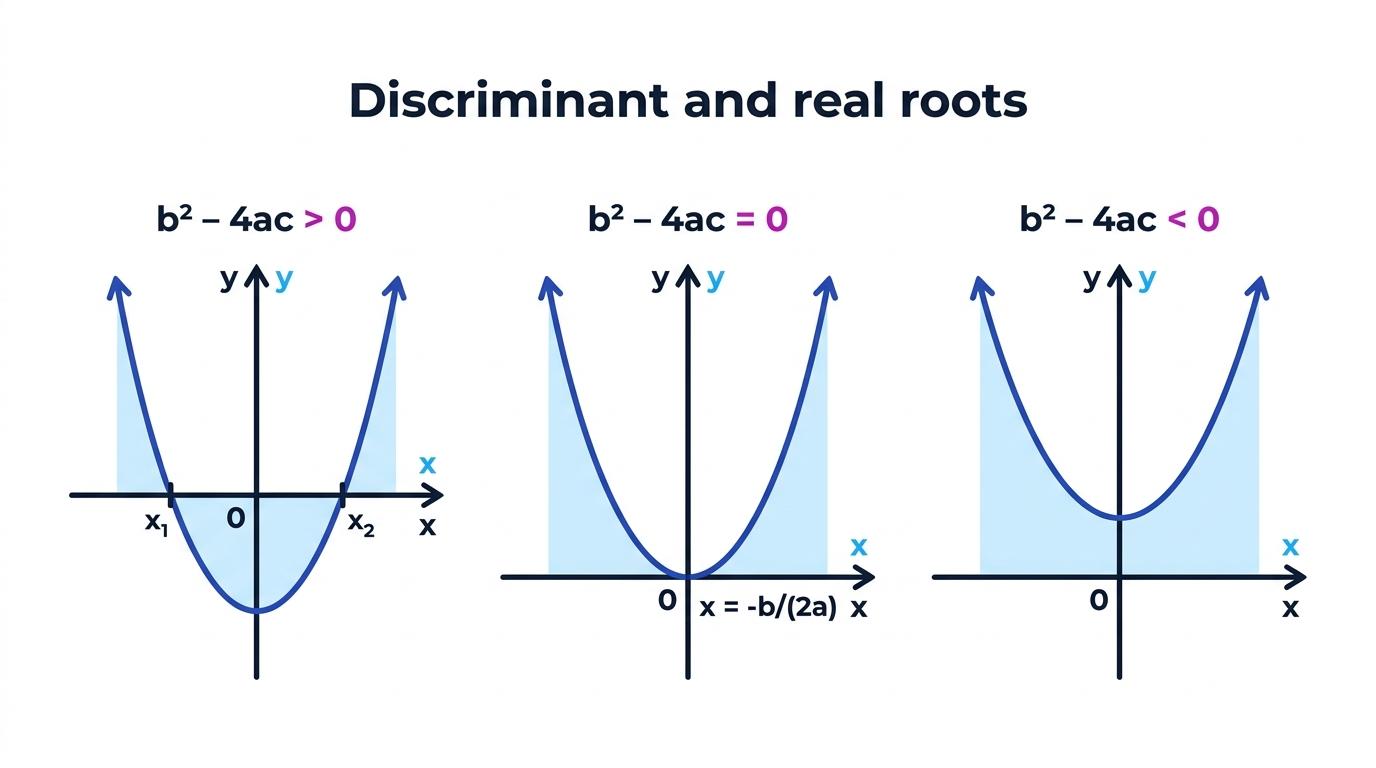
- If Δ>0\Delta>0Δ>0, there are two distinct real roots.
- If Δ=0\Delta=0Δ=0, there is one repeated real root.
- If Δ<0\Delta<0Δ<0, there are no real roots.
Graphically, these correspond to a parabola crossing the xxx-axis twice, touching it once, or not meeting it.
Finding a condition for repeated roots
Find the values of kkk for which x2+kx+9=0x^2+kx+9=0x2+kx+9=0 has a repeated root.
-
A repeated root occurs when the discriminant equals zero:
k2−4(1)(9)=0.k^2-4(1)(9)=0.k2−4(1)(9)=0. -
Simplify and solve:
k2−36=0.k^2-36=0.k2−36=0. -
Factorise:
(k−6)(k+6)=0,(k-6)(k+6)=0,(k−6)(k+6)=0,so k=6k=6k=6 or k=−6k=-6k=−6.
Dropping a negative sign
When calculating b2−4acb^2-4acb2−4ac, put negative values of bbb or ccc in brackets. For example, if c=−3c=-3c=−3, then −4ac-4ac−4ac becomes positive when a>0a>0a>0.
Quadratics in a Function of the Unknown
Some equations are not quadratics in xxx itself but become quadratics after replacing a repeated expression with a new variable.
Quadratic in a function
An equation is quadratic in a function of the unknown if it can be written as
a[g(x)]2+b[g(x)]+c=0,a[g(x)]^2+b[g(x)]+c=0,a[g(x)]2+b[g(x)]+c=0,where g(x)g(x)g(x) is an expression involving xxx.
Use a substitution such as u=g(x)u=g(x)u=g(x), solve the resulting quadratic in uuu, and then return to the original variable.
Solving a disguised quadratic
Solve x4−5x2+4=0x^4-5x^2+4=0x4−5x2+4=0.
-
Since x4=(x2)2x^4=(x^2)^2x4=(x2)2, let u=x2u=x^2u=x2. The equation becomes
u2−5u+4=0.u^2-5u+4=0.u2−5u+4=0. -
Factorise and solve for uuu:
(u−1)(u−4)=0,(u-1)(u-4)=0,(u−1)(u−4)=0,so u=1u=1u=1 or u=4u=4u=4.
-
Replace uuu with x2x^2x2 and solve both equations:
x2=1⇒x=±1,x2=4⇒x=±2.\begin{aligned} x^2&=1 &&\Rightarrow x=\pm1,\\ x^2&=4 &&\Rightarrow x=\pm2. \end{aligned}x2x2=1=4⇒x=±1,⇒x=±2.Therefore, the solutions are x=−2,−1,1,2x=-2,-1,1,2x=−2,−1,1,2.
Return to the original variable
Solving the substituted quadratic is not the end. If u=x2u=x^2u=x2, each positive value of uuu may produce two values of xxx, while a negative value produces no real values of xxx.
In the exam
- Rearrange every quadratic equation so that one side is zero before choosing a method.
- Use the graph, completed-square form and discriminant as connected information: roots are xxx-intercepts, while the vertex controls the maximum or minimum.
- Write discriminant conditions precisely: use >0>0>0 for two distinct roots, =0=0=0 for a repeated root and ≥0\geq0≥0 when at least one real root is required.
- Keep exact roots as fractions or surds unless the question specifically requests decimal answers.
Check yourself
- Can you complete the square for 2x2−12x+52x^2-12x+52x2−12x+5 and identify its vertex?
- What condition on kkk makes x2+4x+k=0x^2+4x+k=0x2+4x+k=0 have two distinct real roots?
- How would you solve x6−7x3+6=0x^6-7x^3+6=0x6−7x3+6=0 using a substitution?
