

What you'll learn
- How to recognise and use the product, quotient and chain rules.
- How to combine several differentiation rules in one calculation.
- How derivatives of inverse functions are related.
- How the chain rule connects different rates of change.
Before you begin
You should already be able to differentiate powers, exponentials and trigonometric functions. For example,
ddx(xn)=nxn−1,ddx(ex)=ex,ddx(sinx)=cosx.\frac{d}{dx}(x^n)=nx^{n-1}, \qquad \frac{d}{dx}(e^x)=e^x, \qquad \frac{d}{dx}(\sin x)=\cos x.dxd(xn)=nxn−1,dxd(ex)=ex,dxd(sinx)=cosx.The new challenge is deciding what to do when functions are multiplied, divided or placed inside one another.
Identify the structure first
Before differentiating, ask whether the function is a product, a quotient or a composite function. Its structure determines the rule you need.
The product rule
A product is the result of multiplying two expressions. For example, x2sinxx^2\sin xx2sinx is a product of x2x^2x2 and sinx\sin xsinx.
You cannot usually differentiate the two factors separately and then multiply their derivatives.
The product rule
If y=u(x)v(x)y=u(x)v(x)y=u(x)v(x), then
dydx=udvdx+vdudx.\frac{dy}{dx} = u\frac{dv}{dx} + v\frac{du}{dx}.dxdy=udxdv+vdxdu.In words: differentiate one factor at a time, leaving the other factor unchanged, and add the results.
Differentiating a product
Differentiate y=x2sinxy=x^2\sin xy=x2sinx.
-
Choose u=x2u=x^2u=x2 and v=sinxv=\sin xv=sinx, so
dudx=2x,dvdx=cosx.\frac{du}{dx}=2x, \qquad \frac{dv}{dx}=\cos x.dxdu=2x,dxdv=cosx. -
Substitute into the product rule:
dydx=x2cosx+(sinx)(2x).\frac{dy}{dx} = x^2\cos x+(\sin x)(2x).dxdy=x2cosx+(sinx)(2x). -
Simplify:
dydx=x2cosx+2xsinx.\boxed{\frac{dy}{dx}=x^2\cos x+2x\sin x}.dxdy=x2cosx+2xsinx.
Multiplying the derivatives
It is incorrect to write dydx=2xcosx\frac{dy}{dx}=2x\cos xdxdy=2xcosx. The product rule contains two terms joined by addition.
A useful memory pattern
Write the product rule as uv′+vu′uv'+vu'uv′+vu′. This compact form helps you remember that each factor is differentiated once.
The quotient rule
A quotient is the result of dividing one expression by another. For example, x2+1x−1\frac{x^2+1}{x-1}x−1x2+1 is a quotient.
The quotient rule
If
y=u(x)v(x),y=\frac{u(x)}{v(x)},y=v(x)u(x),then
dydx=vdudx−udvdxv2,\frac{dy}{dx} = \frac{v\frac{du}{dx}-u\frac{dv}{dx}}{v^2},dxdy=v2vdxdu−udxdv,provided v≠0v\neq 0v=0.
The order of the numerator matters: it is “bottom times derivative of top, minus top times derivative of bottom”.
Differentiating a quotient
Differentiate
y=x2+1x−1.y=\frac{x^2+1}{x-1}.y=x−1x2+1.-
Let u=x2+1u=x^2+1u=x2+1 and v=x−1v=x-1v=x−1. Then
dudx=2x,dvdx=1.\frac{du}{dx}=2x, \qquad \frac{dv}{dx}=1.dxdu=2x,dxdv=1. -
Apply the quotient rule:
dydx=(x−1)(2x)−(x2+1)(1)(x−1)2.\frac{dy}{dx} = \frac{(x-1)(2x)-(x^2+1)(1)}{(x-1)^2}.dxdy=(x−1)2(x−1)(2x)−(x2+1)(1). -
Simplify the numerator:
dydx=2x2−2x−x2−1(x−1)2=x2−2x−1(x−1)2.\begin{aligned} \frac{dy}{dx} &= \frac{2x^2-2x-x^2-1}{(x-1)^2}\\ &= \boxed{\frac{x^2-2x-1}{(x-1)^2}}. \end{aligned}dxdy=(x−1)22x2−2x−x2−1=(x−1)2x2−2x−1.
Reversing the subtraction
The numerator is vu′−uv′vu'-uv'vu′−uv′, not uv′−vu′uv'-vu'uv′−vu′. Reversing these terms changes the sign of the derivative.
Sometimes a quotient can be rewritten using negative powers. For example, 3x2=3x−2\frac{3}{x^2}=3x^{-2}x23=3x−2 is easier to differentiate using the power rule.
The chain rule
A composite function is a function placed inside another function. In (3x2−5)4(3x^2-5)^4(3x2−5)4, the inner function is 3x2−53x^2-53x2−5 and the outer function raises its input to the fourth power.
The chain rule
If y=f(u)y=f(u)y=f(u) and u=g(x)u=g(x)u=g(x), then
dydx=dydududx.\frac{dy}{dx} = \frac{dy}{du}\frac{du}{dx}.dxdy=dudydxdu.Equivalently,
ddxf(g(x))=f′(g(x))g′(x).\frac{d}{dx}f(g(x)) = f'(g(x))g'(x).dxdf(g(x))=f′(g(x))g′(x).Differentiate the outer function while keeping the inner expression intact, then multiply by the derivative of the inner function.
Differentiating a composite power
Differentiate y=(3x2−5)4y=(3x^2-5)^4y=(3x2−5)4.
-
Set u=3x2−5u=3x^2-5u=3x2−5, giving y=u4y=u^4y=u4. Differentiate the outer function:
dydu=4u3.\frac{dy}{du}=4u^3.dudy=4u3. -
Differentiate the inner function:
dudx=6x.\frac{du}{dx}=6x.dxdu=6x. -
Multiply the two derivatives and replace uuu:
dydx=4(3x2−5)3(6x)=24x(3x2−5)3.\frac{dy}{dx} = 4(3x^2-5)^3(6x) = \boxed{24x(3x^2-5)^3}.dxdy=4(3x2−5)3(6x)=24x(3x2−5)3.
Forgetting the inner derivative
Writing only 4(3x2−5)34(3x^2-5)^34(3x2−5)3 misses the factor of 6x6x6x. Always differentiate the inner function as well.
The chain rule also applies to trigonometric and exponential composites:
ddxsin(g(x))=cos(g(x))g′(x),\frac{d}{dx}\sin(g(x))=\cos(g(x))g'(x),dxdsin(g(x))=cos(g(x))g′(x), ddxeg(x)=eg(x)g′(x).\frac{d}{dx}e^{g(x)}=e^{g(x)}g'(x).dxdeg(x)=eg(x)g′(x).Combining the rules
A function may have more than one layer of structure. Work from the main, outermost structure and use another rule when differentiating each part.
Combining product and chain rules
Differentiate y=x2(3x+1)5y=x^2(3x+1)^5y=x2(3x+1)5.
-
The main structure is a product, so choose u=x2u=x^2u=x2 and v=(3x+1)5v=(3x+1)^5v=(3x+1)5. Then u′=2xu'=2xu′=2x.
-
Differentiate vvv using the chain rule:
v′=5(3x+1)4⋅3=15(3x+1)4.v'=5(3x+1)^4\cdot 3=15(3x+1)^4.v′=5(3x+1)4⋅3=15(3x+1)4. -
Apply the product rule:
dydx=15x2(3x+1)4+2x(3x+1)5.\frac{dy}{dx} = 15x^2(3x+1)^4+2x(3x+1)^5.dxdy=15x2(3x+1)4+2x(3x+1)5. -
Factorise the common terms:
dydx=x(3x+1)4(15x+2(3x+1))=x(3x+1)4(21x+2).\begin{aligned} \frac{dy}{dx} &= x(3x+1)^4\left(15x+2(3x+1)\right)\\ &= \boxed{x(3x+1)^4(21x+2)}. \end{aligned}dxdy=x(3x+1)4(15x+2(3x+1))=x(3x+1)4(21x+2).
Keep brackets while differentiating
Do not expand complicated powers unless expansion clearly makes the calculation easier. The chain rule often preserves a much simpler form.
Derivatives of inverse functions
An inverse function, written f−1f^{-1}f−1, reverses the action of fff. If y=f(x)y=f(x)y=f(x), then x=f−1(y)x=f^{-1}(y)x=f−1(y).
The notation f−1(x)f^{-1}(x)f−1(x) does not mean 1f(x)\frac{1}{f(x)}f(x)1.
Reciprocal derivative relationship
If y=f(x)y=f(x)y=f(x) and dydx≠0\frac{dy}{dx}\neq 0dxdy=0, then
dxdy=1dydx.\frac{dx}{dy} = \frac{1}{\frac{dy}{dx}}.dydx=dxdy1.Therefore,
(f−1)′(y)=1f′(x),y=f(x).\left(f^{-1}\right)'(y)=\frac{1}{f'(x)}, \qquad y=f(x).(f−1)′(y)=f′(x)1,y=f(x).The chain rule explains this because f−1(f(x))=xf^{-1}(f(x))=xf−1(f(x))=x. Differentiating gives
(f−1)′(f(x))f′(x)=1.\left(f^{-1}\right)'(f(x))f'(x)=1.(f−1)′(f(x))f′(x)=1.Finding an inverse derivative at a point
Let f(x)=x3+xf(x)=x^3+xf(x)=x3+x. Find (f−1)′(2)\left(f^{-1}\right)'(2)(f−1)′(2).
-
Find the input mapped to 2:
f(1)=13+1=2,f(1)=1^3+1=2,f(1)=13+1=2,so f−1(2)=1f^{-1}(2)=1f−1(2)=1.
-
Differentiate the original function:
f′(x)=3x2+1,f′(1)=4.f'(x)=3x^2+1, \qquad f'(1)=4.f′(x)=3x2+1,f′(1)=4. -
Take the reciprocal at the corresponding input:
(f−1)′(2)=14.\boxed{\left(f^{-1}\right)'(2)=\frac{1}{4}}.(f−1)′(2)=41.
When the reciprocal rule fails
The formula cannot be used where f′(x)=0f'(x)=0f′(x)=0, because division by zero is undefined. An inverse must also exist on the domain being considered.
Connected rates of change
Connected rates of change problems involve two or more quantities that change with time and are linked by an equation.
If yyy depends on xxx, and xxx depends on time ttt, the chain rule gives
dydt=dydxdxdt.\frac{dy}{dt} = \frac{dy}{dx}\frac{dx}{dt}.dtdy=dxdydtdx.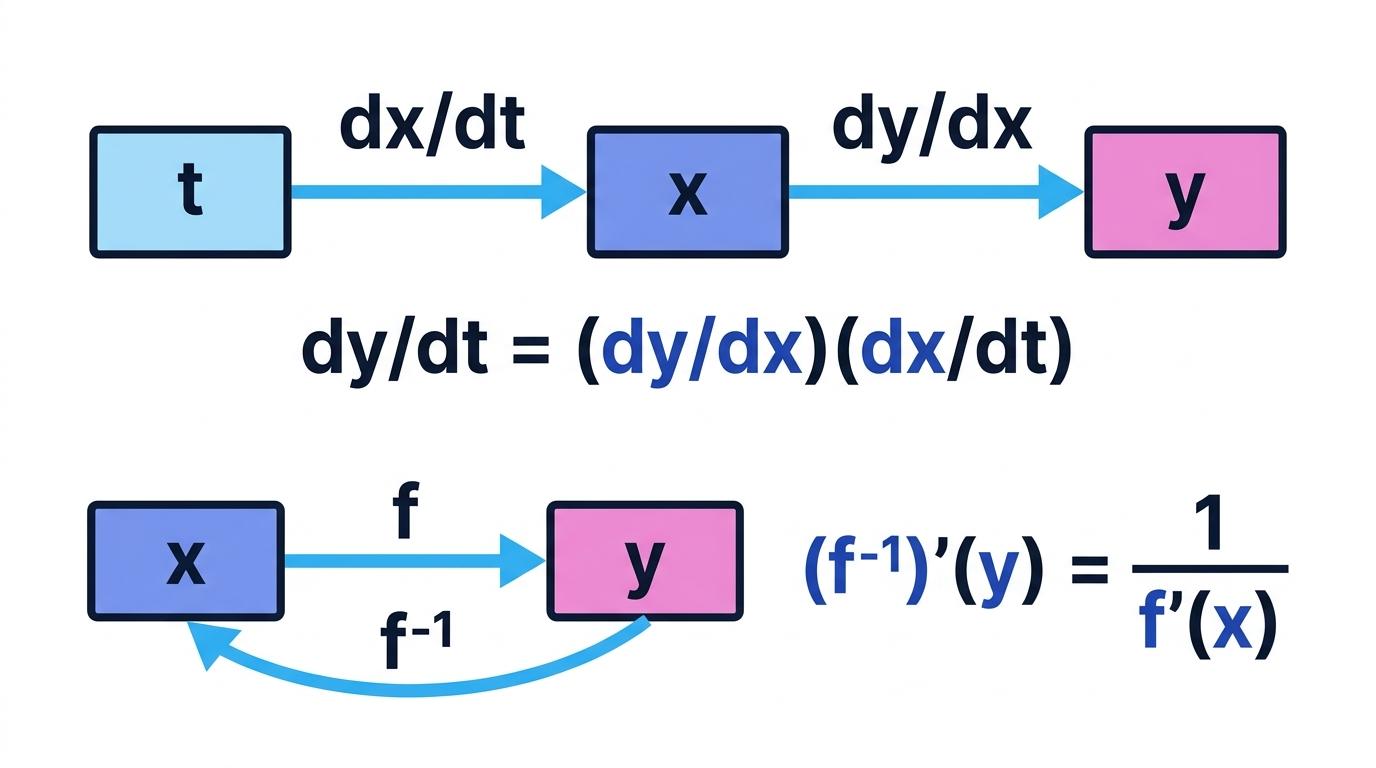
Finding the rate of change of a circle's area
The radius of a circle increases at 3 cm s−13\text{ cm s}^{-1}3 cm s−1. Find the rate at which its area increases when the radius is 5 cm5\text{ cm}5 cm.
-
Link area AAA and radius rrr:
A=πr2,dAdr=2πr.A=\pi r^2, \qquad \frac{dA}{dr}=2\pi r.A=πr2,drdA=2πr. -
Use the given rate drdt=3\frac{dr}{dt}=3dtdr=3 in the chain rule:
dAdt=dAdrdrdt=2πr⋅3.\frac{dA}{dt} = \frac{dA}{dr}\frac{dr}{dt} = 2\pi r\cdot 3.dtdA=drdAdtdr=2πr⋅3. -
Substitute r=5r=5r=5:
dAdt=30π cm2 s−1.\boxed{\frac{dA}{dt}=30\pi\text{ cm}^2\text{ s}^{-1}}.dtdA=30π cm2 s−1.
Substituting too early
Differentiate the relationship before substituting the particular values. If you replace a changing variable with a number too soon, its derivative disappears.
In the exam
- Identify the main structure before choosing a differentiation rule.
- Write the rule symbolically before substituting the functions or rates.
- Keep brackets around composite expressions and simplify only after differentiating.
- In connected-rates questions, include the correct units and use signs to show whether a quantity is increasing or decreasing.
- Check that a quotient denominator is non-zero and that an inverse derivative does not require division by zero.
Check yourself
- Can you differentiate xsinxx2+1\frac{x\sin x}{x^2+1}x2+1xsinx using the necessary rules?
- What factor is missing from the incorrect derivative 5(2x3+1)45(2x^3+1)^45(2x3+1)4?
- How would you connect dVdt\frac{dV}{dt}dtdV, dVdr\frac{dV}{dr}drdV and drdt\frac{dr}{dt}dtdr for a changing sphere?
