

What you'll learn
- How a parameter can define both coordinates of a point on a curve.
- How to plot, interpret and use parametric equations, including the direction of travel.
- How to eliminate a parameter to obtain a Cartesian equation.
- How to convert suitable Cartesian equations into parametric form.
Before You Start: Cartesian Equations
You are already familiar with Cartesian equations, which connect the coordinates xxx and yyy directly. For example,
y=x2+3y=x^2+3y=x2+3describes a parabola.
To find a point on this curve, you choose an xxx-coordinate and calculate the corresponding yyy-coordinate. Parametric equations describe points differently: both coordinates are calculated from a third variable.
What Are Parametric Equations?
Parameter
A parameter is an extra variable, often written as ttt, which determines the coordinates of a point on a curve.
In a pair of parametric equations, xxx and yyy are each given in terms of the same parameter:
x=f(t),y=g(t).x=f(t), \qquad y=g(t).x=f(t),y=g(t).As ttt changes, the point (x,y)\left(x,y\right)(x,y) moves and traces out a parametric curve.
One parameter controls both coordinates
For each permitted value of ttt, calculate xxx and yyy using the same value of ttt. This produces one point (x,y)\left(x,y\right)(x,y) on the curve.
For example, consider
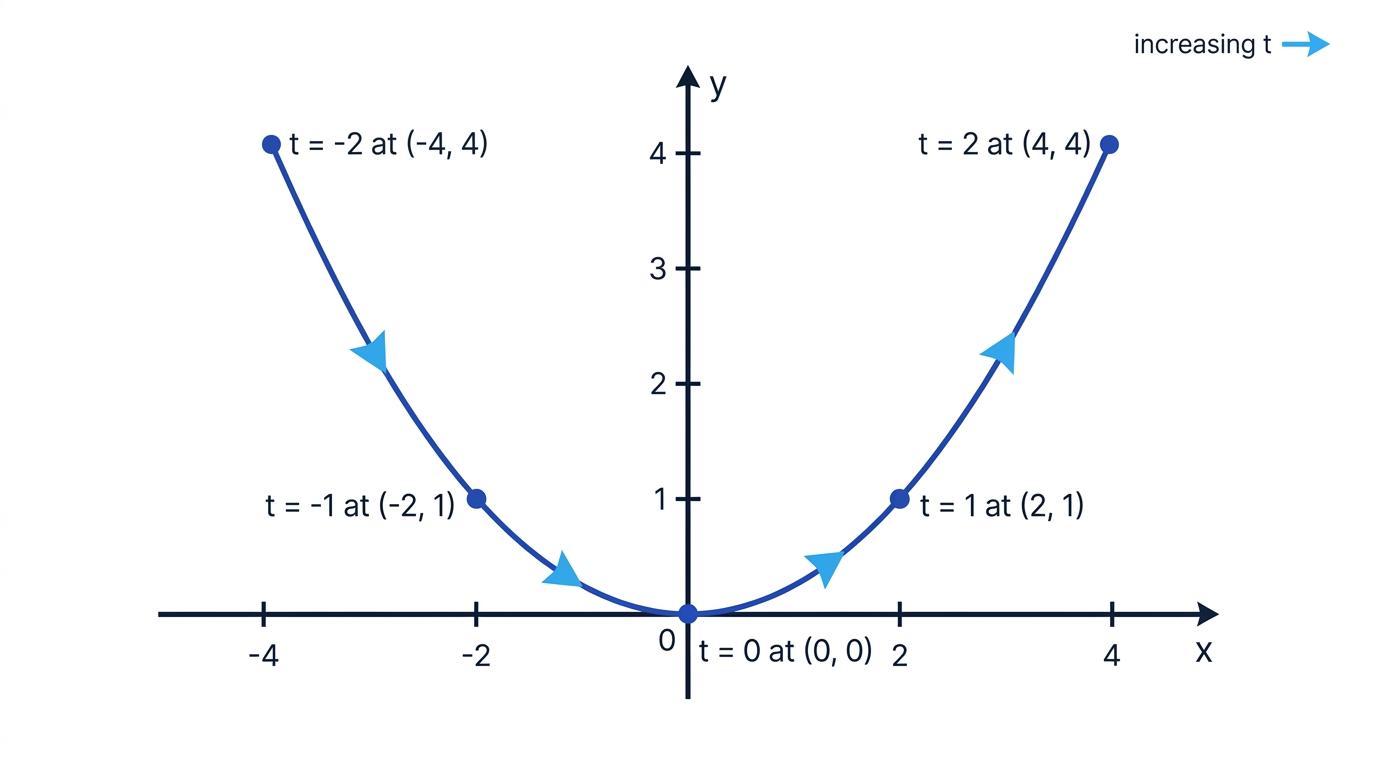
x=2t,y=t2.x=2t,\qquad y=t^2.x=2t,y=t2.Generating points on a parametric curve
-
Choose some values of the parameter, such as t=−2,−1,0,1,2t=-2,-1,0,1,2t=−2,−1,0,1,2.
-
Substitute each value into both equations:
t=−2:x=−4,y=4,t=−1:x=−2,y=1,t=0:x=0,y=0,t=1:x=2,y=1,t=2:x=4,y=4.\begin{aligned} t=-2 &: \quad x=-4,\quad y=4,\\ t=-1 &: \quad x=-2,\quad y=1,\\ t=0 &: \quad x=0,\quad y=0,\\ t=1 &: \quad x=2,\quad y=1,\\ t=2 &: \quad x=4,\quad y=4. \end{aligned}t=−2t=−1t=0t=1t=2:x=−4,y=4,:x=−2,y=1,:x=0,y=0,:x=2,y=1,:x=4,y=4. -
Plot the resulting points. They lie on a parabola with vertex at the origin.
-
Follow the points in order of increasing ttt. The point moves down the left branch towards the origin, then rises along the right branch.
Direction and Restrictions
Direction of Travel
Unlike a Cartesian equation by itself, parametric equations can indicate the direction in which a curve is traced. You find this by considering what happens as the parameter increases.
For x=2tx=2tx=2t and y=t2y=t^2y=t2, increasing ttt moves the point from the upper-left branch, through the origin, and then up the right branch.
Showing direction on a sketch
Calculate points for several increasing values of ttt, plot them in order, and add arrowheads to the curve.
Restrictions on the Parameter
A question may restrict the parameter, for example:
−1≤t≤2.-1\le t\le 2.−1≤t≤2.This means that only the part of the curve generated by those values is included. The restriction may produce a complete curve, an arc, a line segment or just part of a larger curve.
Finding the endpoints of a restricted curve
The curve is given by
x=t+1,y=t2,−1≤t≤2.x=t+1,\qquad y=t^2,\qquad -1\le t\le 2.x=t+1,y=t2,−1≤t≤2.-
At the lower endpoint t=−1t=-1t=−1,
x=0,y=1,x=0,\qquad y=1,x=0,y=1,so one endpoint is (0,1)\left(0,1\right)(0,1).
-
At the upper endpoint t=2t=2t=2,
x=3,y=4,x=3,\qquad y=4,x=3,y=4,so the other endpoint is (3,4)\left(3,4\right)(3,4).
-
Since x=t+1x=t+1x=t+1 increases with ttt, the curve is traced from (0,1)\left(0,1\right)(0,1) to (3,4)\left(3,4\right)(3,4).
Ignoring the parameter interval
After finding the Cartesian equation, do not automatically sketch the whole Cartesian curve. The permitted values of ttt may generate only part of it.
Converting Parametric Equations to Cartesian Form
Eliminating the parameter
To eliminate the parameter means to combine the parametric equations so that the final equation contains only xxx and $y.
The usual method is:
- Rearrange one equation to make the parameter the subject.
- Substitute that expression into the other equation.
- Simplify and include any resulting restriction.
When the Parameter Is Easy to Isolate
Eliminating a linear parameter
Convert
x=3t−1,y=2t2+5x=3t-1,\qquad y=2t^2+5x=3t−1,y=2t2+5to Cartesian form.
-
The equation for xxx is easiest to rearrange:
x=3t−1⇒t=x+13.x=3t-1 \quad\Rightarrow\quad t=\frac{x+1}{3}.x=3t−1⇒t=3x+1. -
Substitute this into the equation for yyy:
y=2(x+13)2+5.y=2\left(\frac{x+1}{3}\right)^2+5.y=2(3x+1)2+5. -
Simplify:
y=29(x+1)2+5.y=\frac{2}{9}(x+1)^2+5.y=92(x+1)2+5.This is a parabola with vertex (−1,5)\left(-1,5\right)(−1,5).
Losing brackets when substituting
If t=x+13t=\frac{x+1}{3}t=3x+1 and the equation contains t2t^2t2, substitute (x+13)2\left(\frac{x+1}{3}\right)^2(3x+1)2. The whole expression must be squared.
When Squaring or Using an Identity Helps
Sometimes you do not need to make ttt the subject directly. Instead, identify expressions that combine conveniently.
For example, if
x=acost,y=asint,x=a\cos t,\qquad y=a\sin t,x=acost,y=asint,then
xa=cost,ya=sint.\frac{x}{a}=\cos t,\qquad \frac{y}{a}=\sin t.ax=cost,ay=sint.Using the identity sin2t+cos2t=1\sin^2t+\cos^2t=1sin2t+cos2t=1 gives
x2a2+y2a2=1,\frac{x^2}{a^2}+\frac{y^2}{a^2}=1,a2x2+a2y2=1,so
x2+y2=a2.x^2+y^2=a^2.x2+y2=a2.This is a circle with centre at the origin and radius aaa, provided the parameter covers a full revolution.
Converting a trigonometric parametrisation
Convert
x=4cost,y=3sintx=4\cos t,\qquad y=3\sin tx=4cost,y=3sintto Cartesian form.
-
Rearrange each equation:
cost=x4,sint=y3.\cos t=\frac{x}{4},\qquad \sin t=\frac{y}{3}.cost=4x,sint=3y. -
Square both equations and use sin2t+cos2t=1\sin^2t+\cos^2t=1sin2t+cos2t=1:
x216+y29=1.\frac{x^2}{16}+\frac{y^2}{9}=1.16x2+9y2=1. -
This is an ellipse centred at the origin, with horizontal semi-axis 4 and vertical semi-axis 3.
Squaring can lose directional information
A Cartesian equation obtained by squaring may describe the correct set of points, but it does not show the direction in which the parametric curve is traced.
Using a Cartesian Equation to Find Coordinates
You do not always need to eliminate ttt completely. If a point satisfies an extra condition, use whichever parametric equation makes that condition easiest to apply.
Finding points with a given coordinate
The curve is
x=t2−1,y=2t+3.x=t^2-1,\qquad y=2t+3.x=t2−1,y=2t+3.Find the points where x=3x=3x=3.
-
Apply the condition to the equation for xxx:
t2−1=3⇒t2=4.t^2-1=3 \quad\Rightarrow\quad t^2=4.t2−1=3⇒t2=4. -
Solve for all possible parameter values:
t=±2.t=\pm2.t=±2. -
When t=2t=2t=2, y=7y=7y=7. When t=−2t=-2t=−2, y=−1y=-1y=−1. Therefore the points are
(3,7)and(3,−1).\left(3,7\right)\quad\text{and}\quad\left(3,-1\right).(3,7)and(3,−1).
Missing a parameter value
An equation such as t2=4t^2=4t2=4 has two solutions. Check every permitted value of ttt, because different parameter values may produce different points.
Converting Cartesian Equations to Parametric Form
To parametrise a Cartesian curve means to choose a parameter and express both xxx and yyy in terms of it.
There is usually more than one correct parametrisation.
A Simple Choice
For a graph written as y=f(x)y=f(x)y=f(x), you can often choose
x=tx=tx=tand then replace xxx by ttt in the equation for yyy.
Parametrising a parabola
Write a parametric form of
y=x2−4x+1.y=x^2-4x+1.y=x2−4x+1.-
Choose x=tx=tx=t.
-
Substitute x=tx=tx=t into the Cartesian equation:
y=t2−4t+1.y=t^2-4t+1.y=t2−4t+1. -
One valid parametrisation is therefore
x=t,y=t2−4t+1.x=t,\qquad y=t^2-4t+1.x=t,y=t2−4t+1.
Choosing a Useful Parametrisation
Sometimes a structured choice is more useful. For the circle
x2+y2=a2,x^2+y^2=a^2,x2+y2=a2,the standard parametrisation is
x=acost,y=asint.x=a\cos t,\qquad y=a\sin t.x=acost,y=asint.For an ellipse
x2a2+y2b2=1,\frac{x^2}{a^2}+\frac{y^2}{b^2}=1,a2x2+b2y2=1,a standard parametrisation is
x=acost,y=bsint.x=a\cos t,\qquad y=b\sin t.x=acost,y=bsint.Parametrisations are not unique
Different pairs of parametric equations can trace the same Cartesian curve. They may trace it at different rates, in different directions or over different parameter intervals.
In the exam
- To eliminate ttt, first identify which equation is easiest to rearrange or which identity links the two equations.
- Keep any parameter restriction and translate it into endpoints or restrictions on xxx and yyy where possible.
- For coordinate conditions, solve for every valid value of ttt before calculating the corresponding points.
- On a sketch, mark key points and use increasing values of ttt to show the direction of travel.
Check yourself
- Can you eliminate ttt from x=2t+1x=2t+1x=2t+1 and y=t2−3y=t^2-3y=t2−3?
- What Cartesian curve is described by x=5costx=5\cos tx=5cost and y=2sinty=2\sin ty=2sint?
- How would you find the endpoints and direction when a parameter interval is given?
